

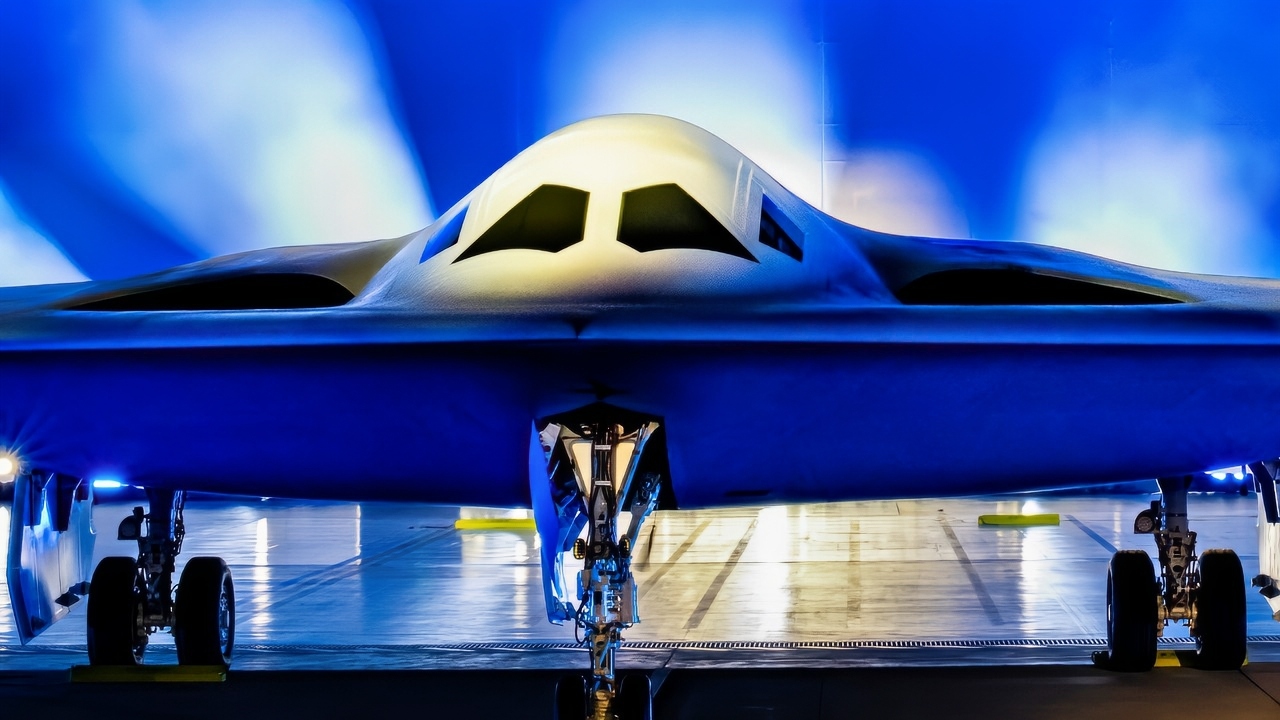
Key Points and Summary – The B-21 Raider is not just an upgrade; it is a fundamental necessity for maintaining American airpower against threats from China and Russia.
-It represents a generational leap in stealth, with durable, low-maintenance coatings that transform it from what some called a delicate “hangar queen” like the B-2 into a true “warfighting asset.”
-Its greatest advantage may be its digital brain—a “smartphone-like” open architecture that allows for rapid software upgrades.
-With its massive unrefueled range, the B-21 solves the “tyranny of distance” in the Pacific, making it the only platform that can credibly deter America’s most powerful adversaries.
The B-21 Raider Bomber Is the Real Deal
For the last thirty years, the U.S. Air Force has held a trump card no other nation on Earth could match: the B-2 Spirit stealth bomber.
A ghostly flying wing, it was a weapon that could penetrate any air defense system on the planet, hold any target at risk, and return home without the enemy ever knowing it was there. It was, and is, the ultimate expression of American power projection.
But that trump card is aging, and our adversaries have not been idle. The world has changed. The rise of near-peer competitors like China and Russia, with their sophisticated anti-access/area denial (A2/AD) networks, has created a daunting new reality.
Our existing bomber fleet—a small, boutique force of 20 B-2s and aging, non-stealthy B-1s and B-52s—is simply no longer sufficient to guarantee American dominance in a future conflict.
This is the world the B-21 Raider was born into. It is not merely an upgrade or a replacement; it is a fundamental necessity.
Take it from me: the B-21 is the most important military aviation program of this century, because it is the only platform that can credibly threaten our most powerful adversaries, ensuring that no target on Earth is safe from American reach.
It is the necessary evolution of American airpower, designed to win a war that we hope we never have to fight.
A Generational Leap in Stealth
To understand the B-21, you must first understand that not all stealth is created equal.
The B-2, revolutionary as it was in the 1980s, is a product of its time. Its stealth coatings are notoriously difficult and expensive to maintain, requiring climate-controlled hangars and countless man-hours to keep the bomber effective.
The B-21 represents a generational leap forward. Benefitting from 30 years of advancements in materials science, manufacturing techniques, and low-observable design, the Raider’s stealth is baked into its very skin. It is reportedly far harder to detect than the B-2, and, just as importantly, its advanced coatings are exponentially more durable. This means the B-21 can be deployed more rapidly, operate from a wider variety of bases, and generate a much higher sortie rate in a conflict.
It’s the difference between a priceless, handcrafted Stradivarius and a modern, mass-produced, and equally lethal Steinway grand piano. One is a hangar queen; the other is a warfighting asset.
This new level of stealth is purpose-built to defeat the integrated air defense systems of China and Russia. Where a B-52 would be shot down hundreds of miles from its target, the B-21 is designed to slip through the densest network of radars and surface-to-air missiles, hunt for targets, and strike with impunity.
The Brains Behind the Brawn: A Digital Bomber
The B-21’s most profound advantage may not be its stealth, but its brain. It is the world’s first sixth-generation aircraft, and that designation is about more than just its physical characteristics. The Raider was designed from the ground up with an open-systems architecture.
Think of it this way: older military aircraft are like flip phones. Upgrading them is a cumbersome, expensive process that requires a complete hardware overhaul. The B-21 is like a smartphone. Its capabilities are defined by its software, which can be rapidly updated to counter new threats and integrate new weapons.
This open architecture makes the bomber “future-proof.” As our adversaries develop new radars or defenses, the Air Force can simply upload new electronic warfare suites or improved sensor algorithms to the B-21 fleet, keeping it on the cutting edge for decades to come.
This digital backbone also means the B-21 is not just a bomber; it’s a node in a vast, interconnected network. It can act as a penetrating intelligence, surveillance, and reconnaissance (ISR) platform, soaking up data from deep inside enemy territory. It can function as a battle manager, using its advanced sensors to cue other assets, like fighters or long-range missiles. It is a system of systems, a flying, thinking weapon that makes the entire U.S. military more lethal.
The Tyranny of Distance: B-21 Raider Winning in the Pacific
Let’s wargame a conflict in the Pacific. China’s A2/AD strategy is designed to push American forces hundreds of miles out to sea, holding our forward bases in places like Guam and Okinawa at risk. Our short-range tactical fighters, like the F-35, are dependent on a vulnerable chain of aerial tankers to even reach the fight.
The B-21 solves this problem. With an unrefueled range of thousands of miles, it can take off from the continental United States, fly a 10-hour mission over the Taiwan Strait, and return home. It is a weapon that completely bypasses the tyranny of distance. It can hold at risk the very assets China relies on to execute its strategy—its command-and-control centers, its missile launchers, its naval bases.
This is the core of its strategic importance. The B-21 is the only weapon in the American arsenal that can provide persistent, survivable, long-range strike capability in a peer conflict. It ensures that even if our forward bases are neutralized and our carriers are pushed back, we can still reach out and touch the enemy where it hurts the most. It is the ultimate deterrent, a credible threat that forces an adversary to think twice, because they know there is no sanctuary.
For the U.S. Air Force, the B-21 Raider is not just another bomber; it is the future of American power.
More About Harry Kazianis
Harry J. Kazianis (@Grecianformula) is Editor-In-Chief and President of National Security Journal. He was the former Senior Director of National Security Affairs at the Center for the National Interest (CFTNI), a foreign policy think tank founded by Richard Nixon based in Washington, DC. Harry has over a decade of experience in think tanks and national security publishing. His ideas have been published in the NY Times, The Washington Post, The Wall Street Journal, CNN, and many other outlets worldwide. He has held positions at CSIS, the Heritage Foundation, the University of Nottingham, and several other institutions related to national security research and studies. He holds a Master’s degree focusing on international affairs from Harvard University.
Military Affairs
China’s Stealth Air Force Has 1 Mission


