

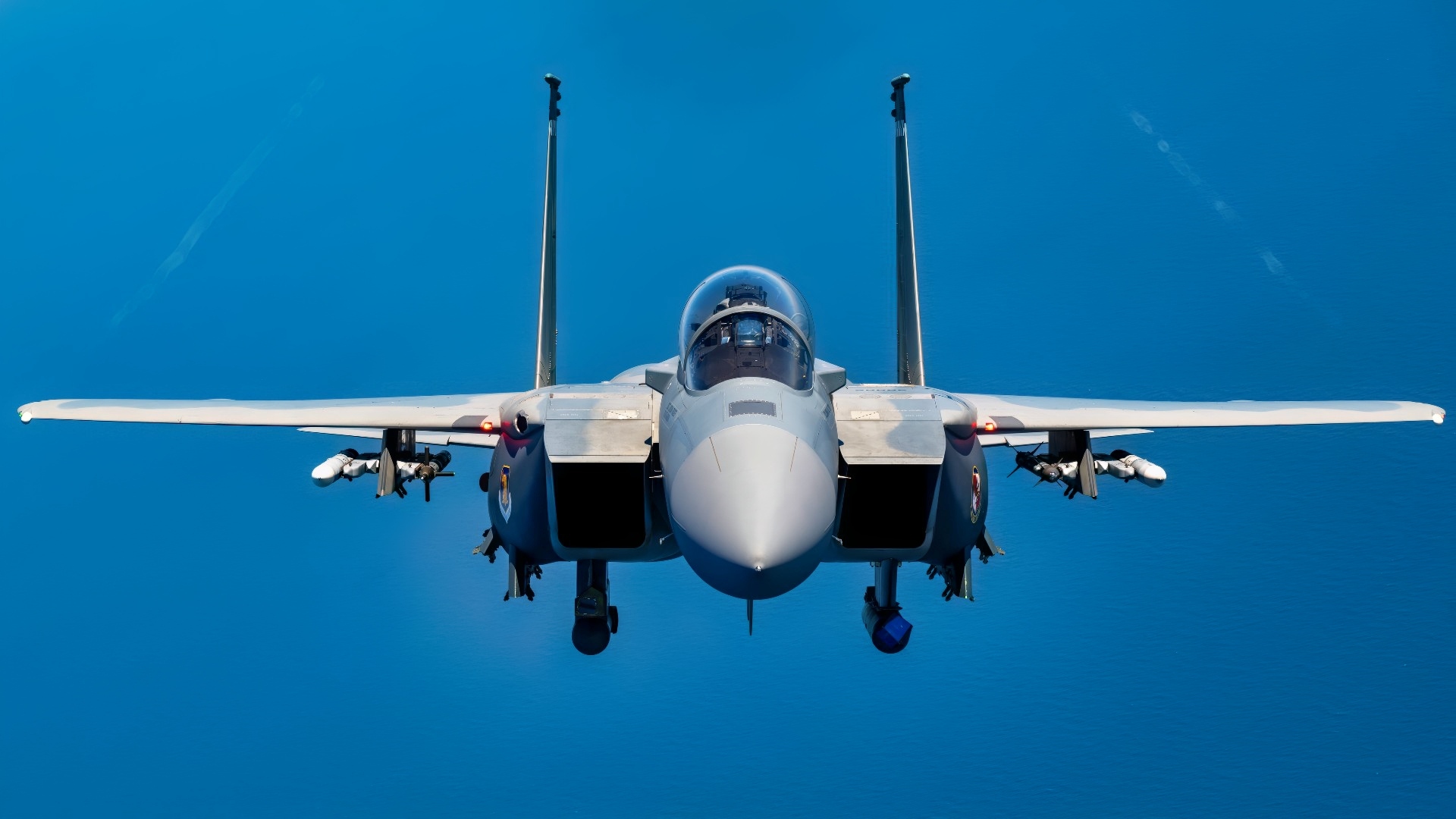
Key Points and Summary – The nearly three-month-old strike by 3,000 Boeing machinists in St. Louis is now officially delaying the U.S. Air Force’s F-15EX fighter jet program, a top general has confirmed.
-Despite the setback, Boeing’s CEO called the strike’s financial impact “immaterial” and announced plans to hire “permanent replacements,” a move that was immediately rebuked.
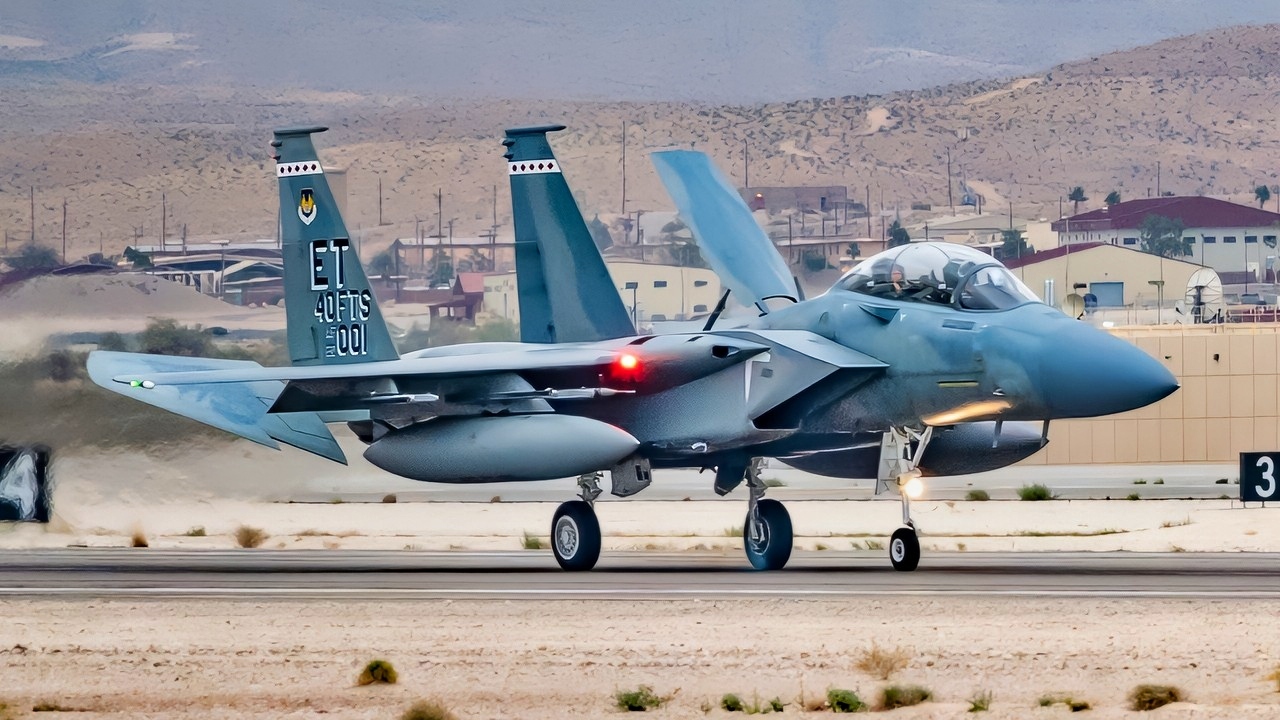
An F-15EX Eagle II lands on the flight line after a training operation at Nellis Air Force Base, Nevada, Nov. 15, 2023. The aircraft is able to fly at a speed of Mach 2.5, constituting it as the world’s fastest fighter jet. (U.S. Air Force photo by Airman 1st Class Elizabeth Tan)

Two U.S. Air Force F-15EX Eagle IIs assigned to the 85th Test and Evaluation Squadron, Eglin Air Force Base, Florida, taxi after landing at Kadena Air Base, Japan, July 16, 2025. Local units conducted integration and familiarization training with the F-15EX. (U.S. Air Force photo by Airman 1st Class Arnet Shayne Tamayo)
-A bipartisan group of 17 House Armed Services Committee members sent a letter urging Boeing to “return to the bargaining table in good faith” and not hire replacement workers, warning the dispute is “vital to U.S. national security.”
The Boeing Strike Is Now Having an Impact
More than 3,000 Boeing machinists in the St. Louis area have been on strike for nearly three months.
According to local TV station KING, the strike “has delayed delivery of the latest F-15 fighter jets,” and Boeing says they are “working to hire permanent replacements” for the striking workers.
According to KSDK, Boeing rejected the latest counteroffer from the union this week. Meanwhile, 51 percent of union members voted down the latest management proposal in a referendum this week.
“We are also expanding the use of third-party support for certain jobs and assessing opportunities to streamline factory operations,” Steve Parker, president and CEO of Boeing Defense, Space & Security (BDS), wrote in a message to employees.

The F-15EX, the Air Force’s newest fighter aircraft, arrives to Eglin Air Force Base, Florida March 11. The aircraft will be the first Air Force aircraft to be tested and fielded from beginning to end through combined developmental and operational tests. The 40th Flight Test Squadron and the 85th Test and Evaluation Squadron personnel are responsible for testing the aircraft. (U.S. Air Force photo/Samuel King Jr.)

F-15EX Eagle II. Image Credit: Creative Commons.
“And we’re welcoming back teammates who are crossing the picket line as we continue to hear from more teammates who tell us they are ready to come back to work.”
The strike has begun to affect the F-15EX program, Gen. Kenneth S. Wilsbach confirmed in written testimony to the Senate Armed Services Committee, ahead of his recent confirmation hearing.
“The F-15EX program is within projected cost, schedule, and performance criteria. Lot 1 aircraft have been delivered. Lot 2 aircraft, initially expected to deliver this calendar year, are delayed due to the ongoing Boeing strikes, with 6 of 12 F-15EX delivered to date,” Wilsbach told the committee.
No Big Impact?
Also this week, Boeing reported “immaterial” impact from the strike, with the company’s defense unit posting a profit.
“In St. Louis, we are executing our contingency plan as our IAM [International Association of Machinists and Aerospace Workers] represented workforce remains on strike,” Boeing CEO Kelly Ortberg said on the company’s earnings call this week, as reported by Breaking Defense.
“While, of course, we prefer not to be in this position, the team continues to work in support of our customers,” the CEO said. “We are building JDAMs [Joint Direct Attack Munitions] without the IAM workforce at about the same production rate as before the work stoppage, and the team is progressing on our MQ-25 and T-7A development programs. We’ll continue to manage through this with focus on supporting our customers.”

A U.S. Air Force F-15EX Eagle II, assigned to 85th Test and Evaluation Squadron, Eglin Air Force Base, Florida, lands at Kadena Air Base, Japan, July 16, 2025. The F-15EX plays a critical role in modern warfare, providing substantial additional capacity for long-range fires, sensors, and electronic warfare in contested areas, complementing 5th generation fighters. (U.S. Air Force photo by Airman Nathaniel Jackson)
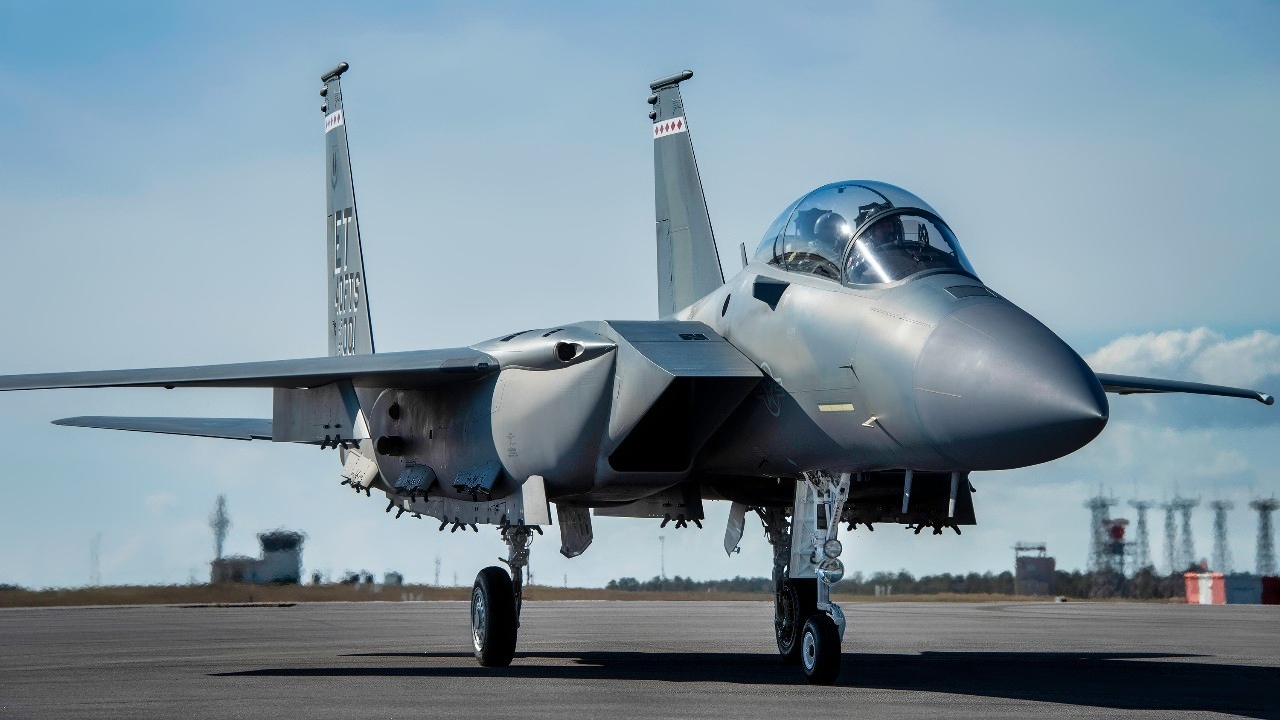
The F-15EX, the Air Force’s newest fighter aircraft, arrives to Eglin Air Force Base, Florida March 11. The aircraft will be the first Air Force aircraft to be tested and fielded from beginning to end through combined developmental and operational tests. The 40th Flight Test Squadron and the 85th Test and Evaluation Squadron personnel are responsible for testing the aircraft. (U.S. Air Force photo/Ilka Cole)
Per CNBC, Boeing went “back into cash-positive territory” for the first time in two years, thanks to continuing delays of its 777X wide-body plane.
There had been some concern, following Boeing’s receipt of a contract earlier this year to build the new F-47 jet in the St. Louis area, that the strike could affect production. However, it does not appear to have had an impact on that project, at least not yet.
The phrase “Next-Gen Jets, Next-Level Skills, Next-Level Contract” has appeared on signs carried by the machinists during the strike.
Meanwhile, there is now pressure on Boeing from a bipartisan group of members of Congress to end the strike.
A Bipartisan Push
According to Flight Global, a federal government mediator has been involved in the talks, although it has not led to a settlement.
So now, a group of 17 members of Congress, representing both parties on the House Armed Services Committee (HASC), has written a letter to Ortberg, calling on him and Boeing to “return to the bargaining table with these workers and to bargain in good faith to reach a fair contract promptly.”
The members of Congress, in particular, expressed concern about the reports that Boeing was looking to hire permanent replacement workers for the striking machinists.
“While we understand that there currently are no new negotiations scheduled between IAM District 837 and Boeing Defense, we are urging both sides to come back to the table to negotiate to conclude this ongoing, disruptive strike,” the letter says.
The letter was sent on the same day as the earnings call, Defense One noted.
The letter goes on to praise the work Boeing does in safeguarding the national defense, while also singling out the company’s “dedicated and highly skilled workforce.”
“These workers are essential to the success of your company, and they deserve compensation that reflects their hard work and sacrifices,” the letter says. “Both the workers and the work they do are vital to U.S. national security through the production of the current and future cutting-edge fighter aircraft.”

A F-15EX assigned to the 85th Test and Evaluation Squadron, Eglin Air Force Base, Florida, flies behind a KC-135 assigned to the 465th Air Refueling Squadron, Tinker AFB, Oklahoma, Oct. 15, 2021. In-air refueling allows fighter aircraft to stay airborne for longer periods of time without having to land to refuel. (U.S. Air Force photo by 2nd Lt. Mary Begy)

Image Credit: US Air Force.
The letter was not signed by every member of the House Armed Services Committee, as Chairman Mike Rogers is not a signatory. In fact, it is only “bipartisan” in the sense that one Republican, Rep. Don Bacon (R-NE), signed the letter along with 16 Democrats. In addition, not every Democrat on the Committee signed the letter.
Per the Defense One story, Boeing did not immediately respond to a request for comment after the letter was sent.
What is the Administration Doing?
Aside from appointing a mediator, the Trump Administration has not appeared eager to get involved in the ongoing strike.
Brian Bryant, head of the 600,000-member International Association of Machinists and Aerospace Workers, visited the picket line in the first weeks of the strike and called for Trump to intervene. Still, the White House denied the request, he said.
“I would request the president of the United States get involved in these negotiations and get this company back to the table since they are the ones who are building the military planes for his military,” the union leader said at the time.
Meanwhile, Boeing’s chief labor counsel, Scott Mayer, was nominated by the Trump Administration to serve on the National Labor Relations Board, but had his nomination tabled after a contentious exchange with Sen. Josh Hawley (R-MO), who represents the area where the strike is taking place.
“What’s different about these Missouri workers?” Hawley said to the Boeing counsel in the hearing, as reported by Politico. “Are we going to get to a fair resolution here where these workers get paid on terms equal to those of other workers at your company across the country, or are these folks going to be permanently replaced by non-union workers?”
About the Author: Stephen Silver
Stephen Silver is an award-winning journalist, essayist, and film critic, and contributor to the Philadelphia Inquirer, the Jewish Telegraphic Agency, Broad Street Review, and Splice Today. The co-founder of the Philadelphia Film Critics Circle, Stephen lives in suburban Philadelphia with his wife and two sons. For over a decade, Stephen has authored thousands of articles that focus on politics, national security, technology, and the economy. Follow him on X (formerly Twitter) at @StephenSilver, and subscribe to his Substack newsletter.
More Military
Canada’s F-35 Fighter Debate Summed Up in 3 Words
The U.S. Air Force’s B-52J Bomber Crisis
Mach 5.1 X-51 Waverider ‘Hypersonic Scramjet’ Has a Message for the Air Force
Beast Mode: How the F-35 Stealth Fighter Bolts on 22,000 Pounds of Bombs


