

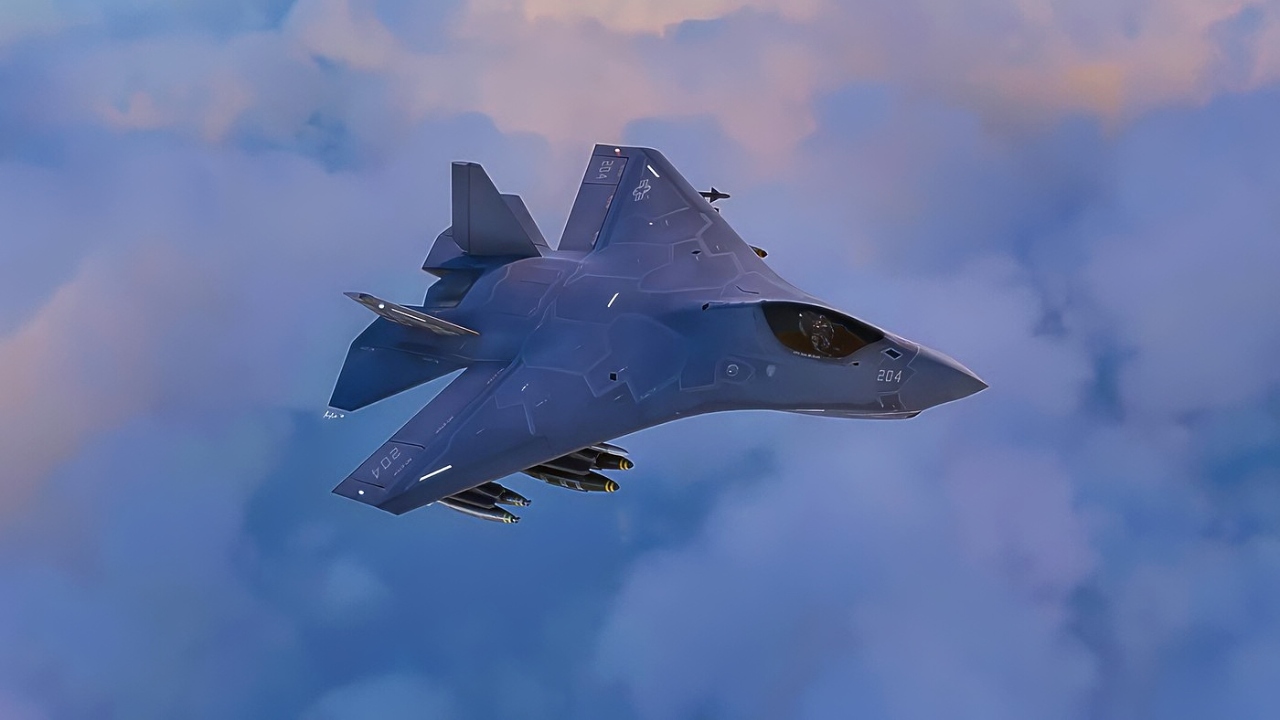
PUBLISHED on August 13, 2025, 8:04 AM EDT – Key Points and Summary – Boeing’s experimental X-32 prototype was famously unattractive, but plans for the production “F-32” version featured a radical redesign.
-The proposed aircraft would have ditched the prototype’s single-piece delta wing for a more conventional wing with tailerons to improve maneuverability.
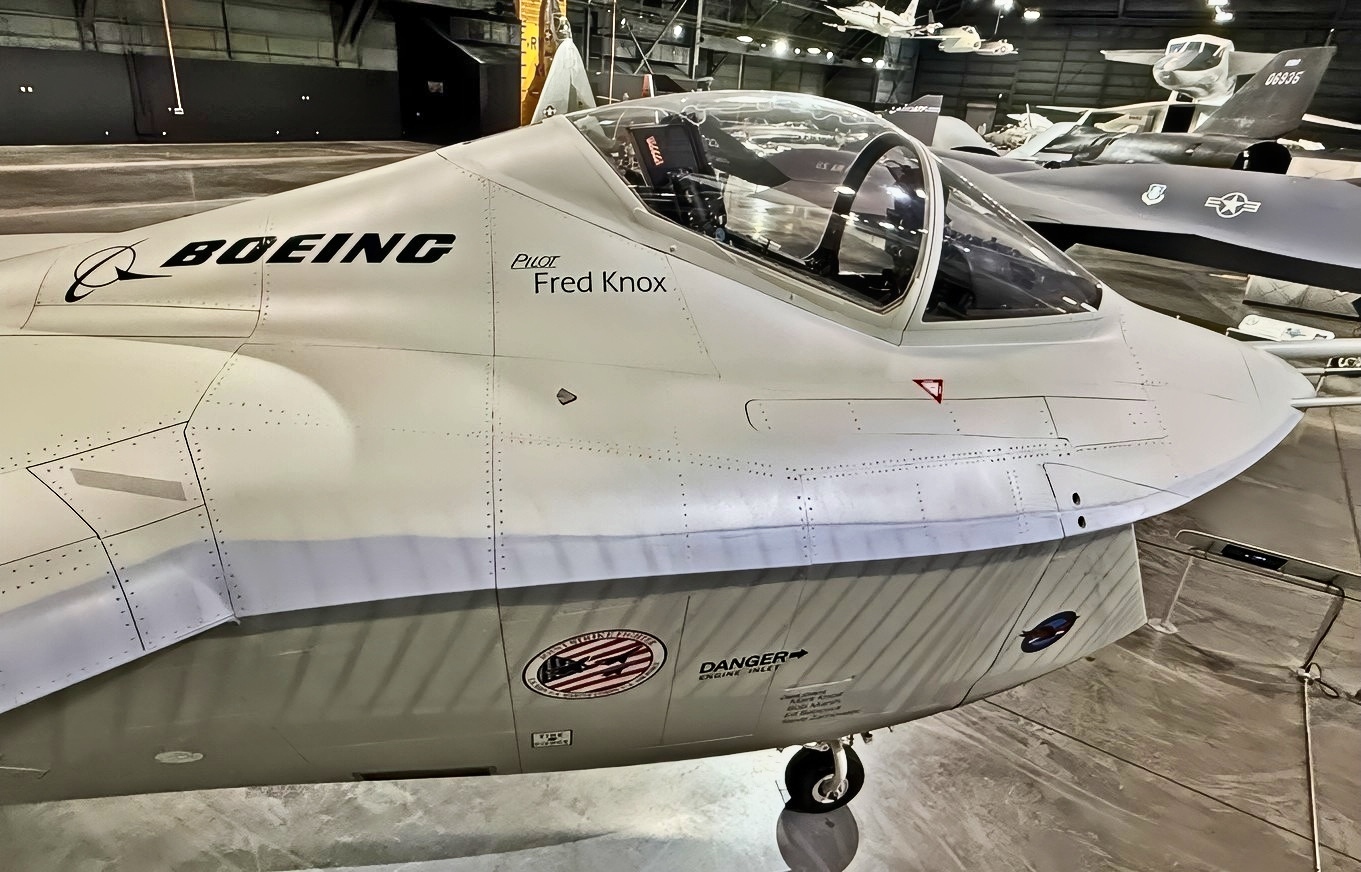
Boeing X-32 JSF. Original Photo Taken By National Security Journal Editor Harry J. Kazianis.
-It also included a refined air intake and a variable geometry baffle to significantly enhance its stealth capabilities.
-Despite these planned improvements, the X-32’s less efficient direct-lift STOVL system and the perceived risks of its redesign ultimately led to the selection of the X-35, which became the F-35 Lightning II.
How the Boeing X-32 Could Have Become the F-32 Stealth Fighter
During the Joint Strike Fighter (JSF) program, Boeing’s X-32 demonstrator aircraft drew a lot of negative press for its unsightly appearance, which sullied the aircraft’s reputation.
However, few people know that plans for the production version of the X-32 would have made significant changes and improved the X-32’s performance.
It’s impossible to say for sure what would have happened if the X-32 were chosen over the X-35; however, Boeing’s plans for the production version of the aircraft give us a small glimpse of what the F-32 could have looked like.
Beyond X-32: What the “F-32” Would Have Looked Like
The production version of the X-32 would have looked significantly different from its prototype. The demonstrator featured a large, single-piece carbon-fiber delta wing and a bulbous fuselage with a prominent chin intake, which earned it some humorous nicknames.
However, Boeing’s production design called for a more conventional wing layout with separate tailerons, which would have improved maneuverability and made the aircraft more suitable for carrier operations. The nose of the aircraft would have been reshaped to house a radar system, and the intake would have been refined to reduce the radar cross-section and improve stealth characteristics. The canopy, which had a bowed appearance on the demonstrator, would have been redesigned into a more streamlined bubble canopy to enhance pilot visibility and reduce drag.
Stealth was a critical requirement for the JSF program, and while the X-32 demonstrator had a relatively exposed engine face, the production F-32 would have incorporated a variable geometry baffle to shield the engine from radar detection. Combined with smoother mold lines and refined shaping of the fuselage and control surfaces, the F-32 would have achieved a significantly lower radar cross-section than the demonstrator.
These changes would have brought it closer in stealth performance to its competitor, the Lockheed Martin F-35.
Performance Improvements
In terms of propulsion and performance, the F-32 would have used the Pratt & Whitney F119-PW-614 engine, the same core engine used in the F-22 Raptor and the X-35.
This engine was capable of producing up to 43,000 pounds of thrust with afterburner, giving the F-32 a top speed of around Mach 1.6 and a service ceiling of approximately 50,000 feet.
However, due to its design and internal fuel capacity, the F-32 would have had a slightly shorter range than the F-35, estimated at around 979 miles unrefueled. While it may have been marginally faster, the trade-off in range could have impacted its operational flexibility.
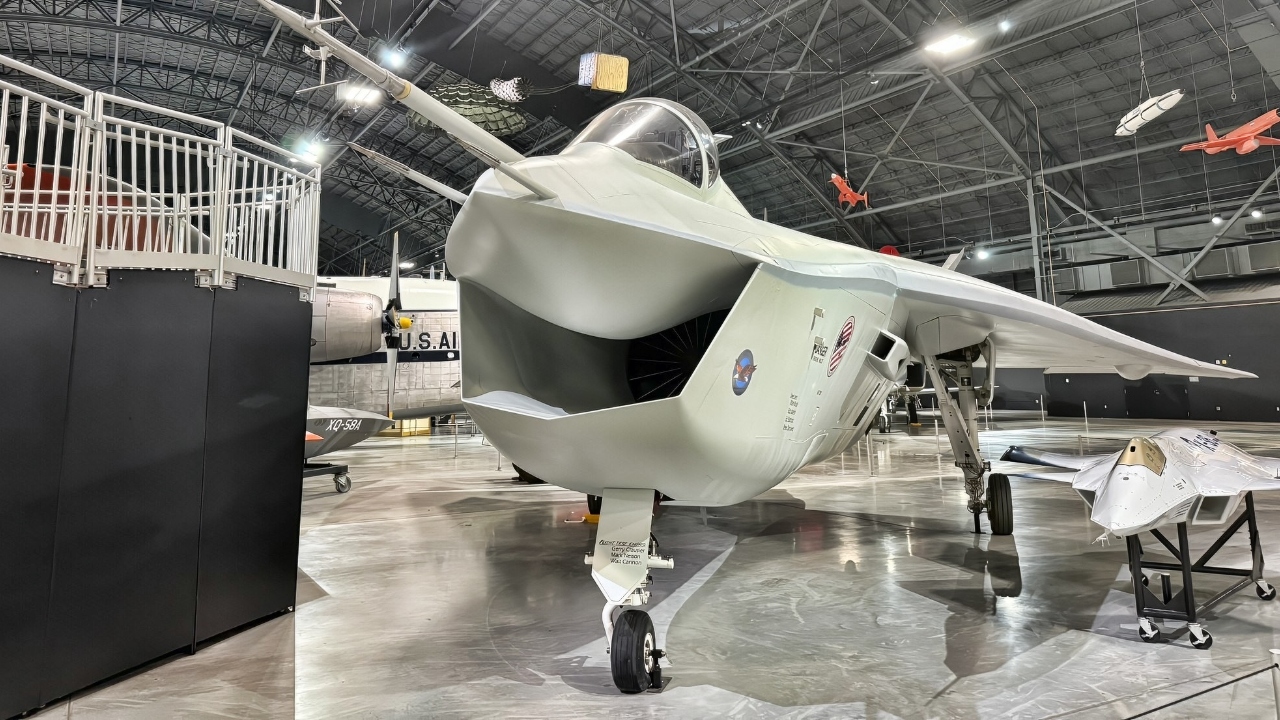
Boeing X-32 Bright Image 2025. Credit: National Security Journal.
One of the most distinctive aspects of the F-32 program was its approach to STOVL capability. Boeing opted for a direct-lift system, similar to the one used in the AV-8B Harrier. This method relied on vectoring nozzles and a single engine to achieve vertical lift. While this system was simpler and more proven than Lockheed’s lift-fan approach, it was also less efficient and offered limited growth potential.
The Marine Corps variant, designated F-32B, would have featured a translating intake cowl to increase airflow during hover, a shortened fuselage, and reduced wingspan to save weight. The thrust vectoring nozzles would have been aligned with the aircraft’s center of gravity to maintain balance during vertical flight.
For the Navy, Boeing had to adapt the F-32 to meet the demanding requirements of carrier operations. This involved enlarging the wings to accommodate slower approach speeds, strengthening the landing gear and tailhook systems, and enhancing the control surfaces for improved low-speed maneuverability.
These changes were essential for safe and reliable carrier landings and takeoffs. Boeing aimed to maintain a high degree of commonality across all three variants, Air Force, Navy, and Marine Corps, targeting around 85% shared components. This would have reduced production and maintenance costs and simplified logistics.
Armament and Avionics
The F-32 was designed to carry a wide array of weapons both internally and externally. Its internal weapons bays could accommodate up to six AIM-120 AMRAAMs or two 2,000-pound bombs. For missions requiring heavier payloads, external pylons could be used to carry up to 15,000 pounds of ordnance, including JDAMs, Paveway laser-guided bombs, AGM-154 JSOW glide bombs, and AIM-9X Sidewinders. The aircraft would also have been equipped with the M61A2 20mm cannon, a reliable and widely used weapon system in U.S. fighters.
The avionics and internal electronics for the JSF program were never fully completed, but experts have made educated guesses as to what the interior could have looked like. The F-32 would have featured an active electronically scanned array (AESA) radar, advanced electronic warfare systems, and sensor fusion capabilities. These systems would have been integrated into a modular architecture, allowing for future upgrades, much like the F-35’s approach.
A helmet-mounted display system would have provided pilots with critical flight and targeting information directly in their line of sight, enhancing situational awareness and combat effectiveness.
The F-32: What Could Have Been
The production F-32 would have been a far cry from the demonstrator’s awkward appearance.
The redesigned fuselage, refined intakes, and more balanced proportions would have given it a sleeker and more aggressive look. These changes would not only have improved aerodynamic performance and stealth but also public and military perception, which can play a role in export sales and long-term program viability.
If Boeing had won the JSF contract, the F-32 would have become the backbone of U.S. and allied air forces for decades. Its simpler STOVL system might have reduced maintenance complexity and costs, making it attractive to budget-conscious partners.
However, Lockheed’s lift-fan system offered better performance and greater potential for future upgrades, which ultimately contributed to the X-35’s victory. The F-32’s design was pragmatic and cost-effective, but it may have faced limitations in adaptability and long-term growth.
Did the Air Force make the right call in the long run? It is impossible to say.
About the Author: Isaac Seitz
Isaac Seitz, a Defense Columnist, graduated from Patrick Henry College’s Strategic Intelligence and National Security program. He has also studied Russian at Middlebury Language Schools and has worked as an intelligence Analyst in the private sector.
Military Matters
The F-22 Raptor Just Keeps Getting Better


