

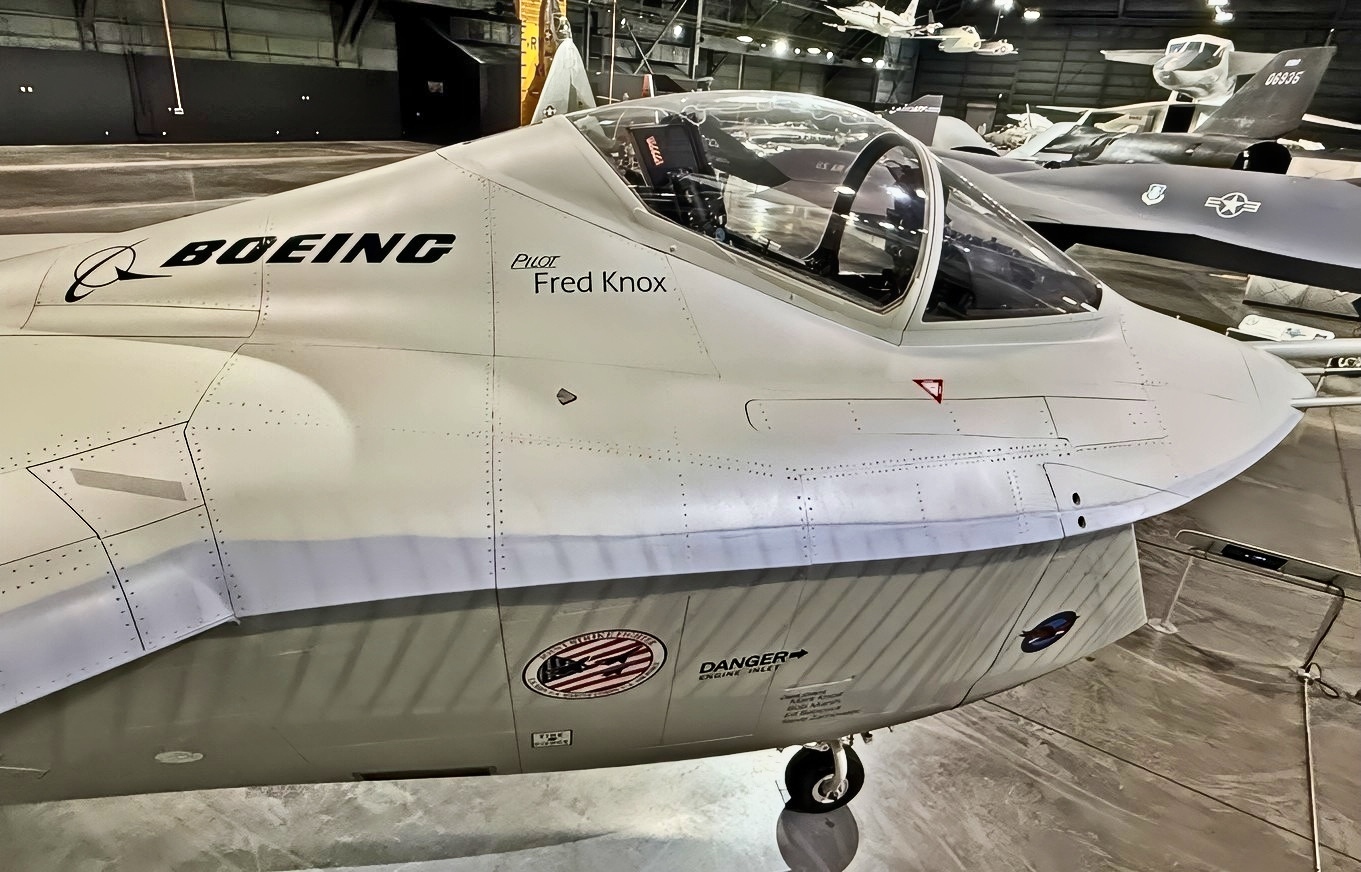
Just last weekend, National Security Journal spent a few hours looking over the Boeing X-32 Joint Strike Fighter at the U.S. Air Force Museum in Dayton, Ohio.
And, to be frank, we can’t get it out of our collective heads.
Boeing X-32A(full drone flight soon)
The Boeing X-32 was a multi-purpose jet fighter in the Joint Strike Fighter contest. It lost to the Lockheed Martin X-35 demonstrator, which was further developed into the F-35 Lightning II.https://t.co/ly2eCfHofd pic.twitter.com/U35rB8Rlzr— National Museum USAF (@AFmuseum) January 27, 2023
So you know what that means: we tried last week to cover the history of this controversial fighter jet, one that could have replaced the F-35 in the U.S. military, to the best of our abilities.
And, to be frank, we have a lot to say, and lots of different opinions on the Boeing X-32 among our staff.
The Boeing X-32 Fighter: What to Know
However, today we have a different type of analysis to share: This time, we take a deeper dive into the X-32’s actual performance during its brief experimental period and ask if it ever had a realistic chance of beating the F-35.
That’s a loaded question that surely will be controversial, but one worth asking.
X-32A First Flight
As we previously noted, Boeing built two airframes in its efforts to win the JSF contract, the X-32A and the X-32B.
These were considered Concept Demonstrator Aircraft (CDA), with the X-32A serving as both a conventional take-off and landing (CTOL) and carrier take-off and landing (CV) version, whilst the X-32B was the short take-off and vertical landing (STOVL) version.
According to a 29 July 2021 article by Aerotech News, “The X-32A featured a non-moving intake and wide-span wings with accentuated tip extensions. The X-32B featured a moving intake cowl that translated forward during hover to allow more air into the engine. The fuselage was slightly shorter and the wing span was narrower to reduce weight.”
The “A” model made its maiden flight on 18 September 2000, That first flight was initially slated for 30 to 40 minutes but ended up getting cut back to a mere 20 minutes out of safety concerns, as the plane sustained a small hydraulics leak.
Despite this in-flight malady, Boeing test pilot Fred Davy Knox, Jr. (LT, USN, Ret.) managed to coax a 13-degree angle of attack–just short of the 15 degrees planned–and 200 knots (230 mph, 370 km/h) of airspeed out of the plane, topping off at an altitude 10,000 feet before landing at Edwards AFB, Calif.
LT (Ret.) Knox had begun his flight at the nearby city of Palmdale, consuming 2,200 feet (670 meters) of runway before becoming airborne at 150 knots (280 km/h; 170 mph).
He stated that the F/A-18 Hornet performing chase plane duties needed “a lot of afterburner” to keep up with him during the initial stages of the flight.
X-32B First Foray
The “B” bird followed suit on 29 March 2001 (this flight had been delayed from the original target timeframe of the third quarter of 2000).
This one also flew the Palmdale to Edwards AFB route and managed to last 50 minutes.
According to the anonymous author of a 13 March 2018 article for Fighter Jets World, “The aircraft successfully transitioned to and from STOVL flight mode by using its direct-lift system to redirect thrust from the aircraft’s cruise nozzle to the lift nozzles…The X-32B also demonstrated its ability to hover and make vertical landings.”
So Then, Could It Have Beaten the F-35?
My take, well, no, not exactly.
Iffy at best. Lockheed Martin’s legendary Skunk Works division had a lot of momentum on its side, as that famed firm already had an established track record with: (1) the 4th Generation F-117 “Nighthawk,” the world’s so-called “Stealth Fighter” which wasn’t really a fighter at all but proved itself extremely effective as a bomber and ground attack platform; and (2) the world’s *true* stealth fighter, the 5th Generation F-22 Raptor.
What’s more, Boeing hadn’t fielded an operational, production phase fighter plane of any kind since the piston-engine, propeller-driven P-26 Peashooter way back in 1932, whilst Lockheed had built successful fighter planes in World War II (the prop-driven P-38 Lightning, flown by both of America’s top two fighter aces of all time) and the Korean War (the P-80/F-80 Shooting Star, the first US-made jet fighter to see combat) alike.
Last but not least, as another one of the X-32’s own test pilots, now-retired US Navy Commander Phillip “Rowdy” Yates, admitted in an interview with Ward “Mooch” Caroll (himself a retired USN CDR), “And the fact [was] that the Lockheed design had performed better than the Boeing design.”
The Poor Boeing X-32 Fighter
But as the saying goes, “He who laughs last laughs loudest.” When Boeing was awarded the USAF contract for the F-47 Next Generation Air Dominance (NGAD) 6th Generation fighter this past March, it demonstrated that the longstanding aerospace giant had, after all these decades, finally established a firm foothold in the stealth fighter business, with a chance to make up for lost and succeed where both the 5th Generation X-32 and the 4th Generation YF-118G Bird of Prey failed.
About the Author: Christian D. Orr, Defense Expert
Christian D. Orr is a Senior Defense Editor. He is a former Air Force Security Forces officer, Federal law enforcement officer, and private military contractor (with assignments worked in Iraq, the United Arab Emirates, Kosovo, Japan, Germany, and the Pentagon). Chris holds a B.A. in International Relations from the University of Southern California (USC) and an M.A. in Intelligence Studies (concentration in Terrorism Studies) from American Military University (AMU).
Aircraft Carrier Drama
The Navy’s Ford-Class Aircraft Carrier Is Obsolete


