

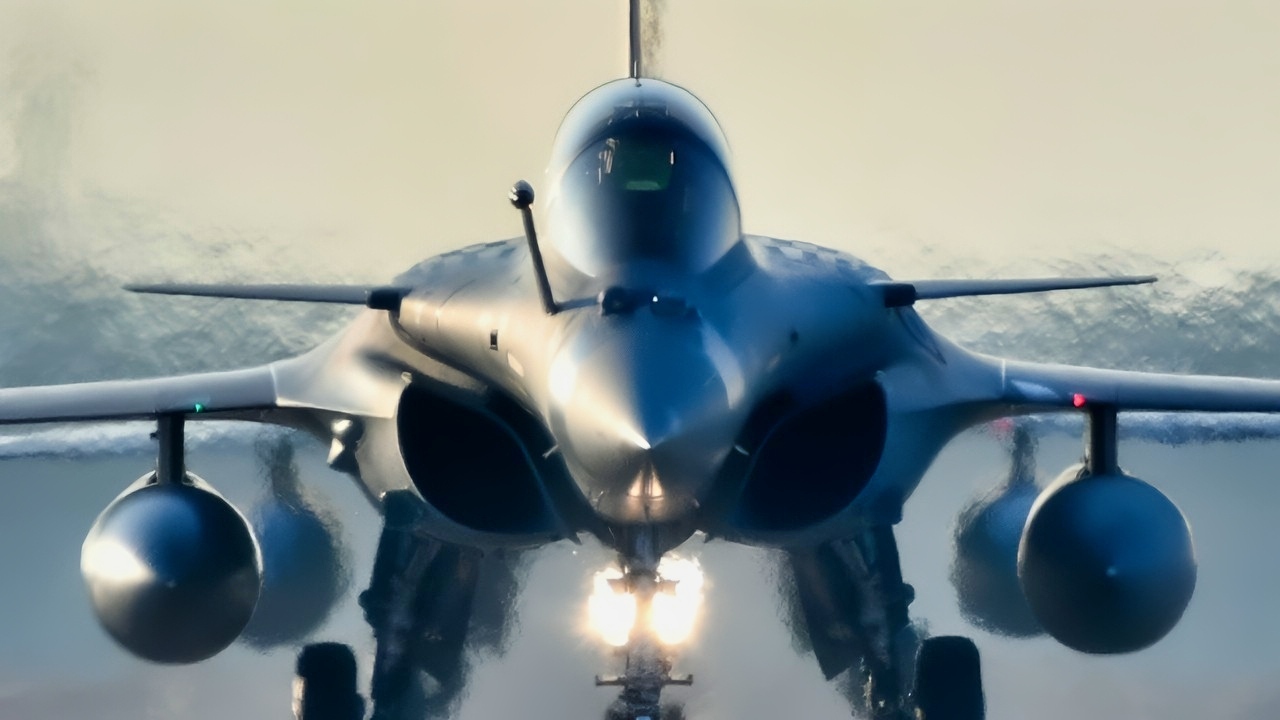
PUBLISHED on August 13, 2025, 3:12 PM EDT – Key Points and Summary – In a hypothetical matchup between France’s 4.5-generation Dassault Rafale and China’s 5th-generation J-20 “Mighty Dragon,” the Chinese stealth fighter would likely emerge victorious.
-While the combat-proven Rafale is more maneuverable and has a cannon for close-range dogfights, the J-20 holds decisive advantages in stealth, speed, and service ceiling.
-This “see-first, shoot-first” capability would allow it to engage from beyond visual range.
-The Rafale’s recent poor combat performance against the less-advanced J-10C fighter further underscores the technological and tactical advantages that would give the J-20 the win.
Here’s Who Wins: France’s Dassault Rafale vs. China’s J-20.
In recent weeks, National Security Journal has published a series of articles about hypothetical head-to-head matchups between the 5th-generation stealth fighters of the People’s Republic of China (PRC) and the 4.5-generation fighter jets.
Now, for the sake of variety, we’ve started a new series examining how some Western European-made 4.5-Generation fighters might fare against the PRC stealth planes.
The first such European contender we examined is one not currently employed by any of America’s allies in the Indo-Pacific region. This time, however, we look at a European-made fighter that’s very much in use by one of the biggest US allies in Asia—a member of the Quad, no less—that being India.
The fighter in question is the French-made Dassault Rafale, and as we did with the Typhoon, we compare it head-to-head with Beijing’s Chengdu J-20 Weilong (“Mighty Dragon;” NATO reporting name “Fagin”).
J-20 Advantages
It’s a no-brainer, but the most significant advantage of the Chinese fighter is its full-fledged stealth technology. As noted by Army Recognition, “The Chengdu J-20 , also known as Mighty Dragon is a single-seat, twinjet, all-weather, stealth fifth-generation fighter aircraft developed by China’s Chengdu Aerospace Corporation for the People’s Liberation Army Air Force (PLAAF).”
In fairness, however, the J-20’s stealth advantage isn’t as completely overwhelming as one might be initially inclined to think. As noted by Defence Aviation: “The Dassault Rafale has an edge over others, having an advanced tracking system capable of detecting and tracking even the extremely stealthy Lockheed Martin F-22 Raptor during mock drills … Since the Chengdu J-20 is heavily modelled on the F-22, there seems to be reasonable doubt regarding its stealth technology, especially since the Indian Air Force have [sic] been able to pick the J-20 on radar in the past.”
True to its “Mighty Dragon” nickname, the Chengdu plane has the more powerful engine of the two contenders. Its two Xian WS-10 afterburning turbofan engines that generate 32,000 lbf. (142 kN) lb. of thrust each in afterburner mode, contrasted with the piddling 17,000 lbf. (75 kN) spooled up by the Rafale’s two Snecma M88 turbofans in afterburner mode. The WS-10 enables the J-20 to fly slightly farther, with a combat range of 1,200 statute miles (2,000 kilometers, 1,100 nautical miles) vs. 1,150 statute miles (1,850 kilometers, 1,000 nautical miles) for the Dassault Aviation product.
Moreover, those more powerful engines result in the Fagin being the faster fighter. Depending upon which source you consult, the J-20 has a max airspeed of either Mach 2.0 or Mach 2.25, whilst as the fighter pilot’s motto goes, “Speed is life.”
The Weilong is also the higher flyer, with a service ceiling of 66,000 feet (20,000 meters), which gives it a hypothetical ability to pounce from above upon the lower-flying Rafale, whose service ceiling tops off at 51,952 feet (15.835 meters).
Dassault Rafale Advantages
The Rafale is the more maneuverable and agile warplane. The European bird also has a very slight rate of climb advantage over its Chinese competitor, with a rate of climb of 60,000 feet per minute (304.8 meters per second) versus 59,800 feet per minute (304.0 meters per second).
Armament-wise, the European plane has a distinct advantage: a gun. The Dassault warbird wields a 30mm GIAT 30/M791 autocannon with 125 rounds of ammunition, whilst the J-20 (just like the Shenyang J-35) omits a cannon altogether. Evidently, the PLAAF doesn’t subscribe to the philosophy of “Better to have and not need than vice versa”. To put it another way, the metaphorical “Mighty Dragon” doesn’t breathe literal gunfire.
Besides the technical aspects, there’s an intangible factor of experience, as in real-world combat experience. The Rafale has been “blooded” in combat in places such as Afghanistan, Libya, and Syria. (Though admittedly the Indian Air Force Rafales did turn in a somewhat inauspicious performance against the Pakistani Air Force’s J-10 “Vigorous Dragon” fighters—coincidentally another Chengdu product—during Operation Sindoor earlier this year.) Meanwhile, the J-20 and its pilots are totally lacking in combat experience (as is also true of the J-35); after all, the PRC hasn’t been in a major shooting war since the 1979 Sino-Vietnamese War.
And the Winner Is…?
Unfortunately, despite the Rafale’s many great attributes, I would still have to go with the J-20 in a one-on-one matchup due to its stealth, see-first, shoot-first capability, as well as speed and altitude.
Even more concerning is the Rafale’s demonstrated vulnerability to Chinese fighters and air-to-air missiles, especially when considering that the J-10 is a 4.5 Generation fighter, like the Rafale, and not a true 5th-generation jet like the J-20.
About the Author: Christian D. Orr, Defense Expert
Christian D. Orr is a Senior Defense Editor. He is a former Air Force Security Forces officer, Federal law enforcement officer, and private military contractor (with assignments worked in Iraq, the United Arab Emirates, Kosovo, Japan, Germany, and the Pentagon). Chris holds a B.A. in International Relations from the University of Southern California (USC) and an M.A. in Intelligence Studies (concentration in Terrorism Studies) from American Military University (AMU).
Military Matters
The F-22 Raptor Just Keeps Getting Better


