


Key Points and Summary – The U.S. Navy once came close to putting the F-16 Fighting Falcon on aircraft carriers via the Vought Model 1600, a navalized “Sea Falcon” pitched against Northrop’s YF-17.
-Heavier landing gear, a stretched fuselage and a more powerful engine promised true multirole punch at sea, but design risks—especially the low air intake, doubts over radar-guided weapons, and carrier-landing concerns—spooked Navy leaders. The twin-engine YF-17, which evolved into the F/A-18, ultimately won.
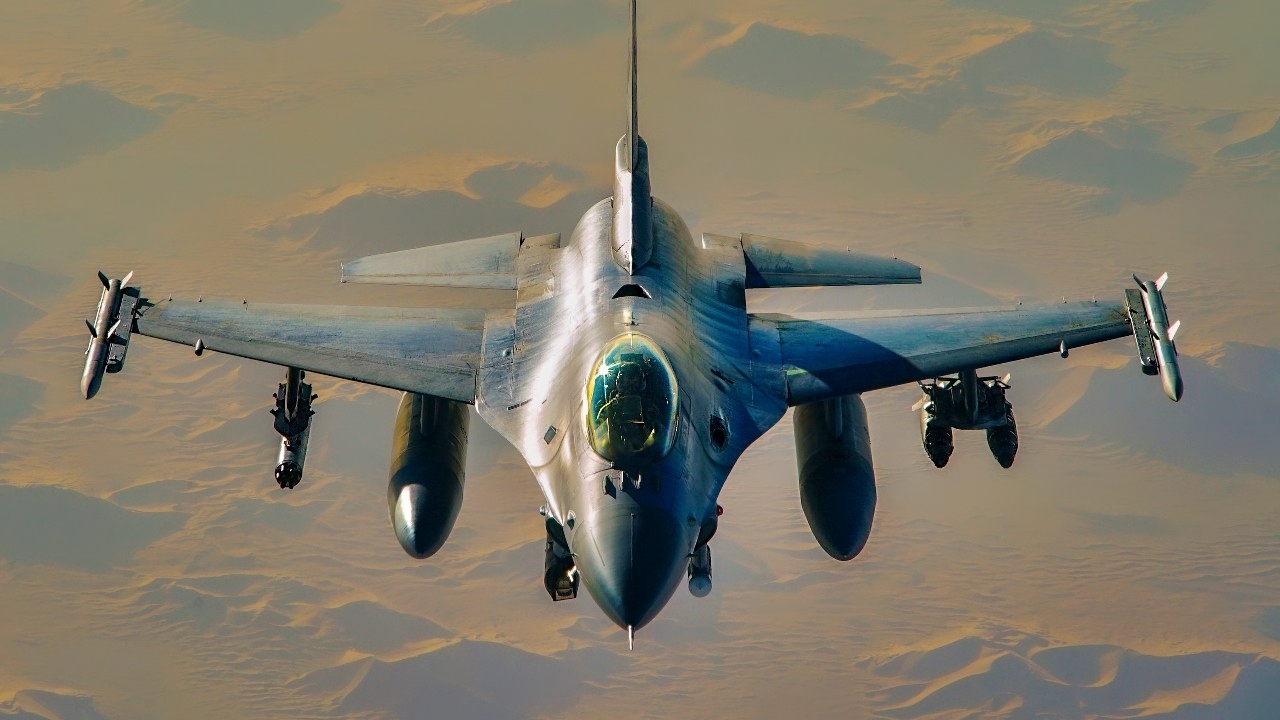
A U.S. Air Force F-16 Fighting Falcon based in the Central Command area of operations conducts armed aerial patrols in Somalia in support of Operation Octave Quartz, Jan. 9, 2020. The F-16s support to OOQ demonstrates the U.S. military’s reach and power projection across vast distances to hold adversaries such as al-Shabaab at risk with flexible, precise and lethal force that is capable of rapidly responding anywhere on the globe. The mission of OOQ is to reposition U.S. Department of Defense personnel from Somalia to other locations in East Africa. (U.S. Air Force photo by Staff Sgt. Taylor Harrison)
-The story shows how narrowly naval aviation history might have changed—and why the Navy still prefers twin-engine fighters for carrier decks. It’s a reminder that performance on paper isn’t enough for life at sea.
You Mean an F-16 Fighting Falcon Could Have Served on Aircraft Carriers?
I am fascinated by the US Navy aircraft carrier aviation. Launching and landing a fighter jet in rough seas and at night is one of the most impressive and dangerous feats in all of the military. We should be thankful that naval aviators flying such amazing aircraft as the F-35C Lightning II and the F/A-18E/F Super Hornet can perform their duties with aplomb. Those are the main carrier fighters today, and they may eventually be joined by the even better sixth-generation F/A-XX.
But what if I told you there was once an effort to fly F-16 Fighting Falcons off carriers full-time? It almost happened. This was known as the Vought Model 1600 program, which originated in the Department of Defense in the 1970s.
The Model 1600 was part of a competition to see which fighter model could survive and thrive off carriers. The Vought eventually lost out to the YF-17, which later would be known as the F/A-18.
The F-16 Had a Message for the Navy
General Dynamics, the producer of the F-16, and Northrop Grumman, the maker of the YF-17, were in a stiff rivalry. The Navy got involved and wondered whether the F-16 could be carrier-borne. This was exciting to aviators who knew the F-16 had the kind of performance that would give the carrier a fighting advantage, with long-range flight, dogfighting, and ground-strike capabilities in spades.

A U.S. Air Force F-16 Fighting Falcon connects with a U.S. Air Force KC-10 Extender over Iraq, Nov. 5, 2021. The F-16 is a compact, multi-role fighter aircraft that delivers war-winning airpower to the U.S. Central Command area of responsibilty. (U.S. Air Force photo by Staff Sgt. Jerreht Harris)
Let the Competition Begin
So General Dynamics put out feelers to Vought for a carrier model called the Model 1600. Vought badly wanted that contract to supply the Navy, and engineers got to work. Northrop and McDonnell Douglas did the same with equal enthusiasm for the YF-17.
The Navy Wanted a Blend of Air Superiority and Ground Strike
The requirements were straightforward. The Navy needed an air superiority fighter that could match the Soviet Union’s naval interceptors pound-for-pound. Surface strikes were also important for close air support and for eliminating tanks and armored personnel carriers that the Soviets and the Warsaw Pact had in great numbers.
The Vought model would feature the AN/APG-66 radar system, which could sniff out enemy fighters and incoming threats with the best of them. But the Navy wanted the Model 1600 to have radar-guided air-to-air missiles. Vought figured that the heat-seeking Sidewinder would be perfect.
The Vought Was the Bigger Warbird
The Model 1600 was going to be larger than the base model F-16. It would be three feet longer, with a 33-foot wingspan. That’s two feet more than the F-16. The fuselage was also broader and flatter. The canopy could be flattened forward.
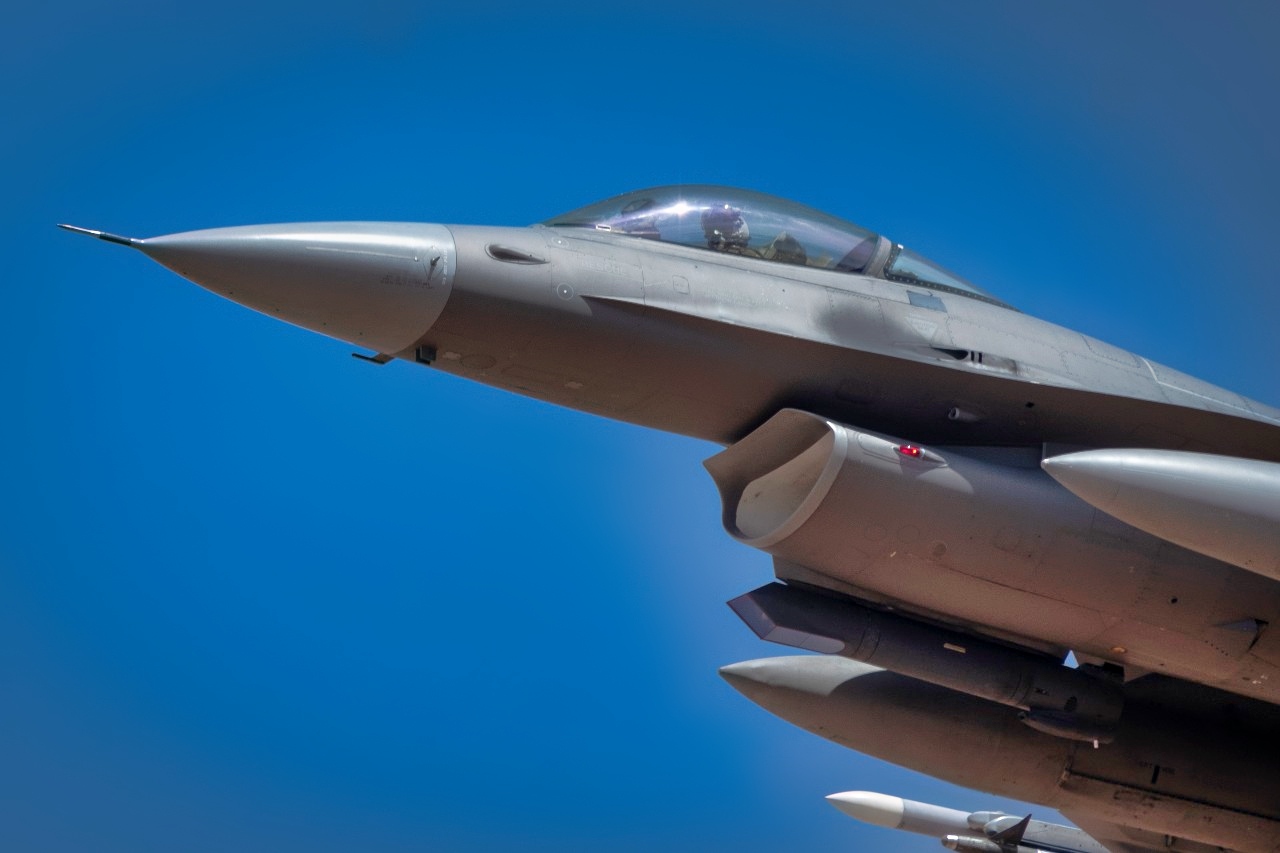
A U.S. Air Force F-16 Fighting Falcon assigned to the 54th Fighter Group soars through the sky over the Oscura Range at Holloman Air Force Base, New Mexico, April 21, 2025. During range operations, F-16 pilots perform munition drops and strafing maneuvers to test their abilities in the aircraft. (U.S. Air Force photo by Senior Airman Nicholas Paczkowski)
There was an important trait that Vought designers had to contend with. The arresting process on an aircraft carrier required landing gear that could withstand countless procedures. Could Vought make the 1600 into a carrier-borne airplane? They demonstrated this important trait by equipping the Model 1600 with heavier, stronger landing gear to withstand the punishment of carrier landings. That meant the fuselage also had to be sturdier.
Better Radar and Engine
The Navy wanted a pulse-doppler radar for better situational awareness. Vought was happy to oblige. This would allow for future beyond-visual-range missiles that could win a dogfight with style.
Since the Model 1600 would be 3,000 pounds heavier due to these additions, Vought decided to go with the new and powerful General Electric F101 engine.
However, as Alex Hollings notes, there were problems with the Vought design.
“The Vought 1600’s low-lying intake located just above the nose-wheel was considered a real risk on the flight deck of a Navy carrier, as it could literally suck unsuspecting sailors straight into it. This wasn’t the first time Vought faced this sort of criticism, as the pilot-favorite Vought F-8 Crusader’s large, low intake had already earned it the nickname ‘the Gator,’ because of its tenacity for gobbling up sailors,” Hollings wrote.
Plus, the Vought 1600 lacked the radar-guided munitions needed for poor weather. This was seen as a disadvantage for air superiority missions. The Navy wanted a fast, whiz-bang fighter that could police a carrier strike group and intercept enemy fighters that challenged the flotilla’s defensive umbrella. The Sidewinders were good, but the Navy still yearned for radar-guided, beyond-visual-range missiles.

Two F-16 Vipers from the 314th Fighter Squadron at Holloman Air Force Base, New Mexico, fly next to a KC-135 Stratotanker from the 121st Air Refueling Wing at Rickenbacker Air National Guard Base, Columbus, Ohio, over New Mexico, Nov. 15, 2022. The 314th FS trains the next generation of F-16 Viper pilots over the Holloman and White Sands Missile training ranges. (U.S. Air Force photo by Airman 1st Class Antonio Salfran)
The Vought Model 1600 had other problems that worried critics like Defense Secretary James Schlesinger. He thought the engine would bang hard against the flight deck upon landing. This would damage the airplane and could even harm the deck, creating other problems when follow-on aircraft tried to land, especially at night and in inclement weather.
Meanwhile, the YF-17 was considered a better option for carriers, mitigating the risks of the Model 1600. The YF-17 was also chosen for its second engine, which provided a better range and thrust that naval aviators preferred.
We’ll never know whether the Vought Model 1600 would have graced the carrier alongside the F/A-18 Hornet and the more advanced Super Hornet. But it is an interesting exercise to examine how close the Fighting Falcon came to flying off carriers full-time. Who knows, it could have been nicknamed the “floating” Falcon and starred in a Hollywood movie like the F-14 Tomcat.
About the Author: Brent M. Eastwood
Author of now over 3,000 articles on defense issues, Brent M. Eastwood, PhD is the author of Don’t Turn Your Back On the World: a Conservative Foreign Policy and Humans, Machines, and Data: Future Trends in Warfare plus two other books. Brent was the founder and CEO of a tech firm that predicted world events using artificial intelligence. He served as a legislative fellow for US Senator Tim Scott and advised the senator on defense and foreign policy issues. He has taught at American University, George Washington University, and George Mason University. Brent is a former US Army Infantry officer. He can be followed on X @BMEastwood.


