

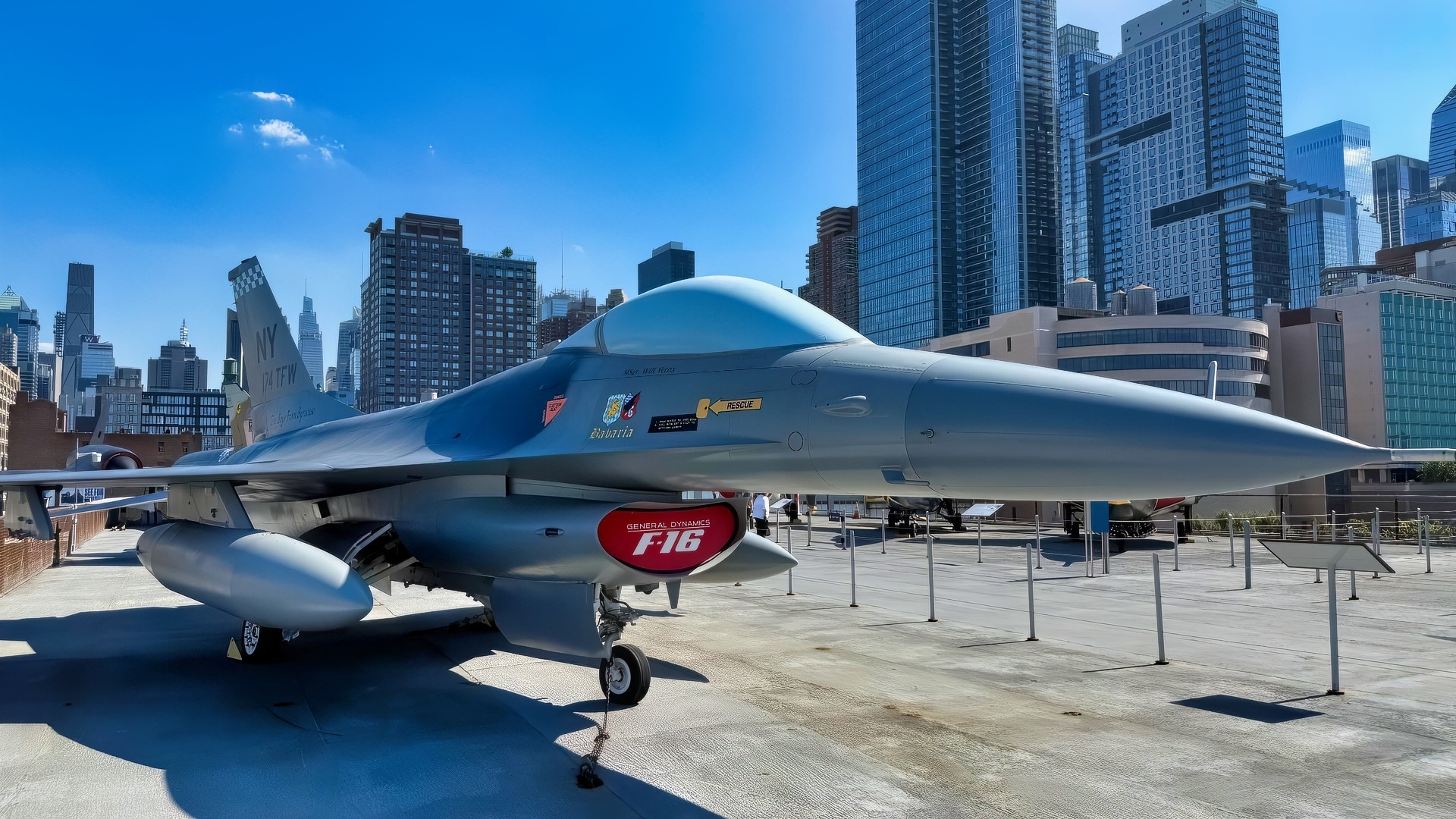
Key Points and Summary – USAF leaders floated an “F-16 Block 80” as a faster, cheaper way to bolster a shrinking fighter force.
-The concept would build on export-only Block 70/72 jets—much like F-15EX updated the F-15—adding an APG-85-class GaN AESA, expanded electronic warfare for “electronic stealth,” modern weapons, and F110-GE-132 engine enhancements.
-Practical hurdles loom: the U.S. stopped buying F-16s; the production line now serves exports from Greenville, SC; and the service must judge requirements, costs, and schedule against F-35 delays and budgets.
-A Block 80 Viper could complement F-35s, but whether USAF has the need—and appetite—to restart Viper procurement remains unclear.
What Are The Possibilities for F-16 “Block 80”?
WARSAW, POLAND – During a May 20 appearance before the Senate Intelligence Committee, the then-United States Air Force (USAF) Chief of Staff General David Allvin raised the possibility of an advanced F-16 variant as a possible and affordable solution to a shrinking US fighter force. Still only a hypothetical design concept at this point, the proposed version is designated “F-16 Block 80.”
An advanced F-16 is an entirely feasible concept for two reasons. The F-16 is currently the most widely used and exported fighter class in the US Air Force or anywhere else in the world. It has progressed through multiple production blocks from the 94 Block 1 and 197 Block 5 aircraft that were built in the late 1970s, to the enhanced Block 70/72 aircraft in production today.
The version widely in use at the turn of the century, the F-16C/D Block 50/52 series, is almost obsolete in the present day. These aircraft are today being kept relevant by replacing their older-generation mechanically-steered array (MSA) radars with the current-generation active electronic scanning array (AESA) models. Turning the F-16 into a Block 80 would be a near-parallel process of incorporating F-35-era technology into the older airframe.
The F-16 has a long history of going through decades of incremental improvements. This leap prompted the chairman of the committee, Sen. Tom Cotton, to ask the then USAF Chief about the possibility of taking the most modern variant, the Block 70/72, which has become an export-only model, another step higher on the technology evolutionary scale.
What Options For a Next-Variant F-16
“Focusing on just the next decade, then, our current acquisition options are pretty limited. Would you be able to use newly built US-configured Block 80 F-16s to strengthen our strike fighter fleet, if Congress can find additional funds for such an effort?” Cotton asked.

F-16 Looks Like Russian Flanker. Image Credit: Top Aces.
Allvin responded that he would need to investigate what “would be [required] to take that export variant and adapt it to a Block 80, and the time it would take, and where that would fall in the production line,” in order “to see if that would be an advisable situation.”
The fact, however, is that the USAF has stopped procuring F-16s of any variant. The Block 70/72 production line has even been moved out of Air Force Plant No. 4 in Fort Worth, Texas, to make room for the F-35 line. The Block 70/72 production line is now located in Greenville, South Carolina, and orders taken for the aircraft are so far only for export customers.
“The question is whether the USAF would want to consider going back to procuring F-16s of any configuration,” said a retired US defense industry executive familiar with the Block 70/72. “Do they have any of the proverbial ‘muscle memory’ left required to design and procure a new F-16 variant, and do they even want to remember how to do that.”
But the possibility of the USAF resuming F-16 procurement continues to be raised. This is partly due to the numerous and growing complications and cost overruns associated with the F-35 program. But the “Block 80” concept remains an undefined one, and it is still uncertain what capabilities this enhanced F-16 would have on board.
A Smaller F-15EX Eagle II?
If the USAF were to seriously consider the option, the F-16 Block 70/72 would become the baseline, as it represents the most advanced variant of the F-16, built upon it. The most likely template for this aircraft’s development would be to mirror the process that created the F-15EX, based on the F-15E.
Just as the USAF has stopped buying F-16s, the service stopped procuring the F-15 in 2001 but then began acquiring them again in 2020. But the 2020 USAF versions were made economically viable by the many improvements that were made to the F-15 in the intervening years for export customers in South Korea, Singapore, Saudi Arabia, and Qatar.
There is a certain logic in looking at an analogy where the F-16 Block 80 would be to the F-16 what the F-15EX Eagle II is to the F-15. What is likely part of any such advanced F-16 is a version of the AN/APG-85 radar, the second-generation model of an AESA that was designed for the F-35 and is based on Gallium Nitride (GaN) technology.
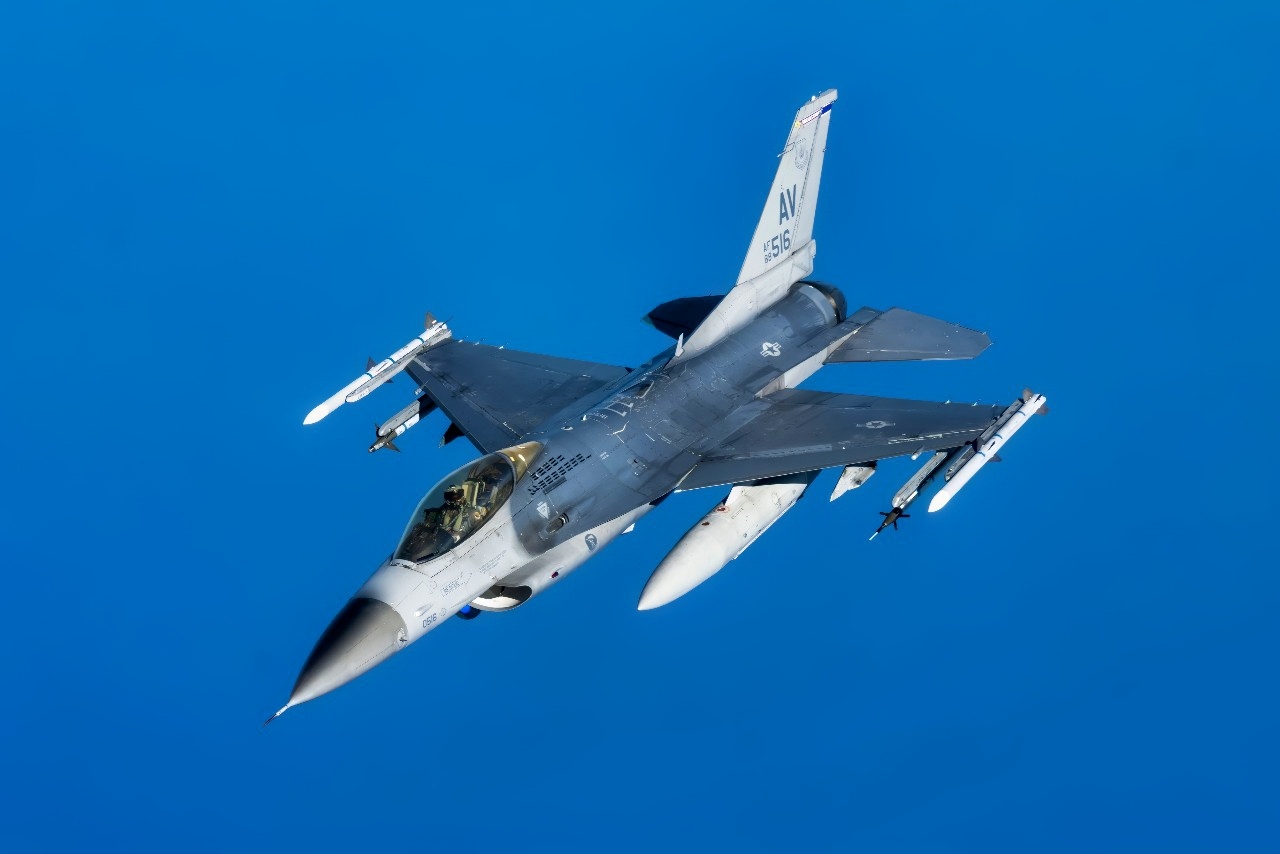
A U.S. Air Force F-16 Fighting Falcon from the 31st Fighter Wing, Aviano Air Base, Italy, descends after receiving fuel from a KC-135 Stratotanker from the 100th Air Refueling Wing, RAF Mildenhall, England, over the Adriatic Sea, Aug 7, 2025. The F-16 is a compact, highly maneuverable multi-role fighter aircraft with robust air-to-air combat and air-to-surface attack capabilities. (U.S. Air Force photo by Senior Airman Christopher Campbell)
Many of the avionics and the electronic warfare (EW) suite would likely be incorporated into a new F-16 as well. One of the prime focal points of the EW would be to enhance the “electronic stealth” of the aircraft, as has been done by Saab for the JAS-39E/F model of the Gripen and the latest 4.3 configuration of the Dassault Rafale.
The aircraft would likely retain the same engine, with enhancements made to the F110-GE 132 model that is the powerplant in the United Arab Emirates (UAE) F-16E/F Block 60. The aircraft would also be optimized to carry all the most modern air-launched weapons.
Although the concept of this aircraft being developed and deployed in operations alongside a 5th-generation F-35 and a 4++-generation F-16 Block 80 strike package is appealing, it remains unclear whether the USAF has sufficient requirements or desire to make this program a reality.
About the Author: Reuben F. Johnson
Reuben F. Johnson has thirty-six years of experience analyzing and reporting on foreign weapons systems, defense technologies, and international arms export policy. Johnson is the Director of Research at the Casimir Pulaski Foundation. He is also a survivor of the Russian invasion of Ukraine in February 2022. He worked for years in the American defense industry as a foreign technology analyst and later as a consultant for the U.S. Department of Defense, the Departments of the Navy and Air Force, and the governments of the United Kingdom and Australia. In 2022-2023, he won two awards in a row for his defense reporting. He holds a bachelor’s degree from DePauw University and a master’s degree from Miami University in Ohio, specializing in Soviet and Russian studies. He lives in Warsaw.
More Military
SR-72 Mach 6 Mistake the Air Force Needs to End
The U.S. Navy’s Ohio-Class Missile Submarine Nightmare
America Has Mini-Aircraft Carriers
Russia’s Su-57 Felon Stealth Fighter: Made in India?
F-22 Raptor vs. J-20 Stealth Fighter: Hope This Never Happens


