


Why U.S. Allies Are Second-Guessing the F-35
Key Points and Summary
-President Donald Trump’s aggressive trade war is causing a major backlash among key U.S. allies, threatening the future of the F-35 program in Europe.
-Stung by biting tariffs and belligerent rhetoric, countries like Switzerland, Spain, Denmark, and Portugal are all reconsidering or outright canceling their planned purchases of the advanced stealth fighter.
-Citing a desire for European defense autonomy and deep concerns about the reliability of the U.S. as a partner, these nations are now looking to domestic alternatives, putting a significant dent in one of America’s most important defense export programs.
The New F-35 Fighter Crisis
Still in the throes of President Donald Trump’s trade war, a number of friends and allies of the United States are asking the question: “What is the future of our F-35 program — if any — and what are the alternatives?”
Stung by biting tariffs, one of the most recent countries to reconsider its previous intent to buy into the F-35 program is Switzerland. The administration imposed a 39 percent tariff rate on that landlocked, neutral country with friendly ties to the United States.
It is the highest tariff imposed on high-income, highly developed countries, and more than double the tariff rate applied to goods originating from the European Union.
Speaking to Handelsblatt last month, a German daily newspaper with a business focus printed in Düsseldorf, Swiss Green Party MP Balthasar Glättli said, “A country that throws stones at us in trade should not receive a gift,” referring to his country’s intention to buy into the F-35 stealth fighter program.
And from here, for the F-35, the situation in Europe is about to get worse.
The Spanish Sour on F-35
In August this year, Spain officially stopped its F-35 procurement negotiations for the Air Force, which had had its eye on the F-35A, as well as the F-35B for the Spanish Navy, looking instead to other alternatives like the Eurofighter Typhoon, a European-made fourth-generation fighter, or potentially the Franco-German Future Combat Air System, or FCAS.
A significant portion of the impetus for the reassessment stems from amended domestic defense spending rules, which prioritize European projects.
Eighty-five percent of the Spanish budget should be allocated to defense projects in Europe, part of Madrid’s strategy to both foster more robust European defense and meet spending target obligations under the NATO defense treaty.
Another crucial factor that turned Spain sour on the deal is concerns about the United States restricting Spanish-flown F-35s electronically, via software patches that restrict access or downgrade performance, or physically by stopping the flow of consumable spare parts and components. € 6.25 billion, out of around € 7.2 billion, is earmarked for new fighter jets built in Europe.
Either case would severely restrict the Spanish Air Force and Navy’s aviation ability — and turning away from the F-35 could leave the Spanish without carrier-capable fixed-wing aircraft until the 2040s.
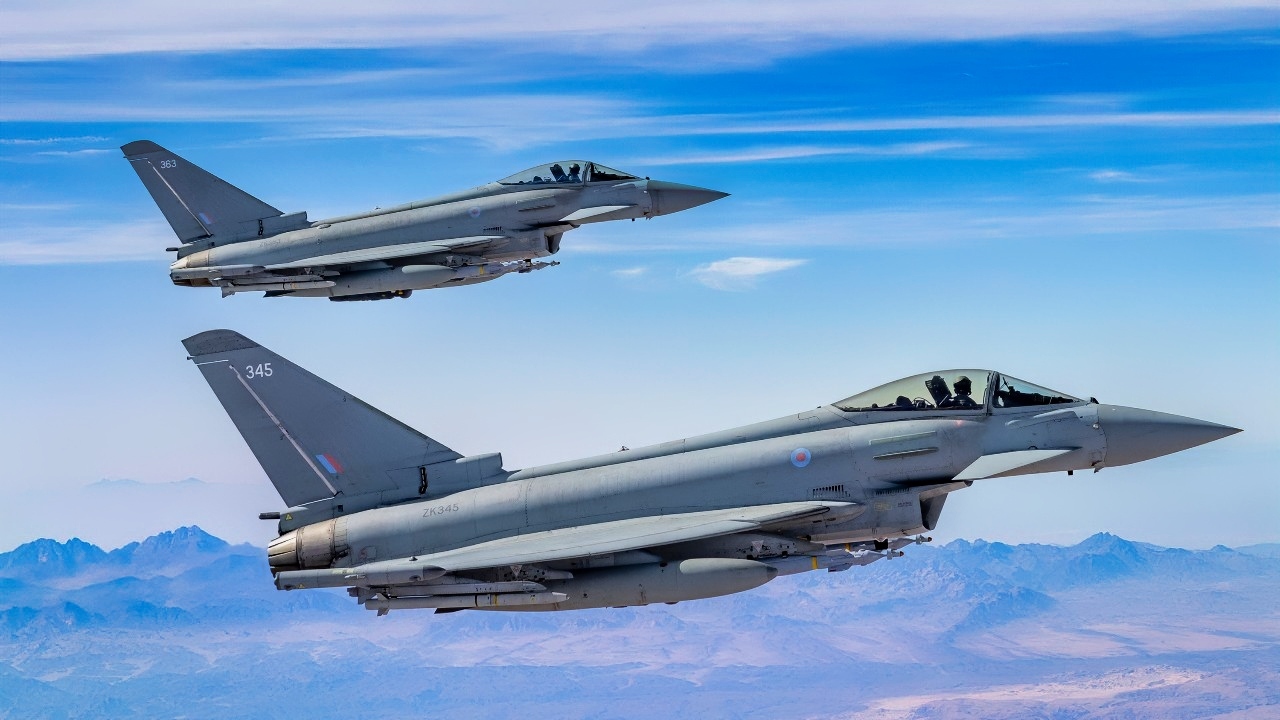
Image of two RAF Typhoon FGR Mk 4 aircraft, seen here during a routine mission over the Middle East as part of Operation Shader.
Op SHADER air to air refuelling sortie took place on Wednesday 13th November, maintaining Typhoon presence across the Middle East running routine missions.
Typhoon, Voyager and Atlas A400 aircraft operate from RAF AKrotiri as part of Op SHADER, part of the International coalition effort fighting terrorist organisations in the Middle East region.
The RAF has been engaged in this mission since 2014 combating Daesh in Iraq and Eastern Syria as well as Houthi Rebels more recently in Yemen who threaten global shipping. Image Credit: Creative Commons.
It is not just the Spanish or the Swiss that have begun to rethink their relationship with the United States vis-à-vis defense platforms or trade. Several other countries — historically close allies and friends of the United States — have reassessed the risks of relying on a now-unreliable American defense industry for their strategic aviation needs.
The Danes Demur
One of these countries is Denmark. Rasmus Jarlov, a Danish lawmaker and Chairman of the Danish Defense Committee, expressed his apprehension on X, formerly known as Twitter.
“I can easily imagine a situation where the USA will demand Greenland from Denmark and will threaten to deactivate our weapons [F-35s] and let Russia attack us when we refuse (which we will even in that situation).”
“Therefore,” Mr. Jarlov explained, “buying American weapons is a security risk that we can not run. We will make enormous investments in air defence, fighter jets, artillery and other weapons in the coming years, and we must avoid American weapons if at all possible.” In addition, he added, “I encourage our allies and friends to do the same.” Some allies and friends have done just that.
The Portuguese Pause
Following President Trump and Vice President Vance’s belligerent rhetoric toward Greenland, the Portuguese seemed to second-guess the wisdom of joining the American-led F-35 program, given the monopoly on spare parts held by the United States.
Concerns have been raised that the United States could, theoretically, turn off the F-35 via a kill switch, although the American aerospace companies responsible for the design, as well as the United States government, have denied that such a switch exists.
What Next for F-35 in Europe?
Regardless of the reality of an F-35 kill switch, the United States could, in theory, hamstring allied F-35 programs by withholding the supply of spare parts and maintenance support, much like it did with the F-16s in Venezuela or the F-14 Tomcats in Iranian service.
What is clear, however, is that despite the President’s own touting of his ability to strike deals, the effect of the Trump-led trade war is a clear cooling on the F-35 stealth fighter.
European apprehension about the program is not enough to torpedo it — the United States remains by far the single largest operator of F-35 jets — but is certainly enough to put a significant dent in the sales of stealth fighters abroad.
About the Author: Caleb Larson
Caleb Larson is an American multiformat journalist based in Berlin, Germany. His work covers the intersection of conflict and society, focusing on American foreign policy and European security. He has reported from Germany, Russia, and the United States. Most recently, he covered the war in Ukraine, reporting extensively on the war’s shifting battle lines from Donbas and writing on the war’s civilian and humanitarian toll. Previously, he worked as a Defense Reporter for POLITICO Europe. You can follow his latest work on X.
More Military
The Su-57 Felon: Worst Stealth Fighter Ever
The U.S.-Venezuela War of 2025?


Allen S Belgarde
September 2, 2025 at 6:26 pm
I don’t believe the European nations would give a thumbs down on the F-35 program. In the first place it would be a very stupid decision on their part. They have no other source of stealth fighters to fill their needs.
Howard Pattis
September 3, 2025 at 12:23 pm
The plane is not the issue….it’s numb nuts Lysol Don the Con who is clearly mentally unstable and totally unreliable in any facet of human interaction.
Rodgman
September 3, 2025 at 1:28 pm
If we’re imposing tariffs on certain European countries, there’s a reason for it. Perhaps the author would be well served to include that point in this article rather than make it appear that the US is acting unilaterally. These countries may have friendly ties with our country, but unfair trade is unfair trade. Level the playing field and the tariffs will go away.