


Key Points and Summary: The recent decisions by Spain and Switzerland to turn away from the F-35 signal a deeper European reckoning with the costs of military dependence on the United States.
-Beyond price disputes, nations are balking at the F-35’s “sustainment monopoly,” where the U.S. controls all future upgrades, software, and operational data.

U.S. Air Force Maj. Melanie “Mach” Kluesner, pilot of the F-35A Demonstration Team, performs aerial maneuvers during the Southernmost Airshow Spectacular at Naval Air Station Key West, Florida, on March 30, 2025. The team’s mission is to inspire, engage, and recruit the next generation of Airmen by showcasing the capabilities of the Air Force’s premier fifth-generation fighter. (U.S. Air Force photo by Senior Airman Nicholas Rupiper)
-This creates a strategic risk in an era of fraying alliances, forcing a choice between short-term capability and long-term autonomy.
-However, this pivot to European solutions is doomed to fail unless Europe overcomes its own chronic industrial fragmentation.
The F-35 Breakup in Europe
Spain shocked Europe with a decision to scrap its plans to purchase the F-35, and public opinion in Switzerland has begun to turn against that country’s planned acquisition.
Madrid had long been expected to select the F-35B to replace its Harrier force aboard the Juan Carlos I and augment its short- and medium-air-support capabilities. It has chosen instead to purchase 25 new Eurofighter Typhoons and double down on the Future Combat Air System (FCAS). Switzerland, where a referendum only three years ago greenlighted the acquisition of 36 F-35As for 6 billion Swiss Francs, is reconsidering after Washington’s refusal to lock in prices, and its decision to impose new tariffs on Swiss exports.
Spain’s choice is the more important of the two. Selection of the Typhoon will delay Spain’s carrier-strike aspirations and leave the service without a true fifth-generation platform for at least another decade. However, the upside for domestic industry is significant.
By diverting billions into European programs, Madrid will ensure that its procurement fuels European supply chains, maintains and creates jobs, and grows technical expertise under European ownership. The risk is that a short- to mid-term capability gap is created in favor of the longer-term benefit of a wholly indigenous system – one with fewer restrictions on licensing and less vulnerable to swings in Washington’s political cycles.
The Swiss case is different, but no less instructive. An early favorite of the competitive assessment, and then a winner in a public referendum in 2022, the F-35 offered the prospect of value, interoperability, and unbeatable capability. Yet by the end of 2023, much of this was beginning to unravel.
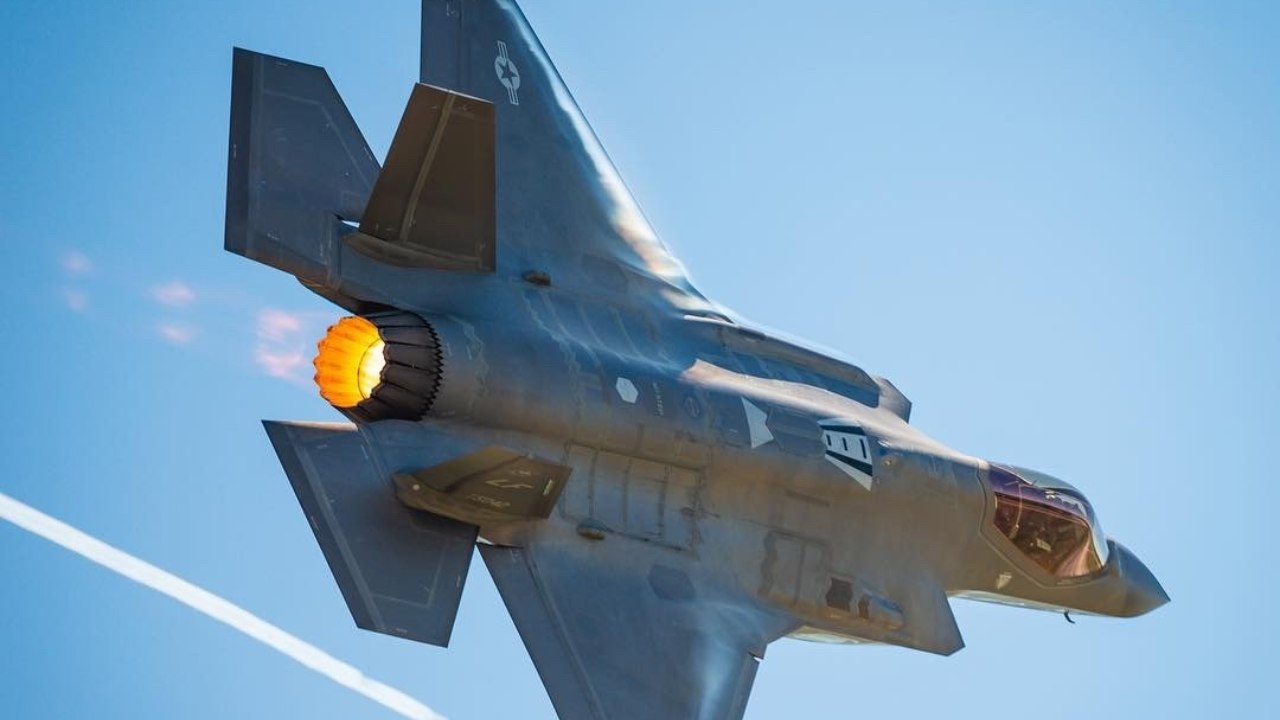
Capt. Andrew “Dojo” Olson, F-35 Demonstration Team commander and pilot performs a dedication pass in an F-35A Lightning II during the 2019 Wings Over Wayne Airshow April 27, 2019, at Seymour Johnson Air Force Base, North Carolina. The WOW Airshow marks the third public performance of the F-35 Demo Team’s new aerial demonstration during 2019 airshow season.
Washington, in closed-door briefings with Swiss government officials, quietly explained that the contract was not fully fixed and was vulnerable to inflation and rises in material costs as the procurement moved forward. Price increases on the order of 650 million or more Francs were suddenly back on the table. Later, Washington’s imposition of new tariffs on Swiss goods further undermined a sense of confidence in the reliability of the offer. This was enough to tip a vocal minority in Bern to call for the deal to be scaled back or scrapped.
Spain has the industrial base and political ambition to drive FCAS, while Switzerland’s neutrality and lack of a domestic aerospace industry mean the calculus is narrower, and its choice between affordability and supply-chain security is more stark. However, the assessments in Madrid and Bern of the strategic need for the F-35, versus the benefits of indigenous solutions, are informed by the same underlying concern. Despite its unrivaled technical capability, the F-35 brings with it deep-seated liabilities in terms of cost, security, and control.
This is a well-known set of problems. Lockheed Martin has built a sustainment monopoly. The software can be changed and improved only with American permission. Lifecycle costs have spiraled higher, calling into question the notion that the F-35 would be affordable.
By contrast, the Eurofighter remains an eminently capable and relevant multirole aircraft that is more adaptable, more upgradeable, and is under European ownership. The FCAS, which is still in the R&D phase, promises to deliver sixth-generation characteristics – stealth, manned-unmanned teaming, advanced electronic warfare, and cloud-based command systems – all under European control from the outset.
The political-strategic logic is clear. To buy the F-35 is to commit oneself to an American-owned ecosystem in which another power will control spares, future upgrades, and even operational data. This may be tolerable when Washington is strongly aligned with European allies, but it becomes a strategic risk if alliances begin to fray or tariffs and politics intrude. Spain’s decision to reject the F-35 is thus not only based on affordability or industrial sovereignty.
It is an insurance policy for the future and a decision to pay the price now in order to avoid having to pay more dearly in the form of lost autonomy. Switzerland, by contrast, is waking up to find that its so-called fixed-price contract may be less fixed than was first agreed.

U.S. Air Force Maj. Kristin “BEO” Wolfe, F-35A Lightning II Demonstration Team commander, flies over Kennewick, Washington, during the Tri-Cities Water Follies Airshow Over the River, July 30, 2023. The F-35 Demonstration Team participated in the 2023 Tri-Cities Water Follies airshow and various other events in support of their mission to recruit, retain and inspire new and old generations of Airmen. (U.S. Air Force photo by Staff Sgt. Kaitlyn Ergish)
The economic lesson is no less brutal. Defense procurement decisions do not stop at the acquisition of hardware. They allocate national resources either to sustain industrial ecosystems or to neglect and let them atrophy. Every euro or franc spent on the F-35 is a euro or franc that circulates in the American economy. Spending on the Eurofighter or FCAS stays in Europe, supporting jobs, reinforcing local technical expertise, and sustaining a pan-European defense economy.
Spain’s decision to reorient its spending into European programs is a conscious choice to invest in industrial resilience: Its defense expenditures stay at home rather than going overseas. Switzerland’s decision to buy the F-35, by contrast, not only risked entrenching the country’s dependence on American suppliers. It also exposed Bern to global supply-chain shocks and the vagaries of U.S. domestic politics.
From an economic perspective, autonomy is secured by sustaining one’s own industrial base. The moment that base is ceded to another power, dependence begins.
What Happens Next?
These cases should lead to three conclusions. First, autonomy is a costly business, but dependence can turn out to be even more expensive – in ways that are not necessarily obvious right away. Second, advanced hardware is of little use if governments are unable to sustain, modify, or adapt it without foreign permission. Third, Europe must address its chronic industrial fragmentation. The FCAS, or at least its current concept, will flounder in the same domestic constraints as gripped its predecessors if partners cannot agree to workshare, align on intellectual property, and achieve the unity of purpose and industrial structure required to build strategic military systems.
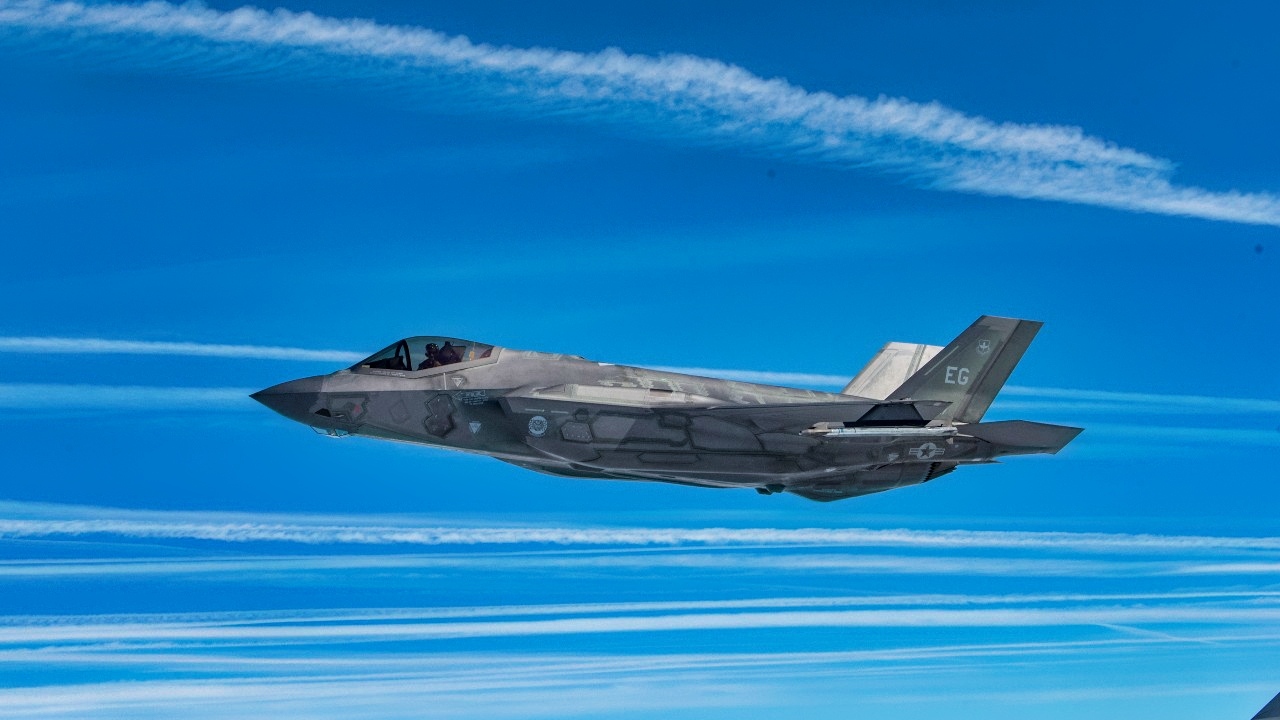
U.S. Air Force F-35 Lightening II with Eglin Air Force Base, Florida flies off the wing of a KC-135 Stratotanker with MacDill Air Force Base, Florida on December 16, 2021. The F-35 is the U.S. Air Force’s fifth-generation fighter and will replace the F-16 Fighting Falcon and the A-10 Thunderbolt II. (U.S. Air Force photo by Staff Sgt. Tiffany A. Emery)
The European continent is perfectly capable of building a sixth-generation fighter. It simply lacks the unity to build one that will succeed.
Spain has already made the choice to bet on Europe over America. Switzerland, lured by America’s technology, but unnerved by its willingness to weaponize dependencies and political leverage, may yet follow suit.
But suppose Europe cannot find the unity of will and purpose to do the same in the coming years. In that case, the next episode of this dance will repeat when the sixth-generation era dawns, and will ensure that powers outside the continent will decide the future of the European skies.
About the Author: Dr. Andrew Latham
Andrew Latham is a non-resident fellow at Defense Priorities and a professor of international relations and political theory at Macalester College in Saint Paul, MN. You can follow him on X: @aakatham. He writes a daily column for National Security Journal.
Fighter Jet Fails
Russia’s Su-57 Felon Stealth Fighter Is a Waste of Rubles


PseudoExpertent
August 22, 2025 at 12:54 pm
Europe doesn’t NEED the f-35.
So, What Does europe need.
Europe needs to set up a robust competition between the rafale and the euro typhoon to see which is the better aircraft.
The planes should fly against each other in a series of tests to validate their capabilities.
The rafale is likely to emerge on top, but right now it costs too much to win over admirers.
So, in the end, better for europe to buy a second tier aircraft, like the gripen.
Off-CNN
August 22, 2025 at 3:02 pm
CNN says the US president must compel russian president to go to the US to talk with the nazi leader herr zelenskyy.
What the hell’s that hubris.
Russia isn’t serbia or iran or venezuela. Russia is a nuke power possessing the sarmat missile that can break the back of any western nation, including uncle sam.
CNN, like all other anglo media in the anglosphere world, think the nazis are in the right and russia is in the wrong.
Thus, the world needs to say NO to the anglosphere world because it’s a warped world.
Putin MUST SHOW some cojones and say ‘Pheck off, trump, rubio and witkoff and erdogan, I ain’t travelling outside russia again until I have screwed the nazis, real and proper’ and be a man about it.
Otherwise, putin needs to STEP DOWN.
Just be able to say NO to US.
For Once.
Jojo
August 23, 2025 at 7:35 am
EU isn’t Spain or France alone. Entire Union are crap show with corrupted bureaucrats. Although certain country refuse one thing then will be forge ahead next incoming US President. Pointless even take them seriously.
GPrivate
August 23, 2025 at 10:37 am
Trump is best thing to ever happen to European defence companies.
USCitizen
August 23, 2025 at 11:00 am
So is what this is saying is the US to should start reinvesting in our own infrastructure and not spend on european goods and face higher prices now, but secure a future of better automony and less reliance on others for our economy? Every US dollar spent on european goods is one less US dollar in the US circulation. The boat goes both ways. Europe talks about this like its only gonna hurt the US and that it lnly benifits the EU but its just driving a larger wedge between alliances just because of a chip on the shoulder built by the liberal machine to begin with. Have people stopped to think about how things would be had they not treated a former president so shamefully that had the possibility to be president again. How they tried ruining his and his families life without any remorse, and even attempted to remove him? Or how only europe can punish the us or talk about it but the us cant do anything in return without europe crying long and hard about it.
USCitizen
August 23, 2025 at 11:07 am
Its very showing that the US while wealthy and strong supported a weaker EU yet the moment the US shows to be at all needing help, the eu turns its back and extends little to help in return for the time its been getting the abusing the alliance. Not all of the EU but some of it.
John
August 23, 2025 at 12:09 pm
This whole article is just wrong. Countries can change systems and software, add their own at any time, case in point is Israel’s F-356I variant, specifically customized for the IAF. Even Japan is buying F-35s as a stop gap until their 6th gen comes on line. Spain’s decision to rely on 4th gen, for the next ten years, that is a really bad decision. “We are all born ignorant, but staying stupid takes some work.”
bobb
August 23, 2025 at 12:43 pm
Off-topic. Yes ?
According to a military website, a french rafale (which costs higher than f-35) ‘shot down’ an f-35 in an aerial dogfight during the atlantic trident 25 war excercise held in finland on 16 to 27 june 2025.
The jet also ‘shot down’ a f-18 jet. In the War excercise.
Usadr
August 23, 2025 at 5:38 pm
Good. The ungrateful freeloaders of Europe, who are free because of the efforts of the US, could go defend Ukraine on their own.
Just say thank you and shut up.
Swamplaw Yankee
August 24, 2025 at 1:07 am
What the h—? Where is the endless blather about the urgent need to Buy thousands of F-35 air frames by Canada? The endless refusal to force Mexico to buy a few F-35 frames to protect their rich drug cartels.
How about the Mexican cash-rich Cartels buy a few dozen F-35 air frames for donation to Ireland, Iceland or Greenland? -30-
DPS
August 24, 2025 at 7:03 am
A few questions for you;
1) Why lump all of Europe in with two countries?
2) Why did you use the word Finally” in the title? It makes you sound like you have an agenda. Hmmmm
3) You mention tariffs imposed on Swiss goods and fail to mention the reason for them (the Swiss as tariffing US goods)
Look, if Spain and Switzerland want their countries to be less capable of defending their airspace that’s just fine by me. Just don’t expect the US to care the next time their current European “allies” want to impose their will on them.
Fred Scribner
August 24, 2025 at 1:03 pm
The US initiates a tariff war against the entire world driving the price of it’s already pricy garage queen fighter up even further and expects other country’s purchase it? That’s not gonna happen, and I expect Canada will be the next to opt out.
Sunder
August 24, 2025 at 4:08 pm
The improvements in F-35 & to some extent, the relaxation in software upgrade, MRO can only make F-35 a compatible mechine for all…..The present snags have to be removed….. Upgradation required…..
Sunder
August 24, 2025 at 4:12 pm
The improvements in F-35 & to some extent, the relaxation in software upgrade, MRO can only make F-35 a compatible mechine for all…..The present snags have to be removed….. Upgradation required…..
B Sutter
August 24, 2025 at 10:54 pm
Great article that shows the consequences of a foreign policy that makes our allies lose faith in America’s reliability. With fewer foreign orders, every F35 America purchases will be more expensive.
JOEL CARLSON
August 25, 2025 at 1:36 pm
Reliability?? So now you can do it on your own. FINALLY!!! THE TRILLIONS OF DOLLARS WE HAVE WASTED ON YOUR COUNTRIES, CAN FINALLY RETURN HOME.
Kevin Hovet
August 25, 2025 at 2:06 pm
Good reasons not to get the F-35. The EU could easily build a competitor but for some reason can’t get all or even a majority of EU countries on board. I’d like to see an in-depth article on why that is. Physician heal thyself.
Franko Ku
August 26, 2025 at 10:04 am
Author from MN of course is happier than a pig in you know where.
Example of Biden administration screwup. They could likely use purchases og the best option as part of increasing NATO spending from 2 to 5%.