

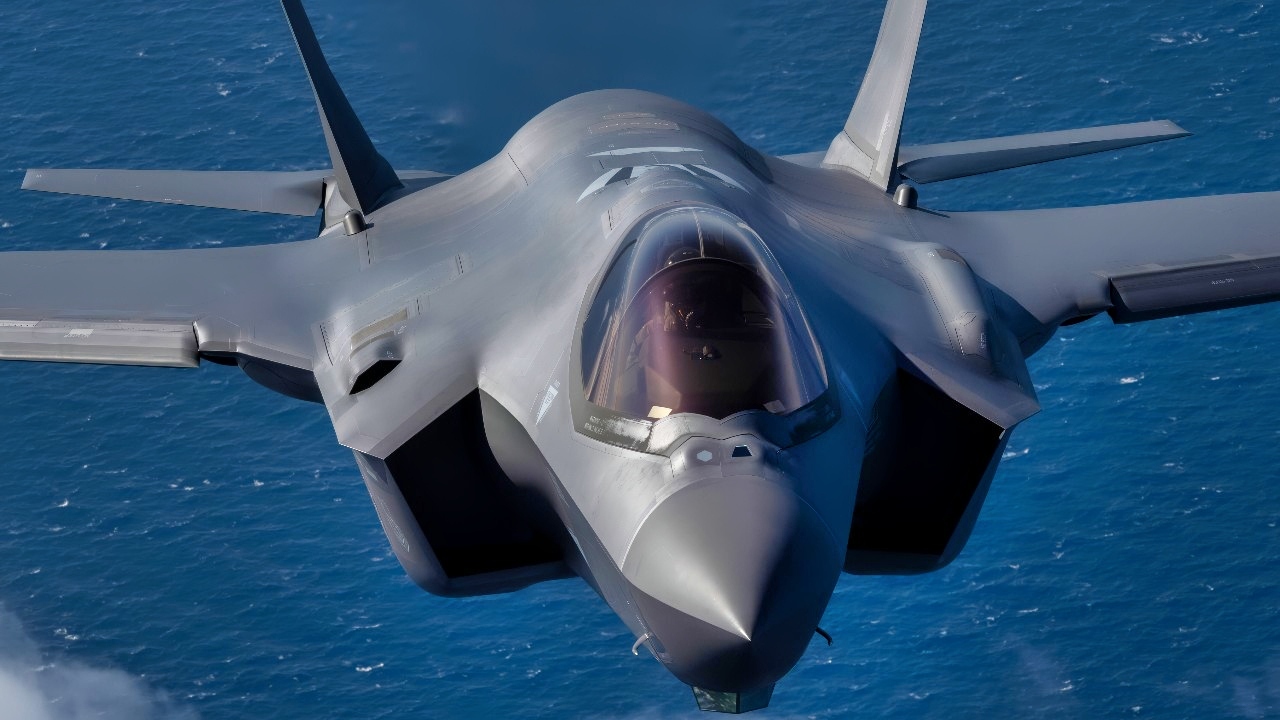
Kielce, Poland: This week’s mystery is learning just what is happening with European nations and why some are re-thinking their decisions to procure the US-made F-35 fighter. Poland, a Central European NATO member that has been on a rearmament spree for years, is one of the latest to possibly rethink the procurement of the F-35, at least if you look at some of the publicly available information on what is happening within the program here in Poland.
Poland and the F-35
This was not something most experts would have predicted. The stealthy American fighter was first signed for by the Polish Government more than five years ago, and there has been a steady buildup of contracts for support services to be implemented once the aircraft are actually delivered. But on the eve of Poland’s annual Międzynarodowy Salon Przemysłu Obronnego (International Defence Industry Exhibition or MSPO), speculation is growing based on what was said both before and during the expo.
Two days before this annual event, now the second-largest defense expo in Europe, a Polish defense publication reiterated what other news outlets have been reporting recently. Namely, that European nations that have already either committed to or were contemplating a purchase of the aircraft are having second thoughts.
The article begins with a discussion of the Spanish Ministry of Defense’s (MoD) decision to abandon its original plans to purchase the 5th-generation single-engine jet. “Poland’s Ally Abandons the F-35. Deemed ‘Incompatible’”, begins the article as it discusses how the MoD has indefinitely postponed the purchase of the F-35.
In the case of Spain, the F-35 was deemed incompatible with the country’s military spending plans. Uncertainty about long-term US plans for supporting its allies, the long-time NATO member, has now prioritized the acquisition of European-made products.
For Spain’s air force, this has meant the Eurofighter and the German-French-Spanish program to develop a new 6th-generation fighter, European Future Combat Air System (FCAS).
Second Thoughts About F-35 Throughout Europe
In recent years, Spain has signed two contracts for the delivery of a total of 45 Eurofighters, which will replace the F/A-18C/D Hornet fighters. The country is also participating in the FCAS program, which could enable it to be part of a 6th-generation fighter development.
This program is regarded as pivotal for the Spanish aerospace industry. Spain’s problem appears to be the same as that of other nations—namely, that the purchase of the F-35 consumes so many resources that other programs are short-changed in the process.
Spain’s decision to proceed with the F-35 would result in cuts to funding for the FCAS, thereby limiting its role in the program. There are also concerns about how Washington could restrict Spain’s operation of its F-35s.
The US can withhold or downgrade upgrades for the aircraft, mostly software updates. Washington can also cut off the delivery of spare parts and other components that must be replaced after a certain number of flight hours or calendar months.
Poland’s Possible Concerns on the F-35
The current dilemma in Poland is that, although an agreement is in place to procure 32 of the aircraft, the procurement process has been put on hold until Warsaw’s military planners develop a new long-term plan for the nation’s airpower requirements. No one can say when these internal deliberations will be concluded.
Poland’s current fighter force consists of 48 F-16s purchased in the early 2000s and delivered between 2006 and 2008, as well as 12 of the 36 ordered Korean Aerospace Industry (KAI) FA-50GF (gap-filler) fighters. These will be followed by 36 FA-50PL models fitted with the Raytheon Phantom Strike radar set. Then, that entire force was to have been supplemented by 32 F-35A model aircraft, which were signed for in January 2020.
What An Expert Told National Security Journal
The process of acquiring those F-35 jets is being delayed as Poland’s armed forces undergo a rethink of their long-time airpower plans. Airpower experts in Poland point out that the F-35 is the new major US export aircraft, but it is not what many would consider an air superiority aircraft.

A U.S. Air Force F-35A Lightning II assigned to the F-35A Lightning II Demonstration Team performs a tactical pitch maneuver during a rehearsal flight over Hill Air Force Base, Utah, Jan. 11, 2023. The F-35 Demo Team performs rehearsal flights regularly to maintain flying certifications and to uphold and maintain their mission and Air Force recruiting standards. (U.S. Air Force photo by Staff Sgt. Kaitlyn Ergish)
“What the Polish forces are struggling with,” said a defense consultant at the MSPO expo, is whether the 32 F-35s will be just this ‘silver bullet’ force for specialized missions or if they will then be backed up by another buy of 32 additional jets—making them the largest component within the air force. We have some other options like the Boeing F-15EX or even the Eurofighter. A lot depends on how—with Russia threatening us and the Baltics—is which aircraft is most needed for that kind of a war.”
About the Author: Reuben F. Johnson
Reuben F. Johnson has thirty-six years of experience analyzing and reporting on foreign weapons systems, defense technologies, and international arms export policy. Johnson is the Director of Research at the Casimir Pulaski Foundation. He is also a survivor of the Russian invasion of Ukraine in February 2022. He worked for years in the American defense industry as a foreign technology analyst and later as a consultant for the U.S. Department of Defense, the Departments of the Navy and Air Force, and the governments of the United Kingdom and Australia. In 2022-2023, he won two awards in a row for his defense reporting. He holds a bachelor’s degree from DePauw University and a master’s degree from Miami University in Ohio, specializing in Soviet and Russian studies. He lives in Warsaw.
More Military
The M1 Abrams Has A Message for the U.S. Army
The F-15EX Eagle II Is No Fighter – Try Missile Truck
The U.S. Navy Has a ‘Battleship’ Problem: Enter the Zumwalt-Class


