


Key Points and Summary – The F-35 Lightning II’s most remarkable attribute is not its stealth but its revolutionary suite of integrated sensors.
-The jet functions as a powerful “informational node,” fusing data from its advanced AESA radar, Electro-Optical Targeting System (EOTS), and 360-degree Distributed Aperture System (DAS).

An F-35 Lightning II from the 115th Fighter Wing flies alongside a KC-135 Stratotanker with the 121st Air Refueling Wing after being refueled over the skies of Wisconsin, March 20, 2024. The F-35 II’s aerodynamic performance and advanced integrated avionics will provide next-generation stealth, enhanced situational awareness, and reduced vulnerability for the United States and allied nations. (U.S. Air National Guard photo by Senior Airman Ivy Thomas)
-This technology collates a vast amount of battlespace information into a single, unified picture for the pilot, lightening their workload and transforming them into a “battlespace manager.”
-This allows the F-35 to share critical data with other assets, making the entire force more lethal and aware.
The F-35 Is Far More Than Just a Stealth Fighter
The F-35 is the world’s most advanced stealth fighter in widespread service today.
Highly stealthy and highly capable, the F-35 is a technological wonder. But some of the F-35’s most remarkable attributes are not immediately visible.
The fighter jet is, in essence, built around a suite of sensors, designed to collate and present a great deal of information for the pilot. This informational fusion strategy also enables each and every individual F-35 to be more than just a stealth jet—far from it.
Instead, the fighter was explicitly designed from the outset to act as an informational node capable of pulling in data from multiple sources—including assets on the ground and in the air—both for the benefit of the pilot as well as other points along the informational pipeline.
There is a broad suite of sensors that enables the F-35’s informational fusion. One of these is the F-35’s Electro-Optical Targeting System, or EOTS for short.

An F-35A Lightning II, flown by Maj. Kristin “Beo” Wolfe, F-35 A Lightning II Demonstration Team commander, performs aerial displays during the Joint Base Andrews 2022 Air & Space Expo, at JBA, Md., Sept. 18, 2022. Wolfe demonstrated several difficult maneuvers throughout her performance at the Air & Space Expo to provide an opportunity for people to see U.S. military air capabilities in action. (U.S. Air Force photo by Airman 1st Class Ben Cash)
“The Electro-Optical Targeting System (EOTS) for the F-35 Lightning II is an affordable, high-performance, lightweight, multifunction system that provides precision air-to-air and air-to-surface targeting capability,” Lockheed Martin, one of the primary contractors for the F-35, explains.
The sensor is essentially a faceted sensor located on the fighter’s chin, which combines forward-looking infrared (FLIR) technology with infrared search and track capabilities, a laser rangefinder, and a target designator. It enables precision targeting for both laser-guided and GPS-guided munitions, both during the day and at night.
The aerospace firm adds that the “low-drag, stealthy EOTS is integrated into the F-35 Lightning II’s fuselage with a durable sapphire window and is linked to the aircraft’s integrated central computer through a high-speed fiber-optic interface.”
“As the first sensor to combine forward-looking infrared and infrared search and track functionality, EOTS enhances F-35 pilots’ situational awareness and allows aircrews to identify areas of interest, perform reconnaissance and precisely deliver laser and GPS-guided weapons. Lockheed Martin has delivered more than 850 systems for the F-35 Lightning II.”
But the EOTS is not the end-all, be-all in the F-35’s sensor suite. Something even more advanced and capable is in the works: What Lockheed Martin calls Advanced EOTS.
“Advanced EOTS, an evolutionary electro-optical targeting system, is available for the F-35’s Block 4 development. Designed to replace EOTS, Advanced EOTS incorporates a wide range of enhancements and upgrades, including short-wave infrared, high-definition television, an infrared marker and improved image detector resolution. These enhancements increase F-35 pilots’ recognition and detection ranges, enabling greater overall targeting performance.”
Radar is an absolutely essential component to any fighter platform, and the F-35’s radar is among the best electronically scanned array radar for a fifth-generation fighter. In the F-35’s case, its radar is built by Northrop Grumman and provides air-to-air and air-to-ground search and track at long ranges. It’s a high-resolution synthetic aperture radar, which also enables high-detail mapping and can electronically jam other radars.
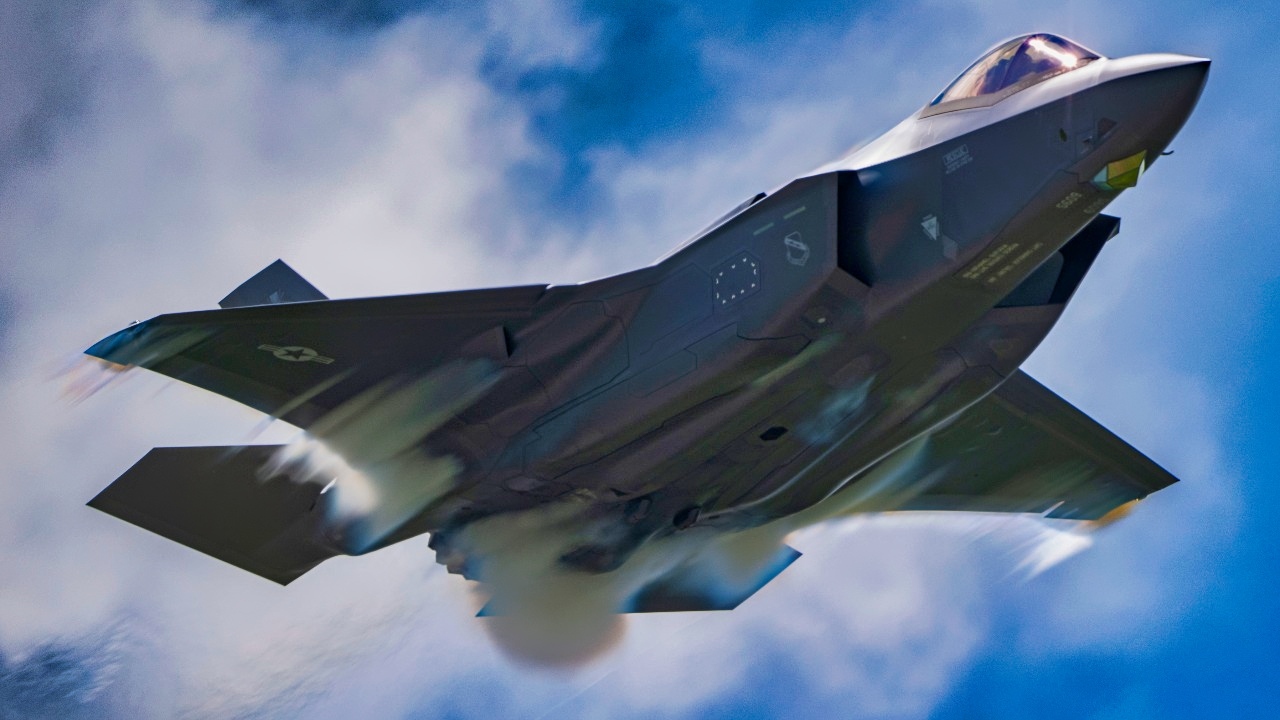
A U.S. Air Force F-35A Lightning II assigned to the F-35A Lightning II Demonstration Team performs at the Westmoreland County Airshow in Latrobe, Pennsylvania, August 18, 2024. The F-35A is an agile, versatile, high-performance, 9g capable multirole fighter that combines stealth, sensor fusion and unprecedented situational awareness. (U.S. Air Force photo by Staff Sgt. Zachary Rufus)
One of the F-35’s significant advantages over other aircraft is its enhanced situational awareness capabilities. Historically, a pilot’s main field of view has been forward through the aircraft’s cockpit glass. This fighter, however, has half a dozen infrared cameras mounted around the airframe that provide 360-degree coverage.
While that is of obvious utility for pilots to see other jets while airborne, that is not all the F-35’s Distributed Aperture System is capable of. The DAS can act as night vision goggles, giving the jet a view of its surroundings even at night. But thanks to the F-35 pilot’s Helmet-Mounted Display System, pilots can, in essence, look through their own airframe at their surroundings.
The F-35’s communications, navigation, and Identification, or CNI suite, is amongst the most advanced in the world. The jet’s Multifunction Advanced Data Link, or MADL, gives the F-35 the ability to disperse large amounts of data around the battle space without compromising its ability to be detected. It is also compatible with Link 16, one of NATO’s communication standards.
The Bottomline
The F-35 combines all of these into a single, tactical picture for the pilot, merging infrared, radar, electronic warfare, and other data into a unified, comprehensive view.

F-35 Fighter. Image Credit: Creative Commons.
Thanks to the clarity of the battle space, pilots are both fighter pilots and battle space managers, capable of taking a close look at the threats in their near environment for the benefit of other aircraft connected to their informational gathering capabilities.
About the Author: Caleb Larson
Caleb Larson is an American multiformat journalist based in Berlin, Germany. His work covers the intersection of conflict and society, focusing on American foreign policy and European security. He has reported from Germany, Russia, and the United States. Most recently, he covered the war in Ukraine, reporting extensively on the war’s shifting battle lines from Donbas and writing on the war’s civilian and humanitarian toll. Previously, he worked as a Defense Reporter for POLITICO Europe. You can follow his latest work on X.
More Military
The B-21 Raider Bomber Nightmare
Russia’s Su-34 Fullback Is a Punisher Bomber


Lkk
August 30, 2025 at 12:14 pm
F-35 stealth goes out the window if it launches a missile. So being a stealth sensor becomes really valuable if another platform in the rear can use the F-35’s sensor data to do the missile launch via datalink and then hand over control of the missile to the F-35 or even another platform with eyes on the target to do the mid course guidance necessary before the terminal phase.