


The F-35 Lightning II is best known for stealth, internal weapons storage, and sensor fusion. It also has a Beast Mode. In stealth configuration, the F-35 is limited to 5,700 pounds of internally stored weapons. In Beast Mode, the jet can carry up to 22,000 pounds — a roughly 400 percent increase. A typical Beast Mode loadout includes four external 2,000-pound GBU-31 JDAMs and two AIM-9X Sidewinders, plus two more JDAMs and two AIM-120 AMRAAMs held internally. Empty, the F-35 weighs 29,000 pounds. Fully loaded in Beast Mode, it weighs about 70,000. The Stores Management System rebalances the aircraft automatically as weapons drop.
The F-35 Stealth Fighter Now Comes in Beast Mode
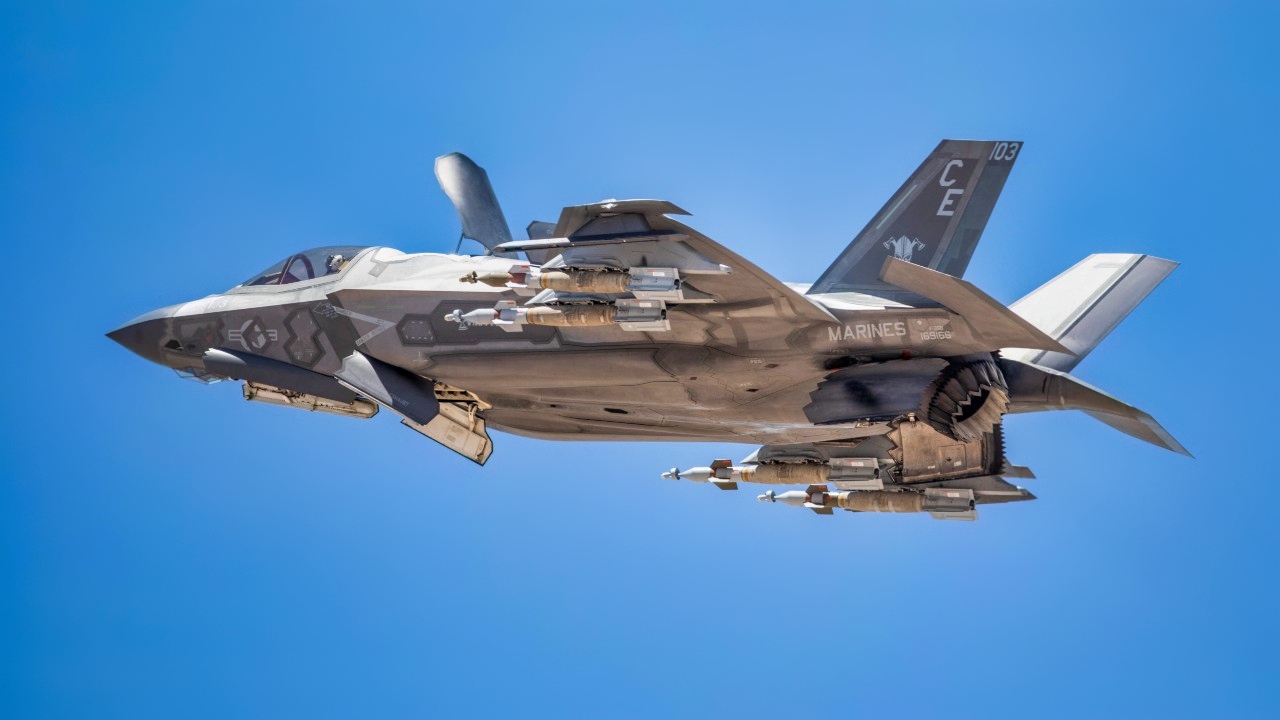
F-35 Beast Mode. Image Credit: Creative Commons.
The F-35 Lightning II is typically associated with stealth, internal weapons storage, and sensor fusion. But the F-35 also has a “beast mode,” in which the stealth fighter can be configured for non-stealth strike operations.
In concept, beast mode allows the F-35 to intentionally abandon its low observable profile in exchange for a dramatically larger weapons load.
In stealth mode, the F-35 is limited to just 5,700 pounds of internally stored weapons. But in beast mode, the jet can carry as much as 22,000 pounds—an almost 400 percent increase—and an indication of how adaptable the F-35 can be.
Day One vs. Day Ten
Different functions are needed for different stages of a conflict. Normally, different aircraft are used to perform those different functions.
But in the case of the F-35, the platform’s adaptability allows for use across different functions and stages of a conflict.
On day one of a conflict, for example, enemy SAMs are still active, integrated air defense systems are intact, and radar networks are operational.
Under such conditions, the F-35 is a valuable stealth platform, flying “clean” with weapons held internally, charged with destroying radars, command centers, and air defenses.
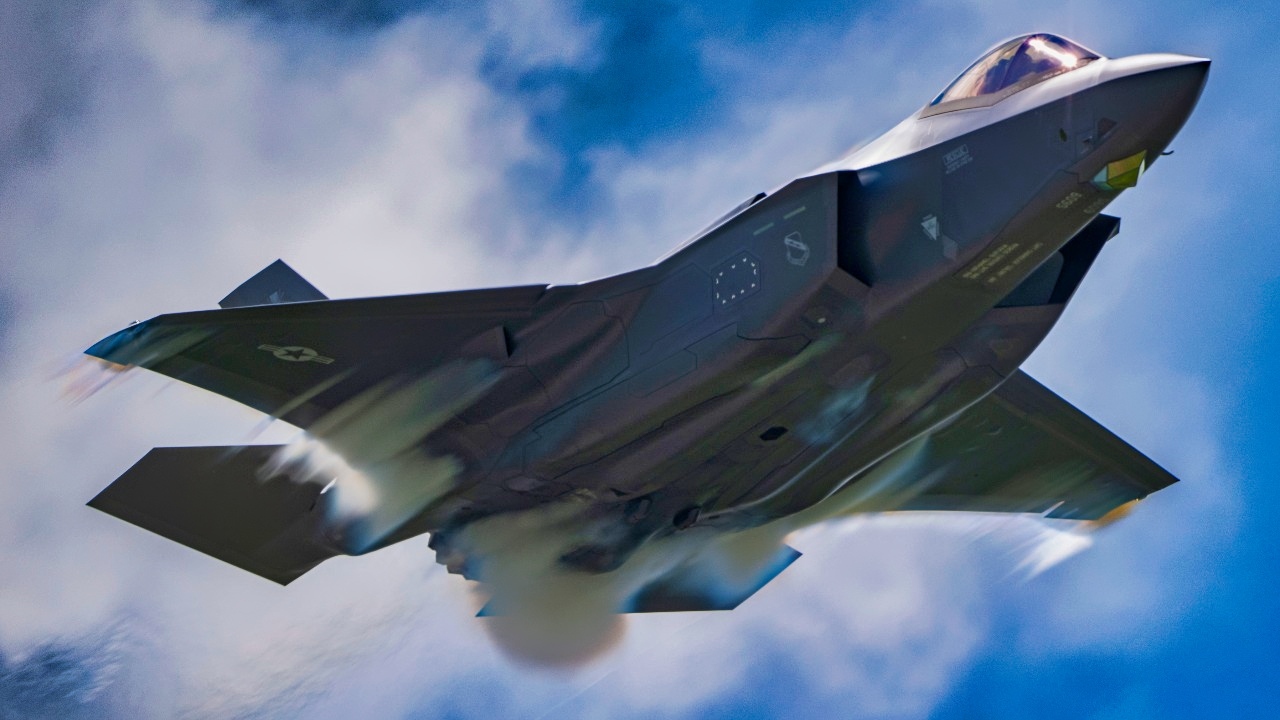
A U.S. Air Force F-35A Lightning II assigned to the F-35A Lightning II Demonstration Team performs at the Westmoreland County Airshow in Latrobe, Pennsylvania, August 18, 2024. The F-35A is an agile, versatile, high-performance, 9g capable multirole fighter that combines stealth, sensor fusion and unprecedented situational awareness. (U.S. Air Force photo by Staff Sgt. Zachary Rufus)

Tyndall Air Force Base’s latest U.S. Air Force F-35A Lightning II sits on the flight line at Tyndall Air Force Base, Florida, Aug. 16, 2024. Tyndall received its newest aircraft on Aug. 12, 2024. The F-35A showcases advanced technology and interoperability for collaborative defense operations. (U.S. Air Force photo by Airman 1st Class Victoria Moehlman)

U.S. Air Force Maj. Kristin “BEO” Wolfe, F-35A Lightning II Demonstration Team commander, flies over Kennewick, Washington, during the Tri-Cities Water Follies Airshow Over the River, July 30, 2023. The F-35 Demonstration Team participated in the 2023 Tri-Cities Water Follies airshow and various other events in support of their mission to recruit, retain and inspire new and old generations of Airmen. (U.S. Air Force photo by Staff Sgt. Kaitlyn Ergish)

A U.S. Air Force F-35A Lightning II aircraft with the Wisconsin Air National Guard’s 115th Fighter Wing ascends into the clouds during exercise Northern Lightning Aug. 9, 2024, at Volk Field. Wisconsin. The F-35 works in parallel with 4th generation fighters, demonstrating the strength of combined airpower in the face of strategic competition. (U.S. Air National Guard photo by Staff Sgt. Constantine Bambakidis)
But oftentimes, by day ten, circumstances change—at least in the US’s recent conflicts. Enemy air defenses are degraded, and air superiority is established. Stealth becomes less critical. So, the mission shifts to suppressing remaining forces, attacking infrastructure, and striking ground targets at scale.
This is when the F-35 can appropriately convert from stealth mode to beast mode.
What is Beast Mode
Beast mode is a heavy strike configuration.
Typically, in beast mode, the F-35 will carry external stations with four 2,000-lb GBU-31 JDAMs and two AIM-9X Sidewinders, along with two additional 2,000-lb JDAMs and two AIM-120 AMRAAMs held internally.
In total, that’s 14,000 pounds of bombs and four air-to-air missiles—almost four times the payload capacity of stealth mode.
In beast mode, the F-35 begins to resemble something more like an F-15E-style strike truck rather than a stealth penetrator.
Beast mode does place engineering stress on the F-35, causing problems that must be addressed.
The empty F-35 weighs 29,000 pounds, but a max-loaded beast mode F-35 weighs about 70,000 pounds.
Naturally, this has the potential to stress the wings; heavy bombs create enormous upward-bending loads, especially during high-G maneuvers.
The solution is forged titanium bulkheads that spread structural loads through the center fuselage.
And the external pylons are not simple ordnance racks. Rather, the pylons include data buses, hydraulic connectors, and power connections.
In all, beast mode requires significant structural engineering; it’s not as simple as hanging bombs under the wings.
Balancing Act
Beast mode forces the F-35 to constantly rebalance itself. The Stores Management System (SMS) is a dedicated onboard subsystem that addresses rebalancing.
The problem, specifically, is that bombs change drag, center of gravity, and aerodynamic behavior. And as bombs are dropped, these performance factors constantly change. The SMS continuously calculates drag changes and adjusts control surfaces accordingly while also managing fuel movement.
For example, if the F-35 drops a 2,000-lb bomb from only the left side, the aircraft is suddenly heavily unbalanced.
The SMS shifts fuel automatically to compensate and applies flight-control corrections instantly.
The result is that the pilot does not have to manually compensate for the significant changes; the software does much of the work automatically.
Reduced Sensor Fusion
The F-35 is renowned for its sensor fusion.
But in beast mode, the giant externally stored bombs physically block sensors, causing sensor occlusion.
The EOTS view becomes partially obstructed, and defensive cameras are affected. But the F-35’s sensor fusion system compensates automatically, merging the AN/APG-81 AESA radar, DAS camera, and EOTS input.
The result is that the aircraft’s computer attempts to create uninterrupted situational awareness despite the external clutter.
Strategic Implications
The benefit of beast mode is that it allows the F-35 to fill two roles: stealth penetrator and heavy strike aircraft.
On day one in a Pacific scenario, for example, the F-35 could help clear Chinese IADS. And in later phases, the same F-35 could be converted into a mass-strike platform.
This supports a broader trend toward fewer specialized aircraft, enabling the US to achieve greater operational flexibility.
About the Author: Harrison Kass
Harrison Kass is a writer and attorney focused on national security, technology, and political culture. His work has appeared in City Journal, The Hill, Quillette, The Spectator, and The Cipher Brief. He holds a JD from the University of Oregon and a master’s in Global & Joint Program Studies from NYU. More at harrisonkass.com.


