


Key Points and Summary on the F-35 and Range Issues – The US Air Force is moving to equip its F-35A stealth fighters with external fuel tanks, a major upgrade under the Block 4 modernization program designed to extend the jet’s combat range significantly.
-Range issues have always been a significant problem for the F-35, and this tries to address that.
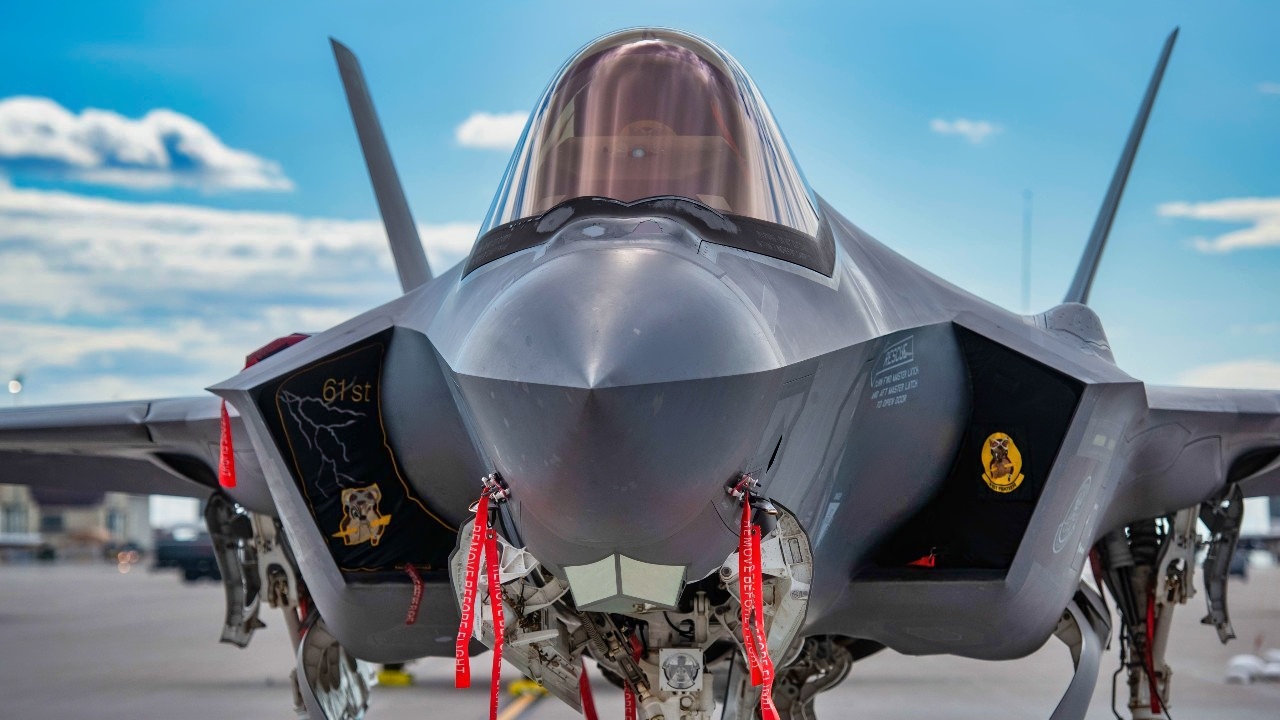
A U.S. Air Force F-35A Lightning II prepares for takeoff at Mountain Home Air Force Base, Idaho, September 22, 2022. The F-35 squadron from Luke Air Force Base, AZ used Mountain Home AFB for the terrain and airspace in order to practice simulated combat scenarios. (U.S. Air Force photo by Senior Airman Cheyenne Bassham)
-This decision was heavily influenced by the Israeli Air Force’s successful use of its modified F-35I “Adir” jets, which reportedly used external tanks to strike targets deep inside Iran without aerial refueling.
-The upgrade, which will sacrifice some stealth capability that can be restored by jettisoning the tanks, is seen as crucial for potential long-range conflicts in the Indo-Pacific theater against adversaries like China.
USAF Giving Its F-35s Longer Range With External Tanks
The US Air Force’s F-35 is undergoing upgrades to increase its combat range, primarily through the integration of external fuel tanks.
This initiative is part of the ongoing Block 4 modernization effort and is a direct response to the success of the Israeli Air Force in extending the range of their F-35I variant.
The US wants to increase the range of its F-35 and F-22 stealth aircraft, especially if the US and China go to war, given the increased distances in the Indo-Pacific.
Stealthy External Fuel Tanks? F-35I Adir Has Set The Stage
Conformal fuel tanks hug the fuselage of a fighter, which produces less drag and is designed to have less negative impact on the fighter’s stealth. Israel’s airstrikes against Iran last month reportedly had the F-35I Adir fighters flying to Iran and back without needing in-flight refueling.
Israel’s F-35Is flew over Turkey, Jordan, Syria, and Iraq without being detected, the Jewish News Syndicate reported.
During some of the 1,500 sorties that F-35I aircraft flew over Iran, they utilized two types of fuel tanks: a 425-gallon external fuel tank made by Israel’s Elbit Systems, which is suspended under the wings and dropped before entering Iranian territory; and an 800-gallon conformal tank, developed in collaboration with Israel Aerospace Industries and Lockheed Martin.

U.S. Air Force Maj. Melanie “Mach” Kluesner, pilot of the F-35A Demonstration Team, performs aerial maneuvers at the Sun ‘n Fun Airshow in Lakeland, Florida, April 4, 2025. The demonstration team showcases the skill and precision U.S. Air Force pilots and aircraft are capable of. (U.S. Air Force photo by Senior Airman Nicholas Rupiper)
The Israeli Air Force’s F-35I, known as “Adir”, has already demonstrated the effectiveness of external fuel tanks and conformal fuel tanks in extending the aircraft’s range. Their experience in successfully striking targets in Iran, without (in some cases) needing aerial refueling, highlighted the potential of this upgrade for the broader F-35 fleet.
Incorporating External Fuel Tanks
The US Air Force is actively exploring the integration of external fuel tanks on the F-35A to extend its combat radius significantly. This would allow for longer-range missions without relying on tanker support, enhancing operational flexibility and survivability.
Alex Hollings from Air Power and Sandboxx wrote, “The F-35A can carry 18,498 pounds of fuel internally, which gives it an already respectable combat radius of some 670 nautical miles. The addition of two 600-gallon stealthy drop tanks would provide approximately another 8,000 pounds of fuel to the F-35A and stretch its combat radius out to more than 1,100 miles with a combat load.”
The increased range capabilities are seen as crucial for addressing current and future operational needs, particularly in scenarios where aerial refueling is not feasible or desirable.
F-35 Block 4 Modernization
The F-35 Block 4 upgrade is a significant modernization program for all three F-35 variants, focusing on a new radar, enhancing its sensors, expanding weapons capacity, and improving electronic warfare systems.
Block 4 is “really going to be about enhancing the sensor upgrades, the sensor fusion, and also bringing the new weapons” to the jet, Chauncy McIntosh, Vice President and general manager of the F-35 program, said.

An F-35A Lightning II, flown by Maj. Kristin “Beo” Wolfe, F-35 A Lightning II Demonstration Team commander, performs aerial displays during the Joint Base Andrews 2022 Air & Space Expo, at JBA, Md., Sept. 18, 2022. Wolfe demonstrated several difficult maneuvers throughout her performance at the Air & Space Expo to provide an opportunity for people to see U.S. military air capabilities in action. (U.S. Air Force photo by Airman 1st Class Ben Cash)
During an interview with Air & Space Forces Magazine, McIntosh said the threat is driving recurrent revisions to the top priorities for Block 4 and later (Block 5) upgrades.
“We have to continue to advance this airplane regarding where that threat is going,” he said. “And so we’ve laid out a plan and a strategy for Block 4, and what we need to do to ensure we stay ahead of that threat.”
This involves over 75 new programs and is considered the most significant evolution of F-35 capabilities to date, according to National Defense Magazine.
The integration of external fuel tanks is part of the Block 4 upgrade package.
Tech Refresh-3 (TR-3), which enables Block 4, introduces open mission systems architecture, a new integrated core processor with greater computing power, an enhanced panoramic cockpit display, a larger memory unit, and other classified capabilities.

Royal Netherlands Air Force F-35 Lighting II fighters fly in formation with Polish Air Force MiG-29 Fulcrums during a training sortie over Poland on 21 March 2023.
Increased Cost Considerations
The Fiscal Year 2026 US defense budget proposes to slash purchases of new F-35s in part to provide more funding for the Block 4 effort, as well as to help sustain existing Joint Strike Fighter fleets.
Despite this, F-35 production, which was 110 aircraft for the US and our allies in 2024, is expected to rise between 175 and 190 aircraft in 2025. Our allies are sure to be keeping a sharp eye on the external fuel tank development.
While the F-35 program has faced cost increases, the need for enhanced range and operational flexibility outweighs these concerns. The potential benefits of increased range and survivability justify the investment in these upgrades.
MORE – A 7th Generation Fighter Is Coming
Future Implications For the F-35
The F-35’s enhanced range will likely play a significant role in future air combat scenarios, allowing for more effective power projection and a wider operational envelope.
If these external conformal fuel tanks are stealthy enough, as the ones co-produced by the Israelis and Lockheed, then the F-35s just got a much longer range, which will increase their overall effectiveness without requiring more refueling tankers.
About the Author:
Steve Balestrieri is a National Security Columnist. He served as a US Army Special Forces NCO and Warrant Officer. In addition to writing on defense, he covers the NFL for PatsFans.com and is a member of the Pro Football Writers of America (PFWA). His work was regularly featured in many military publications.
More Military
The U.S. Navy’s Submarine Crisis Is Real


NOYB
July 16, 2025 at 8:37 am
So, you’re taking a jet which is already at .5 or less T/Wr and 100-110psf wing loading with a known drag deficit on acceleration and you’re dirtying it up with external carriage.
These aren’t 108 gallon paper tanks. You aren’t going to be dropping them to go Invisible Man because a pair likely costs north of 2 million dollars, even if there isn’t a visible scarring of the hardpoint interface with the lower wing skin.
You just won’t have enough of them to make a 1,000 sortie air war work.
While, by accepting a 20% hit on signature, _without increasing weapons carriage_ you all but guarantee that the F-35’s other big problem: being an F-5A in an 40N6/R-37M world isn’t going to matter.
Except it will there goober. Not least because the kinematic penalty of more weight and drag will lower the cruise height to the heart of the conbands around 25-27,000ft.
So if you are worried about J-20s and J-36s clipping you in the transit, behind a tanker, don’t think that simply wimping along in the C172 ceiiling is going to help.
If nothing else, it’s 1,500nm from Andersen to Taipei and 1,700nm from Andersen to Pyongyang.
Pingback: Su-75 Checkmate Will Never Be a Cheap F-35 Stealth Fighter - National Security Journal