

Summary and Three Key Points: On March 28, 2026, the 13th Fighter Squadron’s F-35A Lightning II aircraft arrived at Misawa Air Base in northern Japan, marking the squadron’s transition to fifth-generation airpower and the permanent stationing of the U.S. Joint Force’s most advanced tactical aircraft in northern Japan — a forward-positioning move explicitly intended to reduce the distance F-35s must transit in a Pacific contingency.
The problem the Air Force is trying to solve: the F-35A’s combat radius on internal fuel is approximately 590 to 670 nautical miles, while the distance from northern Japan to the Taiwan Strait is roughly 1,200 miles, meaning the most advanced tactical aircraft in U.S. service cannot reach the Pacific’s most likely flashpoint without aerial refueling.
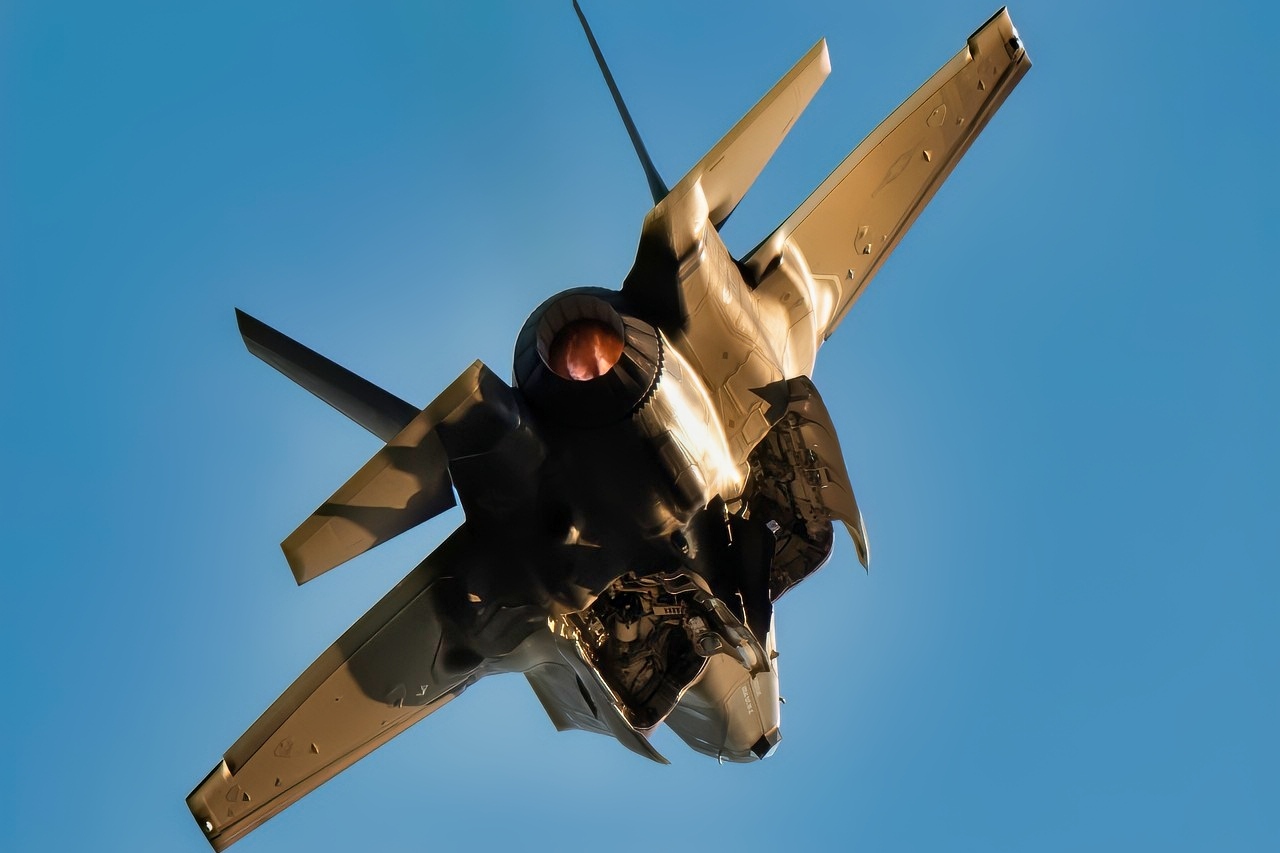
U.S. Air Force Major Kristin “BEO” Wolfe, F-35A Lightning ll Demonstration Team pilot and commander, flies during sunset over Mathers Airport, Calif., Sept. 24th, 2021, at the California Capital Airshow. The team consists of approximately 15 total Airmen to include the pilot and commander, pilot safety officers, superintendent, team chief, maintenance Airmen, aircrew flight equipment specialists, and public affairs personnel. (U.S. Air Force photo by Staff Sgt. Thomas Barley)
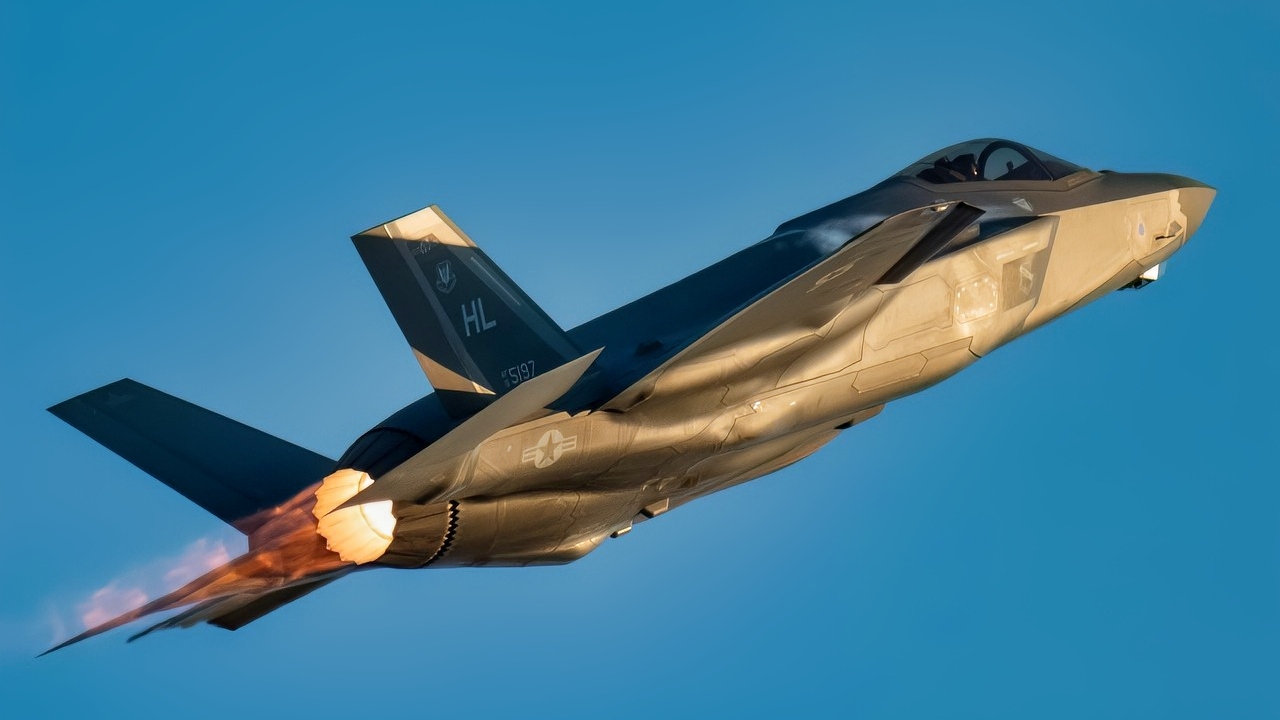
U.S. Air Force Major Kristin “BEO” Wolfe, F-35A Lightning ll Demonstration Team pilot and commander, flies during sunset over Mathers Airport, Calif., Sept. 24th, 2021, at the California Capital Airshow. The team consists of approximately 15 total Airmen to include the pilot and commander, pilot safety officers, superintendent, team chief, maintenance Airmen, aircrew flight equipment specialists, and public affairs personnel. (U.S. Air Force photo by Staff Sgt. Thomas Barley)
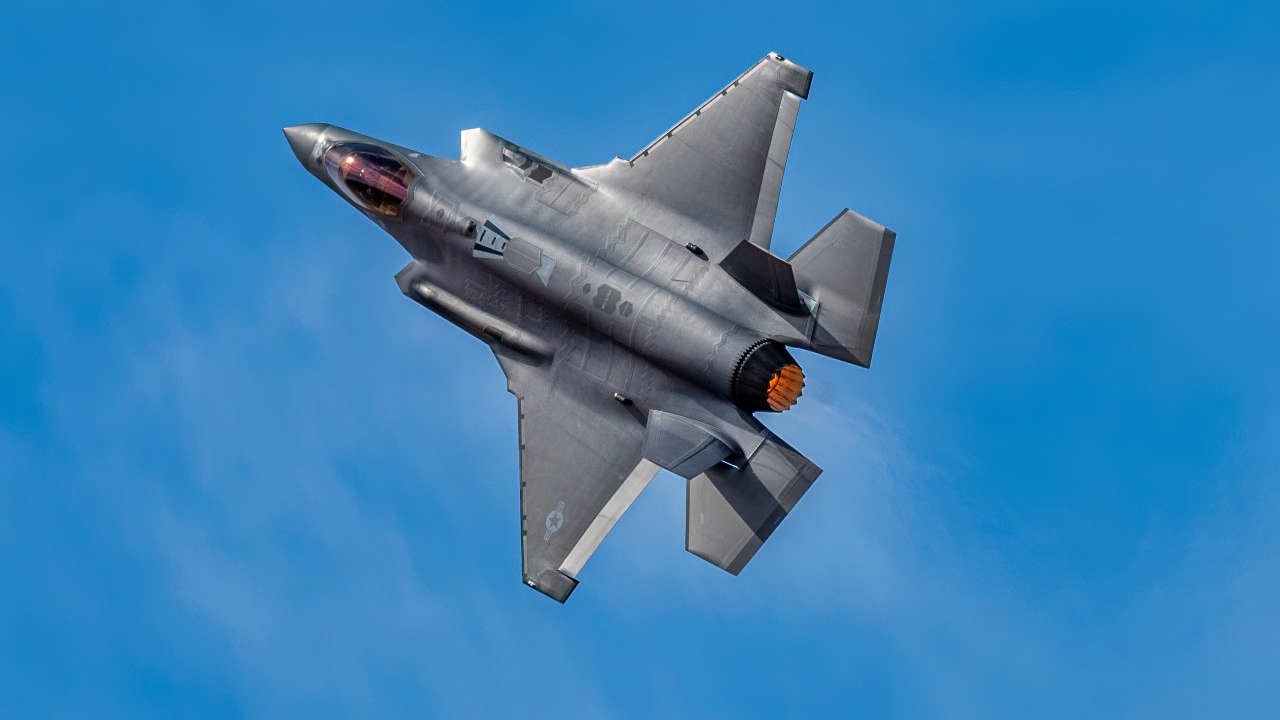
A U.S. Air Force F-35A Lightning II aircraft flies during the Heritage Flight Training Course at Davis-Monthan Air Force Base, Arizona, Feb. 28, 2025. The F-35 is designed to provide the pilot with unsurpassed situational awareness, positive target identification and precision strike in all weather conditions. (U.S. Air Force photo by Senior Airman Jasmyne Bridgers-Matos)
The Pentagon’s FY27 budget request now revisits external fuel tank concepts that were originally rejected to preserve the F-35’s stealth signature, continues funding KC-46 tanker procurement, develops Collaborative Combat Aircraft (CCAs) to push sensors and weapons further forward, and accelerates the F-47 NGAD program with range as a core design requirement.
The F-35 Fighter Has a Range Issue. China Knows All About
In late March 2026, the U.S. Air Force confirmed that additional F-35A Lightning II aircraft had arrived at Misawa Air Base, expanding the fifth-generation footprint in northern Japan. The deployment appeared to be a fairly simple reinforcement of regional combat capability, with Pacific Air Forces (PACAF) stating that the aircraft would enhance deterrence and operational readiness in the Indo-Pacific.
“F-35A Lightning II aircraft assigned to the 13th Fighter Squadron arrived at Misawa Air Base, Japan, March 28, 2026, marking the beginning of the squadron’s transition to fifth-generation airpower and the permanent stationing of the Joint Force’s most advanced tactical aircraft in Northern Japan,” an official statement explained.
Misawa already hosts U.S. and Japanese forces and sits within reach of key operating areas across the Western Pacific. Positioning F-35s there reduces the distance required to reach potential contingencies in the East China Sea or beyond. Distance in this part of the world is one of the most persistent operational constraints, with the Indo-Pacific defined by long transit routes and limited basing options, both of which heighten the missile threat.
The recently-released Fiscal Year 2027 budget request from the Pentagon also continues to fund continued F-35 procurement while investing in tanker aircraft, Collaborative Combat Aircraft (CCA), and early procurement for next-generation systems designed to operate over longer distances.
The Air Force also revisited external fuel tank concepts for the F-35, a capability that was originally dismissed in favor of preserving the aircraft’s low observable profile.
It’s clear that the Air Force and the Pentagon recognize that distance across the Pacific is an obstacle that must be overcome.
That problem shapes where aircraft need to be based and how missions are designed, and with continued advances in Chinese aerospace capabilities, it’s now a focus for current and future U.S. planning.

F-35I Adir. Image Credit: Creative Commons.
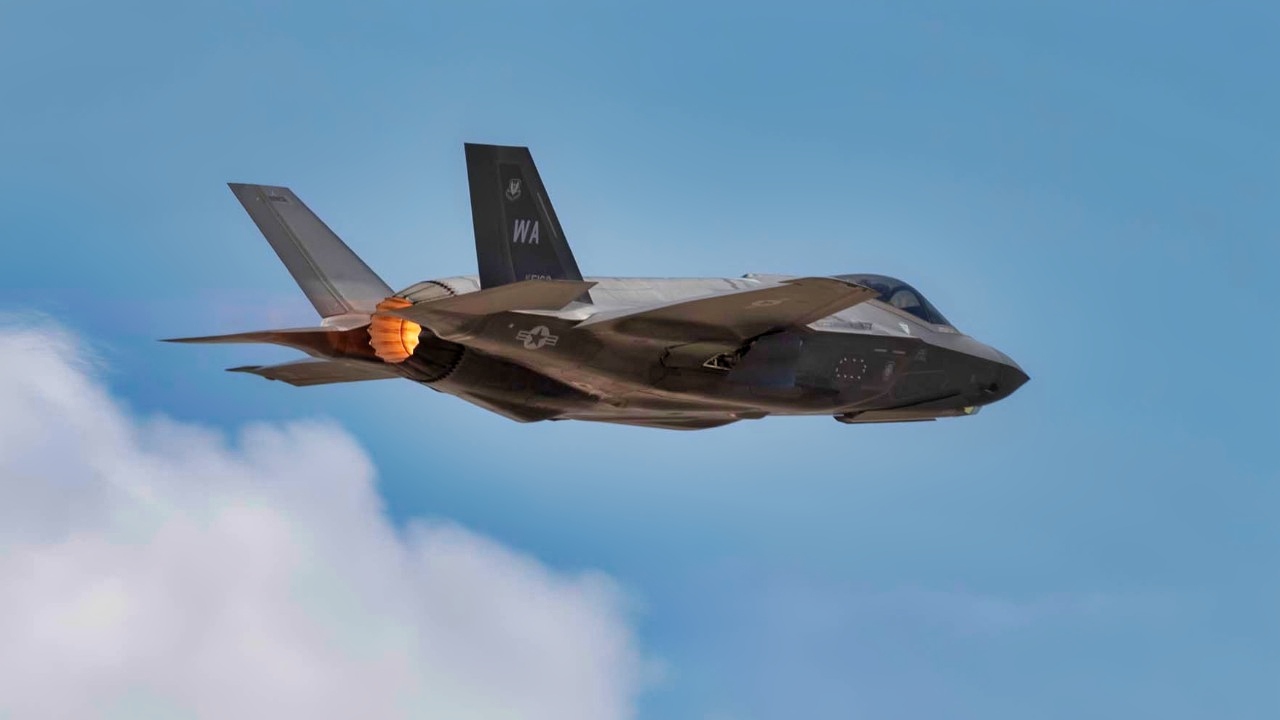
A U.S. Air Force F-35A Lightning II takes off for a mission during U.S. Air Force Weapons School Integration (WSINT) at Nellis Air Force Base, Nevada, June 3, 2025. WSINT serves as the culminating exercise for U.S. Air Force Weapons School students, bringing together air, space, and cyber forces in realistic, mission-critical training scenarios that mirror the complexities of modern warfare. Conducted twice a year, the integration event tests multi-domain operations and strengthens joint force interoperability, enhancing combat readiness across the spectrum of military operations over the Nevada Test and Training Range. (U.S. Air Force photo by William R. Lewis)
Nellis AFB; ACC; Las Vegas; Nellis Air Force Base; contentcollectionweek; readiness; US Air Force Weapons School; WSINT

F-35I Adir. Image Credit: Creative Commons.
What the F-35’s Range Means for the U.S.
The F-35A’s commonly cited combat radius is approximately 590 to 670 nautical miles when operating on internal fuel in a standard configuration. Those figures take into account factors like combat maneuvering and don’t simply refer to a straight-line distance.
In practice, an aircraft’s range is shaped by a number of factors, and it may need to adjust its routing to avoid threats or operate at altitudes and speeds that increase fuel burn. Aircraft may also need to remain on station longer than planned, introducing variables that reduce the effectiveness of each sortie.
In the Indo-Pacific, many variables amplify those constraints. Distances between operating bases and potential target areas are significantly larger than in Europe or the Middle East.
For example, the distance from northern Japan to the Taiwan Strait is roughly 1,200 miles, depending on the route, which pushes tactical aircraft toward the limits of their unfueled operating abilities. And yet, this is a theater in which the United States expects future conflict – and its military hardware needs to keep up.
During a conversation with the Foundation for Defense of Democracies in April 2023, General Kenneth S. Wilsbach, who then served as the Commander of Pacific Air Forces, described pre-positioning of American assets in the region as a solution to the problem.
“One other aspect of the logistics that sometimes people don’t think about is this notion of pre-positioning, and in the 22 budget, the 23 budget, we expect 24 and beyond to have several hundreds of millions, maybe even more of money to purchase items that we are pre-positioning,” Wilsbach said. “We’ve already started this purchase and are deploying some of this equipment, but it relieves you of some of the risk of logistics under attack if you have stuff at the islands you intend to fly from already. Things like food and water, and fuel and weapons, and things like that will already be there.”
The problem is very real, and while the F-35 can certainly perform long-range missions, they are planned with additional layers of support and coordination to ensure success.
Forward Basing Reduces Distance But Changes the Risk
The deployment of F-35s to Misawa is part of an effort to position forces closer to areas where they are likely to operate, thereby reducing transit distance. Forward basing like this allows aircraft to reach targets with less fuel and reduces reliance on target support.
It also increases the number of sorties that can be generated over a given period. This strategy isn’t restricted to Japan, of course; the Air Force has been developing the Agile Combat Employment (ACE) concept for some time, which involves dispersing aircraft across multiple locations rather than concentrating them at a few large bases.
In 2022, the Air Force announced plans to disperse its aircraft across more bases, with Air Force Chief of Staff Gen. CQ Brown Jr. describing efforts as “fundamentally changing the way we generate airpower.” He added that the concept will “complicate adversary planning and provide more options for our joint force and coalition commanders.”
ACE is intended to address both distance and survivability constraints, but forward basing still presents its own constraints. Many of the locations that reduce distance to target are also within range of Chinese ballistic and cruise missile systems. That places air fields, fuel storage, maintenance facilities, and all the assets Wilsbach said are being distributed across the region at risk. Dispersal may mitigate some of that risk, but it also increases logistical complexity.
Tankers Can Extend Reach But Create Dependencies
Aerial refueling is central to the F-35’s extended-range operations. Tanker aircraft, such as the KC-46 and KC-135, enable fighters to fly longer missions, remain on station, and operate from bases that would otherwise be too far from the target area. The continued procurement of KC-46 aircraft reflects the need for them in future planning.
In a Pacific scenario, for example, fighters may rely on multiple refueling events during a single mission. Tankers are positioned at preplanned locations, and mission timing is often tied to those refueling windows. But tankers are large and non-stealthy, making them vulnerable to long-range air-to-air and surface-to-air threats. In a contested environment, they may need to operate further from the fight to reduce risk, which in turn increases the distance the fighter must travel before refueling. See the problem?
The Air Force has acknowledged these dynamics in its planning, recognizing that the distances in the Indo-Pacific increase fuel demand and complicate its delivery to forward aircraft. It means that the F-35’s reach in a Pacific operation is closely tied to tanker availability and survivability. So, what’s the solution?
Addressing Range Through Force Structure
The U.S. response has been to build around the problem. As well as expanding the F-35 fleet, the U.S. is investing in systems designed to extend reach, including Collaborative Combat Aircraft (CCA), which are intended to operate alongside crewed fighters and push sensors and weapons further forward without requiring pilots to fly as far into contested airspace.
At the same time, next-generation platforms like the NGAD fighter are being developed with range and endurance as core requirements, alongside adaptive engines such as the XA100 and XA103 designed to improve fuel efficiency and persistence.
As mentioned, the Air Force has also revisited the use of external fuel tanks for the F-35s.
The F-35 remains central to U.S. airpower, even if its reach in the Indo-Pacific could be a problem – and it will continue to play an important role as support comes in the form of new technology and basing strategies.
About the Author: Jack Buckby
Jack Buckby is a British researcher and analyst specializing in defense and national security, based in New York. His work focuses on military capability, procurement, and strategic competition, producing and editing analysis for policy and defense audiences. He brings extensive editorial experience, with a career output spanning over 1,000 articles at 19FortyFive and National Security Journal, and has previously authored books and papers on extremism and deradicalization.


Jeremy Grant
May 11, 2026 at 8:14 am
If only f35s were based at the nearby futenma and kadena air bases. Oh. They are.
Daniel Levan
May 11, 2026 at 1:39 pm
Also America also has aircraft carriers to launch from obviously with capable defensive measures and the combat radius they give is probably bogus. If China thought they had a chance they would have done it by now. No country on earth has ever had the logistical prowess of the US and certainly not China as they are still a regional power when it comes to air power and Navy. The US Navy outweighs the PLN by almost 2.5 times in tonnage meaning the US operates far larger and bluewater ships and also holds a 5 to 1 fire power advantage on these ships. When it comes to airpower I won’t even bother to explain. What China has built is extremely impressive but the US could stop building ships for the next 20 years and they still wouldn’t match the naval capacity of the US. They count fishing boats with a machine gun as naval assets. The whole China fear mongering scenario was created by US policymakers to increase budget hikes to put money in their back pockets.
Jeff S
May 11, 2026 at 4:44 pm
Does Japan have F35A? The combat range for the B (STVL) is only 450 nautical miles
Mark
May 13, 2026 at 2:41 am
My first thought was … Isn’t that the advantage of having multiple battle groups that include aircraft carriers? Which have been around since the first world war. Surprised the article didn’t make mention