


Key Points and Summary – After the A-12’s cancellation, the Navy considered a carrier-ready F-117N “Seahawk”—a navalized F-117A Nighthawk with stronger gear, more wing, internal weapons, and maritime sensors.
-As an organic, day-one stealth striker, it would have punched holes in coastal defenses, reduced tanker risk, and given air wings magazine depth before F-35C arrived.
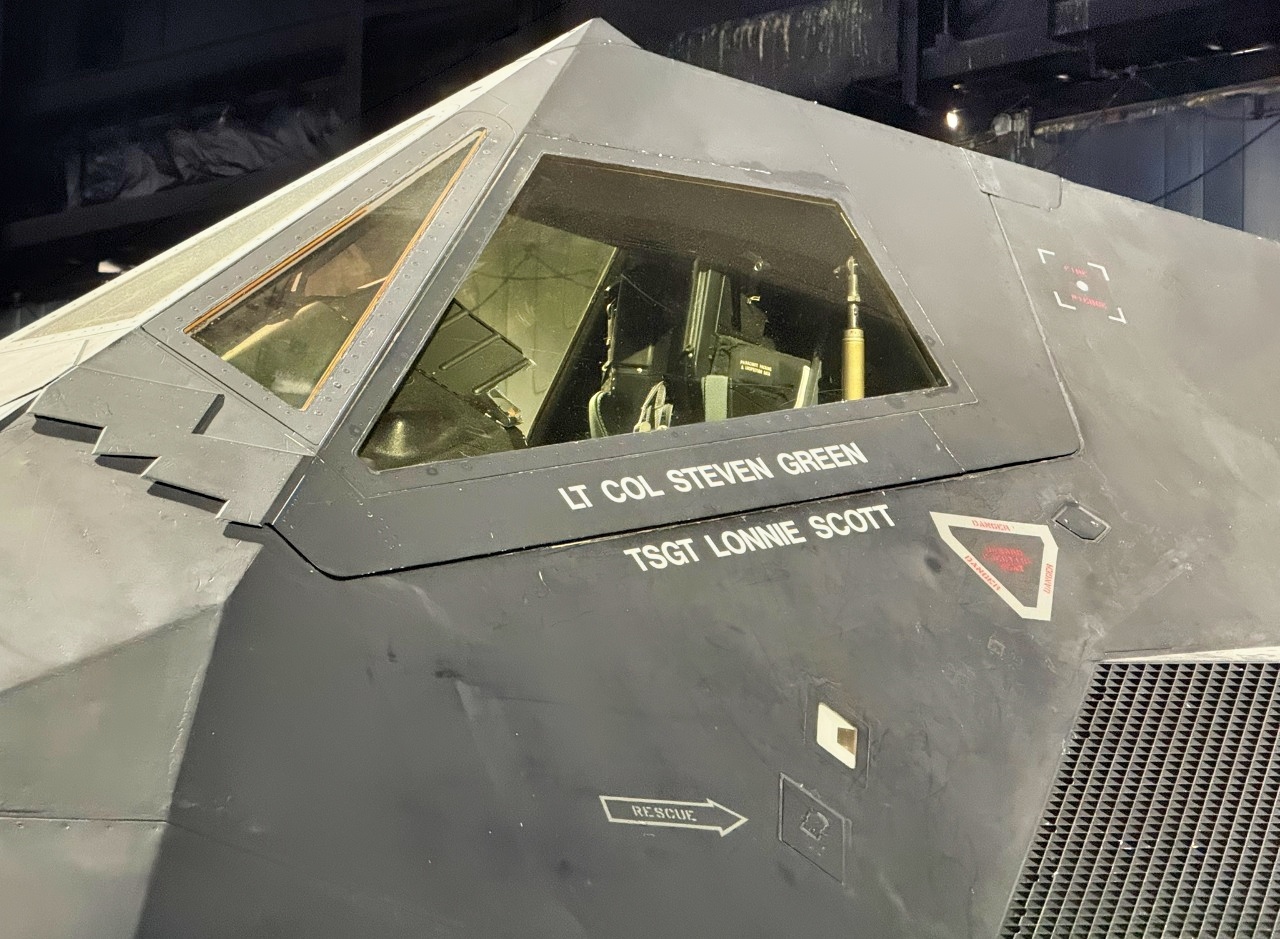
F-117 Up Close at USAF Museum. Image Credit: National Security Journal.
-A small detachment per carrier could have quick-turned precision salvos at range, enabling Super Hornets and F-35Cs to exploit opened corridors.
-Even a flying testbed would have yielded deck-level LO lessons. Three decades later, facing China’s A2/AD, the choice not to prototype remains a costly missed opportunity for carrier airpower today.
-BONUS: National Security Journal presents photos of the F-117 from our recent visit to the U.S. Air Force Museum back in July.
The F-117 Seahawk Concept Might Have Been a Bold Idea
In the early 1990s the U.S. Navy had just lost its next-gen stealth attack jet, the A-12 Avenger II, to cancellation.
The stopgaps—F-14 “Bombcat” conversions and increasingly capable F/A-18s—could sling precision ordnance, but none could sneak into a modern integrated air defense system on night one and surgically remove the eyes and nerves of an enemy force. Meanwhile, the Air Force’s F-117 Nighthawk had proven exactly that sort of day-one utility over Baghdad. It was only natural to ask: could the Navy adapt the idea behind the F-117 to sea—bring low-observable, precision strike to a carrier deck?
That is where the F-117N “Seahawk” concept lived: not as a science-fiction wish, but as a straightforward proposition to graft a proven stealth strike philosophy onto the Navy’s unique operating environment. The proposal never became hardware.
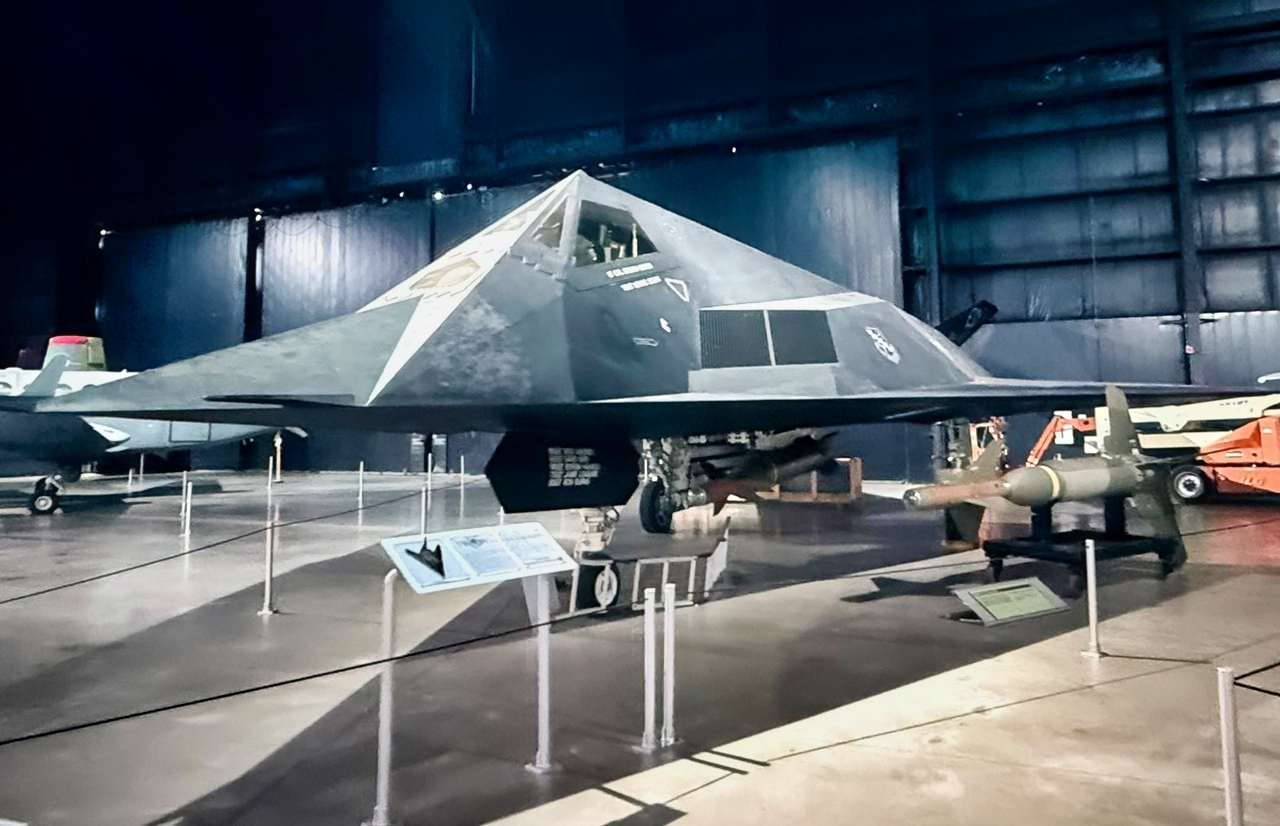
F-117 Stealth Fighter from NSJ at USAF Museum. Image take on 7/20/2025.
Three decades later—staring at China’s layered anti-access/area-denial defenses across the Pacific—it looks like a missed opportunity that still shapes air-sea power.
What The F-117N “Seahawk” Was (And Wasn’t)
Think of the F-117N as “the Nighthawk for the boat,” not a brand-new airplane.
The concept kept the Nighthawk’s stealthy faceting and internal weapons carriage, then evolved the airframe for catapult launches, arrested recoveries, salt-air corrosion, and cyclic operations. In simple terms:
Make It Nautical: Strengthen the structure and landing gear; add a tailhook; rework flaps and high-lift devices for lower approach speeds; provide folding wings or a carrier-sensible span for elevator and hangar clearance; harden coatings and fasteners for salt and sun.
Make It More Self-Reliant: Add a true multi-mode navigation/attack radar (the land-based F-117’s original concept minimized radar emissions), maritime strike modes, and a probe for basket refueling from Navy tankers.

F-117 National Security Journal Photo Taken at U.S. Air Force Museum.
Make It Safer Around Threats: Preserve internal bays for bombs or small stand-off missiles; allow limited external carriage when stealth wasn’t decisive; integrate better defensive avionics and emission control logic for a sea-based EM environment.
“Seahawk” and related “A/F-117” sketches also explored a two-crew cockpit to manage sensors, targeting, electronic warfare, and complex carrier strike choreography—mirroring the way the Air Force later leaned on two-seat strike fighters for high-cognition missions.
It would not have been a dogfighter or a multi-role jack-of-all-trades. This was a purpose-built stealth striker, optimized to kick in the door for everyone else.
Expected Performance: Range, Payload, And The Things That Matter At Sea
Carrier aviation is a tyranny of distance. From a strike group operating prudently outside the densest shore-based threats to a target set hundreds of nautical miles inland, every mile you can claw back organically matters. A navalized F-117 concept concentrated on three performance pillars:
Reach With Margin: More wing, more fuel, and better low-speed handling to make trap speeds sensible for the boat—without giving away stealthy platform. That buys combat radius and tanker flexibility, the coin of the realm in the Pacific.

Head On F-117 Stealth Fighter NSJ Photo Taken at USAF Museum on July 19, 2025.
Survivable Magazine: Internal carriage of precision ordnance—small-diameter bombs for plurality of targets, or compact stand-off munitions to hit defended aimpoints—so a small detachment could dismantle radars, SAM nodes, and command sites early.
Precision In Weather And Clutter: A carrier wing cannot wait for perfect skies. A maritime-savvy sensor suite—EO/IR plus a carefully managed radar—paired with modern targeting pods and tight JTAC/forward air controller integration would allow legal and lethal strikes in ugly conditions.
None of this required bleeding-edge aerodynamics. It demanded coherent systems engineering and the discipline to protect signature while adding the nautical muscle a carrier jet needs.
How It Would Have Worked In A Real Carrier Air Wing
On cruise, the Seahawk would have been the first-in hitter. Before the Super Hornets (and later F-35Cs) pushed across the fence in mass, a handful of stealth strike sorties would cut out key nodes: long-range search radars, sector command posts, and SAM batteries that anchor the outer rings of an enemy’s integrated air defense system. The aircraft would launch at night or under weather, join a tanker if needed, then approach inside a carefully managed emissions plan—silent when possible, skin-painting only when necessary.
On-target, internal weapons mean no external hang-points shining on radar, so you can get close enough for short-time-of-flight releases and confident terminal accuracy. A two-crew Seahawk could time salvos across multiple aimpoints in one pass, update weapons mid-flight if a line-of-bearing changed, and then egress on a different axis to avoid pattern predictability. Hours later, the rest of the air wing would exploit the opened seams—striking with heavier loads, escorting with non-stealth fighters, and flooding the battlespace with sensors and decoys.

F-117 at the US Air Force Museum July 2025. Image taken by National Security Journal.
The point isn’t that one airplane “wins the war.” It’s that organic stealth inside the air wing compresses timelines and reduces risk for everything that follows.
Why The Navy Passed on F-117N—And Why That Logic Feels Thin Now
As hard as it is to admit, there were reasons to say no in the 1990s to the F-117N:
Program Fatigue And Budgets: The A-12 cancellation had scorched trust; starting another stealth strike program—especially a derivative from a different service—looked risky.
Culture And Concurrency: The Navy was modernizing with F/A-18E/F, upgrading carriers, and reshaping the air wing. A niche, single-mission stealth jet threatened to complicate logistics and training.
“We’ll Have Standoff”: The assumption was that Tomahawks, jamming, and fast jets with precision weapons could suppress enough defenses without organic stealth.
“We’ll Have JSF Soon”: The Joint Strike Fighter (what became the F-35C) promised carrier-borne low observability in an all-new multi-role package.
All of that made a sort of sense—then. In 2025, the map argues differently. China fields long-range sensors and missiles, mobile SAMs with modern seekers, and maritime kill chains that push carrier groups farther at the outset of a crisis.

Full F-117 Nighthawk Shot. Image Credit: National Security Journal.
Standoff weapons are invaluable but finite; they also demand exquisite targeting and long time-of-flight. F/A-18E/Fs are superb but visible; F-35Cs are stealthy but relatively scarce on decks and carry limited internal bomb loads. A ready, reliable stealth strike platoon aboard every carrier would widen the commander’s options every hour of the opening fight.
What A Seahawk Would Have Added—Even After The F-35C
The F-35C finally gives the Navy a stealthy, sensor-rich striker. Why still lament the F-117N? Because the two aircraft would have complemented, not cannibalized, each other.
Division Of Labor: Let the F-35C be the quarterback—fusing the picture, cueing others, and taking high-value shots. Use the Seahawk as the battering ram—fewer sensors to babysit, more internal bombs devoted to quick, multiple aimpoints in one pass.
Surge Capacity: Carrier air wings have finite stealth tails. A small Seahawk detachment across the fleet would add magazine depth under low observability—the scarcest commodity on night one.
Deck Rhythm: A simpler, strike-centric stealth jet could turn quickly with modest deck-level maintenance, preserving LO integrity without stealing technicians from multi-role fleets.
You’re not choosing either a precision quarterback or a low-observable workhorse. In a severe contingency, you want this team.
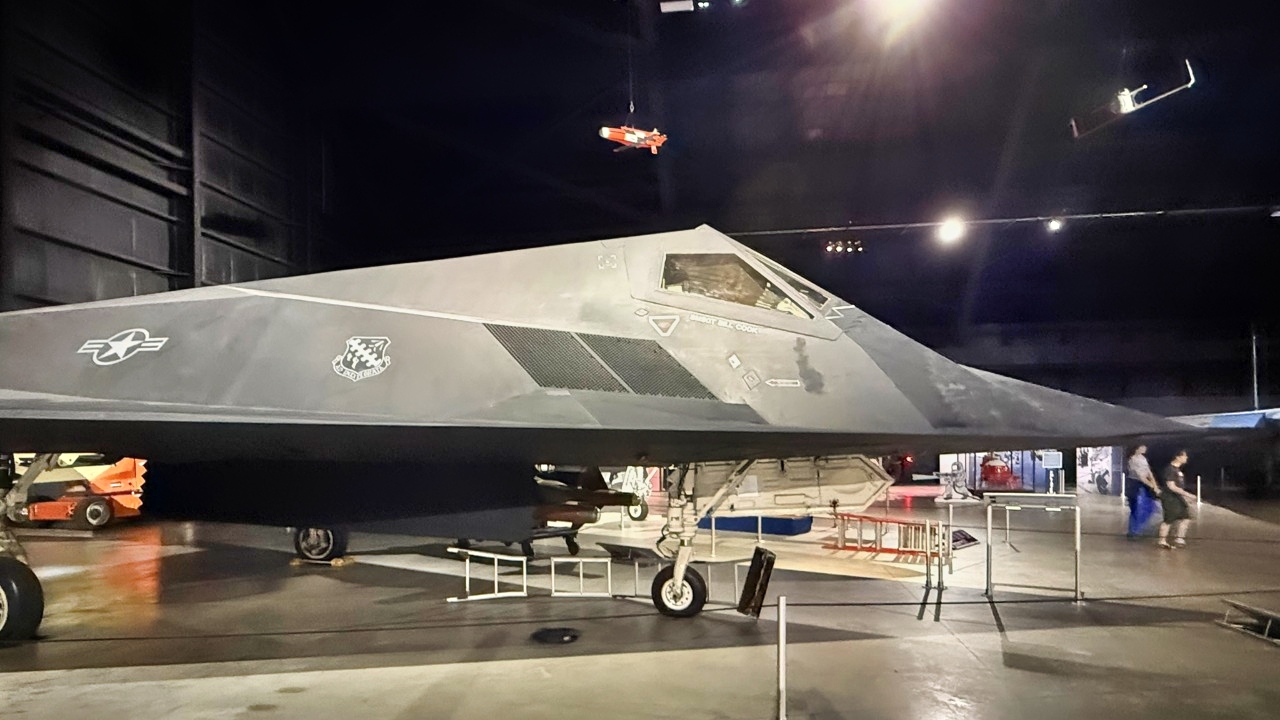
F-117 Stealth Fighter Original National Security Journal Photo.
The “Testbed We Never Built”
Even if a fleet buy was politically or fiscally unrealistic, the Navy could have flown a Seahawk test aircraft. That makes sense for a number of clear reasons:
LO At Sea: How do coatings, sealants, and panel fits hold up under salt, sun, and the abuse of the flight deck? What is the true maintenance rhythm to keep signatures tight without crippling sortie generation?
Low-Speed, LO Carrier Handling: What wing, flap, and control-law tweaks preserve stealth while delivering benign approach speeds and good bolter characteristics?
EM Discipline In A Floating Ant Farm: A carrier deck is a radar and radio jungle. A testbed could have proven emissions tactics and deconfliction that today’s jets must relearn.
Weapons Bay Reality: How many compact precision weapons can you reliably move through a navalized bay per pass? What are the real thermal and acoustic penalties around the catapult and arresting gear?
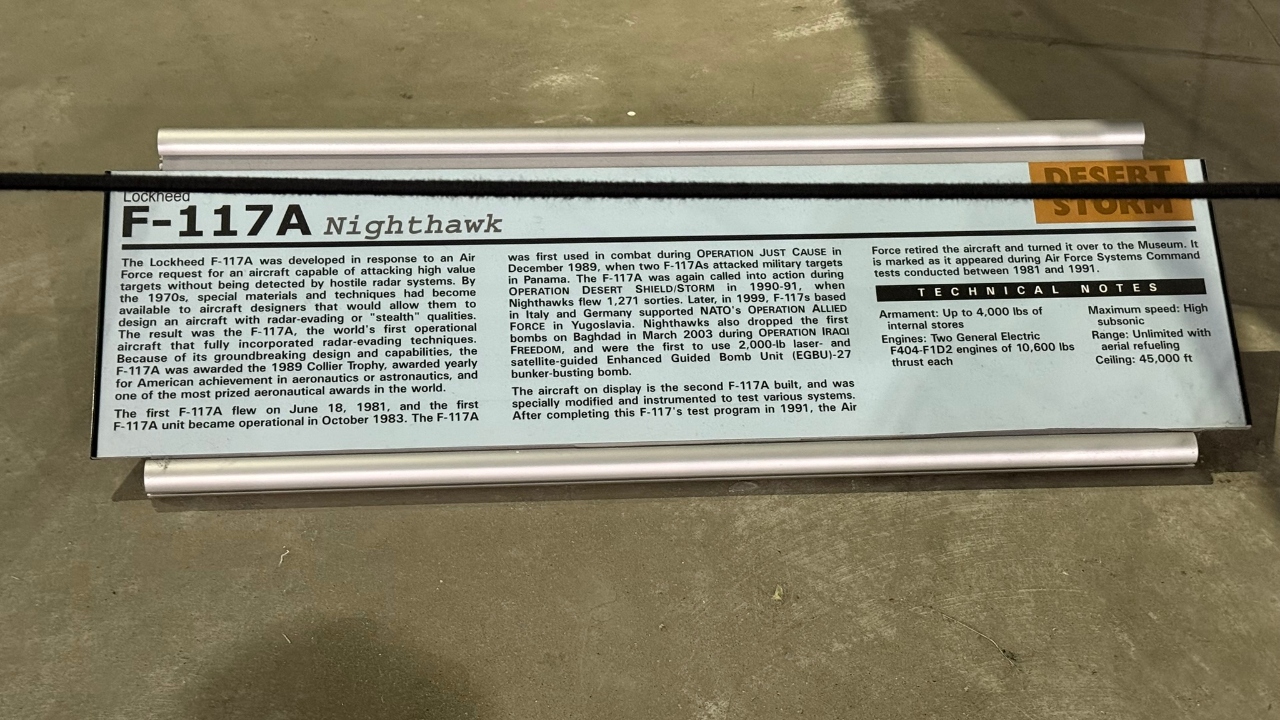
F-117A Nighthawk Sign Image Taken at USAF Museum. Image Credit: National Security Journal.
Those truths would have flowed straight into F-35C tactics, EA-18G teaming, and the design of future carrier stealth. We chose not to learn them the easy way.
Would It Have Been Hard? Absolutely. Impossible? No.
Skeptics point to the F-117’s famously unforgiving handling qualities and ask how such an airplane could ever wave aboard safely. That’s the point of a navalized design: more wing, different control laws, beefier gear, and proper high-lift devices reshape the slow-speed envelope. Others worry about folding edges and hinges ruining stealth. True—poorly done. But there are proven ways to align edges, bury hinge lines, and treat gaps so that a fold does not become a flashlight for enemy radar.
The bigger lift would have been sustainment: building a deck team that understands low-observable care and feeding without freezing the deck cycle. Hard? Yes. Carrier aviation does hard for a living.
F-117N: How It Would Have Fought In The Western Pacific
Picture a strike night from a carrier operating prudently outside the densest coastal threat rings. A Seahawk four-ship launches, tops off at a distant tanker track, then goes quiet. Flying a profile that minimizes look angles to known sensors, the formation splits. Two push inland to remove a long-range surveillance radar and its sector command van; the other pair skims a different axis to drop small, hard-target penetrators onto a mobile SAM battery’s reload site and generator farm. All four egress along pre-briefed “cold doors,” leaving behind dying emitters, stunned operators, and a sudden hole in the threat picture.

U.S. Air Force Museum Display of F-117 Nighthawk. Image Credit: National Security Journal.
Minutes later, F-35Cs exploit the gap to hunt other movers while Super Hornets with stand-off weapons cycle in. By dawn, the air wing has punched three or four such holes and forced the enemy into damage-control tactics—frequent relocations, sporadic emissions, delayed launches. That buys the fleet time and choices—often the difference between a quick, decisive campaign and a long, attritional one.
The Carrier Air Wing We Might Have Had
A F-117N Seahawk detachment per air wing in the 2000s would have rewritten deployment playbooks. Instead of treating organic stealth as a boutique capability that appears with small numbers of F-35Cs two decades later, the Navy would have grown LO competence at sea early—tactics, maintenance culture, deck choreography, and the quiet confidence that comes from actually doing it between the cat and the wire.
It also would have changed deterrence. Adversaries plan against what they know you can launch this afternoon, not what you say you’ll buy in 2030. A visible, routine carrier-borne stealth strike element would have complicated the calculus for any planner gaming out missile salvos and SAM traplines along a contested coastline.
What The “Seahawk” Teaches For The Next Program
You can’t rewind the 1990s, but you can bank the lesson: test planes can spawn new ideas and combat concepts. When a plausible path exists to turn a proven concept into a carrier-credible capability, fly the demonstrator—even if you never buy the warplane. Ample lessons could have been learned for sure. Who know what we would have discovered?
The Navy will face this logic again—whether with a stealthy UCAV, a long-range strike fighter under a future air-wing architecture, or a specialized family of systems that mixes crewed and uncrewed jets. The Seahawk’s ghost should be in every brief: “Show us, at sea, what the actual signatures, cycles, and costs look like.”
A Missed Opportunity Worth Remembering
No one is arguing that a navalized F-117N would have been cheap or simple. The argument is that it was doable—and that doing it would have given the carrier air wing an organic, stealthy door-kicker right when the world’s air defenses were getting organized again.
We opted to wait for a universal solution in the F-35C and made do with standoff and clever tactics in the meantime. The result was a two-decade gap in which America’s premier power-projection tool lacked a routine, sea-based day-one stealth strike option.
That’s the sting. The carrier remains the most flexible political and military instrument the United States owns. Giving it a dedicated stealth striker—so the air wing could start a war the way it intends to finish it—was the sort of practical, evolutionary step naval aviation does best.
We didn’t take it. Next time a good, buildable idea comes around, we should at least open the door and fly it around the pattern.
About the Author: Harry J. Kazianis
Harry J. Kazianis (@Grecianformula) is Editor-In-Chief and President of National Security Journal. He was the former Senior Director of National Security Affairs at the Center for the National Interest (CFTNI), a foreign policy think tank founded by Richard Nixon based in Washington, DC. Harry has over a decade of experience in think tanks and national security publishing. His ideas have been published in the NY Times, The Washington Post, The Wall Street Journal, CNN, and many other outlets worldwide. He has held positions at CSIS, the Heritage Foundation, the University of Nottingham, and several other institutions related to national security research and studies. He is the former Executive Editor of the National Interest and the Diplomat. He holds a Master’s degree focusing on international affairs from Harvard University.
More Military
China Claims New J-35 Stealth Fighter Has Radar Cross-Section ‘Smaller Than a Human Palm’
The SR-71 Blackbird Mach 3 Bomber?
5 Reasons A U.S.-China War Could Start


psilaxs
September 29, 2025 at 3:07 pm
Great AI written article.
Cal Lawrence
October 1, 2025 at 11:00 am
A navalized F-117 with larger wings, radar, and a 2-seat cockpit is effectively an entirely new aircraft. At which point there ceases to be any real advantage over a clean-sheet design.
TDMPE
October 1, 2025 at 5:21 pm
During the 90’s the US had just won the Cold War & China was not a threat. Some questioned the need for carrier aviation. Also the Air Force cculd do no wrong with the Pentagon junkies. The feeling was that the AF had the F22 program and that would be enough. Then Boeing was able to extend FA-18 program giving it Gen 4.5 capabilities, so the Navy had to make do with F-35C. Lockheed will likely be able to extend the F-35C to Gen 5.5 and plug the gap until the FA-xx is ready. But the Navy must absolutely get an early true Gen 6 naval aircraft this time.