

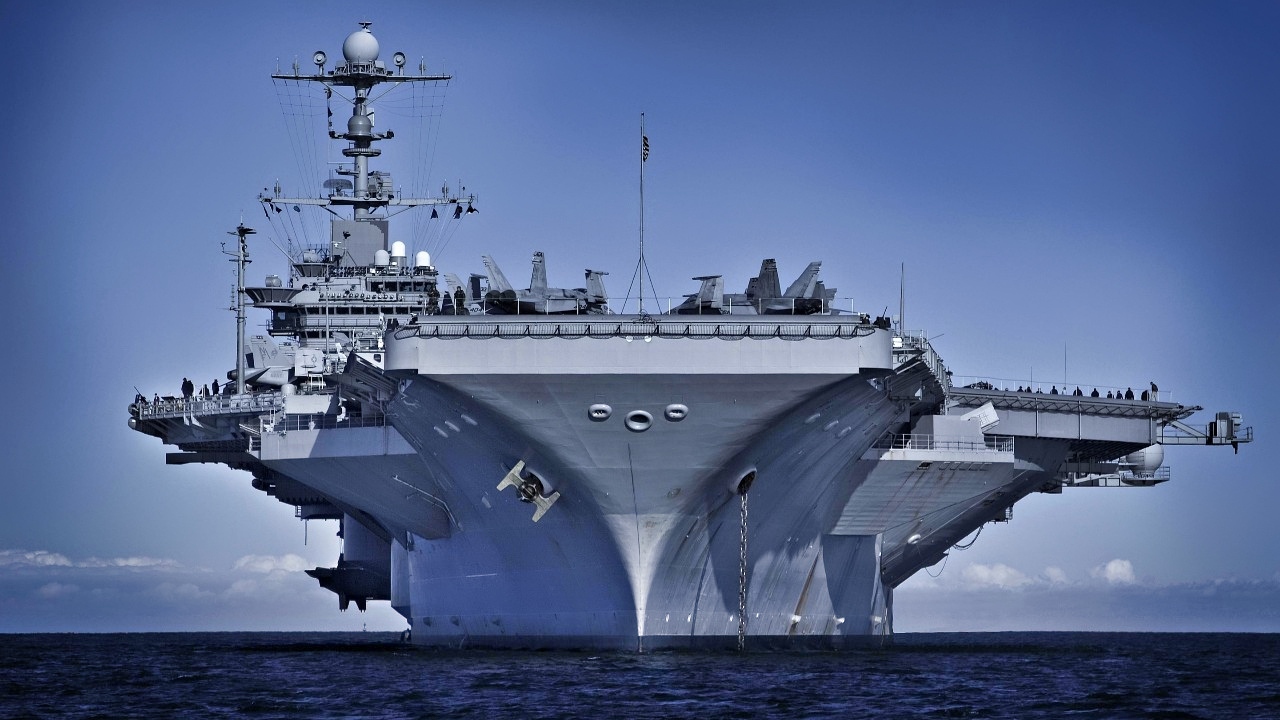
Key Points – The USS United States (CVA-58) was a post-WWII “supercarrier” designed to be a sea-based platform for heavy, nuclear-armed bombers, giving the Navy a key role in strategic deterrence.
-This massive, 1,000-foot-long ship was planned with a completely flat flight deck with no “island” control tower, a design meant to better accommodate large aircraft and help the ship withstand the shockwave of a nuclear blast.
-However, the project faced immense challenges, including its exorbitant $190 million cost, unsolved technical problems, and intense inter-service rivalry with the newly independent US Air Force, which fiercely opposed the Navy controlling its own nuclear bombers. Ultimately, the program was canceled just days after its keel was laid.
USS United States: The ‘Atomic Ship’ Supercarrier That Never Sailed
When you think of an aircraft carrier, you usually conjure up images of fighter jets and support aircraft such as helicopters.
You typically don’t recall that at least one US Navy carrier was designed to launch and arrest large nuclear-equipped bombers during the early days of the Cold War. That was the job of the huge carrier USS United States. This carrier was a proposed ship that never made it to fruition, but the background of the carrier explains much of the innovative thinking that drove the containment strategy of the Cold War.
The job of the USS United States was to overawe the Soviet Union with a floating air base that could bring nuclear weapons to the enemy with strikes that could take place from ships closer to Russia. The USS United States was also intended to be nuclear-powered so that it could attack anywhere and anytime with a nuclear weapon. This supercarrier was known as an “atomic ship.”
It Could Have Been the Bridge Between Two New Designs
The USS United States was a “tweener” carrier, which meant it was intended to be the missing link between the Essex-class and the supercarriers of the 1960s, such as the USS Enterprise. The USS United States was going to be larger than anything in the water after World War Two.
This proposal happened during the Harry S. Truman administration as the Navy at the beginning of the Cold War needed a way to deliver a nuclear weapon that was launched from the ocean instead of from US Army Air Forces bombers. This was before the advent of ballistic missiles and submarine-launched missiles, so the USS United States was ahead of its time.
The Navy Wanted Its Own Nuclear Weapons
The USS United States carrier was designed to deploy the heavy four-engine B-29 Superfortress bomber or another bomber designed by the Navy.
At the time, there was a substantial rivalry between the Navy and the US Army Air Forces. The Strategic Air Command had just been established, and the Navy wanted something similar to ensure it could remain relevant during the Cold War.
Full Complement of New Fighter Jets and Bombers
The Navy had in mind the production of a large jet bomber for use on the USS United States. The jet would have an ultra-long range—longer than the B-29.
It would also be faster and more maneuverable. The carrier could thus stay out of the range of enemy guns and safely send a bomber on a nuclear mission. The carrier was designed to carry 12 to 18 heavy bombers and 54 new jet fighters that were still under construction.
The USS United States would have a different design than other carriers. It wouldn’t have an island. “Instead, radar antennas, telemeters, FCS and the rest of what an island carrier was relegated to the two flight deck side sponsons, port and starboard. No island meant also no vertical funnel ducting and instead, they were truncated into two side funnels installed mid-ship under the flight deck, but far away from the hull with extensions to avoid smoke interference, notably in case of landing operations,” according to Naval-Encyclopedia.com.
Several Questions Went Unanswered
The ship was designed to be 1,000 feet long. The carrier would need a new reinforced deck, and since the bombers would be so heavy, there wasn’t an elevator in existence that could handle the weight. If the USS United States were to be attacked, the bombers could be eliminated topside. The other question was how the nuclear weapons would be stored. There was no existing mechanism for atomic storage. Sailors would have to be trained not only in the planned nuclear power plant but also in handling atomic bombs.
Due to the unique requirements for the large complement of airplanes on board and the new nuclear-powered propulsion system, the USS United States was going to cost $190 million – an exorbitant sum for the era.
The US Army Air Forces Said No Way
Then, there were the US Army Air Force’s objections. The flying branch was not happy that the Navy would get its nuclear weapons. This capability was supposed to be owned by the Army Air Forces. Plus, where would the new airplanes come from?
The USS United States could utilize the existing B-29, but it desired jet propulsion for the aircraft. If any branch had jet bombers and fighters, it should be the US Air Force.
Another difficulty was command and control. Without the island, there would be no room for a bridge. Thus, the United States was going to need another ship to house the command team. There would have needed to be some type of remote-control mechanism – technology that didn’t exist at the time.
Due to all these drawbacks, the USS United States was canceled in a matter of days. It will go down as a footnote to history. The Navy and the Army Air Forces did not get along, and the flying branch was never going to let the Navy control any nuclear weapons or yet-to-be-designed fighter jets and bombers.
Plus, the design of the ship was unwieldy. The nuclear propulsion system was not ready to be deployed, and nuclear weapons would have been difficult to store and operate on the ship. The USS United States was also expensive. Nuclear-tipped ballistic missiles and submarine-launched nuclear missiles later did the job, and a carrier with heavy nuclear bombers was not needed.
But give designers and engineers an “A+” for thinking with innovative foresight. The Cold War military leadership sought individuals with innovative ideas about nuclear weapons delivery and strategy. This would have addressed the need for atomic bombs to become more versatile. The new carrier probably would not have worked as designed, but it was ahead of its time and an interesting ship that took new thinking and ingenuity to the max.
About the Author: Dr. Brent M. Eastwood
Brent M. Eastwood, PhD is the author of Don’t Turn Your Back On the World: a Conservative Foreign Policy and Humans, Machines, and Data: Future Trends in Warfare plus two other books. Brent was the founder and CEO of a tech firm that predicted world events using artificial intelligence. He served as a legislative fellow for US Senator Tim Scott and advised the senator on defense and foreign policy issues. He has taught at American University, George Washington University, and George Mason University. Brent is a former US Army Infantry officer. He can be followed on X @BMEastwood.
Iran War
30,000 Pound Bunker-Buster Bombs Might Not Be Able to Destroy Fordow


