


Key Points and Summary – The F/A-18E/F Super Hornet—born in the 1990s to replace aging F-14s and legacy Hornets—heads for its final production run as Boeing fulfills a last Navy order of 17 jets.
-Larger, longer-ranged, and lower-RCS than the classic Hornet, the multirole E/F variants gained radar, ATFLIR, JHMCS, and MIDS upgrades but never true stealth.
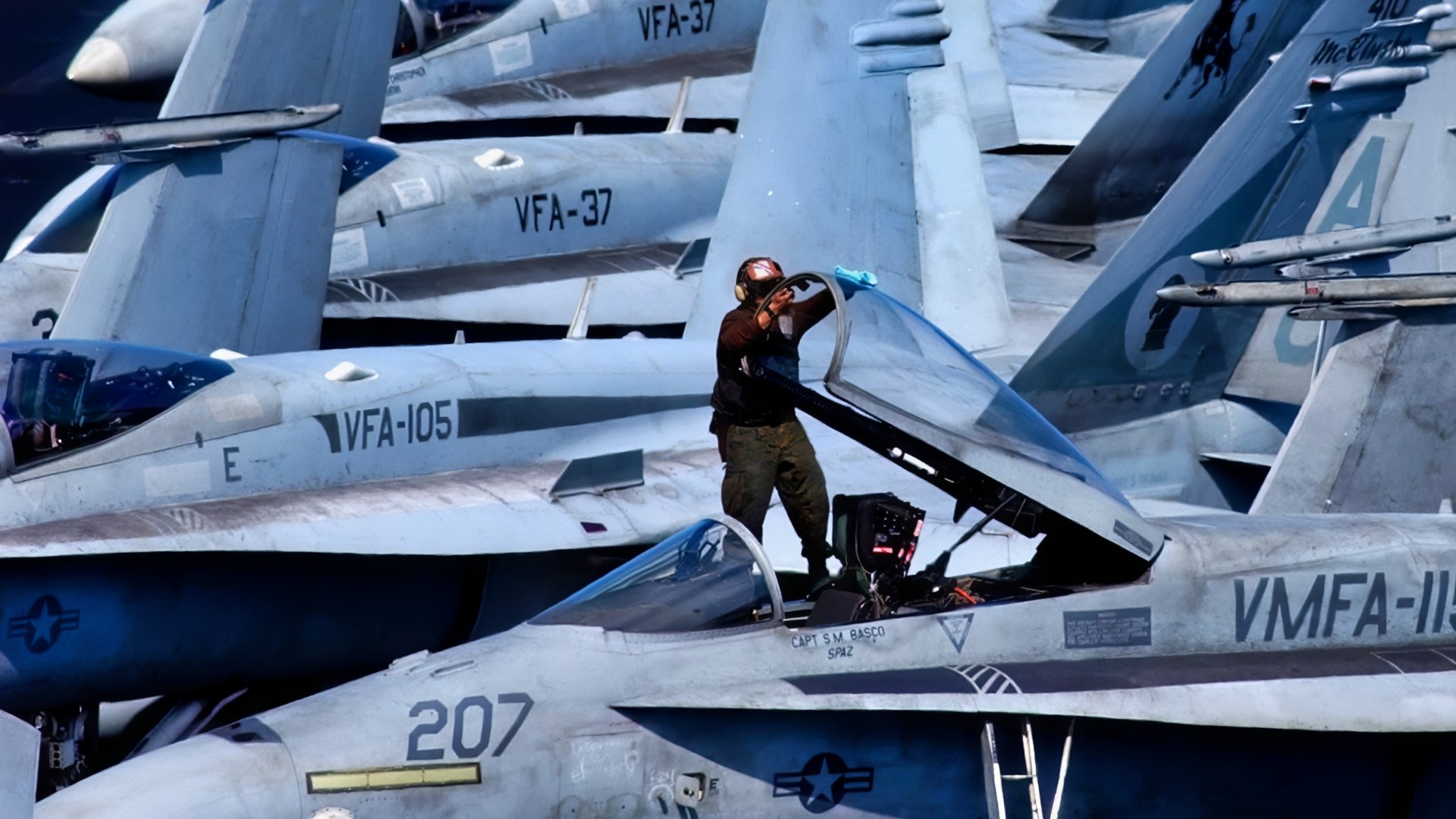
Marine Cpl. Rodger Lagrange cleans the canopy of a Marine F/A-18A+ Hornet onboard the USS Harry S. Truman (CVN 75) while the aircraft carrier operates at sea on Feb. 14, 2005. The Truman Strike Group and Carrier Air Wing 3 are conducting close air support, intelligence, surveillance, and reconnaissance missions over Iraq. Lagrange is attached to Marine Fighter Attack Squadron 115 deployed from Marine Corps Air Station Beaufort, S.C.
(DoD photo by Airman Philip V. Morrill, U.S. Navy. (Released))
-Recent IRST software defects and test delays underscored modernization headwinds, while export losses and the Navy’s shift to F-35s and future NGAD sealed the line’s fate.
-The Super Hornet leaves a deep operational legacy across air-to-air, strike, SEAD, and tanker roles—even as the carrier air wing moves into its next era.
The Last of Boeing’s Venerable F/A-18 Super Hornets
Though the company won’t close its Super Hornet production line just yet, this will be the jet’s last production run.
McDonnell Douglas began developing the F/A-18E/F Super Hornet as a replacement for the legacy Hornet aircraft in the early 1990s to address several problems—strategic, operational, and logistical—that the US Navy faced.
In essence, the F/A-18E/F Super Hornet program was seen as a replacement for the Navy’s aging F-14 Tomcat aircraft as well as a replacement for the Navy’s fleet of assorted Hornets.
As early as the late 1980s, the US Navy faced several immediate challenges. Parts of the fleet, particularly the Tomcat and A-6 Intruder, were becoming outdated, necessitating lengthy and costly maintenance regimes.
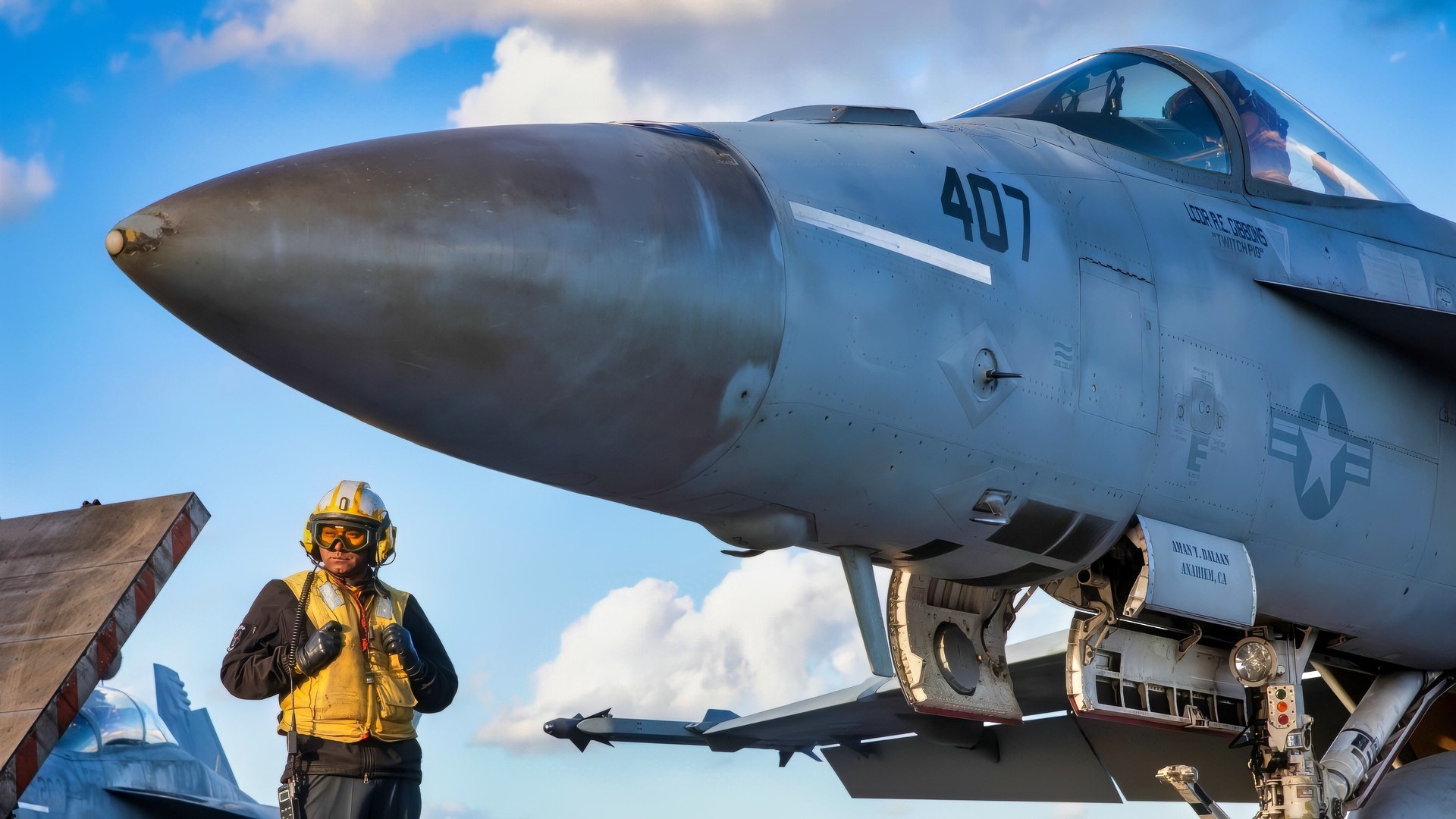
Aviation Boatswain’s Mate (Aircraft Handling) 1st Class Jose Mejiacastro, assigned to Air Department aboard the world’s largest aircraft carrier, USS Gerald R. Ford (CVN 78), prepares to signal to a Carrier Air Wing 8 F/A-18E Super Hornet attached to Strike Fighter Squadron 87 on the flight deck, Sept. 26, 2025. Gerald R. Ford, a first-in-class aircraft carrier and deployed flagship of Carrier Strike Group Twelve, is on a scheduled deployment in the U.S. 6th Fleet area of operations to support the warfighting effectiveness, lethality and readiness of U.S. Naval Forces Europe-Africa, and defend U.S., Allied and partner interests in the region. (U.S. Navy photo by Mass Communication Specialist 2nd Class Mariano Lopez)
Concurrently, the Navy’s planned stealth attack plane, the A-12 Avenger II, and a navalized version of the Advanced Tactical Fighter program were both canceled, providing the impetus for a multirole aircraft. However, if a suitable platform were not available, the Navy’s carrier air wings would risk losing some of their strike capabilities, a gap that would also compromise fleet defense.
Stepping into the breach was a proposal from McDonnell Douglas—later acquired by Boeing—for a new kind of Hornet, based on the Hornet’s design but larger, with much more modern systems.
That new fighter would boast a 25 percent larger airframe with a third greater fuel volume, and later, improved engines offering about 35 percent more thrust and an increased combat range. Overall, the Super Hornet promised higher sortie rates, better target detection and tracking, and lower operating costs, while remaining compatible with existing fleet infrastructure.
Despite the Super Hornet’s larger size, it has a lower radar cross-section than the legacy Hornets, thanks to reshaped engine inlet counters, body panels, and improved panel coatings. However, the jet lacks the all-around radar mitigating characteristics of a full stealth aircraft.
The first /A-18E Super Hornet flew in 1995, reaching low-rate initial production just a couple of years later, and achieved Initial Operational Capability with the U.S. Navy in 1999, replacing the older F-14 Tomcats in the Navy as well as some F/A-18C/D Hornets.
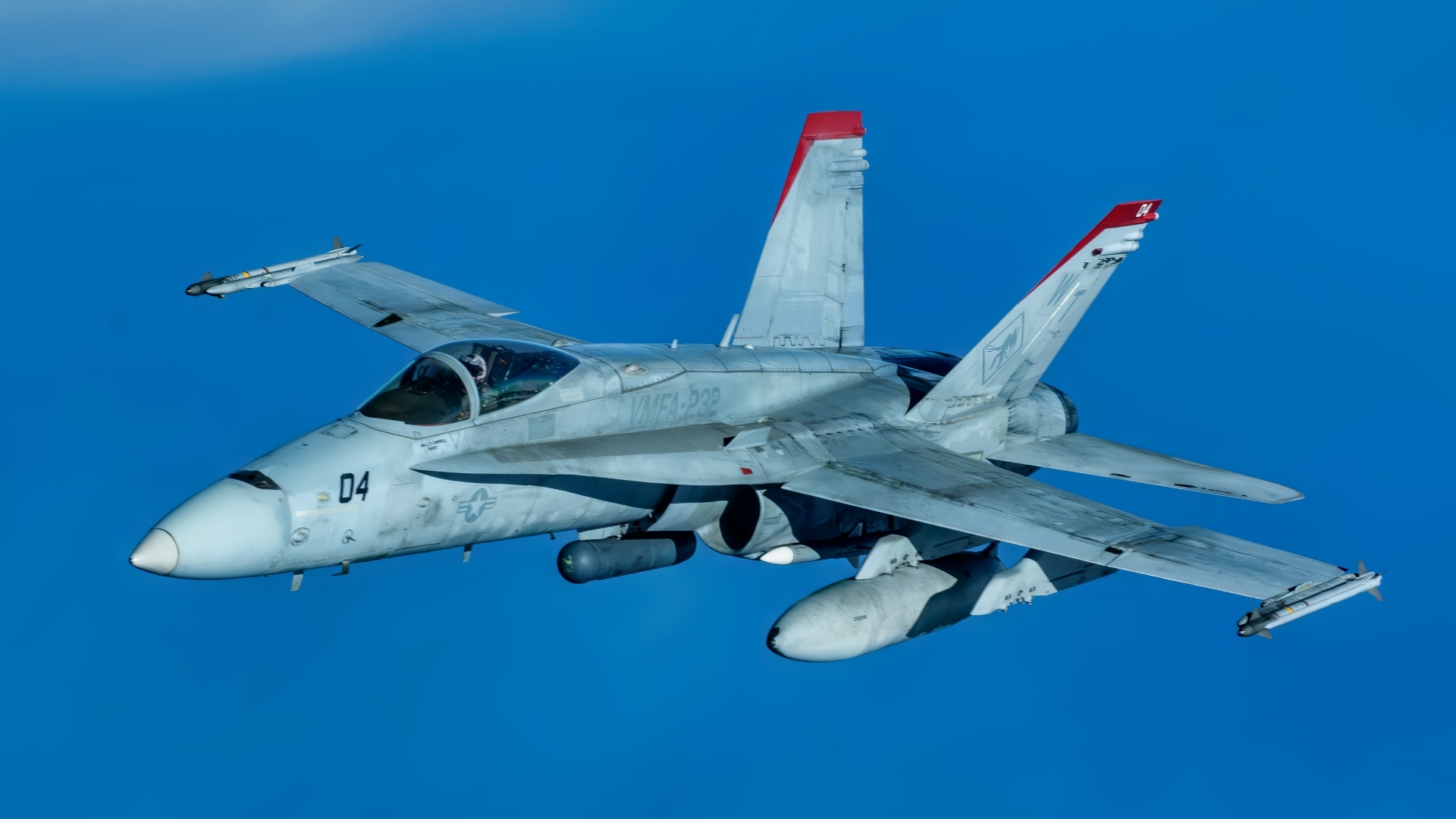
A U.S. Marine Corps F/A-18 Hornet pulls away from a U.S. Air Force KC-135 Stratotanker from Kadena Air Base after refueling over the Pacific Jan. 3, 2024. Conducting joint operations enhances the lethality and readiness of U.S. forces and its ability to project superior airpower to the Indo-Pacific region. (U.S. Air Force photo by Senior Airman Cedriue Oldaker)
Fast forward to today, and Boeing builds two variants of the Super Hornet: the E, a single-seater, and the F, a two-pilot fighter.
“Both are true multirole aircraft, able to perform virtually every mission in the tactical spectrum,” Northrup Grumman elaborates, “including air superiority, day/night strike with precision-guided weapons, fighter escort, close air support, suppression of enemy air defenses, maritime strike, reconnaissance, forward air control and tanker missions.”
And since it was introduced into US Navy service, the platform has integrated a number of improvements and upgrades, including incrementally more powerful radar, and “an advanced targeting forward-looking infrared (ATFLIR), joint-helmet mounted cueing system (JHMCS), multifunctional information distribution system (MIDS), and an advanced aft crew station.”
Headwinds
Although Boeing’s Super Hornets have been repeatedly upgraded since entering service, the naval fighter is far from problem-free.
One persistent problem is the Super Hornet’s Infrared Search and Track system. When in order, the pod detects infrared radiation — heat — that informs the pilots’ tracking and targeting of adversary aircraft; however, the device has repeatedly malfunctioned.
A reporter from the Government Accountability Office, a non-partisan government watchdog that reports to Congress, detailed the issues with the IRST pods that the F/A-18 Super Hornets are experiencing.
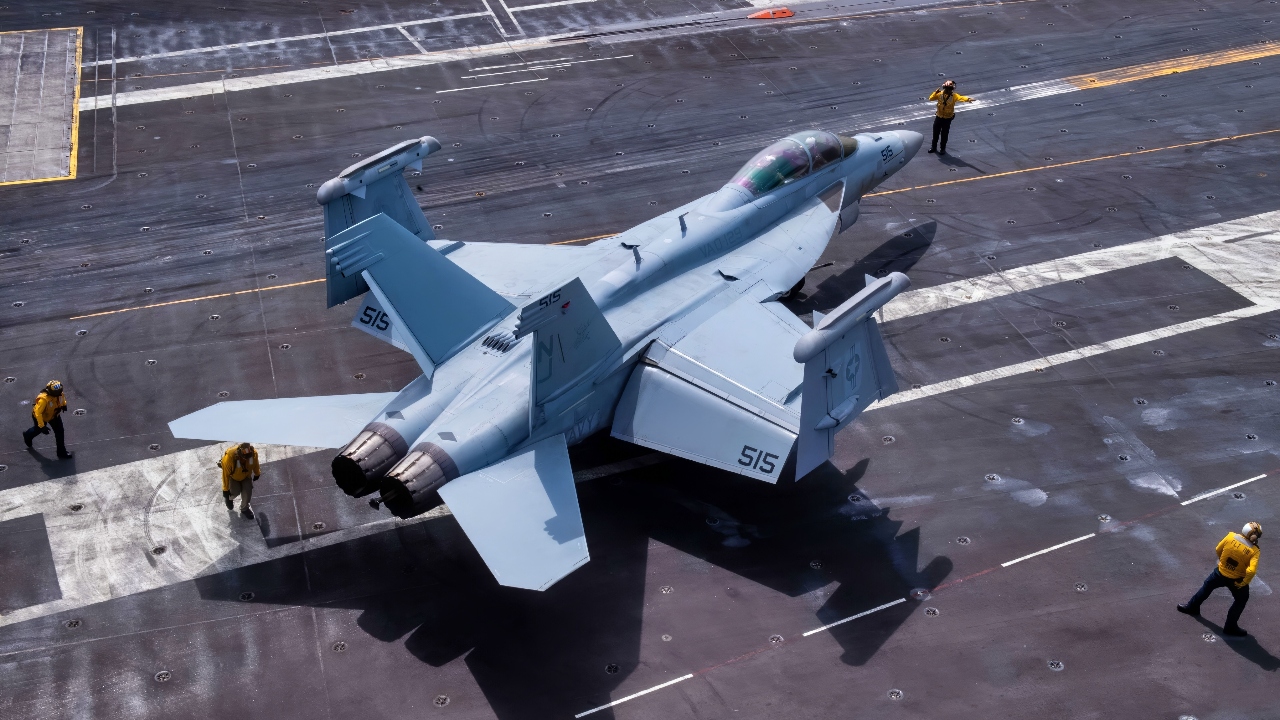
PACIFIC OCEAN (Aug. 11, 2025) – U.S. Navy Sailors direct an E/A-18G Growler, assigned to the “Vikings” of Electronic Attack Squadron (VAQ) 129, on the flight deck of the Nimitz-class aircraft carrier USS Theodore Roosevelt (CVN 71), Aug. 11, 2025. Theodore Roosevelt, flagship of Carrier Strike Group (CSG) 9, is underway conducting exercises to bolster strike group readiness and capability in the U.S. 3rd Fleet area of operations. (U.S. Navy photo by Mass Communication Specialist Seaman Apprentice Cesar Nungaray)
“In November 2024, the IRST program achieved initial capability on schedule by completing initial operational testing and accepting delivery of the first lot of low-rate initial production IRST pods. However,” notes the report from the GAO, “the program reported that it would not reach a full-rate production decision by its baseline schedule threshold in January 2025 due to delays incurred during flight testing.
“IRST officials told us that operational tests were delayed by 2 months due to software defects that caused IRST pods to falsely report overheating. Director, Operational Test and Evaluation (DOT&E) officials told us that the defect was relatively easy to fix and would likely have been addressed during developmental testing had the program allocated more time for that testing.” The GAO underlined that ‘this is the second time the program breached its baseline schedule in the past 3 years.”
Into the Future
In 2023, Boeing announced it would shutter the F/A-18 Super Hornet production facility, citing dwindling orders from the United States Navy and international customers. Despite the jet’s incremental block upgrades, the platform lacked some of the more advanced features of newer jets, particularly those found in the F-35 stealth fighter.
In one interview at the Sea Air Space forum, Boeing Vice President for Fighters Mark Sears explained the rationale behind that decision. “We ran a number of international campaigns or competitions that we were unsuccessful in previous years,” Sears said.
“Those kind of played out and there are no active discussions with the Navy about additional F-18s beyond these.” The following year, however, Boeing announced that it would maintain production to fulfill a final contract for 17 new-build F/A-18 Super Hornets for the Navy. But after that last, small production run, it will be lights out for new-build Super Hornets.
About the Author: Caleb Larson
Caleb Larson is an American multiformat journalist based in Berlin, Germany. His work covers the intersection of conflict and society, focusing on American foreign policy and European security. He has reported from Germany, Russia, and the United States. Most recently, he covered the war in Ukraine, reporting extensively on the war’s shifting battle lines from Donbas and writing on the war’s civilian and humanitarian toll. Previously, he worked as a Defense Reporter for POLITICO Europe. You can follow his latest work on X.
More Military
Canada’s F-35 Fighter Debate Summed Up in 3 Words
The U.S. Air Force’s B-52J Bomber Crisis
Mach 5.1 X-51 Waverider ‘Hypersonic Scramjet’ Has a Message for the Air Force
Beast Mode: How the F-35 Stealth Fighter Bolts on 22,000 Pounds of Bombs


Krystal cane
November 3, 2025 at 4:43 pm
Yeah flexing meanwhile children are starving in the United States because of poor leadership