


Key Points and Summary – Despite its combat-proven record and multi-role capability, the F/A-18E/F Super Hornet has five significant weaknesses.
-As a 4.5-generation fighter, its most critical flaw is a lack of true stealth, making it vulnerable to 5th-generation adversaries.
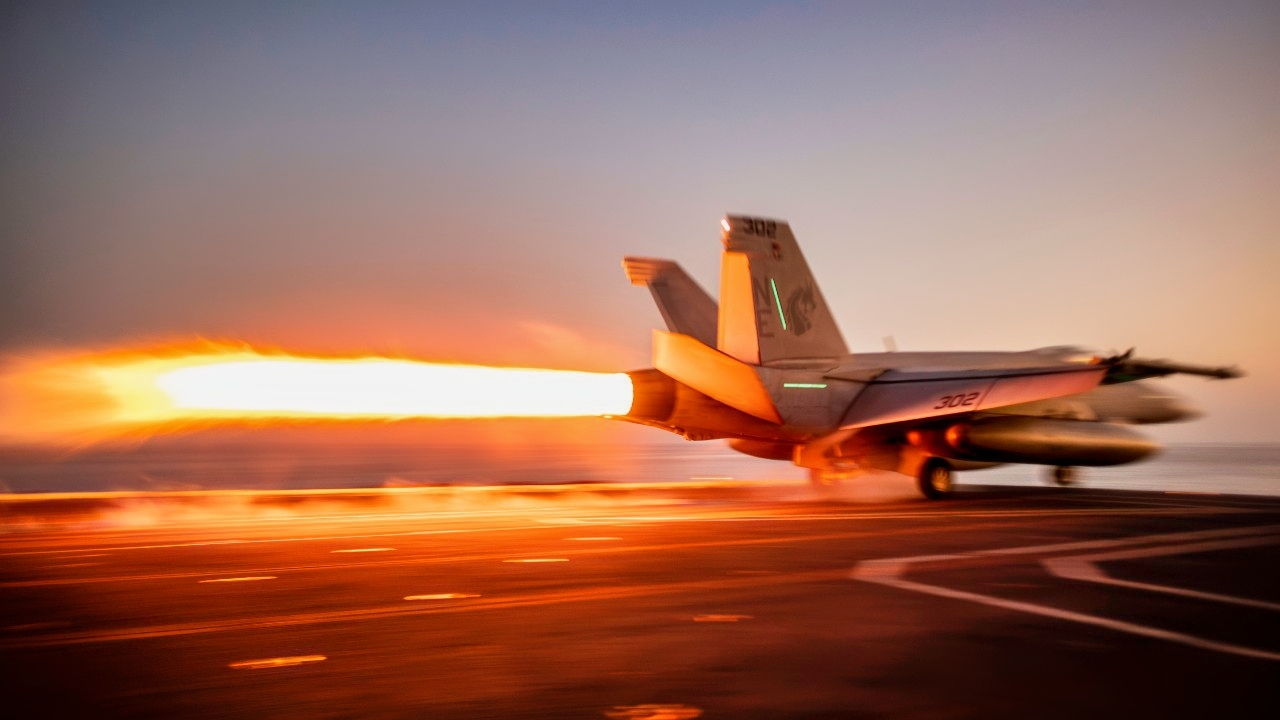
250429-N-FS097-1154 U.S. CENTRAL COMMAND AREA OF RESPONSIBILITY (April 28, 2025) An F/A-18E Super Hornet, attached to Strike Fighter Squadron (VFA) 192, launches from the flight deck of the Nimitz-class aircraft carrier USS Carl Vinson (CVN 70) in the U.S. Central Command area of responsibility. (Official U.S. Navy photo)
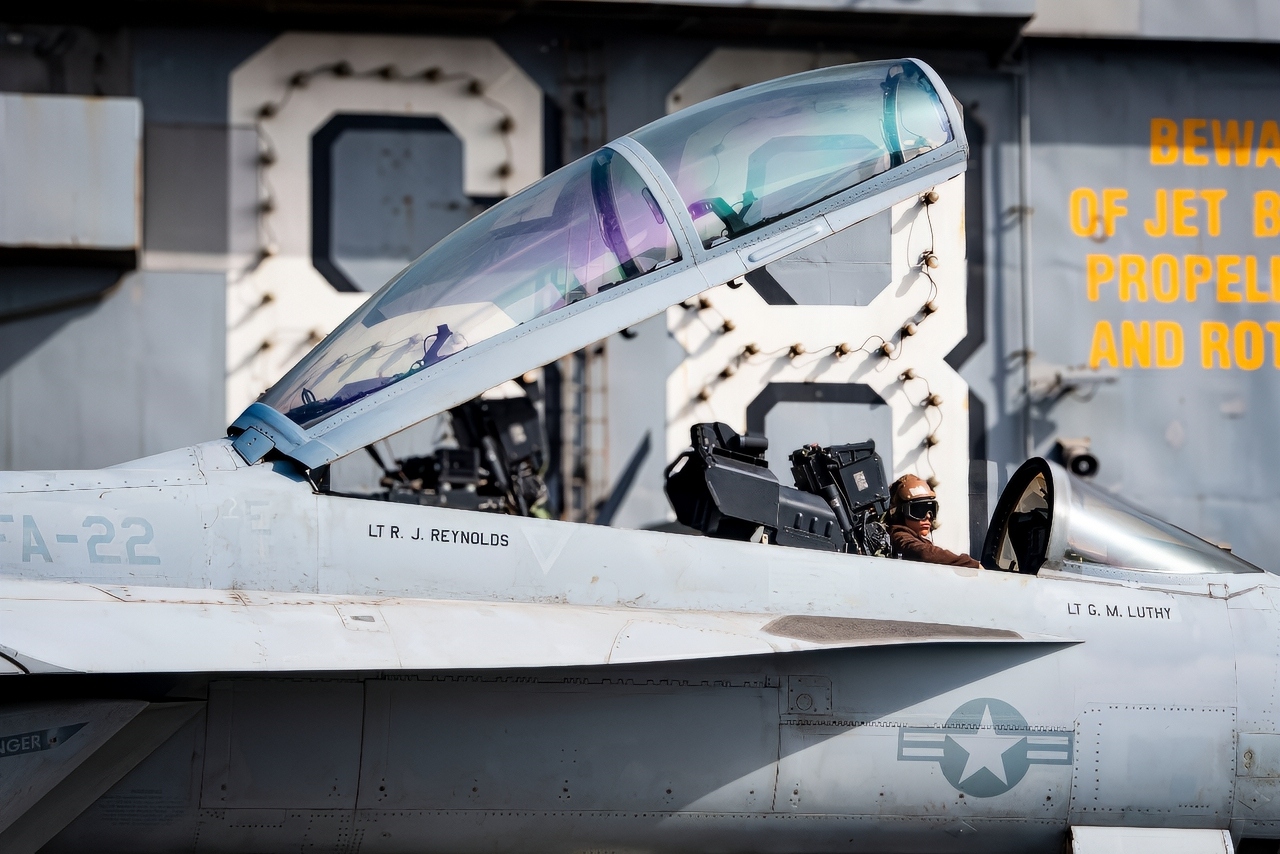
U.S. CENTRAL COMMAND AREA OF RESPONSIBILITY (July 22, 2025) An F/A-18F Super Hornet, attached to Strike Fighter Squadron (VFA) 22, taxis across the flight deck of the Nimitz-class aircraft carrier USS Nimitz (CVN 68) in the U.S. Central Command area of responsibility. (Official U.S. Navy photo)
-It also suffers from relatively limited maneuverability compared to dedicated air superiority fighters.
-Its top speed (Mach 1.6) is considerably slower than many peers, both American and foreign. Pilots describe it as underpowered, struggling to regain energy after high-G maneuvers.
-Finally, its design, optimized for carrier landings, creates significant induced drag, hindering its performance in sustained turns compared to land-based fighters.
5 Biggest Problems (Weaknesses) of the F/A-18 Super Hornet
The F/A-18-E/F Super Hornet is indeed a super(b) warplane.
Besides the fictitious hype it received in the 2022 cinematic blockbuster “Top Gun: Maverick,” it is a highly battle-proven platform in real life, providing excellent service to the US Navy in the air-to-air and air-to-ground roles alike.
Indeed, the only air-to-air kill of a manned enemy aircraft by an American fighter pilot in the 21st century was scored by a Super Hornet driver (that being USN Lt. Cmdr. Michael “M.O.B.” Tremel back on June 17, 2018).
However, like any manmade object, the Super Hornet has its flaws (just like Superman has his Kryptonite).
Accordingly, National Security Journal now does a rundown of the F/A-18’s five biggest weaknesses.
Weakness #1: Lack of True Stealth
Well, this one sounds like a no-brainer in this day and age of 5th-generation stealth fighters (not to mention 6th-generation warbirds like the F-47 NGAD), right? The more easily the enemy can detect you, the more easily they can kill you.
The F/A-18, being a mere 4.5-generation fighter jet, doesn’t have true stealth capability.
In fairness, the latest and greatest iteration of the Super Hornet, the Block III, *has* been made somewhat stealthier and more survivable with additional treatments that reduce its radar cross section (RCS).
Nonetheless, even the Block III bird would be at a distinct disadvantage against an adversary’s Gen 5 fighter, such as China’s Chengdu J-20 Weilong (“Mighty Dragon;” NATO reporting name “Fagin”) and Shenyang J-35, or Russia’s Sukhoi Su-57 (NATO reporting name “Felon“).
Weakness #2: Relative Lack of Maneuverability
Some pundits argue that maneuverability is far less important in this day and age of beyond visual range (BVR) engagements as opposed to up-close-and-personal dogfights, but it’s still better to have and not need than vice versa.
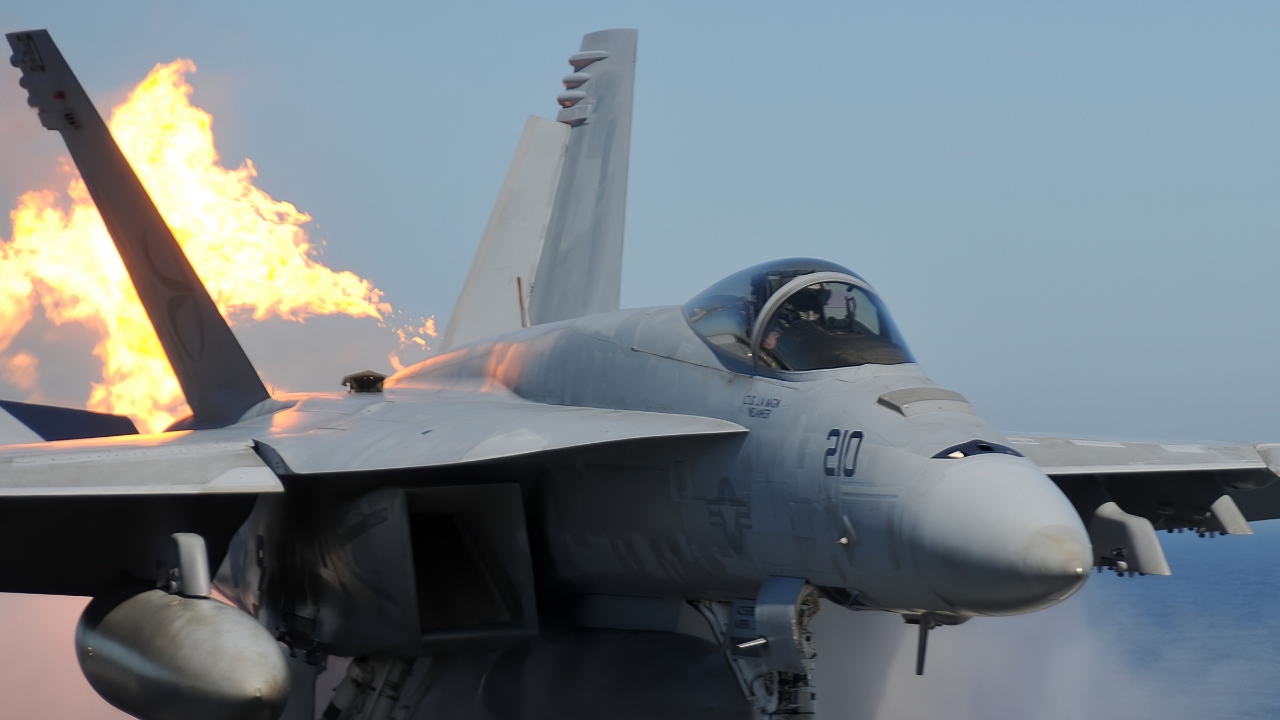
A U.S. Navy F/A-18E Super Hornet aircraft assigned to Strike Fighter Squadron 137 is launched from the flight deck of the aircraft carrier USS Abraham Lincoln (CVN 72) while underway in the Pacific Ocean on Feb.2, 2009.
(DoD photo by Petty Officer 2nd Class James R. Evans, U.S. Navy. (Released))
The F/A-18, though a fine fighter, simply isn’t as maneuverable as true air superiority fighters such as the F-15 Eagle, F-16 Fighting Falcon (AKA the “Viper”), or F-22 Raptor.
Weakness #3: Fast, But Not Quite That Fast
As the fighter pilot’s motto goes, “Speed is life.” The Super Hornet is no slowpoke, generating a max airspeed of Mach 1.60 (1,227.6 mph; 1,975.6 km/h; 1,066.7 knots).
However, that pales in comparison with the other fighters we previously mentioned, friend and foe alike:
-F-15: Mach 2.5
-F-16: Mach 2.0
-F-22: Mach 2.25
-J-20: Mach 1.70
-Su-57: Mach 2.0
To add further perspective, even the original (not so “Super”) Hornet is faster, at Mach 1.80.
Weakness #4: Relatively Underpowered
(Cue Chief Engineer Montgomery Scott in Star Trek: “I’m givin’ her all she’s got, Captain!”)
As stated by C.W. Lemoine, who flew fighters for both the Air Force and Navy Reserves, “The weakness is, it doesn’t have the power … if you did some kind of energy excursion in the ‘A+,’ it’s very hard to get your energy back. I mean, if you traded everything in to get that shot, you’d better not miss, because, odds are, that’s the end of it, you’re out of airspeed, energy, and ideas as that point.”
Or as another F/A-18 driver, Adam Daymude, put it (as quoted by Dario Leone in a July 2, 2025, article for The Aviationist): “Engines are a big part of it, specifically thrust to weight ratio. The Eagle, when it isn’t carrying anything on its wings, has a thrust to weight ratio greater than 1:1. That means it can accelerate in the vertical. Wha?! … ‘Gs are another factor. Vipers can pull 9 Gs. Supers are limited to 7.5.”
Weakness #5: “Kind of a Drag”
(Cue the 1967 rock song by The Buckinghams.)
To quote Mr. Daymude via Signore Leone again, “‘ Our Navy jets have to generate a lot of lift at slow speeds to land safely at the boat; that’s part of the reason why we have such huge leading-edge extensions (LEXs … they’re the part up against the fuselage, next to the cockpit, and extending back to the wing proper). That’s great for recovery at the boat but all that lift comes at a price: induced drag … Basically, that just means the more lift you create, the more drag you have as a result. In practice, what that means is that F-16s and F-15s that don’t have this penalty can add energy or sustain turns better than an F/A-18 of any variety. An F/A-18 has to be flown damn near perfectly to beat either of those two.’”
About the Author: Christian D. Orr, Defense Expert
Christian D. Orr is a Senior Defense Editor. He is a former Air Force Security Forces officer, Federal law enforcement officer, and private military contractor (with assignments worked in Iraq, the United Arab Emirates, Kosovo, Japan, Germany, and the Pentagon). Chris holds a B.A. in International Relations from the University of Southern California (USC) and an M.A. in Intelligence Studies (concentration in Terrorism Studies) from American Military University (AMU). He is also the author of the newly published book “Five Decades of a Fabulous Firearm: Celebrating the 50th Anniversary of the Beretta 92 Pistol Series.”
More Military
Mach 6 SR-72 Darkstar Could Soon Be the ‘Fastest Plane on Earth’
America’s E-4B Doomsday Plane Has a Message for Russia and China
AIP: The Cheap Stealth Submarines the U.S. Navy Will Never Build
Russia’s Su-57 Felon Stealth Fighter Finally Opens Its ‘Secret’ Weapons Bay Doors
Canada’s Big F-35 Fighter Choice Is Stuck in ‘Stealth Limbo’


