
Surprise strikes inside southern Iran on May 26 are risking fragile negotiations between Washington and Tehran, which are beginning to collapse only weeks after both sides suggested that they could be close to an agreement over the Strait of Hormuz.
U.S. Central Command confirmed on Tuesday that American forces carried out “self-defense strikes” targeting Iranian missile infrastructure and Islamic Revolutionary Guard Corps naval assets near the Strait of Hormuz. The strikes follow allegations that Iranian vessels were preparing new mine-laying operations in critical shipping lanes in the Strait of Hormuz. Explosions were reported around Bandar Abbas and other parts of Hormozgan province overnight.

The world’s largest aircraft carrier, USS Gerald R. Ford (CVN 78), sails in the Atlantic Ocean, July 4, 2025. Gerald R. Ford, a first-in-class aircraft carrier and deployed flagship of Carrier Strike Group Twelve, incorporates modern technology, innovative shipbuilding designs, and best practices from legacy aircraft
carriers to increase the U.S. Navy’s capacity to underpin American security and economic prosperity, deter adversaries, and project power on a global scale through sustained operations at sea. (U.S. Navy photo by Mass Communication Specialist 2nd Class Tajh Payne)
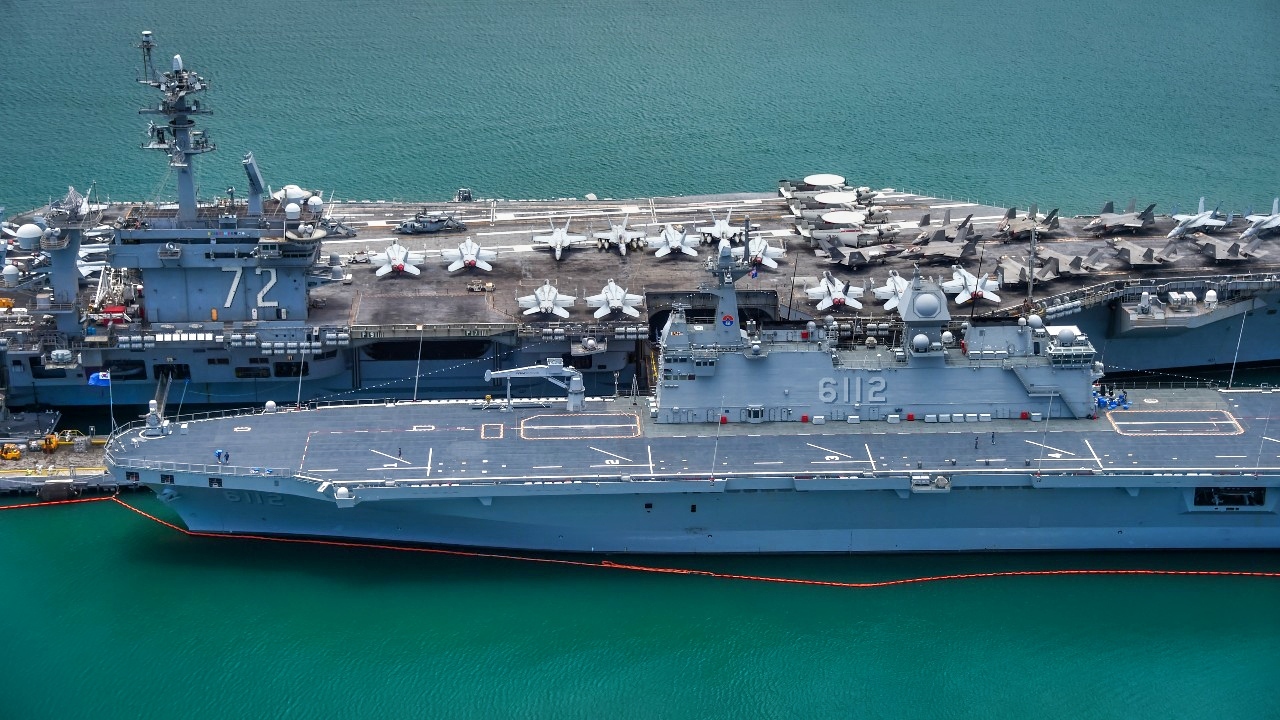
(July 7, 2022) – U.S. Navy nuclear-powered aircraft carrier USS Abraham Lincoln (CVN72) and Republic of Korea Navy amphibious assault ship ROKS Marado (LPH 6112) moored at Joint Base Pearl Harbor-Hickham, Hawaii, during Rim of the Pacific (RIMPAC) 2022. Twenty-six nations, 38 ships, four submarines, more than 170 aircraft and 25,000 personnel are participating in RIMPAC from June 29 to Aug 4 in and around Hawaiian Islands and Southern California. The world’s largest international maritime exercise, RIMPAC provides a unique training opportunity while fostering and sustaining cooperative relationships among participants critical to ensuring the safety of sea lanes and security on the world’s oceans. RIMPAC 2022 is the 28th exercise in the series that began in 1971. (U.S. Navy photo by Mass Communication Specialist Seaman Leon Vonguyen)
Iran immediately accused the United States of violating the April ceasefire agreement and warned that Tehran reserved the right to respond. The strikes also triggered another spike in global oil prices after markets had briefly stabilized over optimism that negotiations could soon produce a breakthrough agreement.
On Tuesday, President Trump announced the convening of a rare cabinet-level meeting at Camp David as negotiations enter what could be their final stages, with Secretary of State Marco Rubio suggesting that the matter could be resolved in a “few more days.”
What Just Happened
According to CENTCOM spokesman Tim Hawkins, U.S. forces conducted strikes against Iranian military threats near the Strait of Hormuz.
“U.S. forces conducted self-defense strikes in southern Iran today to protect our troops from threats posed by Iranian forces,” Hawkins said in a statement.
Targets reportedly included missile launch infrastructure and IRGC naval assets allegedly involved in mine-laying operations near shipping routes, with the strikes focusing on one of the most strategically important naval hubs overlooking the Strait of Hormuz, Bandar Abbas. According to the Trump administration, the strikes were strictly defensive and not part of a renewed offensive campaign against Iran. However, Iranian officials outright rejected the explanation.
Iran’s Foreign Ministry accused Washington of violating the ceasefire and undermining the credibility of negotiations, while Iranian state-linked media reported several casualties among IRGC personnel. According to the Iranian Foreign Ministry, the strikes were “aggressive” and “unjustified.”
The strikes have raised questions about the future of negotiations, with Iranian officials hinting at possible retaliation.
“Without a doubt, the Islamic Republic of Iran will not leave any evil unanswered and will not hesitate to defend the Iranian nation,” a statement reads.
It is not the first strike since the ceasefire technically began in April. Multiple incidents involving tanker traffic, drone operations, naval escorts, and suspected mining activity have already occurred in and around the Strait of Hormuz in recent weeks.
Trump Takes Talks to Camp David
The fresh strikes come just as Trump prepares to hold a major national security meeting at Camp David – a location traditionally associated with wartime planning and high-level diplomatic negotiations. The move is significant because Trump has rarely used Camp David during his second term, suggesting that the administration now views the negotiations as entering a potentially decisive point.
Secretary of State Rubio has previously stated that the United States will not accept any arrangement that allows Iran to effectively control access to Hormuz through toll systems, military coercion, or continued threats against international shipping. President Trump, meanwhile, continues to insist that Iran abandon its nuclear ambitions – a consistent sticking point in the negotiations that would, presumably, need to be overcome before an agreement is signed. On Tuesday, Rubio told reporters that the Strait of Hormuz needs to remain open “one way or the other.”
Is the World Moving Toward an Oil Crisis?
The strikes immediately rattled the global energy markets, with Brent crude climbing back toward $100 per barrel on Tuesday after briefly falling on optimism about a possible agreement. West Texas Intermediate crude also surged back into the mid-$90 range as traders weighed the growing possibility that negotiations could fail entirely.
The Strait of Hormuz is the central point of the negotiations, and its status will ultimately determine whether or not there is an oil crisis. The passageway handles roughly 20 percent of global oil supply and serves as one of the world’s most important energy chokepoints. Even after the April ceasefire, shipping traffic through the Strait never fully normalized.
Tanker insurance premiums reportedly surged severalfold above normal levels in recent weeks, while some operators reduced traffic altogether for fear of mines, missile attacks, and ongoing naval confrontations.
Analysts are warning that even a successful agreement may not immediately stabilize global markets, too.
Joe Brusuelas, the chief economist at financial services firm RSM US, said in April that, to restore shipments, confidence must be rebuilt and tanker insurance reestablished before the oil market begins to return to normal. Similarly, the shipping company A.P. Moller-Maersk said in a statement that the ceasefire created only limited transit opportunities and that full maritime certainty will be achieved only once all potential conditions are understood.
And then there’s the matter of restarting production: Persian Gulf oil producers have cut output by millions of barrels per day during the conflict, and once conditions are believed to be right, restarting production will still be a challenge, with many refineries damaged during the war. Brusuelas, according to Axios, said that restarting production could take three to six months.
Even in the best-case scenario, then, an agreement will not yield immediate results – and the question may not be whether we are headed toward an oil crisis, but how long that crisis might ultimately be.
About the Author: Jack Buckby
Jack Buckby is a British researcher and analyst specializing in defense and national security, based in New York. His work focuses on military capability, procurement, and strategic competition, producing and editing analysis for policy and defense audiences. He brings extensive editorial experience, with a career output spanning over 1,000 articles at 19FortyFive and National Security Journal, and has previously authored books and papers on extremism and deradicalization.


