


Summary and Key Points: Developed by McDonnell in the late 1940s, the XF-85 Goblin was a tiny, stubby interceptor designed to be launched and recovered from the bomb bay of a heavy bomber.
-Intended to protect the intercontinental B-36 Peacemaker, the Goblin lacked traditional landing gear, relying entirely on a trapeze system for mid-air recovery.

XF-85 Sign at USAF Museum July 19 2025. Image Credit: National Security Journal Photo.
-However, flight tests at Muroc Army Airfield revealed that the turbulent air beneath the “mother ship” made docking nearly impossible.
-In approximately half of its test flights, pilots were required to perform emergency skid landings on dry lakebeds, prompting the Air Force to terminate the program in favor of emerging aerial refueling technology.
-This publication went to the National Museum of the Air Force to see the XF-85 and B-36 upclose. We present several photographs we took in this article.
Egg-Shaped and Lethal: The Failed XF-85 Goblin That Almost Changed Air War
Throughout WWII, the U.S. Air Force learned several lessons, particularly regarding the vulnerability of bombers to interception. The USAF considered several methods to ensure that bombers were well protected. Before the technology emerged to allow for long-range escorts, the U.S. briefly pursued the concept of a parasite fighter that could launch from and dock with bombers.
This led to the development of the XF-85 Goblin, a small, stubby aircraft intended to dock with the B-36 Peacemaker. However, the technology at the time limited the reliability of the parasite fighter, leading to the abandonment of the concept as a whole.
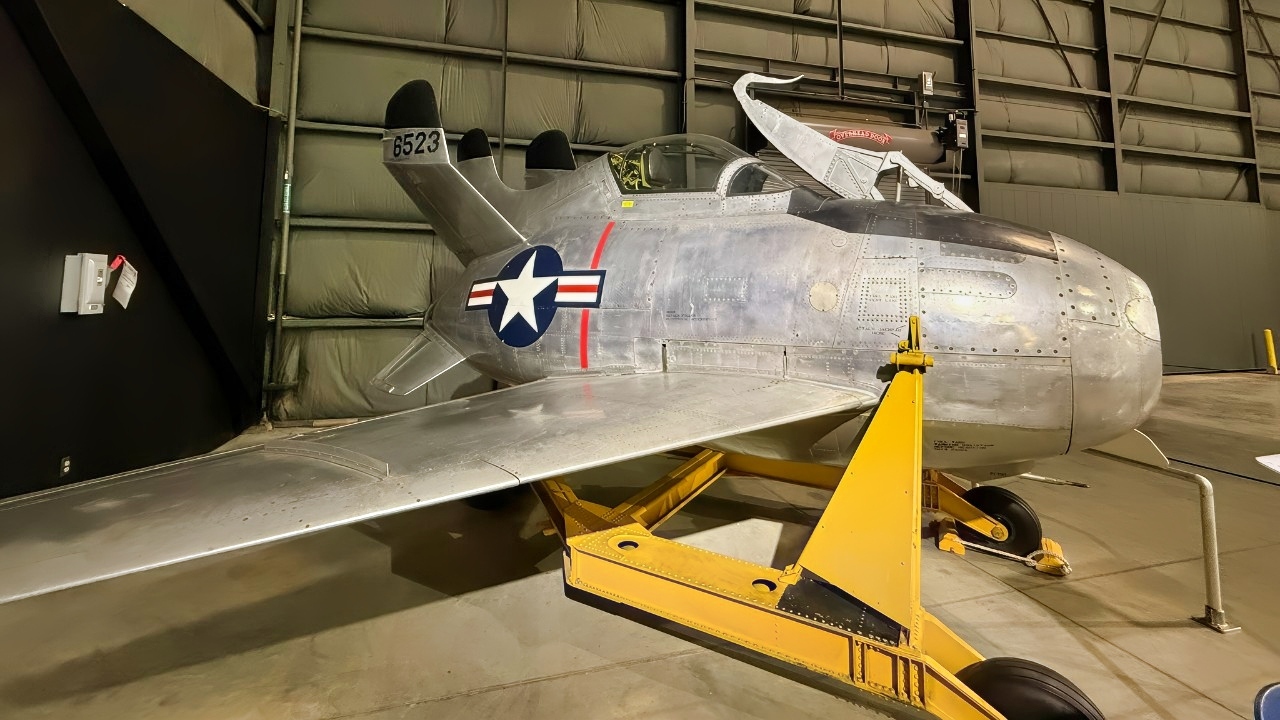
The XF-85 Goblin remains one of the most eccentric “what-ifs” of the early Cold War. Image Credit: National Security Journal.
The Unusual “Parasite Fighter” Concept
During World War II, the U.S. sought to address the issue of bomber protection. Early daylight bombing campaigns over Europe resulted in heavy losses until long-range escort fighters such as the P-51 Mustang became available. Even then, fighter range was always a limiting factor. As bomber technology advanced, the problem intensified rather than diminished.
By the mid-1940s, the United States was developing bombers such as the Convair B-36 Peacemaker, an aircraft capable of intercontinental missions that no contemporary fighter could hope to match in range.
The concept that emerged was that of the “parasite fighter,” a small interceptor carried by a larger “mother ship” and deployed only when enemy fighters appeared.
This idea was not without precedent. During the interwar period, the U.S. Navy had successfully operated Curtiss F9C Sparrowhawk biplanes from the rigid airships Akron and Macon, launching and recovering them using trapeze systems. Earlier still, British experiments during World War I had explored similar concepts using airships.
These historical examples demonstrated that in-flight launch and recovery were possible under controlled conditions, encouraging Air Force planners to consider whether the idea could be adapted to the jet age and to heavy bombers such as the B-36.

B-36J NSJ Photo July 2025. Image Credit: Harry J. Kazianis.

B-36J Bomber National Security Journal Photo. Image Credit: Harry J. Kazianis

B-36 Bomber Dayton, Ohio USAF Museum. Image Credit: National Security Journal.
Design and Development
In response to a 1944–1945 Army Air Forces requirement for a compact fighter that could be carried internally by a bomber, McDonnell Aircraft Corporation proposed what became known as the Model 27. This design was eventually designated XP-85 and later XF-85, and was nicknamed “Goblin” for its small, stubby appearance.
The aircraft was intended to be carried inside the bomb bay of the B-36 or the Northrop B-35 flying wing, deployed in combat, and then retrieved before the bomber returned to base.
The physical design of the XF-85 Goblin was dictated almost entirely by the need to fit inside a bomber’s bomb bay. The result was an aircraft unlike any conventional fighter. The fuselage was short and bulbous, often likened to an egg, with a pressurized cockpit mounted above a single turbojet engine.
The wings were short and swept, folding upward to reduce the aircraft’s footprint when stowed. Overall length was just under fifteen feet, with a wingspan of roughly twenty-one feet, making the Goblin one of the smallest manned jet aircraft ever built.
The compact size imposed severe limitations on fuel capacity, avionics, and pilot comfort, but it was the only way to meet the internal carriage requirement.
General Specifications of XF-85
Power was provided by a Westinghouse J34-WE-7 turbojet producing approximately 3,000 pounds of thrust. In theory, the Goblin could reach speeds approaching 650 miles per hour and climb rapidly enough to intercept attacking fighters. Planned armament consisted of four .50-caliber Browning machine guns, comparable to late-World-War-II fighters and considered adequate for short-range defensive engagements.

XF-85 Goblin Up Close National Security Journal Photo.
Notably, the aircraft had no conventional landing gear. Since it was never meant to operate independently from runways, it relied on its host bomber for launch and recovery. A retractable skid was fitted solely to allow emergency landings during test flights.
Central to the concept was the trapeze launch-and-recovery system.
The host bomber would open its bomb bay and lower a trapeze mechanism, from which the Goblin would be suspended.
For launch, the fighter’s engine would be started while hanging beneath the bomber, after which it would detach, drop away, unfold its wings, and enter free flight. Recovery was far more demanding.
The Goblin’s pilot had to maneuver into position beneath the bomber and engage a retractable hook in the fighter’s nose with the trapeze.
This procedure required precise control in a turbulent airflow environment generated by the bomber’s large fuselage and wings, making the task exceptionally difficult even under ideal conditions.
Flight Tests and Failure of the Parasite Fighter
Flight testing began in 1948 at Muroc Army Airfield in California, using a specially modified B-29 as the carrier aircraft due to delays in the B-36 program. Initial tests showed that the Goblin was generally stable and controllable once in free flight, and pilots reported that its basic handling characteristics were acceptable.
However, attempts at recovery quickly revealed the concept’s most serious flaw. The turbulent air beneath the bomber made it extremely difficult to maintain precise positioning, and even minor errors could cause the Goblin to oscillate violently or miss the trapeze entirely. In one notable incident, the fighter’s canopy struck the trapeze during a recovery attempt, shattering the plexiglass and forcing an emergency landing on a dry lakebed.
Out of seven free-flight tests, only a few ended with successful airborne recoveries.
In approximately half of the flights, pilots were unable to connect to the trapeze and therefore performed emergency skid landings.
Test pilots concluded that if experienced experimental aviators struggled to recover the aircraft under controlled conditions, operational pilots facing combat stress and enemy action would have little chance of success.
These findings cast serious doubt on the practicality of the parasite fighter concept as implemented by the XF-85.
By late 1949, the U.S. Air Force decided to cancel the XF-85 program for several reasons. Jet fighter technology was advancing rapidly, and newer fighters offered superior speed, maneuverability, and armament compared with those of the small Goblin.
At the same time, aerial refueling techniques were improving and proving far more flexible and scalable than parasite fighters. Rather than redesigning bombers to act as airborne aircraft carriers, the Air Force could extend the range of conventional fighters, solving the escort problem more efficiently.
About the Author: Isaac Seitz
Isaac Seitz, a Defense Columnist, graduated from Patrick Henry College’s Strategic Intelligence and National Security program. He has also studied Russian at Middlebury Language Schools and has worked as an intelligence Analyst in the private sector.


