

On Tuesday Morning, Ukraine launched a large-scale drone attack against Moscow and other regions of Russia, utilizing several hundred attack drones.
According to local reports, the attacks set fire to a building in one of Moscow’s industrial districts and damaged civilian infrastructure in the area.

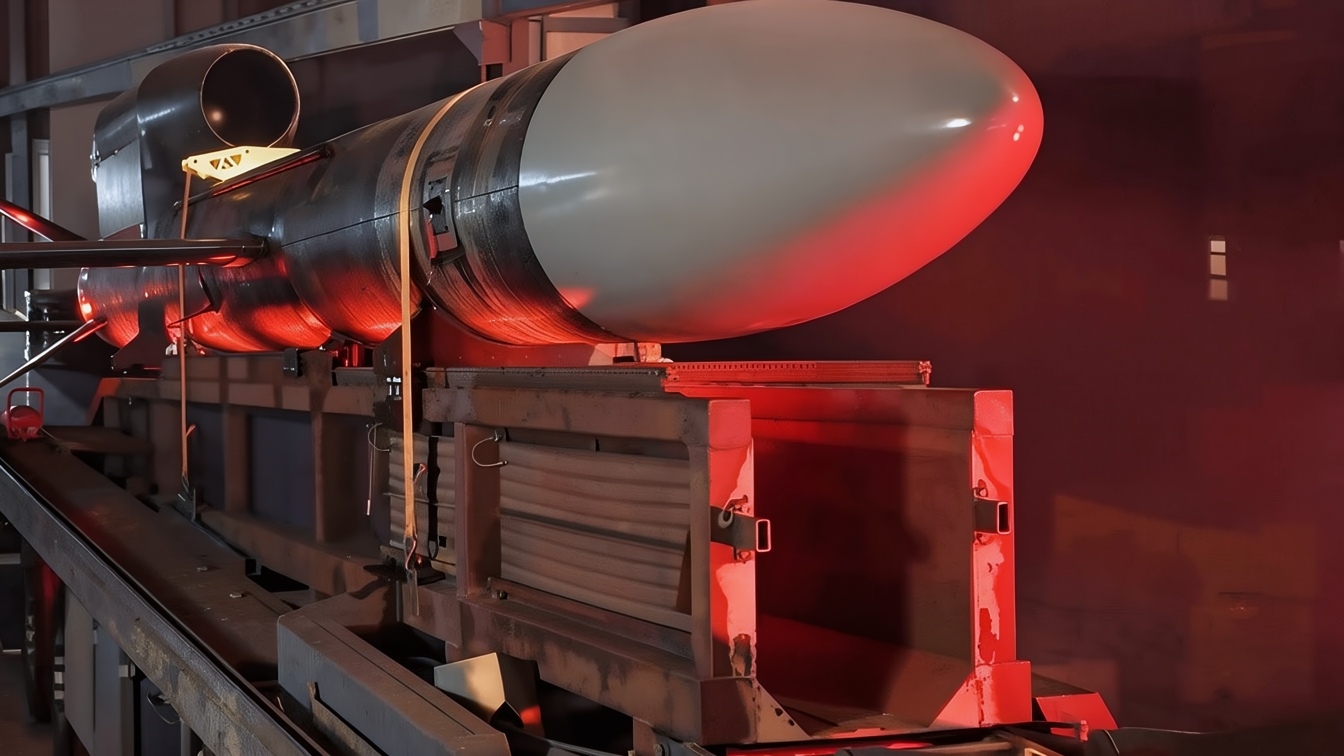
Shahed Drone from Ukraine. Image Credit: Creative Commons.
In the Leningrad region, a drone attack reportedly hit another Wildberries logistics warehouse, while another warehouse in the Tver region was also struck.
According to the Russian Ministry of Defense, over 320 attack drones were intercepted in Russian airspace.
The attacks occur as Russia intensifies its own aerial campaign over Ukraine, as the war between Moscow and Kyiv continues to intensify.
Another Drone Attack Against Moscow
According to Andrey Vorboyov, the regional governor of Moscow, a large number of Ukrainian drones breached Russian airspace, many of which targeted the Moscow region.
Debris from falling drones reportedly started several fires in the Chekhov municipal district and in the Novoselok Industrial zone.
At least five people were killed, and six more were injured as a result of the attacks.
Vorobyov did not specify whether any drones had directly impacted any facilities in Moscow, nor did he specify the exact scale of the damage.
The governor clarified that falling debris had damaged an electrical substation and an administrative building. As of now, there have been no reports of blackouts anywhere in the Moscow region.
Other regions across Russia likewise reported activity from Ukrainian drones. According to the regional governor of Leningrad, Aleksandr Drozdenko, at least 17 drones were intercepted in the region, with no injuries reported.
The attack did, however, strike a warehouse belonging to the online retailer Wildberries in the Krasny Bor area. In the Tver region, another Wildberries warehouse was struck by drones, according to regional governor Vitaly Korolev on Telegram.
Meanwhile, in the Rostov region, another 40 drones were intercepted, and three more were intercepted over the Tula Region.
Escalating the War in Ukraine
According to the Russian Ministry of Defense, air defenses managed to intercept around 320 Ukrainian attack drones across Russia.
UAVs were intercepted in the Belgorod, Bryansk, Kaluga, Kursk, Oryol, and Moscow regions, as well as around the Black Sea.
This latest attack followed another Ukrainian drone attack against the Krasnodar region.
During the attack, one drone, which was reportedly intercepted by air defenses, crashed into a populated beach and killed seven people and injured another 58 people.
Russian authorities accused Ukraine of deliberately attacking civilians, while Kyiv denied the accusations and blamed the strike on Russian air defenses, which intercepted the drone above a populated area.
Both Russia and Ukraine have been intensifying their attacks against each other.
With the development of mid-to-long-range drones by Kyiv, Ukraine has massively intensified its drone campaign against targets deep behind the front lines.
According to the Russian MoD, around 13,312 Ukrainian drones were downed along the front lines and over Russian airspace.
Originally, the campaign’s main targets were fuel infrastructure and refineries, which have caused a fuel shortage that Russia is only now starting to recover from.
Now, the campaign has expanded to include warehouses belonging to the online retailer Wildberries. In the future, Ukraine is likely to target Russia’s electrical grid and other energy infrastructure, especially as winter approaches.
Russia has likewise ramped up its attacks against Ukraine over the past months.
Since May, Kyiv has experienced some of the largest missile attacks of the war yet, with several hundred ballistic missiles being launched at the capital. Consequently, Ukraine’s stock of interceptor missiles has been running low, a fact that Moscow has been more than eager to exploit.
In response to Ukrainian attacks against commercial ships in the Sea of Azov, Russia has also been attacking Ukraine’s Black Sea port and any ships heading to or from the port of Odesa.
Consequently, maritime traffic to and from Ukraine has come to an abrupt halt.
Assessing the Success Of Ukraine’s Drone Campaign So Far
In June, Zelenskyy announced that he had approved a 40-day operation to pressure Moscow into ending the war.
Assuming the operation started on June 25, when Zelenskyy first made the announcement, it has now been two days since the conclusion of Ukraine’s influence operation as of this writing. It is safe to conclude that the operation, if it existed at all, has failed.
While Ukraine has dealt significant damage to the Russian economy, Moscow has instead doubled down on its war effort against Kyiv.
The campaign has indeed brought the war to Russia, as Zelenskyy wanted, but there have obviously been unintended consequences.
Now, Kyiv is running low on Patriot interceptors, its Black Sea ports are effectively closed, and glide bomb strikes from Russia are reaching their all-time highs.
Kyiv’s problems are further exacerbated by manpower shortages on the front lines that have yet to be adequately addressed.
After grinding to a halt in May and June, the front line has started to move again in Russia’s favor.
With Kostyantynivka mostly under Russian control, Russian forces have been consolidating their positions and have begun moving slowly towards Sloviansk and Kramatorsk, and are reportedly only 4 kilometers away from the outskirts of both cities.
According to OSINT estimates, Russian forces have also made small gains in the Zaporizhzhia and Kharkiv regions. This is not to say that the situation is lost for Ukraine, far from it.
Ukraine has made its own gains in the Dnipropetrovsk and Donetsk regions.
However, despite the wide presence of drone attacks against logistics and targets in Russia’s rear, the Ukrainian Army has been unable to translate those strikes into tactical gains.
The reshuffling of the Ministry of Defense in the last month likely hasn’t helped in that regard.
About the Author: Isaac Seitz
Isaac Seitz, a Defense Columnist, graduated from Patrick Henry College’s Strategic Intelligence and National Security program. He has also studied Russian at Middlebury Language Schools and has worked as an intelligence Analyst in the private sector.


