
Russian President Vladimir Putin is under pressure from multiple angles, with his country’s domestic fuel market struggling under the weight of Ukrainian strikes on refineries and diminishing returns on the front line. But with Washington growing tired of the war it started in Iran, Putin may now see an opportunity to test NATO.
New U.S. intelligence suggests that the Kremlin believes the prolonged American campaign against Iran has weakened Washington’s military position and could give Moscow greater freedom to escalate against U.S. interests or allies in Europe, per reports this week.
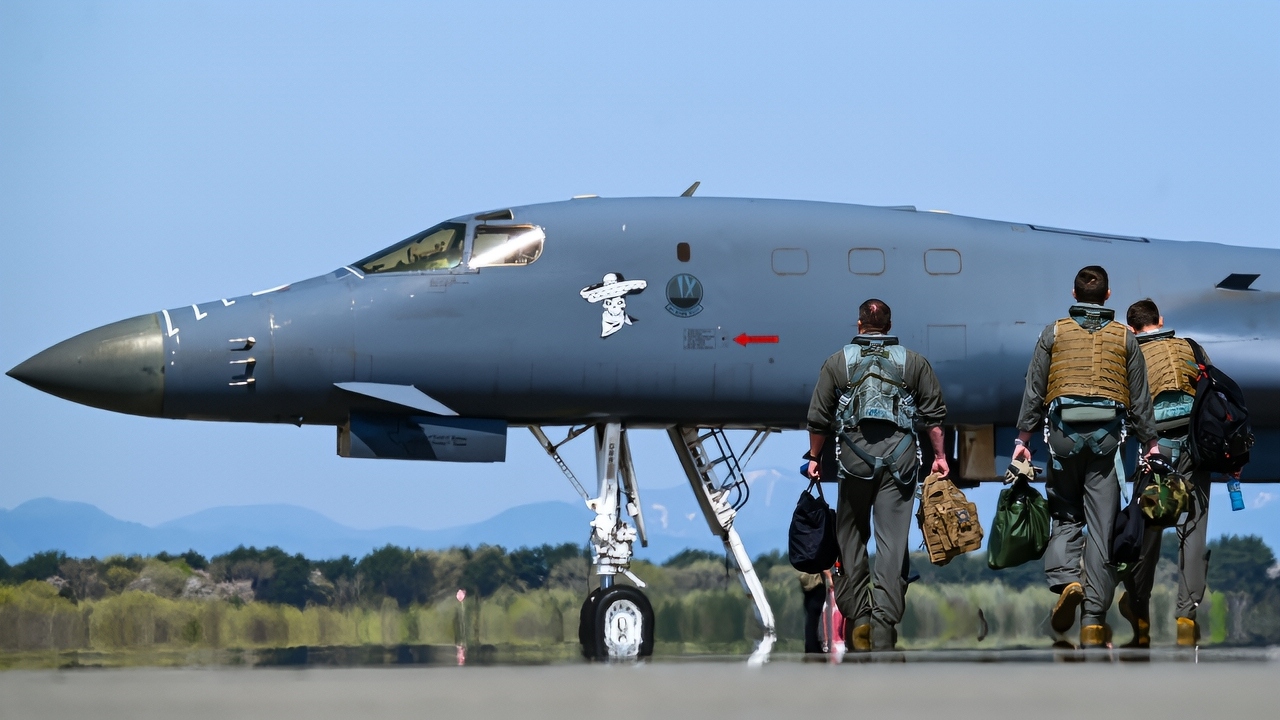
9th Expeditionary Bomb Squadron aircrew step out to the B-1B Lancer during Bomber Task Force 25-2 at Misawa Air Base, Japan, May 9, 2025. BTF 25-2 demonstrates Allied strength by forging strong alliances, showcasing our resolve, and deterring aggression, while also supporting global stability and security and strengthening military capabilities. (U.S. Air Force photo by Airman 1st Class Mattison Cole)

A U.S. Air Force B-1B Lancer assigned to the 345th Expeditionary Bomb Squadron is photographed after landing at Dyess Air Force Base, Texas, Aug. 22, 2025. Three bombers deployed for Bomber Task Force Europe with a total force integration team composed of roughly 30% active-duty and 70% reserve Airmen from the 7th Bomb Wing and 489th Bomb Group. (U.S. Air Force photo by Senior Airman Jade M. Caldwell)
Those assessments appeared publicly after CIA Director John Ratcliffe made a surprise visit to Moscow on Tuesday, August 25.
While the topics discussed during the meeting have not been officially confirmed, the U.S. official is understood to have warned Russian officials against attacking NATO territory and escalating the war in Ukraine.
He also reportedly pressed Moscow over its continued support for Iran and encouraged Putin to pressure Tehran to open the Strait of Hormuz.
But the trip also came as the Pentagon faces a “beyond critical” shortage of some of the weapons needed to defend Europe – particularly Patriot missile interceptors.
The consequences of the Iran war are being felt economically and in a military sense for Washington, and Russia has noticed.
President Donald Trump, however, insists that there is little reason for concern, saying Thursday that Putin would not attack NATO territory. But given Putin also made assurances that he would not invade Ukraine, it’s no wonder the president’s assessment is not shared by every analyst.
What U.S. Intelligence Says
The U.S. intelligence community appears to be concerned that Russia is preparing to escalate against NATO countries, but not necessarily that the Kremlin is preparing a Ukraine-style invasion.
Instead, the most recent assessments indicate that Putin may authorize a more limited operation designed to test NATO’s resolve and see whether NATO members – and particularly the United States – would actually respond collectively.
According to a report by The Washington Post, U.S. intelligence specifically assessed that Moscow sees Washington as being weakened by the Iran war and sees an opportunity to escalate in a way that hurts American interests.
The idea that Russia could test NATO is not all that unlikely, given the multiple ways it could test America’s willingness to respond.
A full invasion involving ground forces would not be necessary.
Moscow could, in theory, pursue asymmetric tactics, hybrid operations, cyberattacks, or other provocations that fall well below the threshold of conventional war.
Recent incidents also show Russia is willing to act. Russian drones have entered Romanian airspace, a missile has crossed into Poland, and there have been suspected examples of Russian sabotage and cyber operations throughout Europe.
Analysts also expect that Russia may be considering an incursion or limited strike against one of the Baltic states (Estonia, Latvia, or Lithuania) – a move that would test whether NATO would invoke Article 5 and treat a limited strike or incursion as a threat to the entire alliance.
Ratcliffe Allegedly Issued A Warning to Moscow
Those details could shed light on what Ratcliffe was doing in Moscow.
The CIA director arrived Tuesday aboard a U.S. C-17 military transport aircraft following a stop in Riga, Latvia. Flight-tracking data then showed the aircraft leaving Moscow about eight and a half hours later.
Ratcliffe did not meet Putin, but Kremlin officials confirmed talks with Russian intelligence officials. Some reports suggested that Ratcliffe warned Moscow not to attack NATO members in response to recent U.S. intelligence assessments, while other reports indicated that he discussed Iran and warned that further sanctions would hit Russia if it continued to do business with Iran.
But other reports suggest that Ratcliffe had a more specific warning: that Washington could do more to help Ukraine if Russia were to significantly escalate the war in Ukraine.
Moscow has disputed those characterizations of the visit, however, with Kremlin spokesman Dmitry Peskov describing the reports as “scare stories.” President Donald Trump also described the visit as “semi-routine.”
Iran War Leaves Plenty Exposed
Moscow has a solid reason to believe Washington is stretched thin. Even before the Iran war, analysts had been warning for years that the U.S. was overextended – and after six months of fighting with Iran, U.S. stocks of Patriot interceptors have been severely depleted. Roughly a quarter of America’s MQ-9 Reaper drone fleet has also reportedly been lost during the conflict.
That matters particularly for Ukraine, which is already struggling with dwindling supplies of U.S.-provided air defense interceptors as Russia intensifies long-range strikes against Ukraine.
European countries have also promised additional interceptors, but the hundreds that have been committed – including recently from Germany – won’t begin to arrive until next year and won’t be fully delivered until 2028.
Putin therefore knows NATO would struggle to respond.
The U.S. could still fight back, obviously, but the chances Washington would calculate that defending NATO was not firmly in its interests are higher than they were before. And Putin knows it.
About the Author: Jack Buckby
Jack Buckby is a British researcher and analyst specializing in defense and national security, based in New York. His work focuses on military capability, procurement, and strategic competition, producing and editing analysis for policy and defense audiences. He brings extensive editorial experience, with a career output spanning over 1,000 articles at 19FortyFive and National Security Journal, and has previously authored books and papers on extremism and deradicalization.


