

Key Points and Summary – Russia is reorganizing for industrial war: fewer prestige projects, more factories, rotations, and repair cycles.
-The future force will be heavier, cheaper, and software-driven—favoring standoff fires, layered air defense, and drone-EW mass over classic air or maneuver dominance.

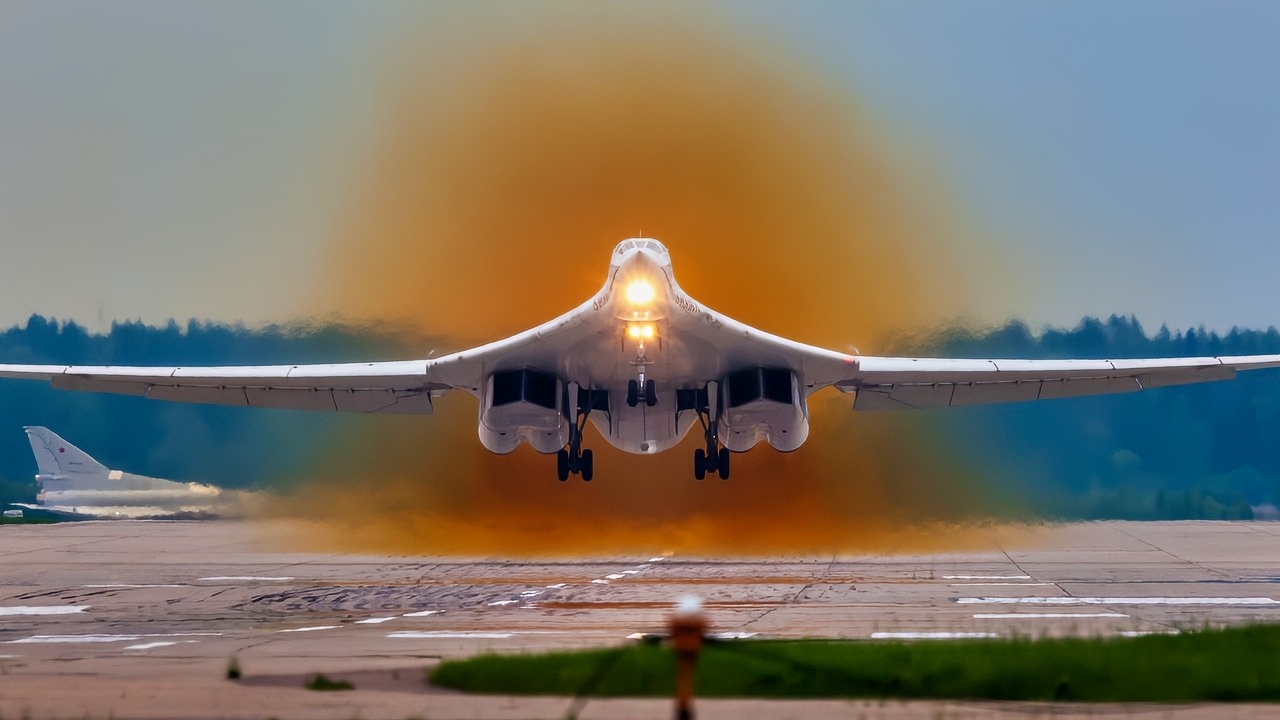
Russia Tu-160 Bomber. Image Credit: Creative Commons.

Russian Tu-160 Bomber. Image Credit: Creative Commons.
-The Black Sea Fleet’s dispersal, mass glide-bomb use, and iterative missile updates preview a doctrine of survivable coercion, not shock-and-awe.
-This makes Russia a regional power with global strike tools—dangerous but containable.
-NATO’s answer is production and resilience: stable magazines, rapid air-defense software refresh, hardened C2/EMS, and SHORAD/EW down to small units.
-Do the math now, and Moscow’s rebuilt military becomes manageable—not a strategic surprise.
Russia vs. NATO: How Moscow Sees the Future
Industrial wars rarely end with banners and brass; they end with a military that staggers out of the furnace, uglier than before but better suited to the fight it just survived.
That is where Russia is headed.
After Ukraine, Moscow is likely to field a force that is heavier, cheaper, more automated, and optimized for grinding campaigns along its rim—not ten feet tall, but dangerous enough to coerce neighbors, complicate NATO planning, and secure Great Power standing through usable, sustainable force.
From Prestige to Production
The most consequential change has been organizational. Reconstituted military districts, revamped command arrangements, and a technocratic defense chief signal a system built to convert rubles into munitions, rotations, and repair cycles at scale.
Instead of chasing prestige platforms, the state has embraced the arithmetic of war management: keep ammunition flowing, keep units manned, keep depots stocked, and keep factories humming.
That choice says more about Russia’s long-term capability than any parade. It reflects a government that anticipates protracted tension and is constructing an apparatus to endure it—and, in doing so, to anchor Great Power status with force that can actually be fielded.
This managerial turn intersects with industrial improvisation. Sanctions slowed but did not halt component flows; domestic lines expanded; foreign sourcing adapted accordingly. The result has been a migration from boutique precision toward “good-enough” precision—an approach that prizes volume, survivability, and iterative software over exquisite hardware.
For the next decade, that bias will shape the force more than slogans about modernization cycles ever could, and it will do so in ways that make Russia harder to deter in its near abroad.
How Russia Will Fight Next
The arsenal that emerged under fire offers the clearest preview of how Russia will fight next.
Russia’s air and missile capabilities evolved into a standoff capability rather than classic dominance. Pilots avoided the densest air defenses while ground crews fed the front with large daily volumes of glide bombs fitted with simple planning kits.
Cruise and ballistic salvos were timed to erode air defenses, strike logistics, and punish cities without risking core aviation assets. Recent battlefield reporting also indicates that altered missile profiles and software updates have occasionally stressed Western intercept systems.
This is not shock-and-awe; it is routinized pressure that conserves aircraft and crews while wearing down an opponent’s magazines and morale. A post-war aerospace force built around this method will emphasize long-range fires, robust air defense of key regions, and continuous software refreshes that keep standoff weapons tactically current.
On the ground, the army that returns from Ukraine will be larger, older, and harder. Losses were severe, training pipelines were thin, and NCO quality was uneven. Yet the force learned to fight inside a dense web of drones, electronic warfare, mines, and artillery.
Battalion-level maneuver at NATO standards remains elusive, but siegecraft has improved, with advances in sapping, fortified lines, rolling barrages, and drone-directed fires that trade time for attrition. This is the grammar of a reinforced positional army—less elegant than combined-arms maneuver, but brutally effective when the aim is to move the front by meters and make each meter stick. Sustained by rail logistics and deep magazines, it is also the kind of army that supports Great Power coercion without overreaching.
Electronic warfare, once a boutique specialty, has become a backbone. Wide-area jamming and targeted spoofing suppressed hostile drones and complicated fire control. In response, Russian units diversified their unmanned systems, including cheap first-person-view drones for close work, fiber-optic-guided variants to bypass jamming, and loitering munitions to track radars and target rear echelons.
The pattern is clear. When software and tactics improve lethality faster than airframes and armor can be replaced, the smart money flows to code, antennas, and munitions that can be manufactured in tens of thousands. That spending profile—characterized by low unit costs, high volume, and rapid refresh—locks in a warfighting ecosystem resilient enough to project power regionally and credibly signal global reach with missiles.
The Naval Fleet Eked Out Its Own Experience
At sea, the Black Sea Fleet’s humiliation forced adaptations that will echo across Russia’s littorals. After high-profile losses and repeated strikes on Sevastopol, the fleet dispersed, hardened ports, leaned into coastal defense, and treated large combatants as missile trucks to be hidden rather than symbols to be displayed. Expect more unmanned countermeasures, layered harbor defenses, and standoff launch profiles.
The navy will remain a coercive tool, but its appetite for exposure in crowded seas has shrunk—another case of trading glamour for staying power.
These adaptations share a common logic: lower unit costs, higher production, shorter integration cycles, and tactics that prioritize survivability over speed. Geography and time—not magic—did the rest.
Rail-fed logistics pushed shells forward; rotation policies preserved unit coherence; and local salients were accumulated without the catastrophic bets early-war planners made and lost. That is the template the General Staff will bank.
It is not designed for expeditionary war; it is intended to prevail in proximity and to deter outsiders from testing that proximity—securing Great Power stature through sustained coercive capacity rather than theatrical breakthroughs.
Containment Is a Math Problem
Post-war Russia will be a regional power with global strike instruments, not a global power with a regional problem. Its army will be built to deny and grind on home ground; its aerospace forces will favor standoff strikes and layered air defense of critical regions; its navy will act as a missile bastion rather than a blue-water duelist.
Demography, training depth, corruption, and mobilization politics will still drag on performance. Even so, mobilized industry, battle-tested processes, and a regime that tolerates loss will offset those weaknesses enough to keep Russia in the Great Power tier.
For the United States and NATO, dismissing Russian sloppiness as institutional collapse would be a mistake. The real lesson is that Russia optimized for the fight it had and will continue to optimize for the fights it expects: border coercion, attrition campaigns, and episodic salvos aimed at eroding political will.
Deterrence is less about rhetoric than math. If allied magazines are scarce, interceptors are thin, counter-UAS kits are limited, and repair timelines are long, the Kremlin’s approach works. If production is steady, C2 is hardened, electromagnetic posture is resilient, and replenishment is predictable, the Kremlin’s approach struggles.
That demands sustained, boring industrial discipline. Shells, rockets, interceptors, and counter-drone systems must be produced at levels that make tempo sustainable, not theatrical. Air and missile defenses should be treated as software-defined systems with continual updates, not decade-long programs with ceremonial milestones.
Ground forces need more EW and short-range air defense at the lowest echelons, not just new vehicles with impressive spec sheets. Maritime concepts should assume contested littorals saturated with unmanned systems on day one and be built to endure that environment.
Will Post-War Russia Continue to Fight?
Russia, after Ukraine, will not be primed to march on Berlin; it will be primed to make Berlin blink. That difference matters. The contest ahead is not a morality play about virtue but a test of who can out-produce salvos, out-adapt code, and out-last the grind.
Do the arithmetic now—industrial, tactical, and political—and a rebuilt Russian military becomes a containable fact of European geopolitics rather than the seed of the next strategic surprise.
In that world, Moscow’s claim to Great Power status rests not on theatrics but on a durable, if ruthless, capacity for sustained coercion—and prudent deterrence must be built to withstand exactly that.
About the Author: Dr. Andrew Latham
Andrew Latham is a Senior Washington Fellow with the Institute for Peace and Diplomacy, a non-resident fellow at Defense Priorities, and a professor of international relations and political theory at Macalester College in Saint Paul, MN. You can follow him on X: @aakatham. He writes a daily column for the National Security Journal.
More Military
Canada Is ‘Full Steam Ahead’ on F-35 Stealth Fighter
Why Does Turkey Have So Many Main Battle Tanks?
‘Cracked Barrels’: The U.S. Navy’s Big Railgun Failure Explained in Just 2 Sad Words
‘Had No Chance’: The Montana-Class Was the 71,000-Ton Battleship Destined to Fail
‘Captain, We Smacked It Another Submarine’: British and French Nuclear Missile Subs Collided


Jim
October 8, 2025 at 8:38 pm
From the Key Points and Summary:
“-This makes Russia a regional power with global strike tools—dangerous but containable.”
A regional power with 6,000 nuclear warheads.
The largest country on Earth.
Has potentially the most natural resources of any country.
Spans eleven time zones.
Has been fighting a NATO proxy and winning.
Russia has been building their military capacity for a long time. Well before the Feb. ’22 invasion, but has since ramped up to a partial mobilization with part dedicated to the present war and another part dedicated to a potential, future General European War against NATO.
After Putin stated Russia’s red line rejecting NATO membership for Ukraine at the 2008 NATO Bucharest Summit, Russia started revitalizing their military industries… although, many basics remained from Soviet times, some where brought out of moth balls.
In 2025, after three and a half years of war (a war they see as existential), Russia has the most nimble, dynamic, and responsive military industrial base on the planet.
It’s not a new thing, but the intensity since the war started is a new dynamic and Russia has benefited from it… nothing like military necessity to speed up innovation.
Given the bellicose statements out of Europe from leaders who almost to a man have deep political problems back home (France, Britain, Germany) one wonders what they are thinking.
Why in their right minds would they want a war of choice against Russia? Yet, it sounds that way.
To see Russia as anything other than a Great Power along with the United States and China, possibly India is to make the mistake of underestimating your opponent.
And, at this point, one can argue Russia is a Super Power along with China and the United States.
This isn’t 1991 anymore.
The idea of “containment” is from the Cold War.
The reality, we are moving to a Multipolar World, if we aren’t already there.
Containment is an outdated concept.
We need new strategy for the 21st Century.
Swamplaw Yankee
October 9, 2025 at 1:55 am
One recalls the scenes when despondent old Canuck men where to be seen moping about Ontario. Many were old pensioners who had to singly lament the recent termination by a real Trudeau of the “HOT” living furnace of Hamilton Ontario’s steel hub. That is, Canada was so very silently industrially reduced by a MSM already weaned on huge tax payments from the Trudeau Cabal. No one in big film and arty Toronto gave a shit about the terminated, suddenly vanished, industrial steel capacity.
One recalls the decades long extirpation of Buffalo, Baltimore, Cleveland, Pittsburgh, Chicago furnaces. Such visual reminders of a cognitive position that this post-war society enjoyed. Yeah, The tsarling Putin NAZI-like FSB networks in North America rejoice as their MSM implants silence any voice in North America who wants to do as their boss Putin does in Ukraine.
Who was that guy who left the Commie embassy in Ottawa loaded with ruuzzkie butcher Stalin’s files on his KGB spy implants all across North America? How the post war ‘arrogant’ Canadians refused to grant this ruuzzkie run away immediate physical protection from the vast army of KGB agent/ spies that suddenly, magically, materialized all across downtown Ottawa to hunt this turn coat so as to immediately kill him.
Yeah, the current tax funded CBC ( Canada’s NPR) always has a traditional great urge to reopen and re-focus on CCP Xi + Ruuzzkie Putin spy/ agent networks in Canada/ USA. Forget about the muslim terrorists such as Unkle Binnie as that is “islamaphobia” in those frozen mind sets.
When we used to walk from the RCMP office to the Ruuzzkie Commie HQ in down town Toronto to monitor their drunken parties in their Commie HQ, I often asked if the various fellas had read all the books authored by the above Ottawa emigre from Stalin’s KGB butcher squad. None had read each and every book. Actually most lefty pinkoe public librarians refused to even stock his books as they were “too” anti-commie for their type of western “taste”.
Yeah, Putin’s oligarch structure must have a morphology change. As the 2014 POTUS H. Obama Democrat Cabal unilaterally green lit the irreplaceable geopolitical loss to NATO of the Ukrainian Crimean soil, Families and Black/Azov Sea jurisdictional zones to the prime vile cold war enemy of the WEST, tsarling Putin the MSM/Academia of the WEST slept.
11 years later, only the Ukrainians have readjusted their industrial capabilities. The Ukrainians know about surge production capacity that their society needs to survive the category of “2012-13-14” snoring of the analysts of the WEST.
That the real NAZI partners in Moscow are still in Moscow seems not to bother any of their ruuzzkie ethnic progeny. The NAZI-like FSB still dreams of huge Genocide hits on innocent Ukrainians to equal the 1932-33 Genocide of 20,000,000 HOLODOMOR victims. Kill and butcher all in legal ruzzkie law, while dressed in Halloween costumes of KGB Stalin or FSB Putin.
The game is afoot. The WEST sleeps, its analysts on opioids, as the PRC CCP Xi regime directs its vassal Putin thru the CCP covert financial coverage of all ruuzzkie deficits. Or, will the Xi regime realistically alter its LONG GAME. Drop the Genocide genetic driven Putin and swivel to a beneficial ( needed ) type partnership with the proven brilliant thinkers of Ukraine? -30-
Krystal cane
October 9, 2025 at 12:41 pm
With a complete moron like Donald Trump in charge of the United States and destroying our credibility with all our allies Putin doesn’t need any more help than that . Think about it any new vets who bust your ass worked hard and it all the stuff you could do to keep America safe You voted in a complete moron more than once to destroy this nation oh just to kind of like stick to the libs right.