

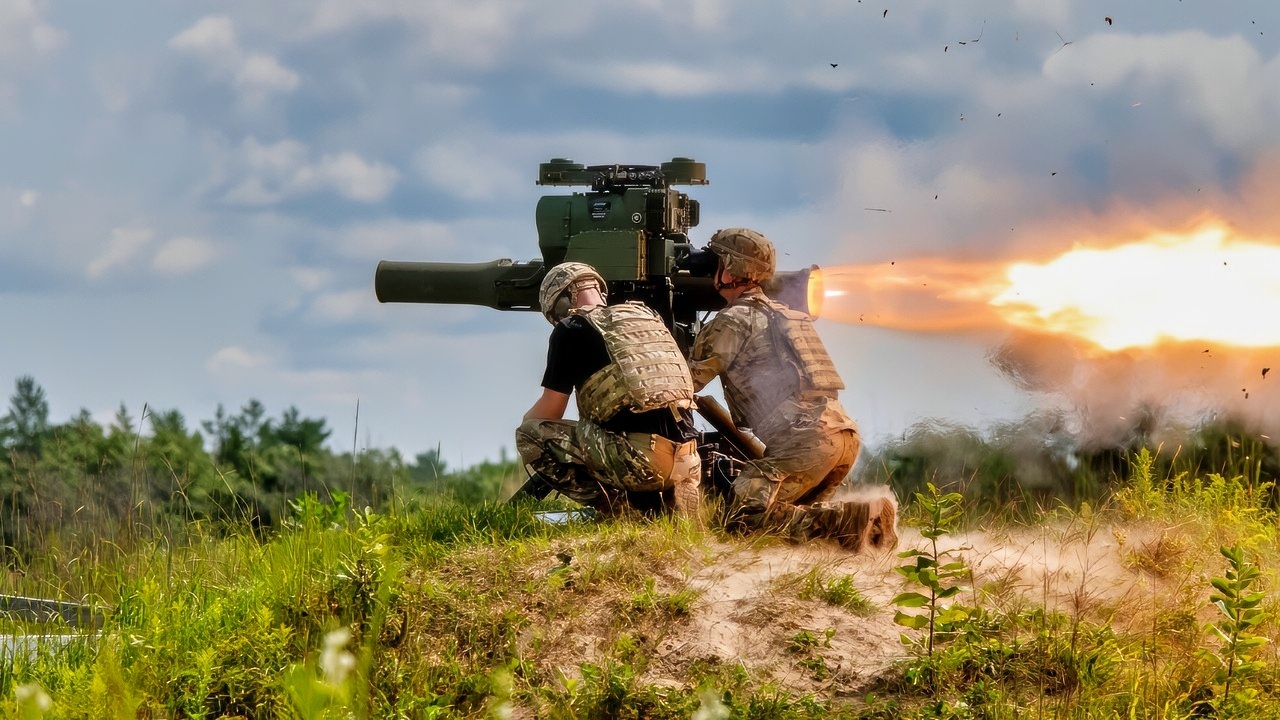
Key Points and Summary – First fielded in 1970, the tube-launched, optically tracked, wire-guided (TOW) missile remains a frontline anti-armor staple because it keeps evolving.
-Early combat wins in Vietnam proved the concept; later TOW 2A tandem warheads defeated ERA, while TOW 2B introduced “fly-over, shoot-down” top-attack with dual EFPs.
-Modern variants like TOW 2B Aero add range, improved guidance, and integration on vehicles, tripods, and helicopters across 46 allied users.
-Ongoing Raytheon upgrades extend service life beyond 2050, enhance lethality, and add wireless guidance options—keeping TOW relevant against today’s tanks, IFVs, bunkers, and even limited helo threats in all-weather conditions.
Why Is The TOW Missile Still Being Used?
The tube-launched, optically tracked, wire-guided (TOW) missile system is a crew-portable, vehicle-mounted, heavy anti-armor weapon system.
It consists of a launcher and a missile that can be employed in all weather conditions to engage tanks, other armored vehicles, and various point targets including bunkers, crew-served weapons and launchers, and non-armored vehicles. The system also has a limited self-defense capability against helicopters.
The launcher consists of a launch tube, traversing unit, missile guidance set, night sight, battery assembly, optical sight, tripod, overpack, shroud, and carrying strap.
The all-up round missile is encased in a disposable launch container. The TOW can be operated from the ground, from vehicles, or from helicopters. It is mounted on the Improved TOW Vehicle, the Bradley Fighting Vehicle, the High Mobility Multipurpose Wheeled Vehicle , and the military’s attack helicopters. A total of 46 allied nations use the TOW, which is co-produced in Switzerland.
Development For The Tow Missile Began In the 1960s
Hughes Aircraft began development of the TOW missile in the 1960s to replace older anti-tank weapons. Full-scale production began in 1968, and the U.S. Army fielded it in 1970.
The system first saw combat in 1972 during the Vietnam War. It has been continually upgraded since its introduction, allowing it to remain a significant anti-tank weapon for the U.S. and allies. The system’s name describes its operation: a missile tube launch, optical tracking by the operator, and wire guidance for flight, allowing for versatile use from vehicles, helicopters, and ground mounts.
Many analysts wonder why the Army continues to use the TOW missile today, as it was first fielded nearly 55 years ago. The short answer is two-fold: it is still deadly, and it is constantly being upgraded to be more effective.
First Combat In Vietnam Was Very Successful
On May 2, 1972, the TOW missile made military history by becoming the first American-made guided missile to be fired in combat by U.S. soldiers. While fighting at Kontum, South Vietnam, the 1st Combat Aerial TOW Team, equipped with an XM26 TOW subsystem mounted on a UH-1B Huey helicopter, destroyed a four M-41 tanks, one 2.5-ton truck, and a 105-mm howitzer.
Hugh McInnis was the airborne TOW engineer in the TOW Project Office at the time of the system’s deployment. He recalled, “At that point the airborne TOW was the most novel weapon in the war, and it was a dazzling success. The team never failed to destroy a target once seen.
“Tanks were the primary target, but also on our list were armored personnel carriers, trucks, and machine gun positions. One of the latter I remember especially.
“The enemy had a penchant for mounting a machine gun on the pinnacle of a water tower in Kontum. We would shoot it down, he would replace it, and we would shoot it down again.
“One day someone spotted a small, suspicious looking island in the middle of a river. On a hunch one of our crews shot at the foliage – and sure enough a tank exploded when the missile hit. This led to a suspicion of another island, so it too was shot. But this island – was just an island. Only leaves and dirt rose into the air.”
The TOW 2 was introduced in 1984. This variant featured improvements to deal with armor developments such as Explosive Reactive Armor (ERA).
The BGM-71E TOW 2A incorporated a tandem-warhead armament system to increase lethality against tanks protected by ERA.
The newest version of the TOW missile is the BGM-71F TOW 2B, which started production as an engineering-change proposal to the 1990 production contract.
The TOW 2B is a “flyover shootdown” missile with two Explosively Formed Penetrator warheads. It features a dual-mode sensor and a new armament section equipped with two warheads substantially different from those used in earlier TOW versions.
Because the TOW 2B is designed to attack targets from the top, the trajectory places the missile slightly above the target at the moment its two warheads explode downward. The TOW 2B was not designed to replace the TOW 2A – the U.S. Army concurrently fielded both missiles. The last TOW missiles for U.S. forces were produced in May 1997.
The TOW Keeps Getting Improved And Deadlier
The TOW missile is getting better thanks to continuing development by Raytheon.The company has been awarded a contract modification valued at more than $271 million to continue production of the latest upgraded system.
Recent upgrades have extended the missile’s life cycle beyond 2050, enhanced its lethality against modern armor, and improved its safety and wireless guidance capabilities. The latest variants, such as the TOW 2B Aero, feature improved range and are integrated into various ground, vehicle, and helicopter platforms.
Look Down, Shoot Down Capabilities
The Army is locking in the supply of a long-serving anti-armor staple at a moment when anti-tank guided munitions are being fired in conflicts around the world. The 2B variant – the top-attack version designed to strike from above – is especially relevant.
By attacking from the top, it exploits the thinner roof armor on tanks and infantry fighting vehicles. This development can be seen as a direct result of the drone war in Ukraine.
These changes and upgrades to the TOW missile systems are guaranteed to keep the weapon in the Army inventory for many years to come.
About the Author:
Steve Balestrieri is a National Security Columnist. He served as a US Army Special Forces NCO and Warrant Officer. In addition to writing on defense, he covers the NFL for PatsFans.com and is a member of the Pro Football Writers of America (PFWA). His work was regularly featured in many military publications.
More Military
The F/A-18 Hornet Fighter Has a Message for the U.S. Navy
F-15E Strike Eagle Has Just 1 Mission
Russia’s Su-27 Flanker Fighter: Moscow’s Best Warplane Ever? You Decide
Iowa-Class Battleship USS Wisconsin Has a Message for the U.S. Navy
The U.S. Navy’s USS Connecticut Seawolf-Class Nuclear Attack Submarine Summed Up in 4 Words


