

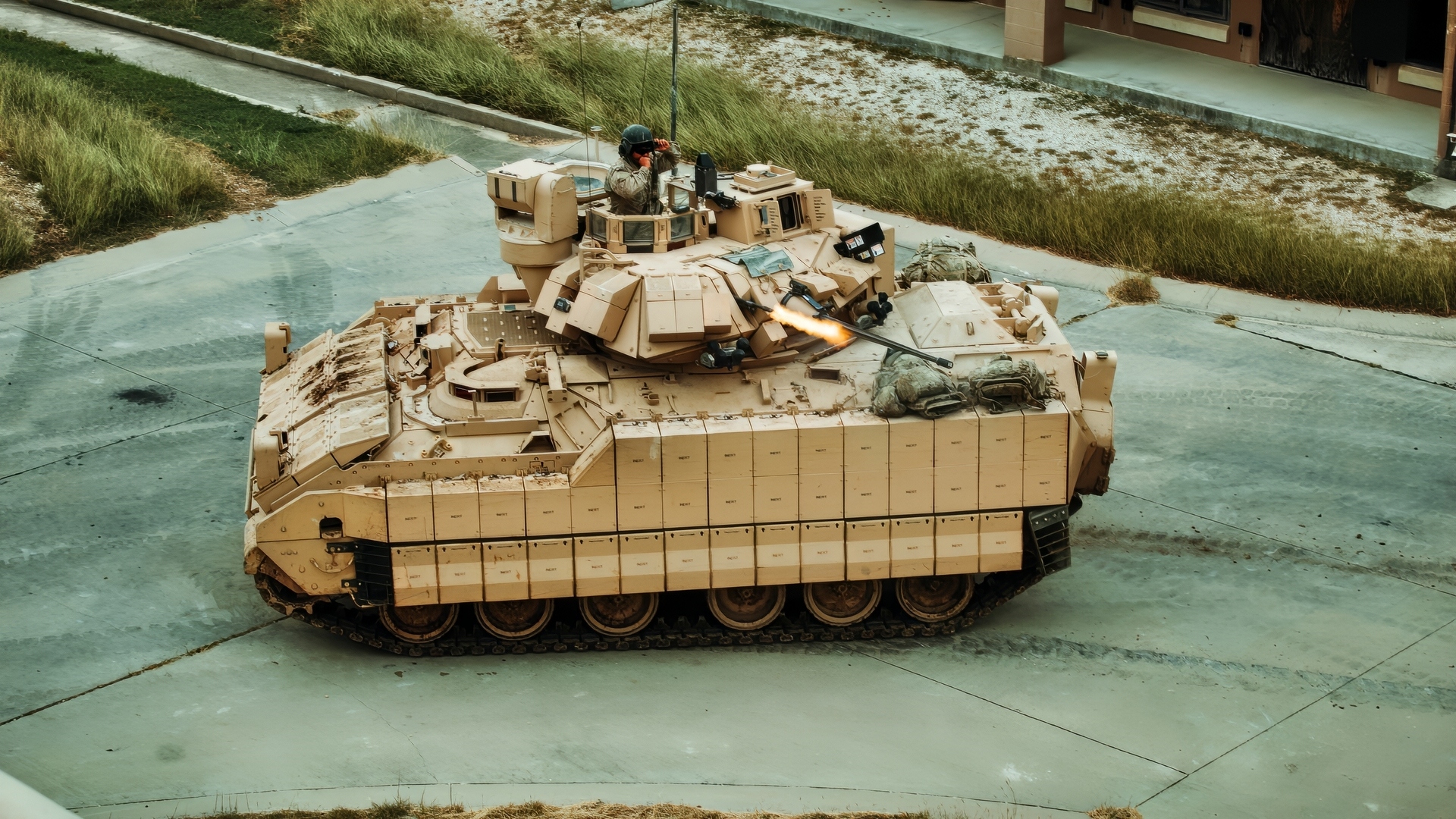
The US Army’s one-two punch on the battlefield during the Cold War was the M1A1 Abrams main battle tank and the M2 Bradley Infantry Fighting Vehicle (IFV). Both platforms were supplied to Ukraine for its war against Russia and were operated mostly by the 47th Mechanized Brigade.
The M1A1’s performance in theatre has been less impressive than anticipated, for a number of reasons. One of those is that this tank was not supplied in sufficient numbers. Other complications, such as logistical support and less than adequate maintenance, also have arisen.
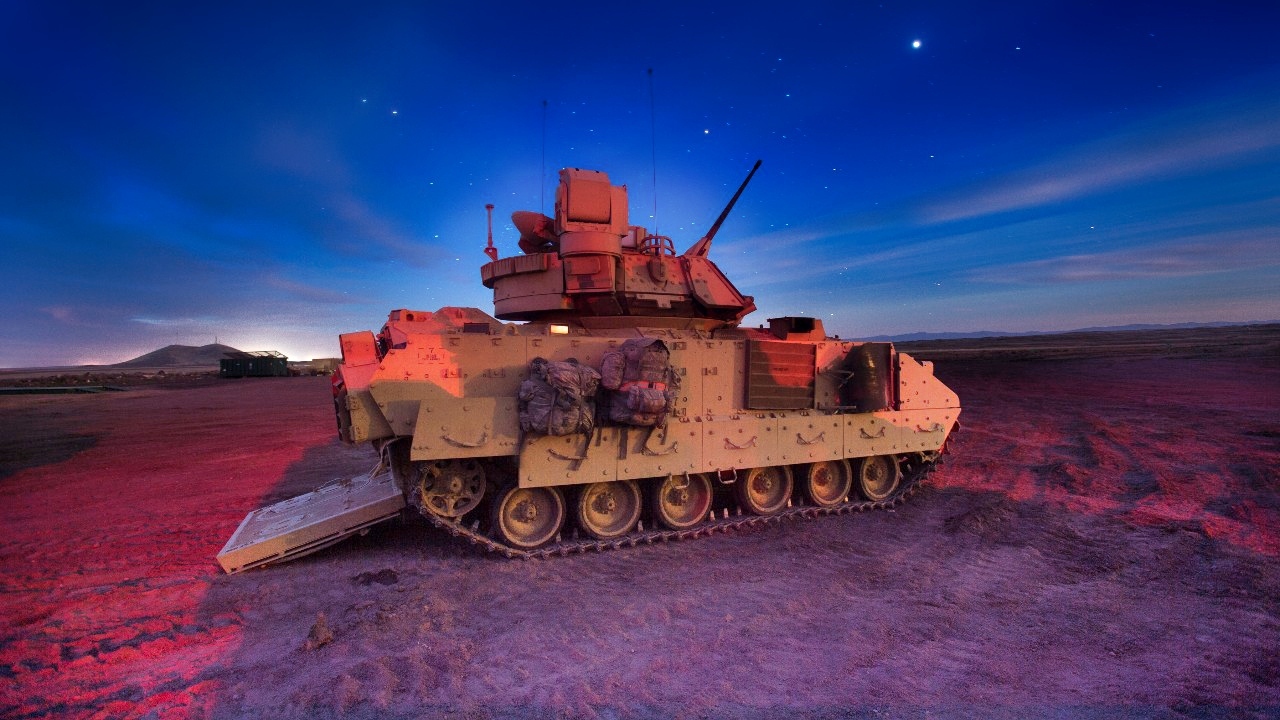
Engineers with the 116th Brigade Engineer Battalion conduct M2A3 Bradley fighting vehicle gunnery qualification on March 27, 2018, Orchard Combat Training Center, south of Boise, Idaho. Combat engineers with the 116th BEB trained through gunnery table XII, evaluating their ability to execute collective platoon-level tasks in a tactical live-fire environment; including integrating dismounted soldiers with their assigned BFV. (U.S. Army National Guard photo by 1LT Robert Barney)
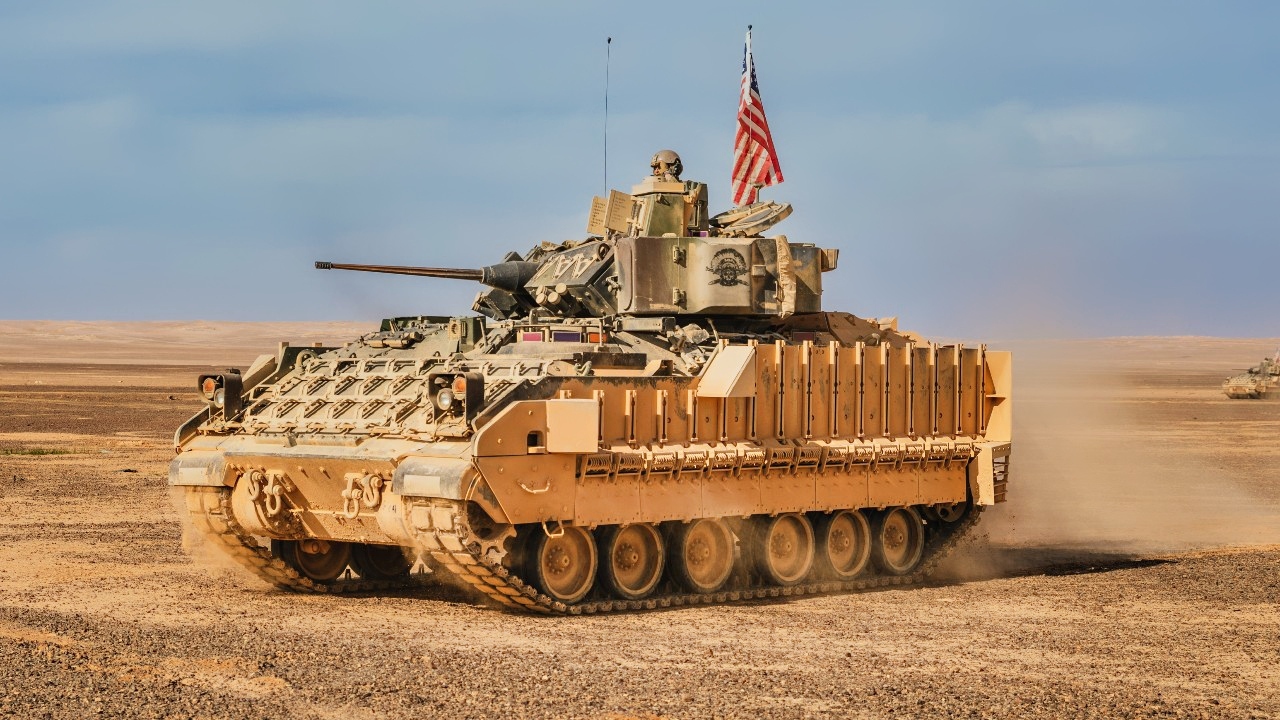
U.S. Army Soldiers assigned to 2nd Squadron, 278th Armored Cavalry Regiment, Task Force Reaper, conduct movement procedures with M2 Bradley Fighting Vehicles during the Jade Cobra VI exercise in the U.S. Central Command’s area of responsibility, Feb. 19, 2025. Jade Cobra VI strengthens military-to-military partnerships, increases readiness, and facilitates security cooperation between the United States and Jordan. (U.S. Army photo by Staff Sgt. Hector Tinoco)
The M2, on the other hand, has performed so well that Russian troops reportedly dread going up against the Bradley in combat. The vehicle and its legendary Bushmaster 25-mm chain gun have permitted the Ukrainians to use the vehicle not as an IFV, but as a mini-tank.
The M2 famously took out one of Russia’s most modern MBTs, the UralVagonZavod T-90. The T-90 did not erupt into a ball of fire, but the M2’s gun achieved a complete mobility kill.
A Coming Replacement
But the Bradley was first fielded more than four decades ago.
The vehicle is kept current by numerous improvements and add-ons. Key upgrades across the years include the Iron Fist Active Protection System (APS), improved third-generation forward-looking infrared sensors, an upgraded suspension, and increased electrical power for the modernized electronics that have been inserted into the vehicle over the years.
The system is reaching the end of its service life, which is why the U.S. Army is developing the XM30 Mechanized Infantry Combat Vehicle as a replacement. However, the XM30 is not expected to be fielded until around 2029, which would leave the Ukrainians without a suitable substitute for perhaps another 10 years.
The XM30 is designed around the modern combat environment. As such, the system features either a XM913 50-mm cannon—twice the caliber of the M2’s 25-mm—or a 30-mm gun with a development path for an upgrade that ultimately reaches the 50-mm mark.
The vehicle will also be powered by a hybrid propulsion system, and it will be equipped with sufficient automation that it may be operated remotely.
This will create the ability to use the XM30 in scenarios where crew survivability is a major concern or an unmanned operation would be more effective.
The Replacements’ Graveyard
However, the Army has been trying since the early 1990s to develop and field a replacement for the Bradley.
Like many U.S. weapon programs at the time, this effort collapsed when the Cold War ended and the political support for a new-generation vehicle to fight a conventional war in Central Europe collapsed with it.
As the Army entered the 21st century, the service passed through a series of programs and initiatives to replace the Bradley.
These were all rejected for the same reasons that often afflict programs of this type—systems are overweight, too expensive, will not fit into the C-17, or their design is not adequate to meet rapidly evolving threats.

U.S. Soldiers assigned to the 2nd Armored Brigade Combat Team, 1st Cavalry Division supporting the 4th Infantry Division maneuver an M1A2 Abrams tank and M2 Bradley Fighting Vehicle past a simulated opposing force’s Leopard 2A6 tank during exercise Arrow 23 in Niinisalo, Finland, May 5, 2023. Exercise Arrow is an annual, multinational exercise involving armed forces from the U.S., U.K., Latvia, Lithuania and Estonia, who train with the Finnish Defense Forces in high-intensity, force-on-force engagements and live-fire exercises to increase military readiness and promote interoperability among partner nations. (U.S. Army National Guard photo by Sgt. John Schoebel)
It is not an exaggeration, says one retired U.S. Army flag-rank officer who worked on some of these projects, to refer to Bradley substitutes as the “graveyard of replacement programs.”
The XM30 may finally be the one that succeeds, because it solves many of the Bradley’s shortcomings, including cramped spaces and a lack of other human-factors engineering.
The XM30 solves some of these issues because it is designed to carry a crew of two, plus six infantry soldiers.
It will match the Bradley in the size of the squad that can be on board, but has reduced the number of in-vehicle crew thanks to an unmanned turret and other automation features.
About the Author: Reuben F. Johnson
Reuben F. Johnson has thirty-six years of experience analyzing and reporting on foreign weapons systems, defense technologies, and international arms export policy. Johnson is the Director of Research at the Casimir Pulaski Foundation. He is also a survivor of the Russian invasion of Ukraine in February 2022. He worked for years in the American defense industry as a foreign technology analyst and later as a consultant for the U.S. Department of Defense, the Departments of the Navy and Air Force, and the governments of the United Kingdom and Australia. In 2022-2023, he won two awards in a row for his defense reporting. He holds a bachelor’s degree from DePauw University and a master’s degree from Miami University in Ohio, specializing in Soviet and Russian studies. He lives in Warsaw.


