


The U.S. built 49,324 M4 Sherman tanks between 1942 and 1945. The Sherman was the most-produced tank of World War II. Germany produced only 6,000 Panthers, 1,347 Tiger I tanks, and 492 King Tigers combined. The Sherman outnumbered Tiger tanks more than 30 to 1. British Sherman crews nicknamed the M4 “the Ronson” after the cigarette lighter brand. The lighter’s slogan was “Lights first time, every time.”
The M4 Sherman Tank, America’s Workhorse Of World War II
The US tank doctrine and strategy have undergone significant changes since World War I and World War II. It has evolved with the development of our armored forces.

M26 Pershing Tank. Image Credit: Creative Commons.
The US was late to the tank design competition in the early 20th century. The US believed tanks were only infantry support vehicles, not spearhead forces like the ones envisioned by cavalry officers such as George S. Patton and Adna Chaffee.
Many of the early American tanks were of poor quality and already obsolete when they were produced. By the time the US entered the war against the Axis powers, tank designs were improving. And US industrial might was churning out armored vehicles that supplied US, British, Canadian, Free-French, and Russian forces.
The US Army has fielded numerous exceptional tanks over the past century. And a few that weren’t so great. But the US workhorse of WWII was very misunderstood and underappreciated.
The US “Arsenal of Democracy” Produced The M4 Sherman Tank from WWII
As a fledgling force created in 1940/41, the US forces were playing catch-up from the start. And tank production, once it got going, showed US industrial might, which was incredible.
Many assume that the M4 Sherman tank was a terrible tank. The Sherman has been much-maligned by historians. But you’d be wrong. As an all-around tank, the Sherman was among the best of the war.
But what made the Sherman outstanding was the American war machine.
The arsenal of democracy produced nearly 50,000 (49,324) Sherman tanks between 1942 and 1945. It was the most-produced tank of the war. German tank production couldn’t hope to keep up.
By comparison, the German Panther, considered the best tank in the world, was produced in only 6,000 units. The Tiger I tank had only 1,347 produced, and the infamous “King Tiger” had only 492 produced.
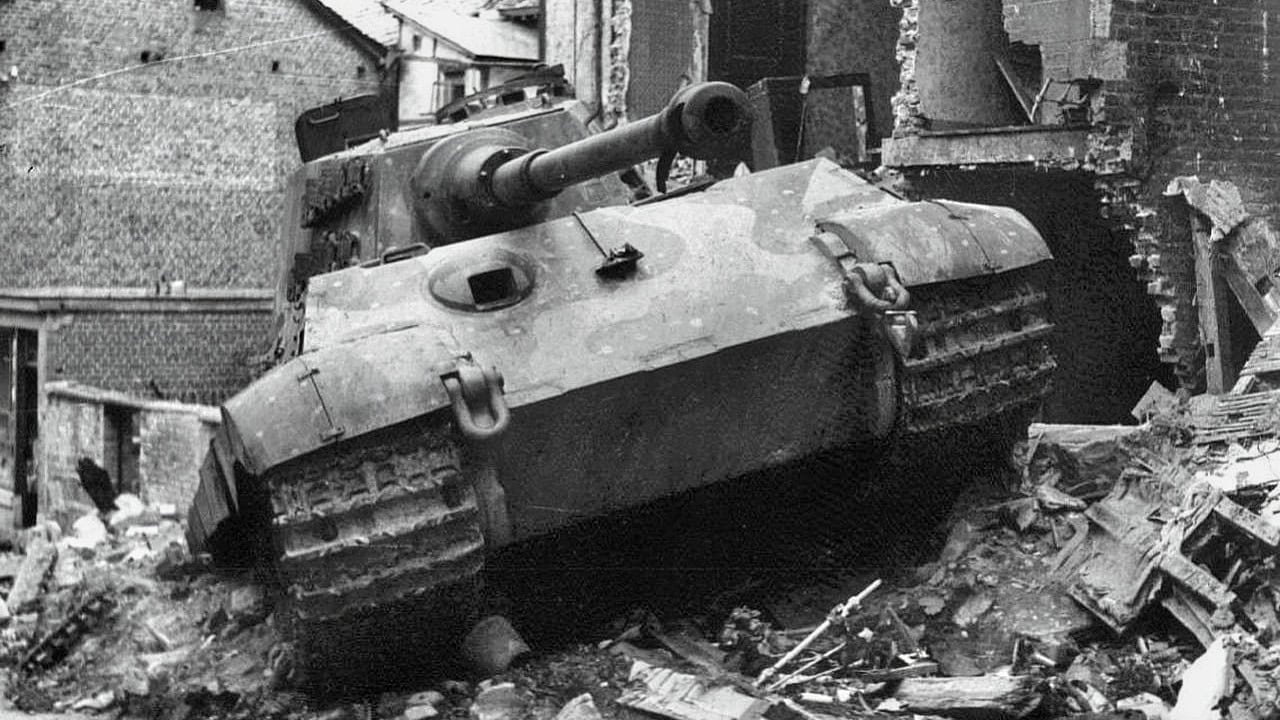
King Tiger Tank. Image Credit: Creative Commons.
The Sherman’s Simplicity Of Design and Ease of Maintenance
The Sherman tank was explicitly engineered to be repaired in the field, often by its own crew with minimal specialized tools.
Key components were designed for quick removal and replacement. For example, the transmission and final drive assembly were bolted to the front hull, allowing the entire unit to be unbolted and replaced from the outside, a task that required much more extensive workshop facilities for German tanks like the Panther.
A Sherman tank’s engine could be removed and replaced in just a couple of hours by field maintenance troops.
A high degree of parts commonality and interchangeability existed across different production variants (e.g., turrets, final drive housings, and engines could often be swapped), simplifying logistics and ensuring parts were readily available.
The chassis served as the basis for the M10 Wolverine tank destroyer, with its 3-inch (76mm) gun, and the later M36 Jackson, with its 90mm main gun, which was more than a match for any German armor. The production numbers for the two tank destroyers combined exceeded 9,000 during the war.
The Sherman was mechanically reliable compared to its contemporaries, particularly the complex and often-troubled German heavy tanks such as the Tiger and Panther, which frequently suffered mechanical breakdowns requiring specialized recovery.
The American logistics system was robust, ensuring a consistent and ample supply of spare parts, allowing broken-down tanks to be brought back into service within hours or days.
The Shermans Were Easy To Operate
The tank was roomy, allowing the five-man crew to perform their tasks efficiently and providing quick egress through multiple hatches if the tank was hit. The Sherman was known for its speed and agility, which were crucial for rapid advances and infantry support, its primary intended role.
Each crewman had rotating vision blocks that provided excellent all-around situational awareness, a significant advantage over some opposing tanks.
The Sherman was very easy to drive, featuring simple controls and a reliable engine (especially the Ford GAA V8 used in the M4A3 variants), making it easier to train new crews.
The Shermans had superior ergonomics, reliability, and controls compared to their contemporaries. The synchro-mesh gearbox was very user-friendly, and virtually anyone who could drive a car could drive a Sherman.
The Sherman’s Penchant For Catching Fire
The Sherman had some bad flaws. Its profile was too tall, the armor was never good enough, and tankers were forever welding extra armor plates or road wheels wherever they could.
Because of the gasoline-powered engines, the Sherman tank caught fire easily when hit, due to gasoline vapor and the dry storage of its ammunition. Its British crews nicknamed it “the Ronson” after the cigarette lighter because of the lighter’s slogan, “Lights first time, every time.”
In 1944, however, that changed when the tank’s ammunition was moved to “wet storage” in water-glycerin jackets, significantly reducing fire risk.
The standard 75mm main gun was a medium-velocity weapon. It was generally worthless against the frontal armor of Germany’s best tanks.
When the Sherman was designed in 1941, it was a very good tank. When it appeared in late 1942 or 1943, it was a step behind; by 1944, it was completely outclassed by modern German designs.
The 76mm Gun Was a Huge Upgrade
However, late in 1944, upgrades were made by the US; a high-velocity 76mm gun was a big improvement.
It would seem that the difference of just 1mm in the main tank gun wouldn’t have that much of a difference. But the 76mm T1 gun was a high-velocity weapon, and the improved ammunition was important for engaging the heavily armored German tanks.
The Sherman was the first tank in history to have a gun-stabilizing gyro installed. No one else had that in their tanks during the war. It increased the chances of first-round hits by the main gun.
The M4 Sherman “Easy Eight” Was A Much-Needed Upgrade
The “Easy Eight” is the nickname for the M4A3E8, a late-WWII variant of the American M4 Sherman tank.
It was known for its significant upgrades over earlier models, including the Horizontal Volute Spring Suspension (HVSS) system with wider tracks, a more powerful 76mm high-velocity gun, and a welded hull and turret.
The Horizontal Volute Spring Suspension (HVSS) was a new suspension system that used four wheels per bogie instead of two, allowing for wider tracks and a smoother, more stable ride over rough terrain.
The HVSS system enabled the use of 23-inch-wide tracks, reducing ground pressure and improving performance on soft ground.
The “W” in its full designation, M4A3(76)W, signifies “wet storage,” which meant the main gun ammunition was stored in liquid-filled containers to reduce the risk of a catastrophic explosion if the tank was hit. The US produced more than 2,600 during 1944 and early 1945.
These improvements made it a more capable and reliable tank, allowing it to remain in service through the Korean War and beyond.
The M4 Sherman tank was highly successful and effective, especially when its strengths in mobility, firepower, and survivability are weighed against its limitations. It outnumbered Tiger tanks by more than 30 to 1.
It was a reliable and formidable platform that served as the backbone of American armored forces and remained in service well after World War II.
About the Author: Steve Balestreri
Steve Balestrieri is a National Security Columnist. He served as a US Army Special Forces NCO and Warrant Officer. In addition to writing on defense, he covers the NFL for PatsFans.com and is a member of the Pro Football Writers of America (PFWA). His work was regularly featured in many military publications


