

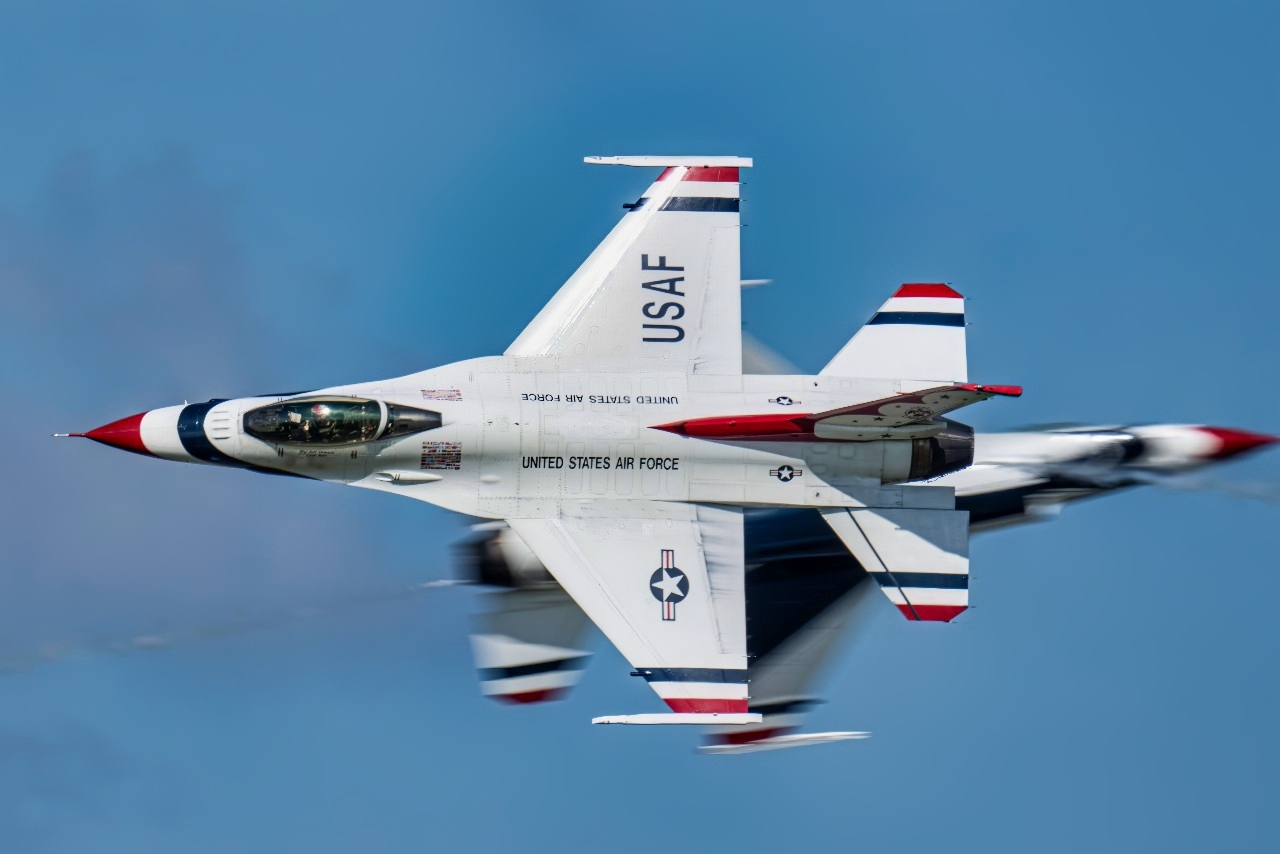
The Pentagon is arming its fleet of F-16 fighter jets and UH-60 SeaHawks with a new air-to-air missile variant engineered with a “proximity” fuse designed to counter drone swarms by dispersing fragments across an “area.”
New counter-drone explosives are being built into a variant of the classic, highly cherished infrared-guided Advanced Precision Kill Weapon System (APKWS) rockets.

F-16A on USS Intrepid NSJ Image. Taken by Jack Buckby on 9/18/2025.

F-16 Logo on F-16A in NYC. Image Credit: National Security Journal.
These weapons have historically fired Hydra-70 2.75 in folding-fin laser-guided rockets.
These APKWS weapons have armed helicopters, aircraft, and some ground platforms for many years as a low-cost, yet precision-guided explosive designed to destroy fixed and moving targets from the air.
Air-to-Air C-UAS
In more recent years, its maker, BAE Systems, has even engineered an “Air-to-Air Dual Mode” AGR-20F FALCO rocket used as a counter-drone air-to-air weapon.
This new proximity-fuse variant, emerging in response to a Central Command Joint Urgent Operational Needs Statement, builds upon this new variant by adding new elements of infrared seeking technology to a weapon that has primarily relied upon laser designation.
Combining laser designation with infrared targeting streamlines targeting against maneuvering targets by shortening the time a laser designation needs to “paint” a target.
“The upgraded configuration adds a nose-mounted, long-wave infrared (LWIR) seeker and a mid-body warhead equipped with a dual safe proximity fuse. The new seeker enables a handoff from laser designation to infrared homing, reducing the time an aircrew must maintain laser illumination. The reduced lasing time enables faster engagements against maneuvering or massed unmanned aircraft. The smaller diameter enables fighters to carry a dozen or more missiles per sortie,” an article from Naval News describes.
Iranian Drone Swarm Threat
It makes sense that CentCom would seek to move beyond existing point-detonate counter-UAS rockets now in service to add an “area” detonation or “air burst” technology to counter drone swarms.
Iranian drones are a known threat, and the concept of a “swarm” is to overwhelm defenses and countermeasures by presenting too many targets at once.
Blanketing an area with mini-drone explosives is a specific way to counter C-UAS systems, such as the existing air-to-air APKWS and ground-fired C-UAS, attacking with so many small weapons that they cannot be intercepted before “hitting” their intended target.

GJ-11 Drone. Image Credit: State Media Screenshot.
A “proximity” fuse, therefore, is designed to explode fragments across an area to, in effect, destroy groups of attacking drones at once.
It makes sense that the Pentagon and regional Commanders at CentCom would seek to strengthen air-fired C-UAS weapons, as Navy forces successfully used that tactic in the Red Sea to defend against Houthi drones and missiles.
Lessons from the Red Sea
The Commanding Officer of Carrier Strike Group 2, Rear Adm. Davon Hakimsadeh, who led maritime warfare efforts in the Red Sea in 2024, told me last year that air-fired C-UAS proved extremely helpful during combat engagements there.
Carrier-launched fighter jets successfully helped track and target incoming Houthi drones and cruise missiles by acting as aerial “sensors” or “nodes” capable of passing targeting details down to ship Commanders in position to fire interceptors.
In one instance, an F-18 Growler was able to “see” and “destroy” a Houthi target from the air.
The tactical benefits of using aerial C-UAS were one of the key lessons learned from the U.S. Navy’s Red Sea experience, so it makes sense that these proximity-fuse-enabled APKWS rockets are now arming fighter jets and helicopters.
About the Author: Kris Osborn
Kris Osborn is the President of Warrior Maven – Center for Military Modernization. Osborn previously served at the Pentagon as a highly qualified expert in the Office of the Assistant Secretary of the Army—Acquisition, Logistics & Technology. Osborn has also worked as an anchor and on-air military specialist at national TV networks. He has appeared as a guest military expert on Fox News, MSNBC, The Military Channel, and The History Channel. He also has a Masters Degree in Comparative Literature from Columbia University.


