

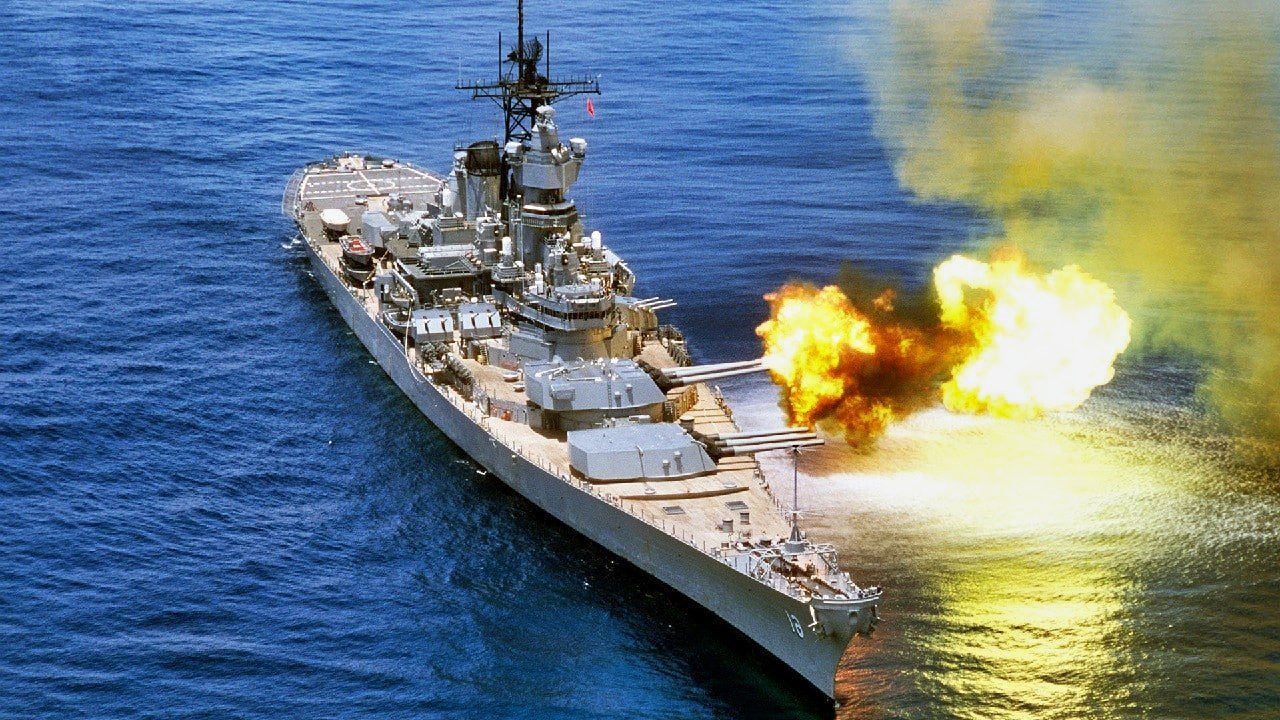
Summary and Key Points: The U.S. Navy has officially suspended the DDG(X) program in favor of the BBG(X) Trump-class battleship, a move intended to reclaim maritime dominance through sheer mass and lethal “Golden Fleet” innovation.
-Displacing over 35,000 tons, the lead ship USS Defiant will feature a first-of-its-kind arsenal: nuclear-armed sea-launched cruise missiles, a 32-megajoule railgun, and 600kW lasers.

Trump-Class Battleship. Image Credit: White House.

Trump-Class Battleship. Image Credit: White House.
-While Admiral Derek Trinque argues that the ship’s massive hull is required for future hypersonic and directed-energy weapons, analysts from CSIS and the Hudson Institute warn that a $15 billion-per-ship price tag and reliance on unproven tech make the project a high-risk gamble.
Nuclear Battleships? How the Trump-Class BBG(X) Changes America’s Deterrence Forever
The proposed “Trump-class” battleships, officially designated BBG(X), seem to be intended to replace the planned DDG(X) next-generation destroyer program by incorporating its capabilities into a larger hull design. The DDG(X) program effectively has been cancelled in favor of the new BBG(X) class.
At least, for the moment, that’s what I would argue it looks like.
Navy officials explain the shift by pointing to the need for a larger platform with more space, power, and cooling capacity to accommodate future weapon systems, such as hypersonic missiles, railguns, and high-powered lasers, that the DDG(X) design struggled to incorporate.
But are the BBG(X) ships necessary, or even feasible?
What Is The Navy’s DDG(X) Program?
The DDG(X) program is developing the next generation of guided-missile destroyers to replace aging Ticonderoga-class cruisers and Arleigh Burke-class destroyers. It aims for a larger, more powerful, flexible platform with integrated power systems for future directed-energy weapons and hypersonic missiles.
It is designed with significant growth possibilities for space, weight, power, and cooling, and will build on the Flight III Burke-class’s Aegis system (the SPY-6 radar) to provide enhanced integrated air and missile defense and ballistic missile defense.
That means being able to simultaneously engage air and ballistic threats with greater range, speed, and stealth detection than previous ships. However, it faces challenges with cost, shipyard capacity, and integrating new tech. The first ship is slated for procurement in the early 2030s.

Iowa-Class Battleship Guns 16-Inch, USS Iowa. Image Credit: National Security Journal.

Iowa-Class Battleship Looking Really Old. Image Credit: Harry J. Kazianis/National Security Journal.

Iowa-Class Battleship Secondary Guns. Image Credit: Harry J. Kazianis/National Security Journal.

Iowa-Class Battleship National Security Journal Visit from August 2025. Image Credit: Harry J. Kazianis.
Navy Cancelling DDG(X) For The Trump-class Battleships
U.S. President Donald Trump announced in December that the Navy would design and develop a new class of battleships as part of a future so-called “Golden Fleet.”
“This ship isn’t just to swat the arrows; it is going to reach out and kill the archers. And for the first time in generations, we’ll have a new leg in America’s nuclear deterrence, because the Trump-class battleship will carry the nuclear-armed, sea-launched cruise missile,” Navy Secretary John Phelan said.
“Striking dominance isn’t all that the Trump-class battleship brings to the fight at sea. It has the size and capacity to serve as a flagship for our fleet commanders, so that they can command and control naval forces far out to sea,” Phelan added. “This new battleship will command everything from warships to drones and everything in between.”
The new vessels are planned to be significantly larger than current destroyers, displacing more than 35,000 tons.
Armament For The Trump-class Battleships:
The planned armament could include:
-Conventional Prompt Strike (CPS) hypersonic missiles
-Nuclear-armed sea-launched cruise missiles
-A large number of vertical launching systemcells
-Advanced systems such as a 32-megajoule railgun and high-energy lasers
The vessels would be the first battleships built by the United States since World War II. Many analysts have expressed concern over the sea service’s ability to build the massive ships. Bryan Clark, a senior fellow at the Hudson Institute, suggested the president may be drawn to the symbolic power of battleships, which were the most visible icons of naval firepower until World War II.
Clark estimated the Trump‑class battleship, at about three times the size of the current destroyers, would cost two to three times more than them. With Arleigh Burke destroyers priced at about $2.7 billion each, that implies a single battleship could cost in the range of $8–10 billion.
The cost of crewing and maintaining them will put more pressure on an already strained Navy budget, he added.
Is The Building Of The Trump-class Ships Feasible Or Necessary?
The proposed battleship is widely seen by defense analysts as neither feasible nor necessary. It conflicts with current U.S. naval strategy, faces immense cost barriers, relies on unproven technologies, and introduces large, vulnerable targets at a time the Navy needs dispersed, numerous smaller ships and munitions.
The proposal contradicts the Navy’s Distributed Maritime Operations (DMO) concept, which favors smaller, dispersed forces over large, centralized ones.
Its cancellation is highly probable. Mark Cancian, a senior adviser at the Center for Strategic and International Studies, wrote in a Dec. 23 commentary that “there is little need for said discussion because this ship will never sail.”

Iowa-Class 16-Inch Shell Menu. Image Credit: National Security Journal.
Cancian rightly points out that, “a BBG class is extremely high risk. When the full cost and schedule become known, the program will almost certainly be canceled. However, that may be after spending several years and several billion dollars.
“The Navy needs to build ships now rather than begin long development programs that will take years to produce usable capability, if they ever do,” he added. “Far better to upgrade existing, proven designs and ramp up their production rates. That’s the way to reach the higher production levels that President Trump cited in his speech and to expand the U.S. presence on the world’s oceans.”
The program is currently in the design phase, with construction of the lead ship, the USS Defiant, projected to begin in the early 2030s.
It Is A Necessary Program, Admiral Says
Rear Admiral Derek Trinque, director of surface warfare, said during a keynote speech at the annual Surface Navy Association symposium that larger platforms able to carry more weapons and equipment will be necessary in the near future.
He pointed out that with the CPS hypersonic weapon and directed energy lasers approaching fielding stages, the Navy couldn’t retrofit the DDG with all of the new systems.
“DDG(X) came from a recognition that we were approaching the limit of what we could add to the Arleigh Burke-class destroyer,” Trinque added. “We needed something newer and bigger that could have more power and accept more weapons and project more power than the Arleigh Burke-class destroyer.”
He continued: “The battleship will have command-and-control capacity to truly command a surface action group. So this can be a centerpiece of a surface action group, or it could be a part of a carrier strike group. But this is command and control and offensive capability capacity that we need.”
But spending billions of dollars on programs that aren’t ready for production yet, when there is a current need for surface warfare ships that are already in production, will come under serious question if this effort falls flat.
About the Author: Steve Balestrieri
Steve Balestrieri is a National Security Columnist. He served as a US Army Special Forces NCO and Warrant Officer. In addition to writing on defense, he covers the NFL for PatsFans.com and is a member of the Pro Football Writers of America (PFWA). His work was regularly featured in many military publications.


