


Key Points and Summary – As the final Littoral Combat Ship (LCS) is delivered, a review of the program’s mixed legacy shows it was a gamble that didn’t pay off.
-Conceived in the post-9/11 era for low-intensity coastal missions, the LCS was plagued by cost overruns, technical failures, and a failed “mission module” concept.

PACIFIC OCEAN (Oct. 1, 2024) The Independence-class littoral combat ship USS Mobile (LCS 26) comes alongside the Nimitz-class aircraft carrier USS Theodore Roosevelt (CVN 71) for a fueling-at-sea, Oct. 1, 2024. Theodore Roosevelt, flagship of Carrier Strike Group 9, is underway conducting routine operations in the U.S. 3rd Fleet area of operations. An integral part of U.S. Pacific Fleet, U.S. 3rd Fleet operates naval forces in the Indo-Pacific and provides he realistic, relevant training necessary to execute the U.S. Navy’s role across the full spectrum of military operations – from combat operations to humanitarian assistance and disaster relief. U.S. 3rd Fleet works together with our allies and partners to advance freedom of navigation, the rule of law, and other principles that underpin security for the Indo-Pacific region. (U.S. Navy photo by Mass Communication Specialist 3rd Class Richard Tinker)
Most critically, its light armor and armament make it non-survivable in a modern great power conflict.
-Now outdated upon arrival, the LCS serves as a painful lesson in naval procurement, a ship likely to be relegated to secondary coastal duties.
Lessons Learned About the Littoral Combat Ships.
When the U.S. Navy first conceived the Littoral Combat Ship, I thought it was a good idea.
It was the post-9/11 era, and the Navy was looking for a new role to remain relevant. U.S. aircraft carriers were used for strike attacks against the Taliban in Afghanistan and later the Iraqis in the Second Gulf War.
American submarines and some ships fired Tomahawk cruise missiles, so that was good.
But the ordinary destroyer, frigate, and cruiser did not have a clearly defined role during the Global War on Terror.
The LCS Could Have Been the Solution to Many Problems.
Enter the Littoral Combat Ship (LCS). This was designed to patrol closer to the shore in “brown water” and conduct bombardment against terrorists and insurgents.
They could also be used against pirates and conduct counter-narcotics operations.
Additionally, mine-clearing duties were crucial, and they were also designed for anti-submarine operations.
The LCS could also support special operations forces.
The Concept Fits the Times?
They were agile and fast – just what the doctor ordered in the days of less intense brush fire wars instead of major force-on-force naval engagements.
The name of the game in those days was low-intensity conflict, and the LCS would excel in these conditions. The Taliban had no navy in the landlocked country, for example, and the war in Afghanistan wasn’t going to be like naval battles in World War II.
The Navy was seeking a solution to coastal confrontations that plagued the U.S. military on continents with vast shorelines, such as Africa.
What Does the Future Hold?
Today, the LCS has a mixed legacy. It has gone from relevance to irrelevance, and back again.
The Navy has considered selling them to other countries, which would have been a significant insult to the original calculus that inspired the ship.
Now the last LCS has been built and is ready for active duty. Austal USA produced the last of the 19 Independence-class LCS vessels constructed in Mobile.
The USS Pierre departed the Alabama port on October 10.
The LCS program has endured its share of troubles.
There were plenty of cost overruns and delays.
The engines were problematic, and there have been hull cracks. The USS Independence and the USS Coronado have been taken out of service.
Can the LCS Take a Punch?
The LCS, during the era of great power conflict, is seen as not being survivable against modern anti-ship missiles with its light armor.
The weapons were believed to be insufficiently robust against large enemy vessels.
The Navy equipped some with the Naval Strike Missile, a projectile designed for long-range precision attacks.
This is a good development for the LCS. Several will also receive the Mk 70 Payload Delivery System, featuring an improved vertical launch system, to accompany the Rolling Airframe Missile.
It could also someday be adept at manned-unmanned teaming features with sea drones.
There are still downsides. One positive aspect of the LCS was that it was more self-sustaining, with sailors able to conduct their own repairs and maintenance.
This hasn’t happened as much as the Navy thought it would.
Outside contractors have performed many repairs. Sometimes, contractors had to be flown out to the ships to make fixes, which added to the maintenance costs.
One bright spot, though, is the USS St. Louis, which saw its Main Propulsion Diesel Engine go on the fritz. The crew on the St. Louis was able to repair that system independently.
Government Watchdog Sinks Its Teeth Into the LCS.
Sharp criticism has been the downfall of the LCS program over the years.
In 2022, the U.S. Government Accountability Office (GAO) released a scathing report about the compact ships.
The LCS doesn’t have mission-essential equipment, the GAO said. The vessels needed to do a better job at creating mine countermeasures, according to the researchers.
“The Navy has begun to take steps to address some of these issues, but it does not have a comprehensive plan to address the various deficiencies identified during testing and deployments. Without a comprehensive plan to address deficiencies, perform adequate testing of the mission modules, and implement lessons learned from completed deployments, the LCS will remain at risk of being unable to operate in its intended environment. Further, gaps between desired and demonstrated capabilities have substantial implications for the Navy’s ability to deploy the LCS as intended. Until the Navy makes future operational deployments contingent on progress in addressing gaps between desired and demonstrated capabilities, the LCS will continue to be dependent in combat and require protection by multi-mission combatants,” the GAO wrote.
The next question regarding the LCS is its survivability in the event of a missile attack. The armor is simply not sufficient in the levels required to survive an enemy missile strike. This means that deployments to East Asia or Europe will not be as effective. The LCS will likely have to remain close to shore in the Western Hemisphere for counter-drug missions.
So, is the LCS really a “Little Crappy Ship” as its detractors have claimed?
It has suffered from numerous afflictions over the years and has gone over budget due to manufacturing errors. The various missions it was designed for, which would have made it valuable, have not emerged as core competencies.
The LCS will serve as a lesson for naval brass, Congress, and defense acquisition officials to ensure that a ship will not be outdated by the time it is built.
The LCS was a gamble that made sense in 2002, but by 2025, the vessel was outdated.
The new missiles on board will help, but their survivability in modern combat is in question.
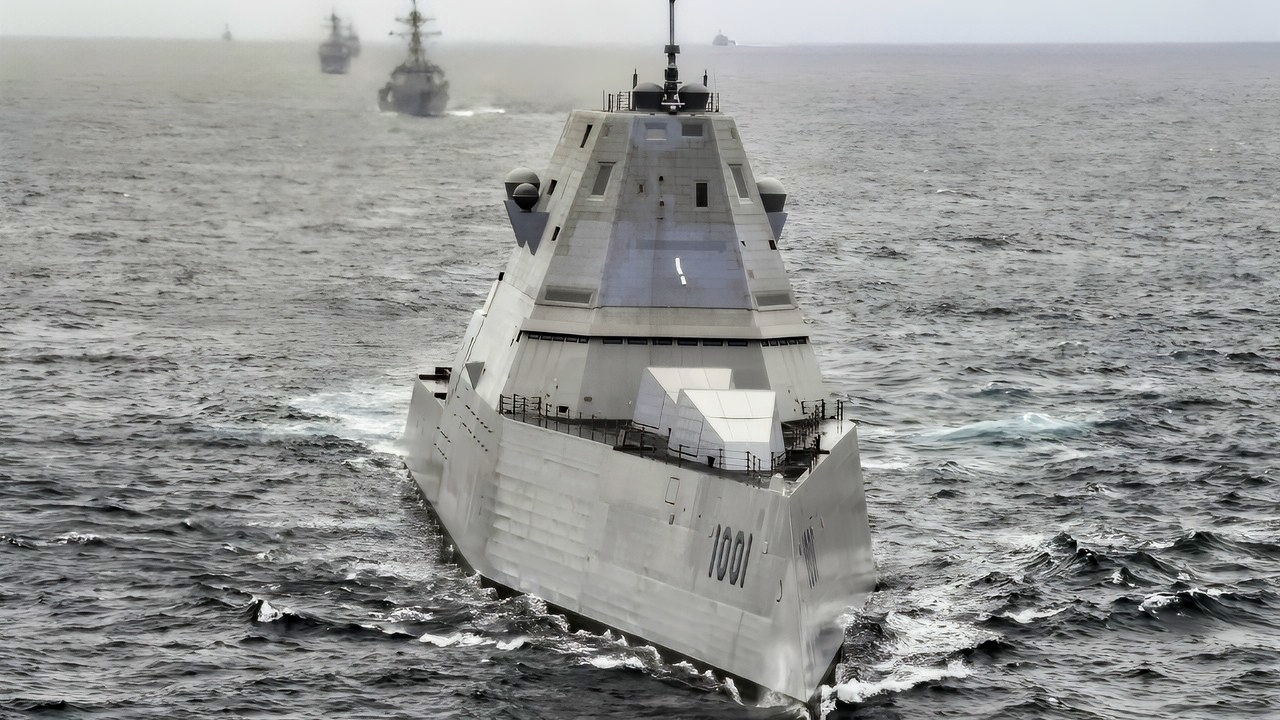
(April 21, 2021) The Zumwalt-class guided-missile destroyer USS Michael Monsoor (DDG 1001) leads a formation including the Arleigh Burke-class guided missile destroyers USS Fitzgerald (DDG 62), USS Spruance (DDG 111), USS Pinckney (91), and USS Kidd (DDG 100), and the Independence-variant littoral combat ship USS Coronado (LCS 4) during U.S. Pacific Fleet’s Unmanned Systems Integrated Battle Problem (UxS IBP) 21, April 21. UxS IBP 21 integrates manned and unmanned capabilities into challenging operational scenarios to generate warfighting advantages. (U.S. Navy photo by Chief Mass Communication Specialist Shannon Renfroe)
I view it as a vessel more suited for coastal duty in waters that require an anti-terror or anti-drug asset.
Those missions may not have been worth all the time, money, and resources expended on the program.
About the Author: Brent M. Eastwood
Brent M. Eastwood, PhD is the author of Don’t Turn Your Back On the World: a Conservative Foreign Policy and Humans, Machines, and Data: Future Trends in Warfare plus two other books. Brent was the founder and CEO of a tech firm that predicted world events using artificial intelligence. He served as a legislative fellow for US Senator Tim Scott and advised the senator on defense and foreign policy issues. He has taught at American University, George Washington University, and George Mason University. Brent is a former US Army Infantry officer. He can be followed on X @BMEastwood.
More Military
Army MV-75 Has a “Digital Backbone” to Stand Up to China in the Pacific
The F-35 Stealth Fighter Great Leap Forward Has Arrived
New Challenger 3 NATO Tank Is Built for Just 1 Mission It Can’t Fulfill
Sunk 10,000 Feet Down: A U.S. Navy Nuclear Submarine Was Lost, And No One Knows Why


