

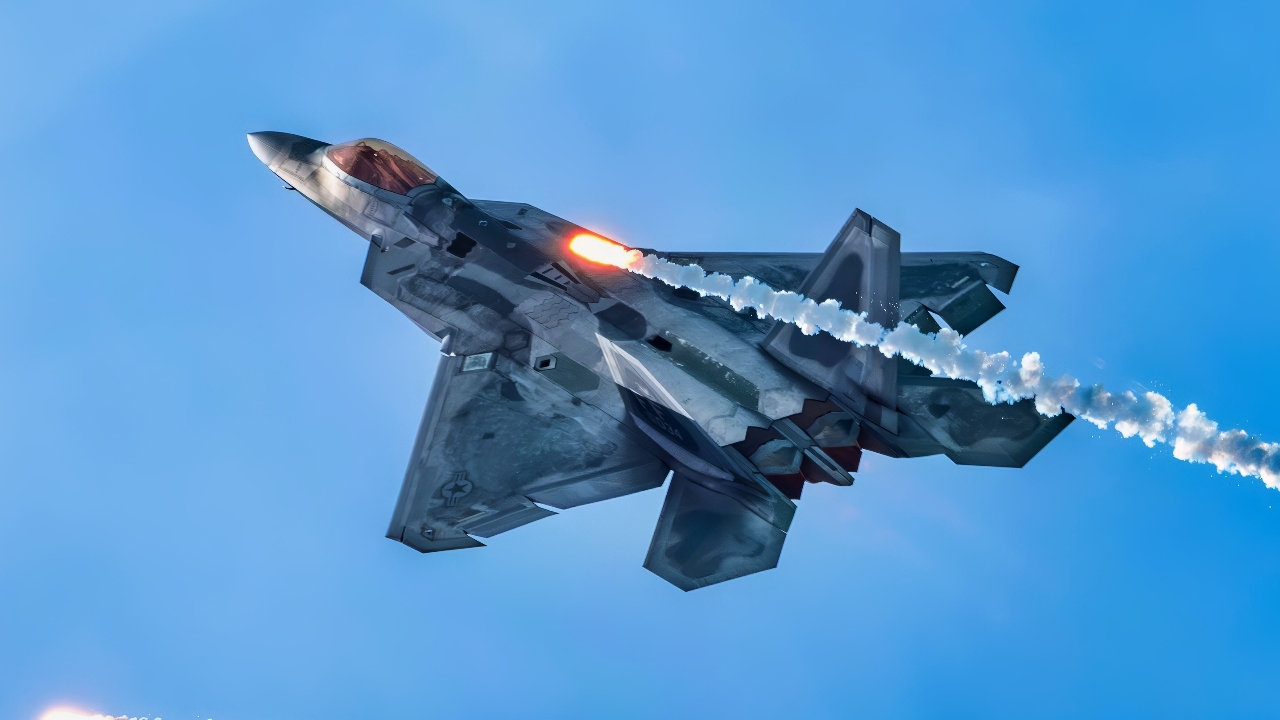
Lockheed Martin’s $11 billion F-22 Raptor 2.0 upgrade adds stealth-compatible conformal external fuel tanks and infrared search and track pods on the outer wings — extending the F-22’s combat radius by up to 850 nautical miles without sacrificing stealth. Katie Ciccarino, vice president of Lockheed Martin’s F-22 program, said the new Low Drag Tank and Pylon fuel tanks can stay on the aircraft through combat. The F-22 Raptor’s current unrefueled combat radius is roughly 590 nautical miles — a critical limitation in the Pacific. The Raptor also recently controlled a General Atomics MQ-20 Avenger drone from its cockpit, making it the first aircraft to command a Collaborative Combat Aircraft.
F-22 Raptor 2.0 Stealth Fighter Is Coming
The F-22 Raptor remains the world’s best air superiority fighter, but it is easy to forget that the Raptor is 30 years old and has issues, especially with its range, which can be a problem in the Indo-Pacific.
As an air dominance fighter, the F-22 was the first fifth-generation stealth fighter jet to fly. It combines advanced technology, such as stealth and sensor fusion, to produce superb situational awareness and an airframe that is highly maneuverable and can supercruise, or fly at supersonic speeds without the use of afterburners.
However, the range has become a thorny issue in the context of a potential war with China. Its ability to project power across the vast Pacific Ocean is limited by its short range. The F-22 Raptor has a combat radius of approximately 450–530 nautical miles (about 515–600 miles or 850–980 km) on internal fuel.
But the Air Force is looking at ways to sharpen the Raptor’s talons.
$11 Billion Worth Of Upgrades, The Raptor 2.0:
And with an $11 billion upgrade that includes conformal, stealthy new fuel tanks and infrared search-and-track pods being installed further outboard on the wings, the Raptor has increased its combat range without sacrificing its incredible stealth profile.
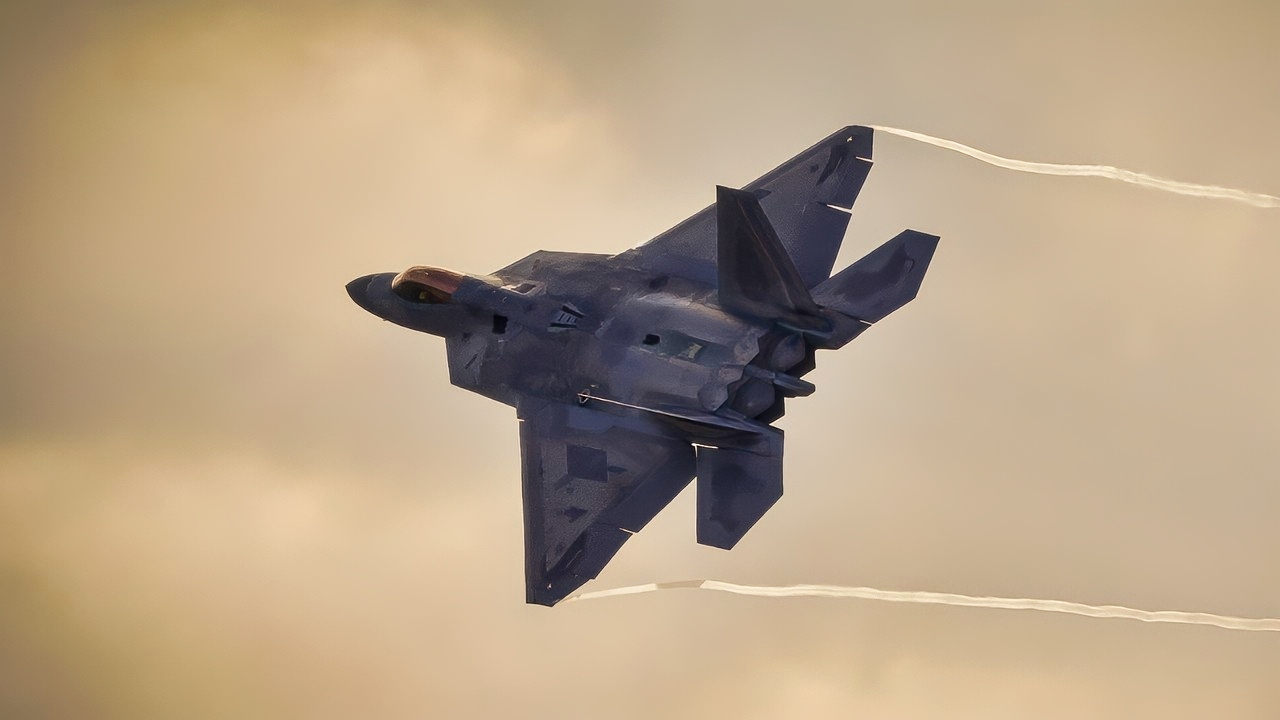
A U.S. Air Force F-22 Raptor assigned to the 90th Fighter Squadron soars over Joint Base Elmendorf-Richardson during ARCTIC EDGE 2025 (AE25), Aug. 18, 2025. AE25 provided Special Operations Command North the opportunity to test a range of capabilities and response options to deter, disrupt, degrade, and deny competitor activity in the Arctic in support of globally integrated layered defense of the homeland. AE25 is a NORAD and U.S. Northern Command-led homeland defense exercise designed to improve readiness, demonstrate capabilities, and enhance Joint and Allied Force interoperability in the Arctic. (U.S. Air Force photo by Airman 1st Class Gracelyn Hess)
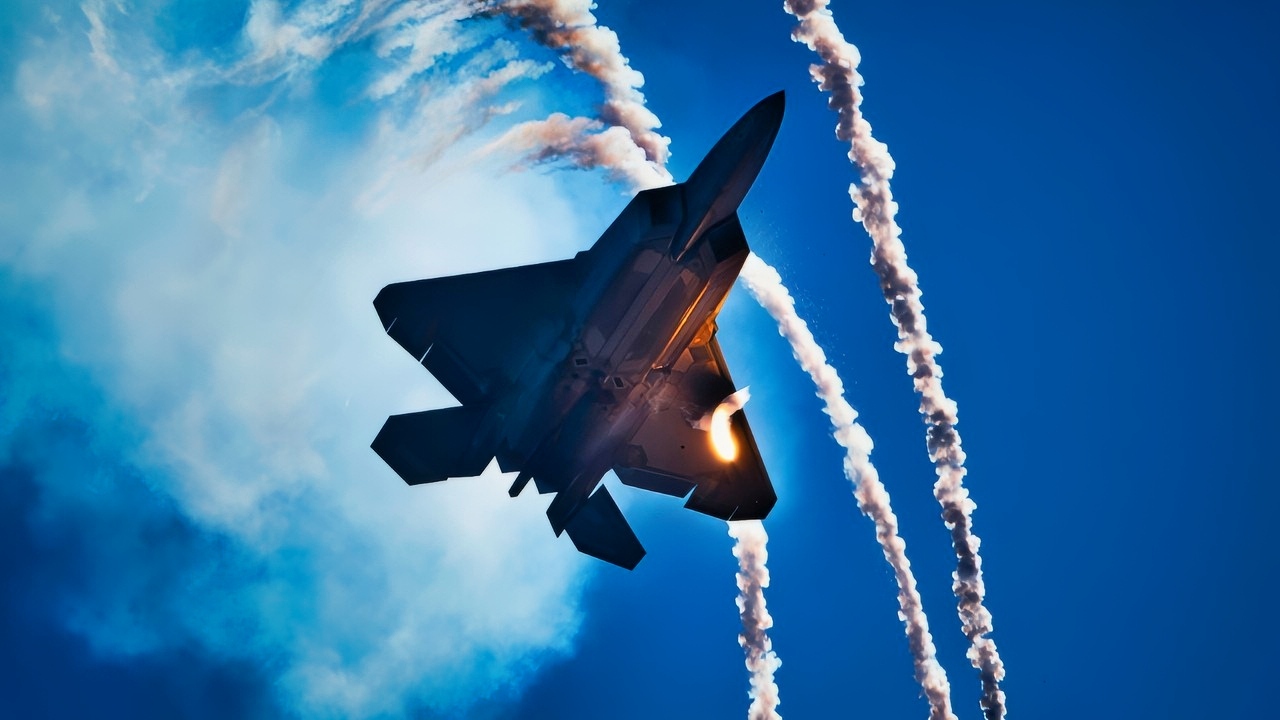
A U.S. Air Force F-22 Raptor, flown by Capt. Samuel “Razz” Larson, F-22 Raptor Demonstration Team pilot, deploys flares over the Gulf of Mexico during the 2024 Gulf Coast Salute Air Show at Panama City Beach, Florida, May 4. The F-22’s unique combination of stealth, speed, agility and situational awareness, combined with lethal long-range air-to-air and air-to-ground weaponry, makes it one of the most advanced fighters in the world. (U.S. Air Force photo by Staff Sgt. Stefan Alvarez)

An F-22 Raptor creates vapor trails during a high-speed maneuver during a training flight at Joint Base Langley-Eustis, Virginia, June 13, 2025. The aircraft’s design allows it to remain highly maneuverable while maintaining low observability. (U.S. Air Force photo by Senior Airman Adisen Smith)
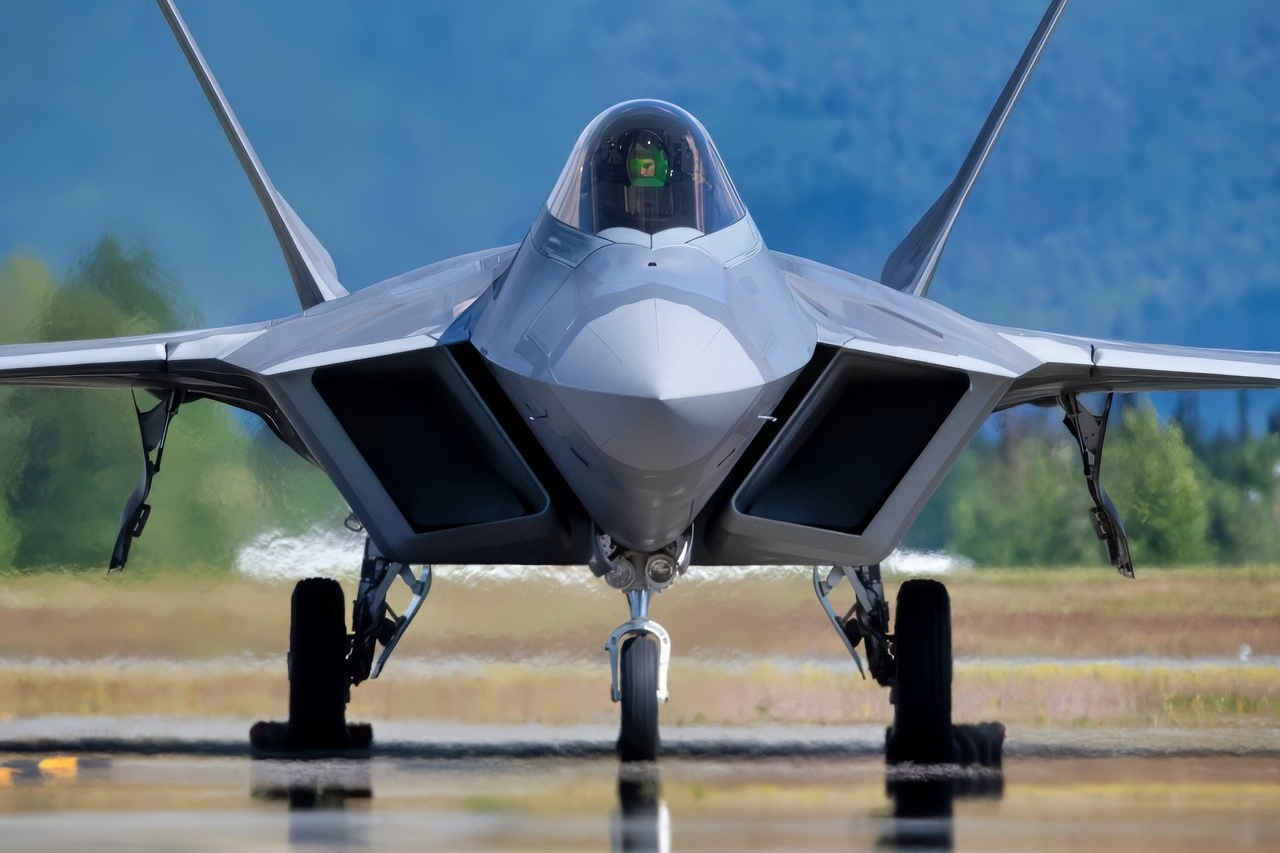
U.S. Air Force Maj. Joshua “Cabo” Gunderson, F-22 Raptor Demonstration team pilot and commander, prepares to take off in a U.S. Air Force F-22 Raptor assigned to the 90th Fighter Squadron over Joint Base Elmendorf Richardson, Alaska, July 9, 2020, as part of JBER Salutes, a two-day event to show appreciation to service members and nearly 100 Anchorage-area “COVID Heroes” and their guests. The service members and COVID Heroes, nominated for their support to the community during the COVID-19 pandemic, toured various areas of the installation, viewed exhibits and static displays of aircraft, and watched demonstrations by Explosive Ordnance Disposal, military working dog teams, and Chemical, Biological, Radiological and Nuclear experts. (U.S. Air Force photo by Alejandro Peña)
Lockheed Martin unveiled a model of the improved F-22 “Raptor 2.0” at the Air and Space Forces Association Annual Warfare Symposium back in February.
This modernization ensures the Raptor will continue to maintain air dominance for many years to come, until the F-47 reaches maturity and is ready for deployment.
Lockheed Martin-designed fuel tanks can now fly into combat:
One drawback of the Raptor, especially in the Indo-Pacific, has always been its short range. Raptors have carried 600-gallon fuel tanks under each wing to increase their ferry range, but these had to be dropped if the Raptors went into combat. The drop tanks also severely affected the Raptor’s stealth capability.
The F-22’s unrefueled combat range was 590 nautical miles. However, these new drop tanks, which Lockheed says have been developed after years of flight testing, can be flown directly into combat without being jettisoned. Alex Hollings from Air Power wrote, “Lockheed officials would not disclose a maximum G-rating for these new external fuel tanks, but did say that the intent would be for the aircraft to keep them in place throughout most combat operations.”
The Low Drag Tank and Pylon (LDTP) program is a Lockheed Martin effort to develop stealth-compatible external fuel tanks for the F-22 Raptor, significantly extending its combat range for Pacific operations without sacrificing low-observability. These tanks feature a low-drag, sleek design and can be jettisoned to leave a clean, stealthy aircraft profile or left in place.
“These can go into combat,” says Katie Ciccarino, vice-president of Lockheed’s F-22 program.
“They are droppable if they need to be,” she added. “But the idea would be not to drop them, and to retain them throughout whatever the pilot is doing and then coming home and being able to use them again.”
Both the current and new external tanks provide F-22s with an extra 850 nautical miles (1,570km) of range, according to Lockheed.

A U.S. Air Force F-22 Raptor assigned to Joint Base Langley-Eustis, Virginia, takes off during Checkered Flag 23-1 at Tyndall Air Force Base, Florida, Nov. 4, 2022. Checkered Flag is a large-force aerial exercise which fosters readiness and interoperability through the incorporation of 4th and 5th-generation aircraft during air-to-air combat training. The 23-1 iteration of the exercise was held Oct. 31 – Nov. 10, 2022. (U.S. Air Force photo by Tech. Sgt. Betty R. Chevalier)
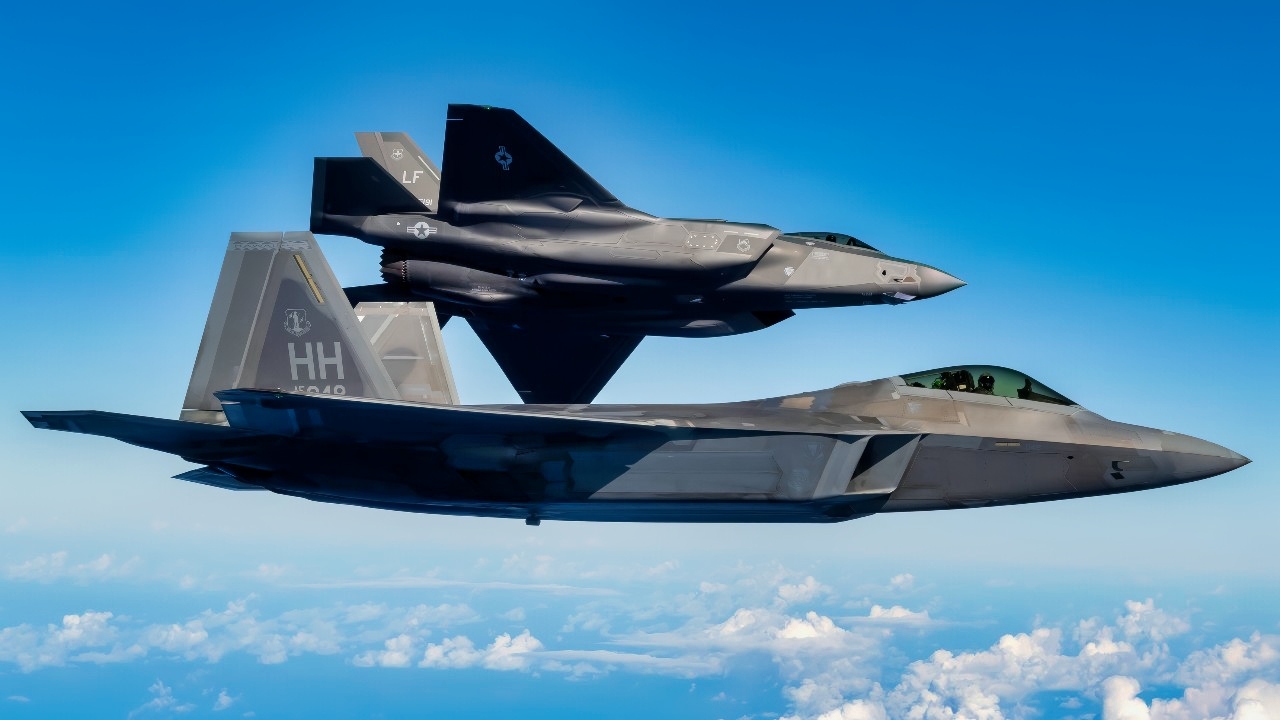
An F-35A Lightning II banks away from an F-22 Raptor Feb. 6, 2020, near the Hawaiian Islands. F-35 Airmen from Luke Air Force Base, Ariz., temporarily relocated to Joint Base Pearl Harbor-Hickam, Hawaii, to join other flying squadrons in exercise Pacific Raptor. Every training mission of the exercise was carried out by total-force teams from the Air Force’s Active, Reserve and Air National Guard components. (courtesy photo)
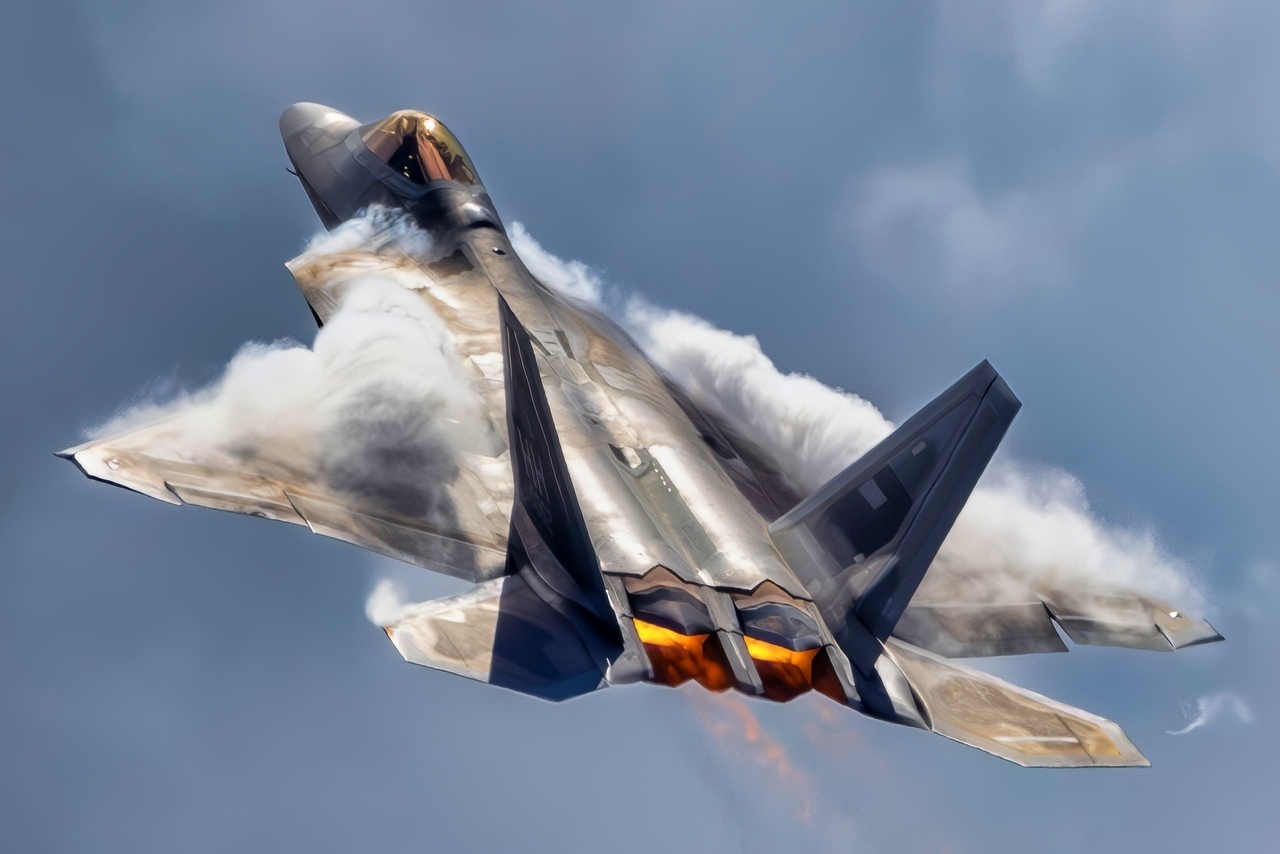
An F-22 Raptor performs an aerial demonstration at Marine Corps Air Station Kaneohe Bay, Hawaii, Aug. 8, 2025. The rapid change in angle of attack causes visible vapor to form around the aircraft, giving spectators a clear view of the jet’s aerodynamic performance. This demonstration highlights the unique thrust-vectoring capabilities of the F-22, allowing it to achieve extreme agility unmatched by other fighter aircraft. (U.S. Air Force photo by Staff Sgt. Lauren Cobin).
New IRST Sensors, More Survivability In A Stealth Environment:
Lockheed Martin has upgraded its F-22 Raptor with upgraded infrared threat-detection sensors. This latest enhancement will improve the aircraft’s survivability and lethality by adding an infrared search-and-track (IRST) capability.
The inclusion of infrared search-and-track pods enables passive detection and tracking of airborne targets by sensing thermal signatures, eliminating the need to use radar signals that could reveal the aircraft’s position.
Although mounted externally, the pods appear optimized for stealth management. Although any externally mounted equipment will affect stealth, the trade-off in capability is considered worth it. In environments characterized by advanced electronic warfare and anti-access strategies, passive sensing enhances survivability and situational awareness.
TWZ pointed out that “an IRST sensor is useful for detecting stealthy targets, something that is also becoming increasingly relevant in the Pacific region. There is also the option of IRST-equipped Raptors sharing their sensor data with ‘clean’ F-22s, enhancing their situational awareness.”
President Trump Hints At More Changes That Are Upcoming:
More changes are possibly coming for the stealthy “Super Raptor.”
“We’re going to do an F-55 and – I think, if we get the right price, we have to get the right price – that’ll be two engines and a super upgrade on the F-35, and then we’re going to do the F-22,” President Trump said to reporters during a trip to Doha.
“I think the most beautiful fighter jet in the world is the F-22, but we’re going to do an F-22 Super, and it’ll be a very modern version of the F-22 fighter jet,” the president added. “We’re going to be going with it pretty quickly.”
TWZ also noted that the F-22 Raptor has been tested and evaluated with various iterations of a mirror-like coating, which has since appeared on a number of other stealth tactical jets.

U.S. Air Force Capt. Melanie “MACH” Kluesner, F-35A Lightning II Demonstration Team pilot and commander, flies an aerial demonstration certification flight at Hill Air Force Base, Utah, Feb. 22, 2024. Upon the 388th Fighter Wing commander certification, the F-35 Demo Team pilot is required to complete the Air Combat Command Heritage Flight Training Course. (U.S. Air Force photo by Staff Sgt. Kaitlyn Ergish)

An F-35A Lightning II, flown by Maj. Kristin “Beo” Wolfe, F-35 A Lightning II Demonstration Team commander, performs aerial displays during the Joint Base Andrews 2022 Air & Space Expo, at JBA, Md., Sept. 18, 2022. Wolfe demonstrated several difficult maneuvers throughout her performance at the Air & Space Expo to provide an opportunity for people to see U.S. military air capabilities in action. (U.S. Air Force photo by Airman 1st Class Ben Cash)
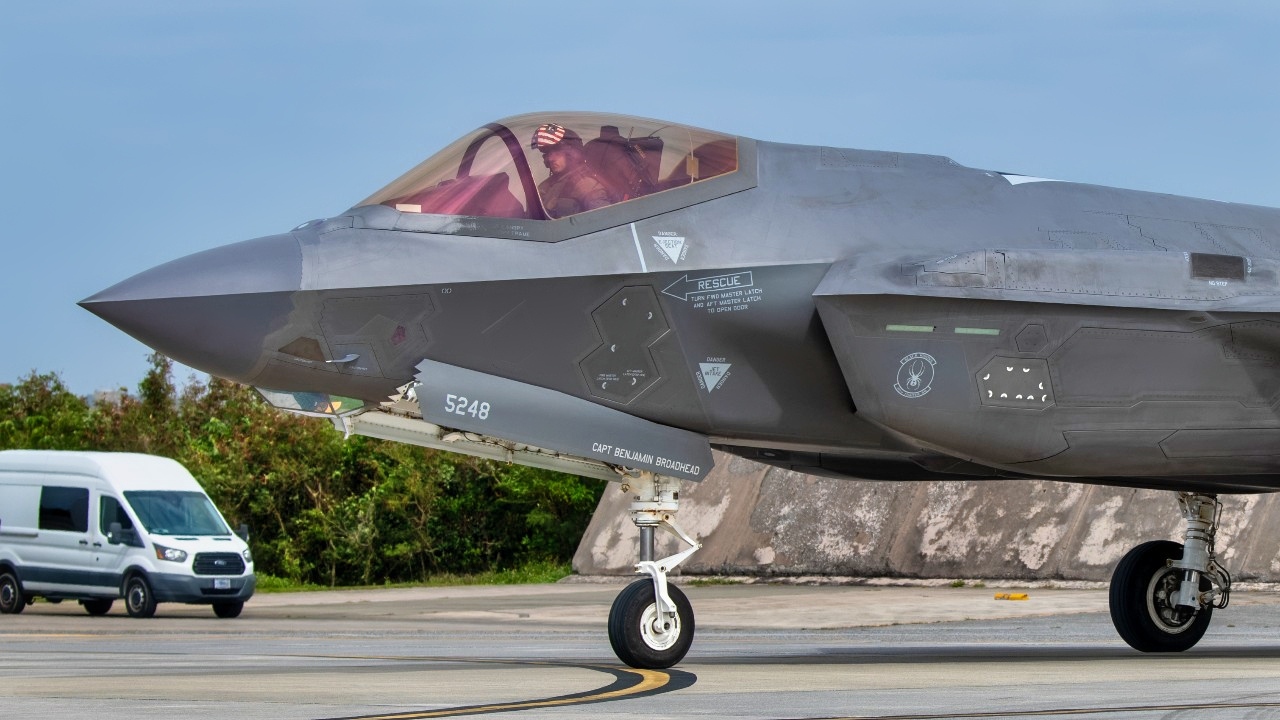
An F-35A Lightning II assigned to the 4th Fighter Squadron, Hill Air Force Base, Utah, taxis into position in front of two U.S. Air Force Airmen with the 18th Logistics Readiness Squadron for forward area refueling point operations during a FARP demonstration at Kadena Air Base, Japan, Feb. 14, 2024. FARP allows operators to transfer fuel from one aircraft to another; this process enables fighter aircraft to land, refuel or re-arm before returning to air-battle operations rapidly in contested environments. (U.S. Air Force photo by Airman 1st Class Jonathan R. Sifuentes)
The F-22 Remains The Best Stealth Fighter In The World
Whenever a US or NATO ally needs support to protect its borders or airspace, the Air Force sends the F-22 to put out fires, project power, and deter aggression.
In April 2023, F-22 fighters were dispatched from Poland to Amari Air Base in Estonia to bolster NATO’s Air Shielding mission and deter Russian aggression in the Baltic Sea region.
“It cannot be matched by any known or projected fighter aircraft, making it a highly strategic platform to support NATO Air Shielding,” the USAF said.
The F-22’s stealth is so good that it has a radar cross-section estimated to be as much as 15 times smaller than the F-35 and roughly 100 times smaller than China’s J-20.
The F-22 remains the standard against which every other stealth fighter is measured. Even after 20 years of service, it is still the best stealth fighter in the world.
But the rest of the world is slowly catching up. And it’s time, as #1 will soon end and be replaced by the sixth-generation F-47 Next Generation Air Dominance Fighter.
But what makes the F-22 great in a dogfight today is the aircraft’s thrust vectoring capabilities. Its two engines have specially designed nozzles at their ends that can move on a vertical plane to vector the aircraft’s 70,000 pounds of thrust in one direction, even if the aircraft is heading in another, thus allowing the F-22 to do some impressive acrobatics, as well as leverage an extremely high angle of attack during a within-visual-range engagement.
In November, the US deployed F-22 Raptors, and later F-35s, to Kadena Air Base in Japan as a show of force against China.
Kadena is located in Okinawa, one of Japan’s southwest Ryukyu islands that form the first island chain. This U.S. defense concept links Japan, Taiwan, and the Philippines, pooling allied nations to contain the Chinese military in the region. And it is only 370 miles from Taiwan.
F-22s were used in the US airstrikes against Iran’s nuclear facilities last June, as well as the operation in Venezuela to remove strongman Nicolas Maduro. And in the ongoing air campaign, F-22’s are once again patrolling the skies over Iran during Operation Epic Fury.
The Raptor Is Already Operating With Collaborative Combat Aircraft:
The F-22 Raptor has it all: stealth, supercruise capabilities, and integrated avionics. And it just got better. It is equipped with an advanced sensor suite to detect, identify, and engage threats before they can be detected.
The cockpit design and advancements in sensor fusion have notably improved pilots’ situational awareness. Another contract involves upgrading the Raptor’s countermeasures.
The Raptor is the first aircraft to control the Collaborative Combat Aircraft during flight testing.
An F-22 pilot controlled an MQ-20 drone from the fighter’s cockpit. General Atomics Aeronautical Systems (GA-ASI) MQ-20 Avenger uncrewed aircraft performed a test mission with an Air Force F-22 stealth fighter as the company separately plans long-range standoff weapons for the MQ-9B.
Flight Global wrote that the “F-22 acted as a command aircraft and the MQ-20 demonstrated the ability to receive and execute commands through a tactical data link.
“The MQ-20 was able to send messages to the F-22, which in turn sent commands via the Autonodyne Bashi Pilot Vehicle Interface (PVI), software that lets a human pilot in a manned aircraft command and task autonomous uncrewed aircraft during missions.”
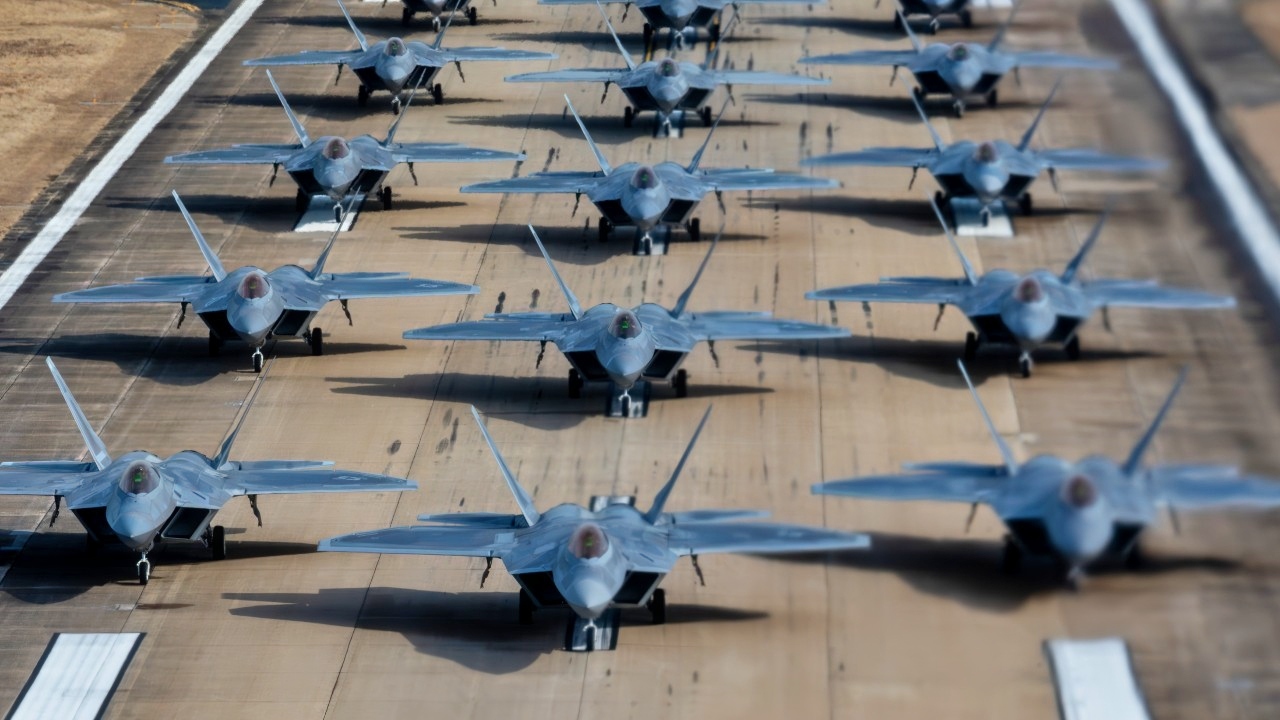
Aircraft from the 1st Fighter Wing conducted an Elephant Walk at Langley Air Force Base, Jan. 31, 2025, showcasing the wing’s readiness and operational agility. This demonstration highlighted the wing’s capability to mobilize forces rapidly in high-stress scenarios. The wing’s fleet includes F-22 Raptors and T-38 Talons. As Air Combat Command’s lead wing, the 1 FW maintains unparalleled combat readiness to ensure national defense at a moment’s notice. (U.S. Air Force photo by SrA Ian Sullens)
The upgrades to the F-22 will help preserve the aircraft’s air-superiority fighter role and competitive edge as the US military confronts more advanced threats from its enemies, especially in the Indo-Pacific, where China poses a particular challenge.
And the Raptor 2.0’s increased range, with stealthy conformal fuel tanks that add up to 850 nautical miles, and the continued development of stealthy drone aerial refueling tankers are good news for US war planners in a possible war scenario there.
MORE – The Dodge Durango of Submarine: The Virginia-Class Is Best on Planet Earth
About the Author: Steve Balestrieri
Steve Balestrieri is a National Security Columnist. He served as a US Army Special Forces NCO and Warrant Officer. In addition to writing on defense, he covers the NFL for PatsFans.com and is a member of the Pro Football Writers of America (PFWA). His work was regularly featured in many military publications.


