


Iran’s Hormuz Attacks Have an Eye On The Midterms – Iran can read a calendar, and they know what is right around the corner.
With less than a month until Americans head to the polls for the midterm elections, Tehran is turning up the heat in the Strait of Hormuz. The Washington Post reported that Iran hit at least nine vessels in the strait last week, a level of violence not seen in months, according to United Nations data and the maritime tracking firm Kpler.

(Oct. 16, 2025) The Arleigh Burke-class guided-missile destroyer USS Paul Ignatius (DDG 117) renders honors to the USS Roosevelt (DDG 80), Oct. 16, 2025. Paul Ignatius is on a scheduled deployment in the U.S. 6th Fleet area of operations to support the warfighting effectiveness, lethality and readiness of U.S. Naval Forces Europe-Africa, and defend U.S., Allied and partner interests in the region. (U.S. Navy photo by Seaman Bradley Wolff)
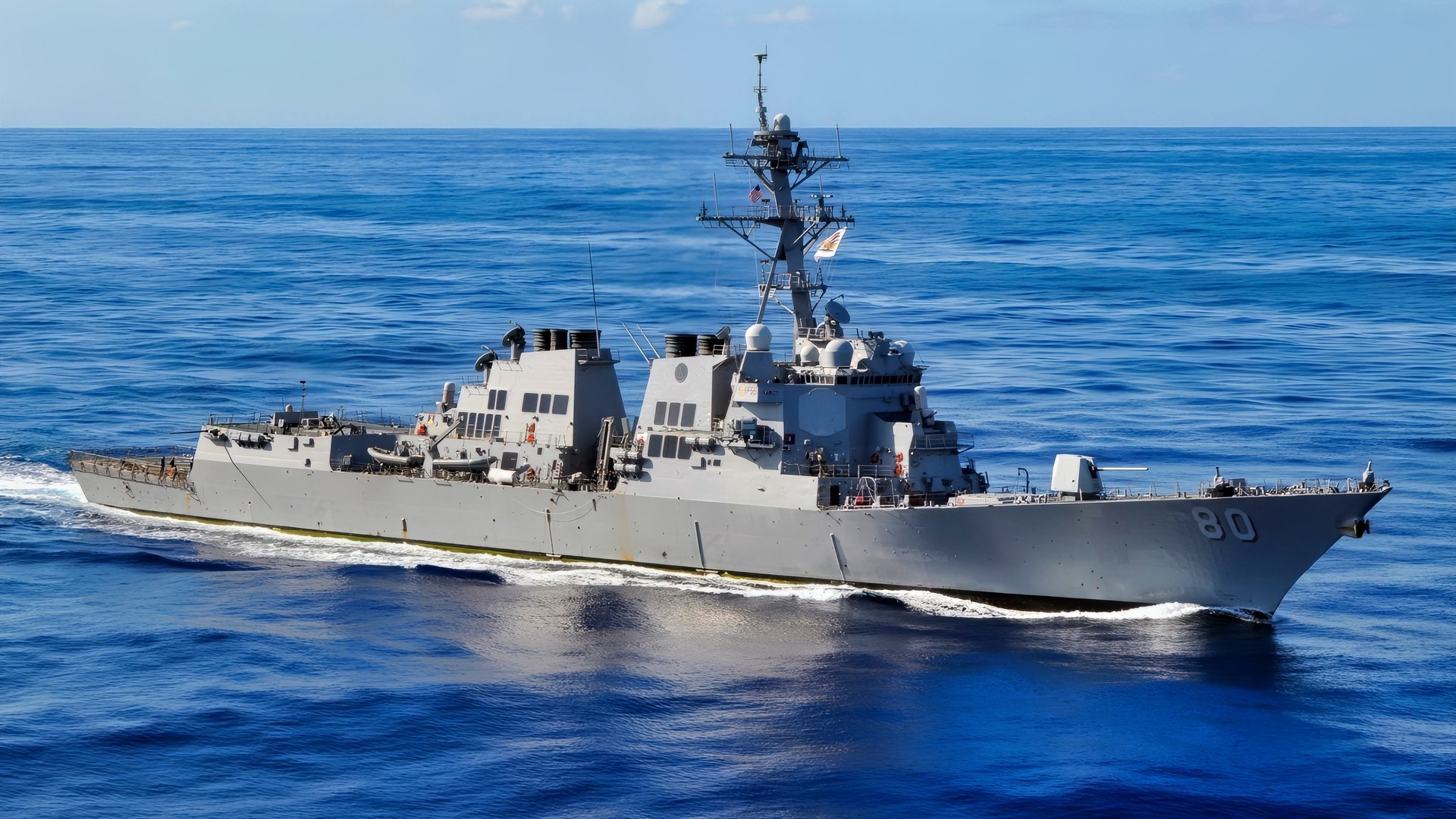
ATLANTIC OCEAN (Sept. 06, 2008) – The guided-missile destroyer USS Roosevelt (DDG 80) steams through the Atlantic Ocean. Roosevelt is deployed as part of the Iwo Jima Expeditionary Strike Group (ESG) in support of maritime security operations in the Navy’s 5th and 6th fleet areas of responsibility. The Iwo Jima ESG is made up of Roosevelt, homeported at Mayport, Fla.; the amphibious assault ship USS Iwo Jima (LHD 7); the amphibious dock landing ship USS San Antonio (LPD 17); the amphibious transport dock ship USS Carter Hall (LSD 50); the guided-missile cruiser USS Vella Gulf (CG 72); the guided-missile destroyer USS Ramage (DDG 61); all homeported at Norfolk, Va.; and the fast attack submarine USS Hartford (SSN 768), homeported at Groton, Conn. U.S. Navy photo by Mass Communication Specialist 2nd Class Jason R. Zalasky (Released)
The attacks have sharply cut the amount of oil moving through the chokepoint. They also came right after the Trump administration celebrated US naval escorts pushing oil flows back to about 80 percent of prewar levels.
The timing isn’t an accident. It’s the whole point.
The Numbers Tell The Story
Maritime security sources tracking the strait counted at least 12 attacks on oil, LNG, and LPG tankers during the week of Sept. 28 to Oct. 5, Reuters said. That’s the most in any single week since the conflict began on Feb. 28.
The UK International Maritime Organization‘s separate count showed nine incidents that week. The previous high was eight, back in mid-July.
The list of ships attacked reads like a who’s who of Gulf shipping. The Kuwait Oil Tanker Co.’s Kazimah III, a 317,250-ton crude carrier, was struck on Oct. 1.
A brand-new Greek Aframax, the Lipsi, was hit on Oct. 4, and in another incident on Oct. 3, a drone dropped straight down a tanker’s funnel into the engine room. India’s foreign ministry said 12 crew members were injured when a projectile hit the Panama-flagged tanker On Peace.
Over the weekend, the IRGC hailed an inbound tanker north of Khasab, Oman, and told it to turn around or be targeted. It turned around.
Iran’s self-styled Persian Gulf Strait Authority claims it’s only hitting ships on its “non-compliant” list. However, at least two Kuwaiti-controlled tankers hit that week weren’t on it. There are no rules, and the non-compliant list is just more Iranian fallacy.
Why Are The Attacks Happening Now?
There is a pattern to all this since this spring. Chris Newton of the International Crisis Group explained it to USNI News back in September. When Washington boasts that ships and oil are flowing again, Iran’s claim to control the strait starts to look hollow, and so does its leverage at the negotiating table.
So Tehran escalates attacks. “It fits the pattern we’ve seen for six months now,” Newton said.
In that same article, energy analyst Neil Atkinson of the National Center for Energy Analytics said the regime is waiting to see whether the US tires itself out and is watching the midterms to figure out how to inflict the most political damage on the Trump administration.
That’s not a conspiracy theory. That’s Iran’s strategy. It is waging a war for opinion in American news coverage centered on the US elections. Iran can’t sink the Fifth Fleet. It can, however, push up the price of a gallon of diesel in Ohio and Pennsylvania three weeks before an election.
The Pain At The Pump Is The X Factor
And that’s exactly where it lands. Diesel hit a record $5.85 a gallon in early September, and gasoline set a Labor Day record at $4.14. Diesel moves the trucks that stock grocery store shelves, so every Iranian drone that hits a tanker eventually shows up on a receipt at the checkout line.
Political scientists have been saying for months that the White House would wear this. George Washington University’s Todd Belt told reporters in the spring that with Republicans controlling the White House and both chambers of Congress, the GOP is likely to pay for pocketbook pain. Tehran has clearly watched CNN.
The administration hasn’t helped itself with its messaging. Treasury Secretary Scott Bessent claimed 10 million barrels a day were moving through the strait in late August. Independent analysts told USNI the real figure was closer to 5 to 7 million.
The prewar daily average was between 130 and 138 ship transits according to the Joint Information Maritime Center. On some late-summer days, independent tracking showed single digits. With Washington crowing about increased oil flows, they handed the Iranians a target. Iran took the shot.
Tit For Tat On The Water
To be fair, the US hasn’t been sitting on its hands. After IRGC ballistic missiles were fired at a US carrier and a destroyer in late August, Central Command struck three Iranian crude carriers, permanently disabling two of them.
The Navy cleared more than 100 suspected mines from the shipping lanes. Escorted convoys have moved real volume, nearing 80 percent of pre-conflict levels.
However, convoys don’t make a strait safe. They make it survivable. Shipping companies and insurers make decisions based on risk, and Campbell University’s Sal Mercogliano warned USNI that if Iran keeps killing sailors or sinking ships, even the state-backed Gulf operators will eventually balk at paying the rising insurance premiums. He compared the global oil supply to driving on a quarter tank of gas. You’re fine until the next station isn’t there.
Iran has, unsurprisingly, raised the ante, as anyone should have suspected before the midterms. Now, the question is whether Washington lets Tehran set the tempo on the water until Nov. 3.
The IRGC has figured out it can dial attacks up and down like a thermostat, and each spike buys it headlines in the US, higher oil prices, and pressure on the White House.
Tehran is betting that American voters will blame the man in the Oval Office for what they pay at the pump. And they’re betting that an influx of Democrats will offer them a golden parachute before their economy completely crashes. It’s an old play. But it has precedent.
About the Author: Steve Balestrieri
Steve Balestrieri is a National Security Columnist. He served as a US Army Special Forces NCO and Warrant Officer. In addition to writing on defense, he covers the NFL for PatsFans.com and is a member of the Pro Football Writers of America (PFWA). His work was regularly featured in many military publications.


