

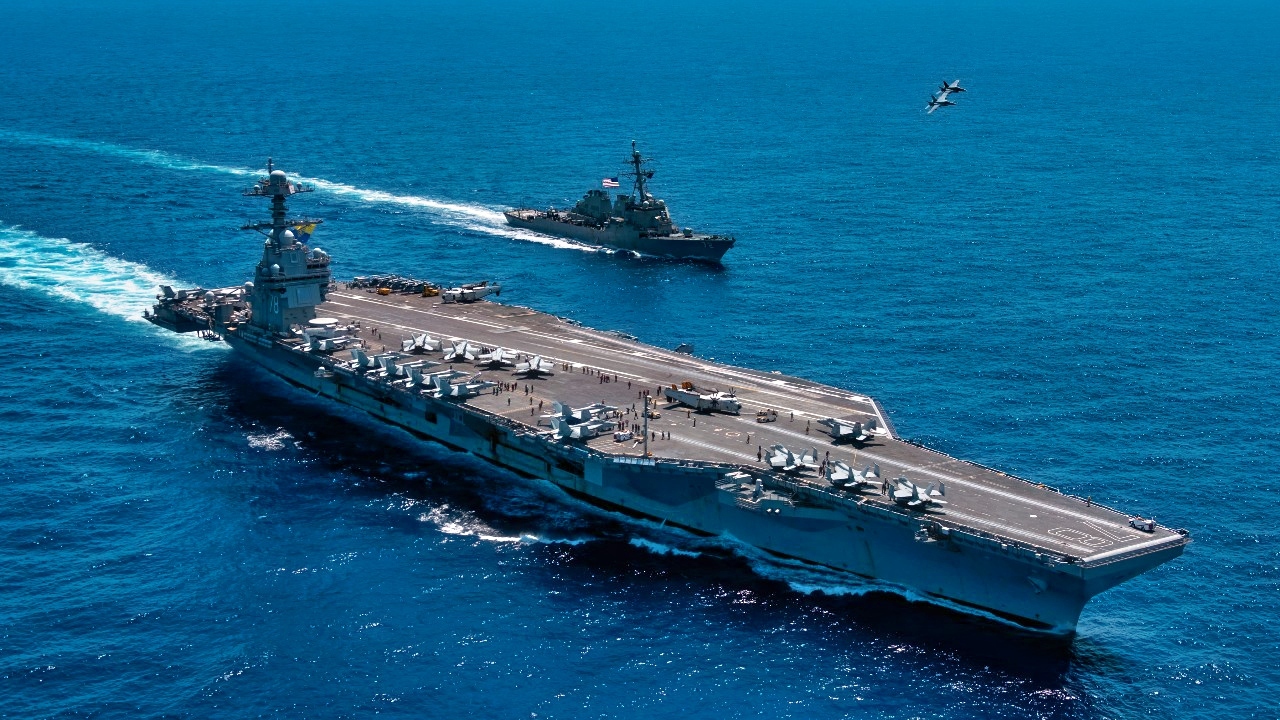
Key Points – The Ford-class aircraft carriers, despite their high cost (around $13 billion per unit) and developmental challenges, represent a revolutionary leap in naval technology.
-Nonetheless, the cost of these aircraft carriers is a significant problem that can’t be fixed without gutting the platform’s effectiveness.
-The simultaneous introduction of numerous unprecedented systems—including electromagnetic launch (EMALS), electric weapons elevators, advanced computer automation, and a vastly more powerful electrical grid—was an ambitious undertaking leading to initial “teething problems.”
-However, these innovations are designed to yield significant long-term benefits: reduced crewing (500-900 fewer sailors), lower maintenance requirements (30% reduction), higher sortie rates (160/day), and ample power for future weapons, ultimately aiming to justify the substantial investment once fully operational.
The Ford-Class Is A Massively Expensive Aircraft Carrier
The Gerald Ford-class aircraft carriers have turned out to be far more expensive than originally projected.
The program cost was up to $37.3 billion as of FY2018, and the unit cost was now $12.998 billion.
Numerous parties have questioned whether the carriers are “worth it” after so many increases in program cost after another.
However, that evaluation greatly depends on numerous factors, most of which remain unknown at this point.
Some of the unknowns include the actual capabilities of the ships once in service – as opposed to their “on-paper” projected operational effectiveness, their performance once at sea, and the broader strategic context of what aircraft carriers will be called on to do in the event of conditions not existing in the present day, such as a conflict with the People’s Republic of China (PRC).
More Gained Than It Seems
The Ford-class carrier is in the water and now in trials due to no small amount of effort required to reach this point.
There have, however, been numerous complications with the entire process, and they have been what has prompted all of the inquiries as to whether the ship’s cost is justified.
But a major US naval shipbuilding engineering contractor tells us that “despite the many headaches along the way and technological bottlenecks that had to be overcome, the truth is that there are aspects of this program that go far beyond just being able to put one of the ships in the water and prove that the first one in its class can be made operational.”
“What gets lost in all the criticism of the program delays isof the scope and depth of the impact of validating all the Ford’s on-board systems. Getting past its shortcomings, failings, and then the greatest benefits are all a product of the ultimately successful effort to introduce many new unprecedented technologies into a platform – and to introduce all of them all at the same time.”
“As an overall program and the platform’s new systems all taken as a whole, the project was decidedly ambitious. It has taken years to wring all of the bugs out of them and there has been no small amount of duress.”
“But the ship is now finally operational with a new electromagnetic propulsion system, a set of breakthrough developments in computer automation, electric weapons elevators, an unprecedented on-board electrical power grid system, and a much larger deck space that will support a higher sortie rate.”
Looking Back On The Beginning
If the Navy is to blame in any way for the Ford-class carrier’s problems, one might look at the extreme ambitions of the program.
The Ford-class carriers were not just a next-generation iteration in carrier design. The jump from the previous Nimitz-class was nothing less revolutionary and represents an investment – if not a gamble – that has the potential for multiple long-term strategic benefits.
However, their high cost and developmental challenges have raised questions about whether or not their value in the end will be worth the resources that have had to be expended to date.
Whether the Ford-class boats are worth what it cost to get to where we are now with the state of their operation is not a question that can be answered in the present day.
Only the US Navy can answer once its needs and priorities are balanced against how the ship actually performs in service.
It bears reminding those in charge just what the achievements of the Ford carriers are and just how much will be gained from their being in operation with the Navy over time:
The Ford-class ships will require between 500 and 900 fewer crew members.
They will also feature 23 new or upgraded systems compared to the Nimitz-class carriers, this is a greater number involved with the introduction of a new class of carrier than has been attempted before.
The Gerald R. Ford-class carriers will have a length of 333m, a beam of 40.8m, and a flight deck width of 78m.
It is estimated that the new carrier technologies will lead to a 30 per cent reduction in maintenance requirements and a further crew workload reduction will be achieved through higher levels of automation.
Other main differences in operational performance compared with the Nimitz-class are increased sortie rates at 160 sorties a day (compared with 140 a day), a weight and stability allowance over the 50-year operational service life of the ship, and an increase of approximately 150 per cent in electrical power generation and distribution to sustain the ship’s advanced new systems.
The immediate positive impacts from this design will be felt for decades and will address most of the shortcomings of current carrier ops and improvements that have been needed for many years.
About the Author:
Reuben F. Johnson is a survivor of the February 2022 Russian invasion of Ukraine and is an Expert on Foreign Military Affairs with the Fundacja im. Kazimierza Pułaskiego in Warsaw. He has been a consultant to the Pentagon, several NATO governments and the Australian government in the fields of defense technology and weapon systems design. Over the past 30 years he has resided in and reported from Russia, Ukraine, Poland, Brazil, the People’s Republic of China and Australia.
The Ukraine War


Pingback: Nimitz's Last Stand: Navy Aircraft Carrier on Final Mission in China's Backyard - National Security Journal
Pingback: China Could 'Starve' Taiwan into Submission - National Security Journal
Pingback: F-16XL Fighter Summed Up In 4 Words - National Security Journal
Pingback: The F-35 Stealth Fighter Is Back - National Security Journal
Pingback: No Tom Clancy Novel: Navy Nuclear Sub Smashed Into Russian Titanium Submaine - National Security Journal
Pingback: Iran's Nuclear Weapons Program Isn't Dead Yet - National Security Journal
Pingback: Russia's T-80 Tank Is 'Circling the Drain' in the Ukraine War - National Security Journal
Pingback: M60A3: A Deep Dive into the Last and Best M60 Patton Tank - National Security Journal