

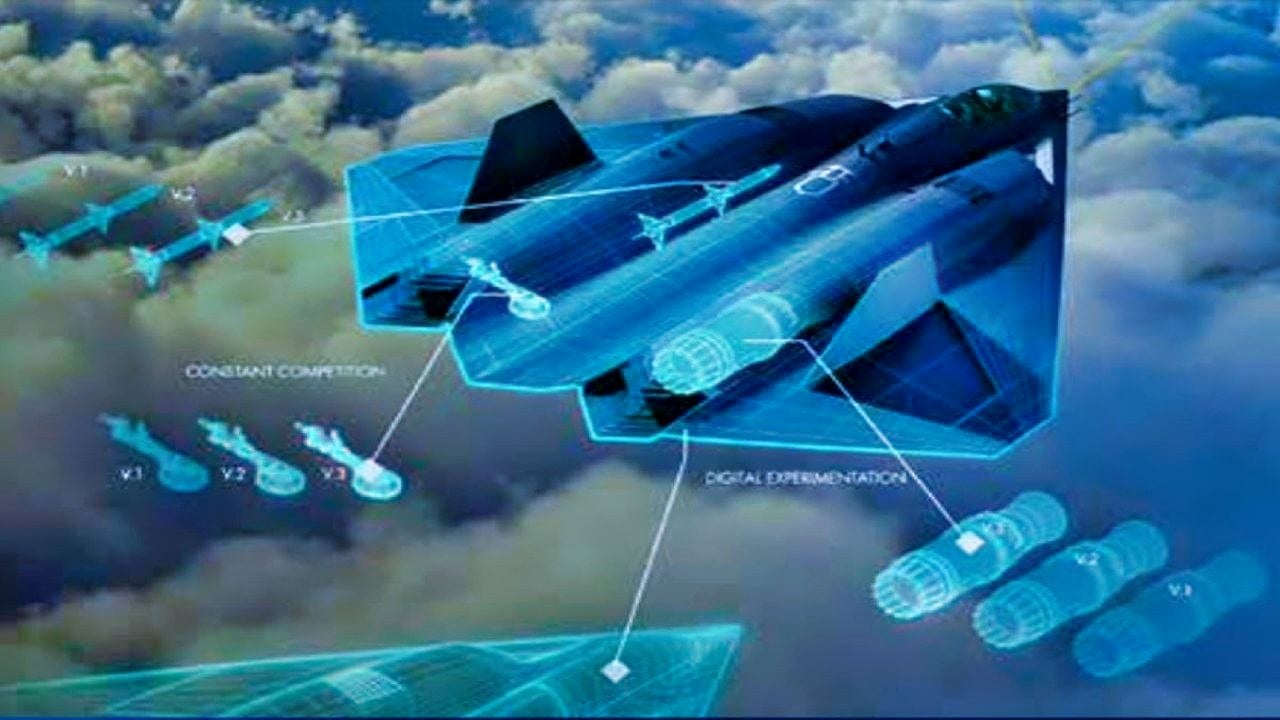
Key Takeaways – The X-44 MANTA never left the drawing board, but its ideas still loom over future air-dominance planning.
-Conceived as a tailless evolution of the F-22, the MANTA wrapped proven Raptor engines and sensors in a stealth-first delta planform with no vertical or horizontal tails.
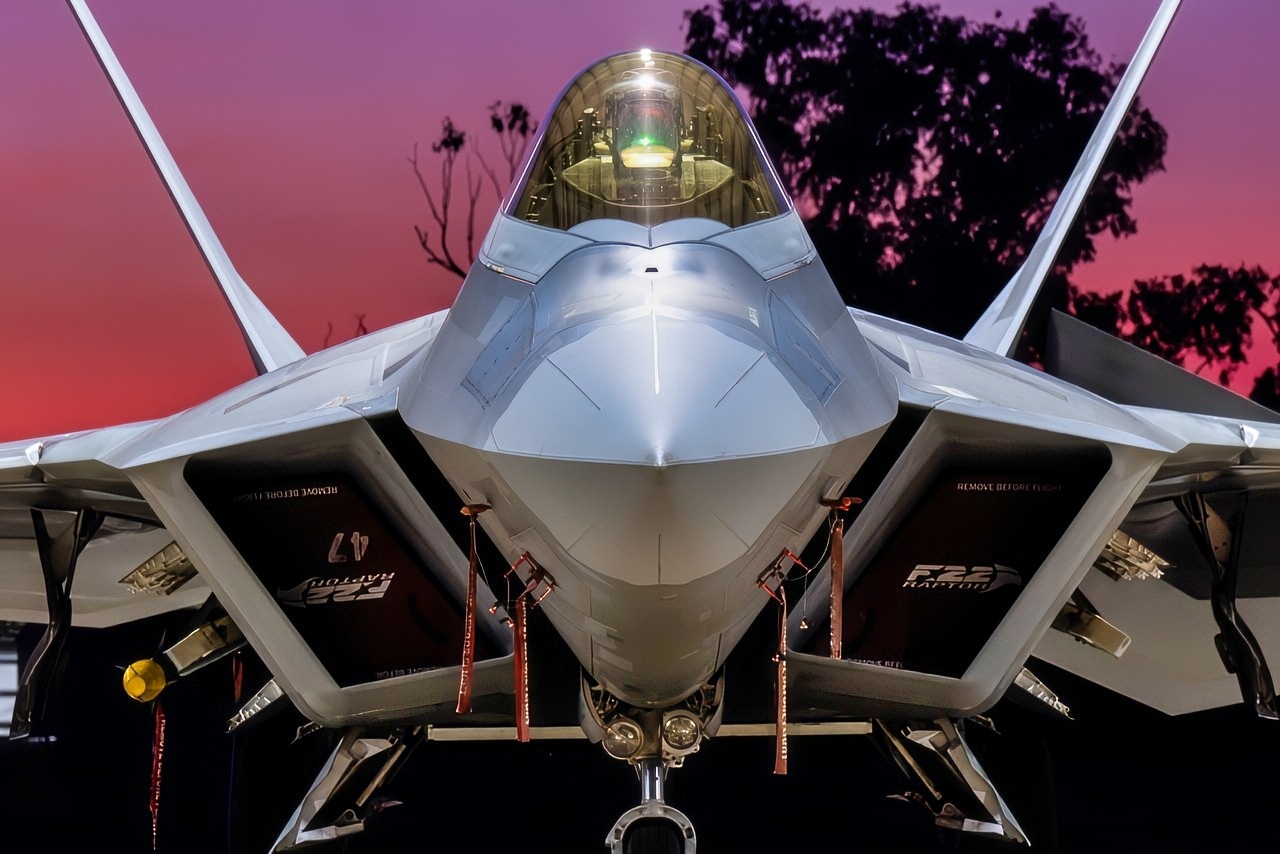
A U.S. Air Force F-22 Raptor assigned to the 199th Air Expeditionary Squadron sits beneath a hangar as the sun sets in Northern Territory, Australia, July 16, 2025, during Talisman Sabre 2025. Talisman Sabre is the largest bilateral military exercise between Australia and the United States advancing a free and open Indo-Pacific by strengthening relationships and interoperability among key allies and partners, while enhancing our collective capabilities to respond to a wide array of potential security concerns. (U.S. Air Force photo by Senior Airman Natalie Doan)
-Thrust vectoring was meant to act as a primary flight control, with software doing what metal once did—keeping a highly unstable airframe tame while unlocking extreme agility and range.
-Bigger internal fuel, cleaner signatures and software-defined stability made X-44 a glimpse of sixth-generation thinking, even if budgets, timing and risk kept it from ever flying.
X-44 MANTA Can Be Summed Up in 1 Word: Gamechanger
The X-44 MANTA sits in that fascinating corner of aviation history where a few memos, wind-tunnel runs, and control-law studies spawned years of hangar-talk.
The premise was almost mischievously simple: tails are great for control, but they’re terrible for stealth and drag.
What if you deleted them entirely, then let modern engines and flight-control software do the work that aluminum once did?
Wrap that in a big delta wing for fuel and lift, reuse the F-22’s proven engine and sensor lineage, and you have a thoroughly modern fighter with fewer edges, fewer hinges, and—crucially—more range.
5 Reasons the X-44 MANTA Story Won’t Go Away
It was an engineer’s answer to the question of where to go after the F-22: take the cleanest possible planform, give it sophisticated software and thrust vectoring, and you might get more of everything that matters—stealth, persistence, agility—without the penalties of big movable tails.
Here are the five possible features that made the X-44 so compelling.
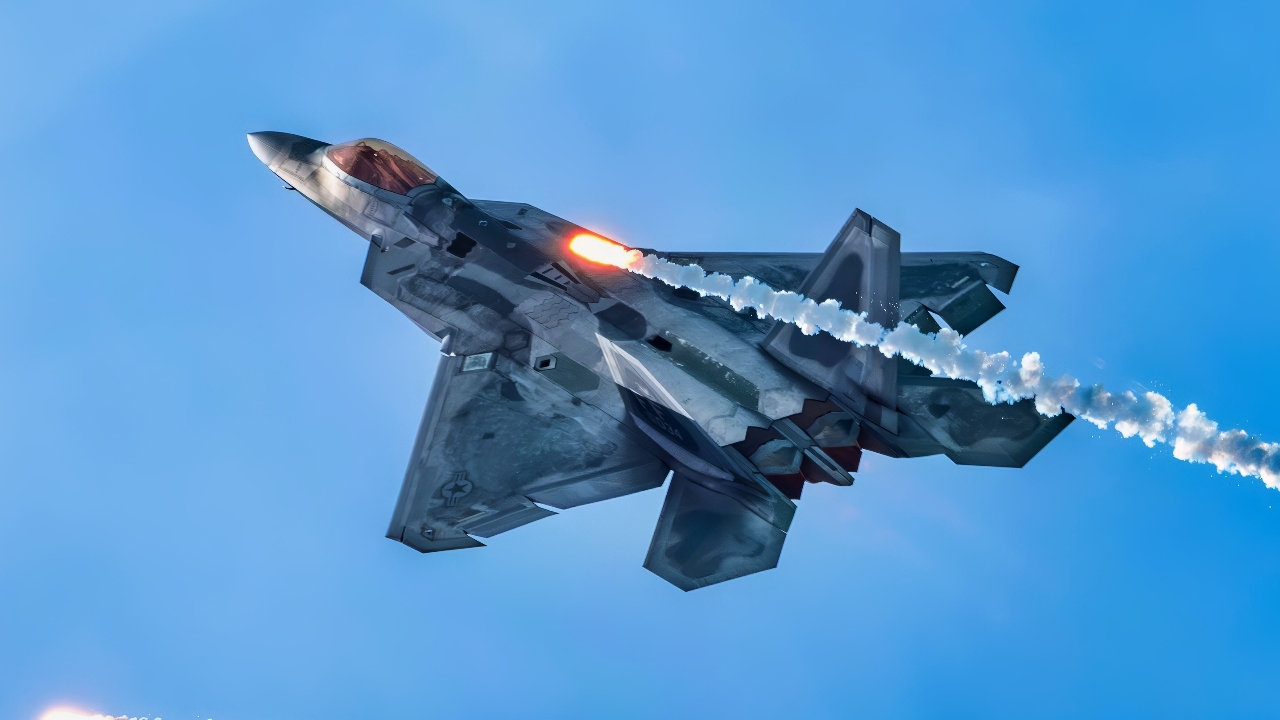
U.S. Air Force Capt. Nick “Laz” Le Tourneau, F-22 Raptor Aerial Demonstration Team commander, performs an aerial maneuver during the Cocoa Beach air show in Florida, July 12, 2025. The team joined the community in celebrating Cocoa Beach’s 100th anniversary, marking a century of coastal heritage and patriotic spirit, while showcasing the unmatched power, agility, and precision of America’s fifth-generation fighter and reinforcing public trust in the Air Force’s mission to fly, fight, and win. (U.S. Air Force photo by Staff Sgt. Lauren Cobin)
Tailless Stealth-First Planform
The most obvious feature was also the most decisive: no verticals, no horizontals—just a broad, carefully sculpted wing/body that blended lifting surfaces into a single stealth-optimized shape.
In stealth design, every edge is a potential liability; every hinge and gap adds radar “glitter.” Tails create corner reflectors and present radar-friendly surfaces from many angles. Delete them and you simplify the scattering picture across a wide swath of threat sectors.
A cleaner shape isn’t just about radar. Tails add drag in cruise, especially when trimmed at high speeds and altitudes. With a tailless planform you trim with wing and body lift instead of deflecting big control surfaces that create extra drag. The payoff is twofold: stealth that is more uniform around the clock and super-cruise efficiency—sustained supersonic flight without afterburner—at fuel burns that look more like a long-range interceptor than a point-defense sprinter.
The catch, of course, is that tails exist for a reason: they give you pitch and yaw authority and damping. Removing them means the aerodynamics must be inherently stable enough for cruise but “actively” stabilized by software everywhere else.
The MANTA embraced that trade, betting that modern control theory and thrust vectoring could supply the authority tails once provided—without their radar and drag penalties.
Thrust Vectoring As A Primary Flight Control
If the tailless shape was the headline, the control method was the plot twist. The X-44 wasn’t just going to use thrust vectoring for stunt-show post-stall maneuvers; it was going to lean on the engines as primary control effectors.
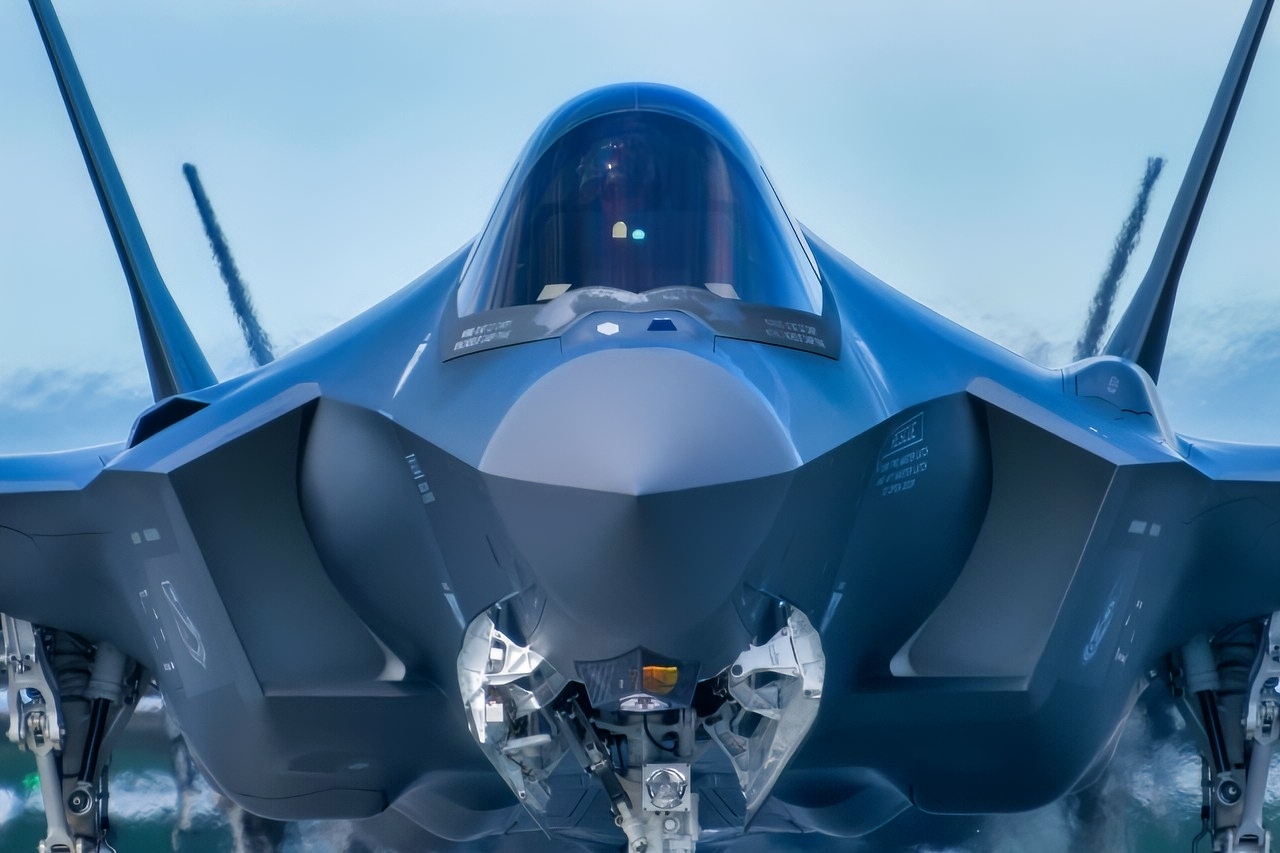
U.S. Air Force aircraft participate in a capabilities demonstration in honor of the U.S. Air Force’s 75th Anniversary at Eielson Air Force Base, Alaska, Aug. 12, 2022. Aircraft, including F-35A Lightning II, F-16 Fighting Falcon and F-22 Raptor aircraft, participated in the 75-fighter jet formation. (U.S. Air Force photo by Tech. Sgt. Timothy Moore)
With 3-axis vectoring nozzles, the flight-control system could command pitch, yaw, and roll moments by “bending” the exhaust, not by cranking big tail surfaces into the airstream.
Why does that matter? First, it restores the authority you gave up by deleting tails. Second, it lets you keep the external surfaces relatively neutral most of the time, which helps stealth by minimizing deflections that create radar returns. Third, it unlocks silly amounts of control at high angles of attack, where traditional control surfaces start to lose bite. In the knife-fight regime—post-stall, energy-bleeding, nose-pointing moments—thrust vectoring gives you options that an all-aerodynamic jet just doesn’t have.
There’s a fourth benefit that rarely gets airtime: control redundancy. If turbulence, icing, or damage compromises one set of effectors, having two independent “muscles” (aerodynamic surfaces and engine vectoring) in the loop can keep the pilot in the fight.
The X-44 would have been a flying thesis on that redundancy—software orchestrating exhaust plumes and small surfaces to achieve incredibly precise control, all while keeping the airframe clean.
Big Delta Wing, Big Internal Fuel, Big Reach
Look closely at the MANTA art: that wing isn’t just a styling cue. It’s a fuel tank with lift—a lot of both. One of the quiet metrics that wins wars is persistence: how long you can stay on the edge of the battlespace, sensors up, waiting to take the right shot. The X-44 chased persistence the old-fashioned way—by giving itself more gas.
A larger planform buys real estate for tanks and a broader, more efficient lifting surface.
Combine that with a low-drag, tailless cruise and you begin to see the “why” behind the concept: the MANTA was meant to be a long-range stealth fighter that didn’t need to hang pylons full of external fuel (which ruin stealth and drag you down). In an era when tankers are high-value targets and base distances are growing—think the Pacific—the promise of a deep-legged stealth fighter is not incremental. It changes how you plan the air war.

A U.S. Air Force F-22 Raptor assigned to the Air Force F-22 Demonstration Team, Air Combat Command, performs aerial maneuvers during the 2025 Marine Corps Base Hawaii Kaneohe Bay Air Show, Aug. 9, 2025. The Kaneohe Bay Air Show provides an opportunity to showcase the aircraft, equipment and capabilities of the armed forces in the Indo-Pacific region to the local community. The air show, which contained aerial performances, static displays, demonstrations and vendors, was designed to celebrate MCBH’s longstanding relationship with the local community. (U.S. Marine Corps photo by Lance Cpl. Blake Gonter)
More internal volume also hints at payload flexibility. While the X-44 was never designed to be a bomb truck, additional bay room or flexible internal arrangements could have supported new sensors, more air-to-air missiles, or novel mission kits without wrecking the signature. For a concept jet, having that kind of margin is gold.
Software-Defined Stability And Sensing
The X-44 was conceived in the late 1990s, just as fly-by-wire confidence and model-based control were coming into their own.
A tailless fighter needs a brain that can predict, detect, and correct tiny deviations before a pilot even notices them. That means fast processors, high-fidelity aerodynamic models, and sensor fusion not just for tactics, but for keeping the airplane pointed where physics says it shouldn’t want to be.
That same computational muscle underwrites the jet’s tactical brain. The X-44 was sketched to inherit and extend the F-22’s approach to sensing: fuse radar, infrared, and electronic signals into a coherent picture the pilot can use without staring at raw feeds. A tailless jet with big electrical power and cooling margins becomes a sensor platform as much as a shooter, able to run next-gen apertures and electronic-warfare tricks while staying quiet on the outside.
Just as important: software is the one thing you can upgrade quickly at scale. A tailless control law might begin life conservative, then unlock agility later as flight testing validated the models. Tactics, threat libraries, electronic-attack behaviors—the “living” parts of a fighter—could grow annually. The MANTA’s design philosophy assumed that code is a weapon, and the airframe should make room for more of it.
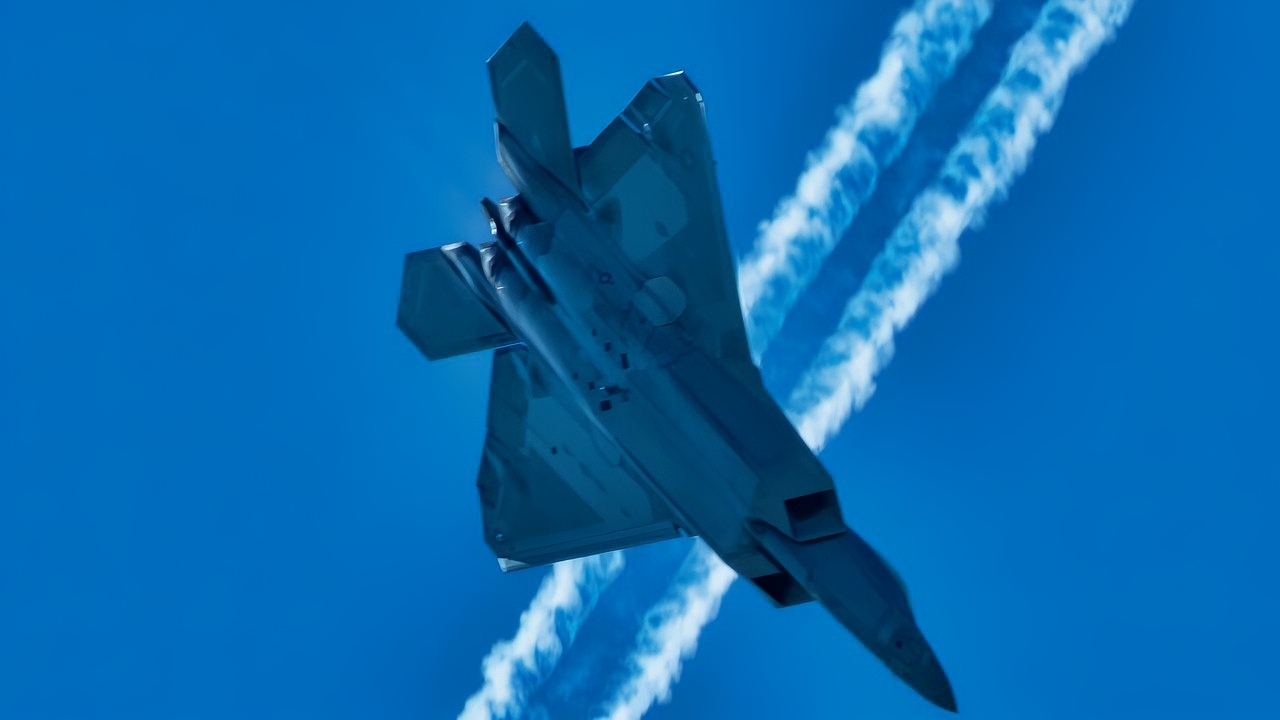
U.S. Air Force Maj. Josh Gunderson, F-22 Demonstration Team pilot, soars through the sky during a demonstration practice Feb. 27, 2020, at Davis-Monthan Air Force Base, Ariz. The Heritage Flight Training Course is a training course for all single-ship aerial demonstration teams prior to the upcoming summer air show season. (U.S. Air Force Photo by Captain Kip Sumner)
Clean Signature Across The Spectrum
Stealth isn’t only radar. The X-44’s smooth planform, reduced control deflections, and efficient cruise profile pointed toward a lower multi-spectral signature. Fewer external edges help in radar; fewer big, flapping surfaces help in radar and infrared because you’re not yanking the jet around and dumping energy as heat with every maneuver. A tailless jet can also hide control-surface gaps and hinge lines that leak returns.
Signature control also benefits from exhaust management. Vectoring nozzles give designers latitude in shaping and mixing flows, potentially reducing hot spots and smoothing plume geometry. None of that makes an airplane invisible, but it buys seconds—precisely the seconds a stealth fighter trades in.
The MANTA was essentially a case study in how much you can depress signatures by starting with the geometry and letting the software do the rest.
Just as critically, stealth uniformity matters. Many stealth aircraft are very low observable in specific sectors (head-on, for example) but more vulnerable from others. A tailless shape reduces the number of “bad angles.” For a fighter that must thread sensor networks, arrive unannounced, and leave the same way, a more even signature is an operational advantage.
So Why Didn’t The X-44 Fly?
For all its elegance, the MANTA never got the money, the program office, or the political oxygen to jump from paper to prototype. The reasons say as much about budgets and timing as they do about technology.
First, technical risk. Flying without tails as a matter of course—replacing them with thrust vectoring as primary control—demands extraordinary confidence in control laws, engine response, and failure modes.

F-22 Raptors from the 1st Fighter Wing and 192nd Fighter Wing, participate in a total force exercise at Joint Base Langley-Eustis, Virginia, Feb. 28, 2019. Both wings partnered with the 633rd Air Base Wing during the Phase I exercise to showcase their readiness and deployability of the F-22s. (U.S. Air Force Photo by Tech Sgt. Carlin Leslie)
Cutting-edge? Absolutely. But enticing a conservative acquisition system to underwrite a one-off demonstrator with that degree of novelty is hard, especially when there are safer ways to buy capability now.
Second, overlapping programs. The F-22 was still maturing; the F-35 was consuming vast resources and political capital; and the United States was pivoting to counterinsurgency campaigns that didn’t scream for a fresh air-dominance type. In that environment, a “Raptor-plus” experiment was easy to shelve. If you can only fund one moonshot, you fund the one already in production and the one promised to dozens of allies.
Third, no urgent operational requirement. The Raptor fleet, though capped, satisfied the near-term air-superiority bill. The case for a tailless successor was compelling but not urgent, and urgency is the mother of funding.
Fourth, the future moved on. As the 2010s arrived, the conversation shifted to sixth-generation families of systems—manned/uncrewed teammates, longer ranges, new propulsion, and even lower signatures. In that world, the X-44 looked less like the next fighter and more like a stepping stone. The appetite turned to larger leaps rather than a bold—but still incremental—evolution of the Raptor.
Finally, testing costs. A true X-plane demands a flight-test campaign with bespoke hardware, safety cases, and recovery paths if things get spicy. Without an institutional champion, those costs become cliffs. The MANTA had admirers, not patrons.
The Idea Still Echoes
If you squint at today’s concept art and patent filings, you’ll see the MANTA’s DNA: tailless planforms, deeper internal fuel, three-axis vectoring, and software that treats engines and flight surfaces as interchangeable muscles.
Uncrewed combat air vehicles and future manned fighters are circling the same problem set from different angles: how to fly cleaner shapes, farther, with fewer tells, and how to let code swallow complexity that aluminum no longer has to carry.

A U.S. Pennsylvania Air National Guard KC-135 Statotanker aircraft from the 171st Air Refueling Wing out of Pittsburgh provides fuel for a U.S. Air Force F-22 Raptor from Joint Base Langley–Eustis, April 2, 2025. The air refueling mission was part of routine proficiency training. (U.S. Air National Guard photo by Master Sgt. George Perkins)
The X-44 didn’t fly, but its questions still matter. How much control can you safely shift from metal to math? How much range and stealth do you win by deleting tails? And how do you balance those gains against risk in engines, flight controls, and test budgets? The answers are showing up—quietly—in the sketches of what comes next.
About the Author: Harry J. Kazianis
Harry J. Kazianis (@Grecianformula) is Editor-In-Chief and President of National Security Journal. He was the former Senior Director of National Security Affairs at the Center for the National Interest (CFTNI), a foreign policy think tank founded by Richard Nixon based in Washington, DC. Harry has over a decade of experience in think tanks and national security publishing. His ideas have been published in the NY Times, The Washington Post, The Wall Street Journal, CNN, and many other outlets worldwide. He has held positions at CSIS, the Heritage Foundation, the University of Nottingham, and several other institutions related to national security research and studies. He is the former Executive Editor of the National Interest and the Diplomat. He holds a Master’s degree focusing on international affairs from Harvard University.


JOEL JUSTIN CARLSON
November 2, 2025 at 9:20 pm
Go *^$# yourselves
Elwalid Osman
November 2, 2025 at 9:47 pm
Compound ignorance… Your era is over… These aren’t Superman movies. Why don’t you try saying these things yourself to get a proper response from China and Russia?
David
November 3, 2025 at 5:39 pm
I’m all for the Elephant 🐘 party charging $14,000 to the military for $39 HomeDepo toilet seats. So it make me wonder what the Grift for this would be.