

In September, transit through the Strait of Hormuz surged following a lull in the ongoing war with Iran. According to data from various maritime tracking agencies, an average of 10 million barrels of crude oil passed through the waterway in September, compared to 17 million to 20 million barrels before the war started. This data suggested that Iran’s blockade over the Strait was weakening and that traffic was beginning to return to normal.
Despite the good news, oil prices have remained high. Brent Crude is still priced at around $100 per barrel and has never dipped below $94, even while traffic surged in September. How can this be? Many other factors drive oil prices besides the Strait.

Generic Oil Tanker Image. Image Credit: Creative Commons.
What’s Driving Oil Prices?
As Ron Bousso writes on Reuters, the main problem for the oil market isn’t supply; it’s logistics. “For decades, the global oil industry functioned as a finely tuned system designed to move enormous volumes of crude and fuels over long distances at the lowest possible cost,” Bousso writes. “The conflicts in the Middle East and Eastern Europe have fractured that model, as a combination of record-high tanker rates, soaring insurance costs, and a severe shortage of refining capacity has created bottlenecks across the energy supply chain.”
The solutions to these problems will take months, if not years, to implement, a timeline further exacerbated by continuing attacks on oil infrastructure in Saudi Arabia.
Although traffic through the Strait of Hormuz has picked up, the increased risk of attacks from Iran or from the Houthis near the Bab al-Mandeb Strait is still a major concern for major tanker companies.

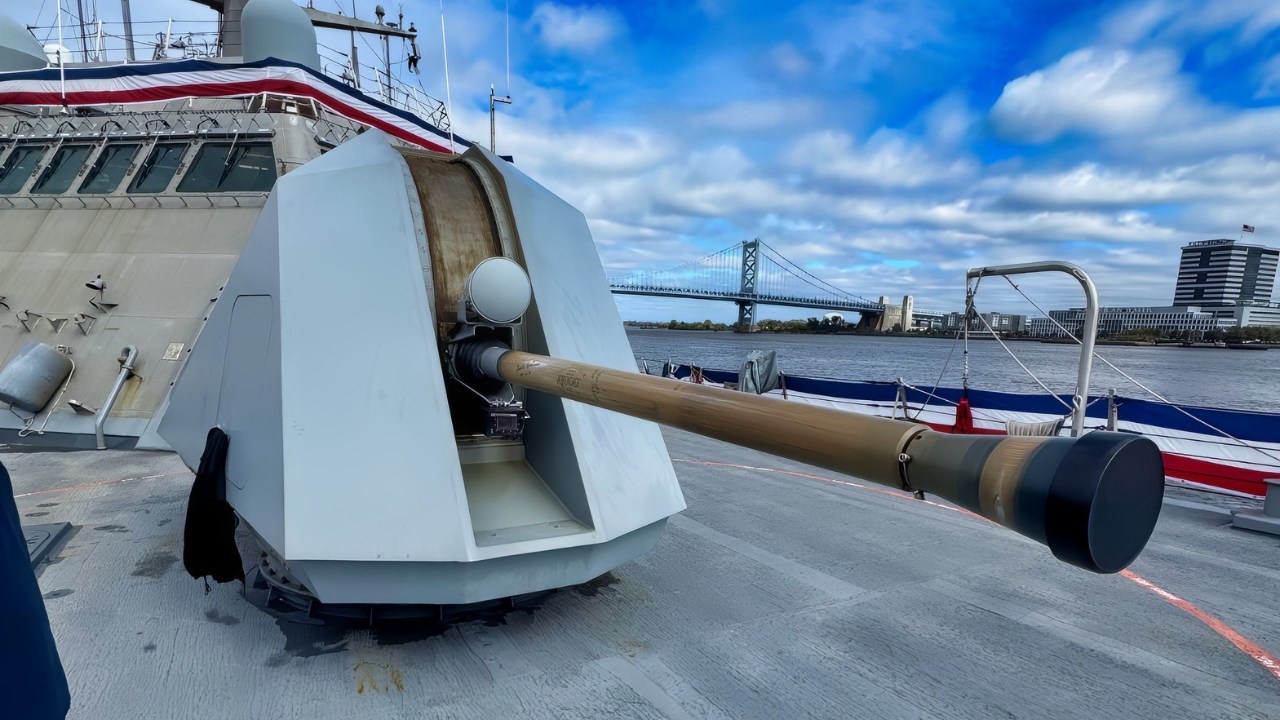
Littoral Combat Ship Gun Close. Image Credit: Stephen Silver/National Security Journal.
As a result, freight and insurance costs have skyrocketed in 2026.
Before the war, insurance rates sat comfortably at around 0.15% to 0.25% of vessel value.
After the conflict broke out, however, premiums rose to around 1%-3% of a ship’s value, with some extreme cases reaching 7.5%-10%.
Tanker companies are also charging higher rates to move oil from the Middle East to Asia, with some rates exceeding $1.2 million per day, up from $30,000 per day in January before the war.

U.S. Air Force Senior Airman Colby Delia, 9th Expeditionary Bomb Squadron crew chief, and Airman 1st Class Olivia Ward, 9th Expeditionary Bomb Squadron crew chief, prepare for a B-1B Lancer to take off for a mission at Misawa Air Base, May 9, 2025. BTF missions provide opportunities to train and work with our allies and partners in joint and combined operations and exercises. (U.S. Air Force photo by Airman 1st Class Mattison Cole)

B-1B Lancer Bomber. Image Credit: Creative Commons.
Refining Shortfalls
Another factor affecting oil prices is a global shortage of refining capabilities.
Since the war in the Middle East began, the region’s refining infrastructure has been targeted.
In Iran and the Gulf states, multiple oil facilities and refineries have been struck since February, with the Houthis in Yemen continuing to attack Saudi oil infrastructure.
Last month, the Houthis attacked the East-West Pipeline in Saudi Arabia, which was intended to serve as an alternative to the Strait of Hormuz.
The war in Ukraine has also played a major role in the current refinery shortage.
Russia is one of the world’s leading energy exporters.
In 2026, however, Ukraine has stepped up its attacks against major refineries across Russia to disrupt its war economy.
Consequently, major refineries worldwide were taken offline simultaneously, creating an immediate refining shortage that is still struggling to recover.
The ongoing war in Iran complicates efforts to return the energy market to pre-war norms.

Littoral Combat Ship USS Cooperstown NSJ Photo Taken On October 14, 2025.
Despite mounting pressures on the Islamic regime, Iran continues to attack civilian vessels in the Strait, which has again raised uncertainty over the prospects of using the vital waterway.
Over the last week, the UK Maritime Trade Operations (UKMTO) Center recorded 11 tanker attacks in the Strait across 14 separate incidents.
Since then, traffic through the waterway has dropped since September.
At the same time, as mentioned earlier, oil infrastructure across Saudi Arabia continues to be targeted by Houthi missiles and drones.
Just a few days ago, the Houthis claimed to have hit an Aramco facility in Riyadh, with footage of the facility showing a fire burning after at least one impact.
Expect Oil Prices to Remain High
High energy prices are a major concern for the Trump administration as the November midterm elections approach.
On Friday, the G7 countries agreed to release 100 million barrels of diesel and crude oil from their strategic oil reserves after facing pressure from President Trump.
This measure is likely a short-term fix, as the global market still reels from a shortage of refining capacity.
The U.S. has also tried to offer insurance for tankers attempting to cross the Strait of Hormuz to return to pre-war levels.
According to most polls, the war with Iran is still largely unpopular in the U.S., as gas prices remain a top priority for most Americans.
Unfortunately, the energy market will take time to return to normal once the war ends.
As mentioned above, the war has damaged or altered the logistics that enabled the industry to run so efficiently.
With the wars in Ukraine and the Middle East still ongoing, attacks against fuel infrastructure are certain to continue, making it more difficult to refine and transport fuel.
The best hope for the market and the average consumer is that these conflicts end soon, but given the current state of diplomacy in both conflicts, that is probably unlikely.
About the Author: Isaac Seitz
Isaac Seitz, a Defense Columnist, graduated from Patrick Henry College’s Strategic Intelligence and National Security program. He has also studied Russian at Middlebury Language Schools and has worked as an intelligence Analyst in the private sector.


