

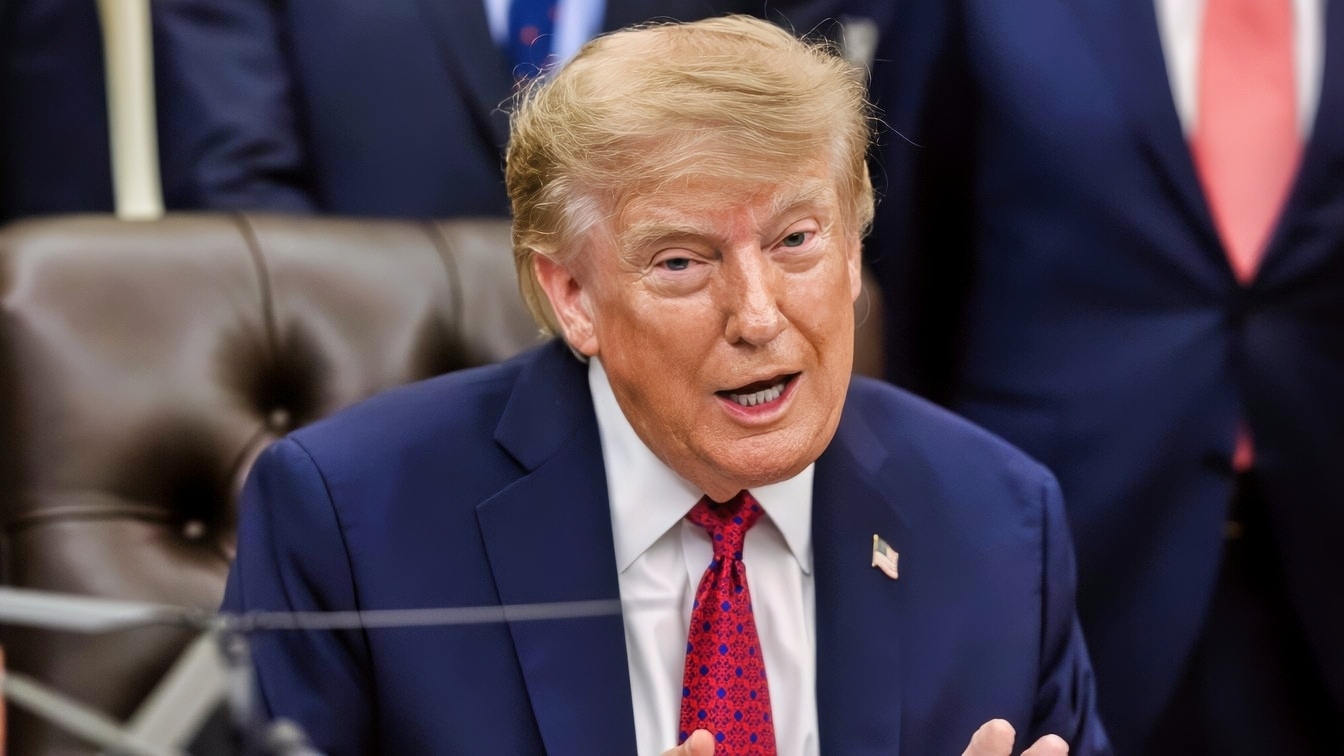
The Political Considerations of the Iran War – As the Iran War has stopped and started in recent months, some political questions have sort of existed in the background: If this war is continuing, and it remains historically unpopular, what will that mean for President Donald Trump’s party in the midterm elections? And will members of the president’s party need to answer for his support of the war?
Reuters looked at those considerations in a report published Thursday.

OVER NEVADA — A B-1B Lancer from the 37th Bomb Squadron, Ellsworth Air Force Base, S.D., streaks through the sky. Carrying the largest payload of both guided and unguided weapons in the Air Force inventory, the multi-mission Lancer is the backbone of America’s long-range bomber force. It can rapidly deliver massive quantities of precision and non-precision weapons against any adversary, anywhere in the world, at any time.
(U.S. Air Force photo by Master Sgt. Lance Cheung)

U.S. Air Force F-16 Fighting Falcons intercept two U.S. Air Force B-1B Lancers during exercise Amalgam Dart 21-2, March 23, 2021. The exercise will run from March 20-26 and range from the Beaufort Sea to Thule, Greenland and extend south down the Eastern Atlantic to the U.S. coast of Maine. Amalgam Dart 21-2 provides NORAD the opportunity to hone homeland defense skills as Canadian, U.S., and NATO forces operate together in the Arctic. A bi-national Canadian and American command, NORAD employs network space-based, aerial and ground based sensors, air-to-air refueling tankers, and fighter aircraft controlled by a sophisticated command and control network to deter, detect and defend against aerial threats that originate outside or within North American airspace. NATO E-3 Early Warning Aircraft, Royal Canadian Air Force CF-18 fighter aircraft, CP-140 long-range patrol aircraft, CC-130 search and rescue and tactical aircraft, and a CC-150T air refueler; as well as U.S. Air Force F-16 fighter aircraft, KC-10 Extender refueler, KC-46 Pegasus, KC-135 Stratotanker, as well as C-130 and C-17 transport aircraft will participate in the exercise. (U.S. Air National Guard courtesy photo)
Top aides to Trump, Reuters reported, are “pushing to keep the Iran war from escalating before November’s midterm elections to staunch Republican electoral losses.”
That strategy, however, is “under strain,” now that the U.S. and Iran are once again trading strikes. And the report also states that, after the midterm elections two months from today, the White House “will consider ramping up military action.”
While the Reuters story cited “four people familiar with the discussions,” one White House official stated, “We are keeping the pressure on Iran, and also that “November is a priority.”
The report cited a Reuters/Ipsos poll at the end of last month, which found that less than one-third of Americans supported the war, with 31 percent approving and 66 percent disapproving. That 31 percent figure is slightly lower than Trump’s own approval rating, which has dropped to 33 percent.
Trump has always said that politics are not “driving” Iran strategy, but his aides are saying the opposite to Reuters.
“The timetable has changed,” one senior White House official told the agency, with another telling them that the “calendar is driving Iran.”
And of course, should Democrats win one or both houses of Congress in November, Trump will be subject to greater Congressional oversight on the Iran War and various other issues.
Pivoting Back and Forth
After weeks of relative quiet, the conflict in Iran has again ramped up in recent days, with the U.S. striking areas around the Strait of Hormuz, including one strike that hit a wedding party in a residential area. Iran, meanwhile, has launched missiles at U.S.-allied military bases in Jordan, Bahrain, and elsewhere.
The return to active warfare followed, less than a week after what appeared to be a White House pivot to economic pressure rather than a military-first approach.
The strategy now appears not to be to stop the war altogether, but to “prevent the unpopular conflict from dominating the news” in the final weeks of the midterm campaign. Whether that strategy is successful, especially if gas prices remain high, is an entirely different question.
And Reuters’ sources also told them that a “tactical pause,” should one actually take place, “could also give the US military some breathing room to replenish its heavily depleted munitions stockpiles.”
One problem with that strategy is that Iran is aware of those political pressures and can act on them.
“The regime has every incentive to disrupt the ‘calm’ — which is no real calm, after all, since the administration’s explicit aim is to increase economic pressure massively on Iran,” Barbara Leaf, a State Department official in the Biden era, told Reuters.
In addition, Trump, even during periods of relative calm in the region, has seen fit to hype up rhetoric, whether by making threats on social media or by posting an A.I.-generated video of a fictional United States strike on Kharg Island, Iran’s oil export hub. Each time he has done this, Trump has contravened the goal of reducing the political salience of what’s happening in Iran.
Politics and War
Trump’s allies having to defend an unpopular war during the final midterm election of his presidency forms a sharp contrast to how Trump has treated war and peace during his previous campaigns.
During the 2016 Republican primaries, Trump assailed the Iraq War and bashed several of his opponents for having supported it. In all three of his general election campaigns, Trump vowed to keep the United States out of major, open-ended foreign wars and said his opponents would launch new ones. In the 2024 campaign, Trump accused the Biden-Harris Administration of “leading us to the brink of World War III.”
During his first year back in office, Trump often campaigned openly to win the Nobel Peace Prize, complained about having been passed over for it, and shared dubious lists of the number of wars that he had ended as president. He has said far less of that since the Iran War began in February.
About the Author: Stephen Silver
Stephen Silver is an award-winning journalist, essayist, and film critic, and contributor to the Philadelphia Inquirer, the Jewish Telegraphic Agency, Broad Street Review, and Splice Today. The co-founder of the Philadelphia Film Critics Circle, Stephen lives in suburban Philadelphia with his wife and two sons. For over a decade, Stephen has authored thousands of articles that focus on politics, national security, technology, and the economy. Follow him on X (formerly Twitter) at @StephenSilver, and subscribe to his Substack newsletter.


