

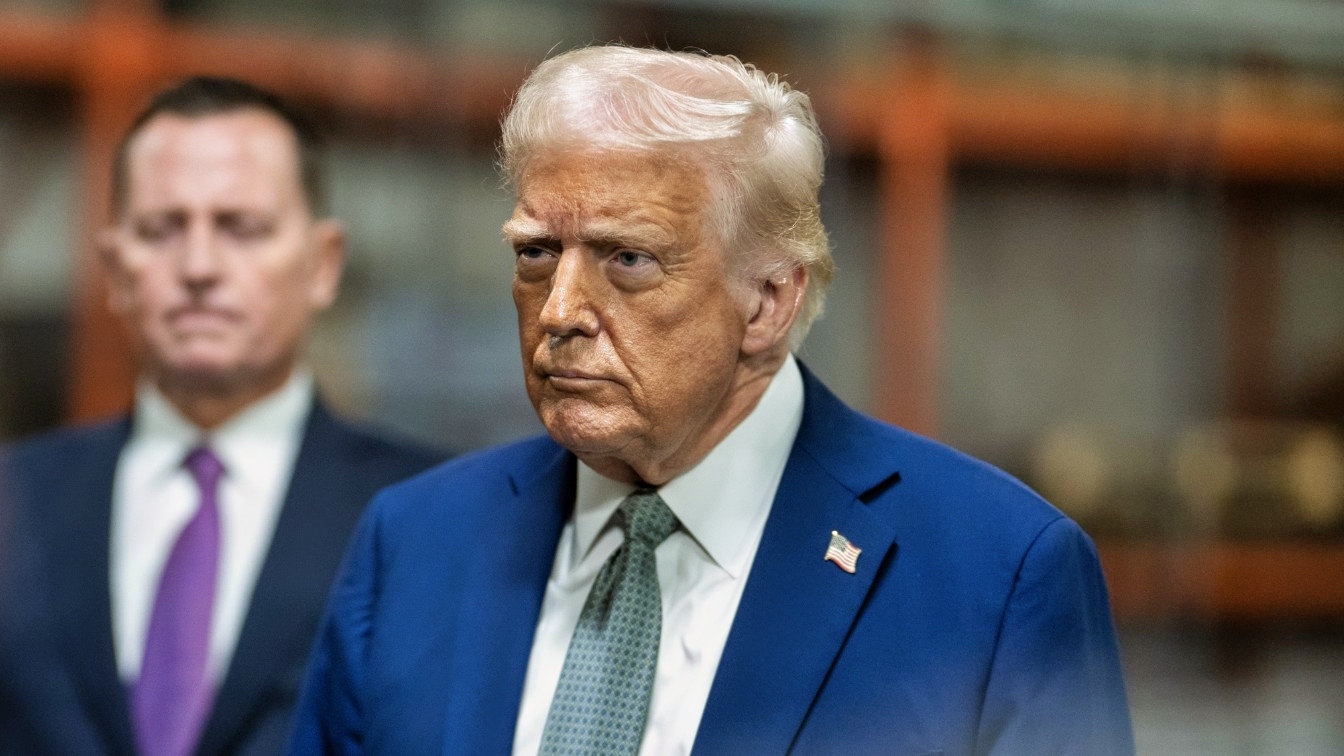
U.S. President Donald Trump recently told reporters that “Iran militarily is effectively over” and that the Islamic Republic of Iran’s theocratic totalitarian regime was “decapitated,” and followed up on that claim with Veterans Day remarks at Arlington National Cemetery wherein he said the war had been “won.” However, that rhetoric notwithstanding, the Iran War—aka Operation Epic Fury in the United States and Operation Roaring Lion in Israel—is far from over.
The kinetic phase now mostly consists of tit-for-tat, back-and-forth pinprick strikes. However, the U.S. naval blockade is very much still in effect, and a spokesperson for the Islamic Republic has just reaffirmed their seriousness about challenging that blockade.

A U.S. Navy EA-18G Growler prepares to refuel from a U.S. Air Force KC-135 Stratotanker over the U.S. Central Command area of responsibility, March 29, 2025. The Growlers are assigned to the Harry S. Truman Carrier Strike Group supporting maritime security operations in the CENTCOM AOR. (U.S. Air Force photo by Staff Sgt. Gerald R. Willis)
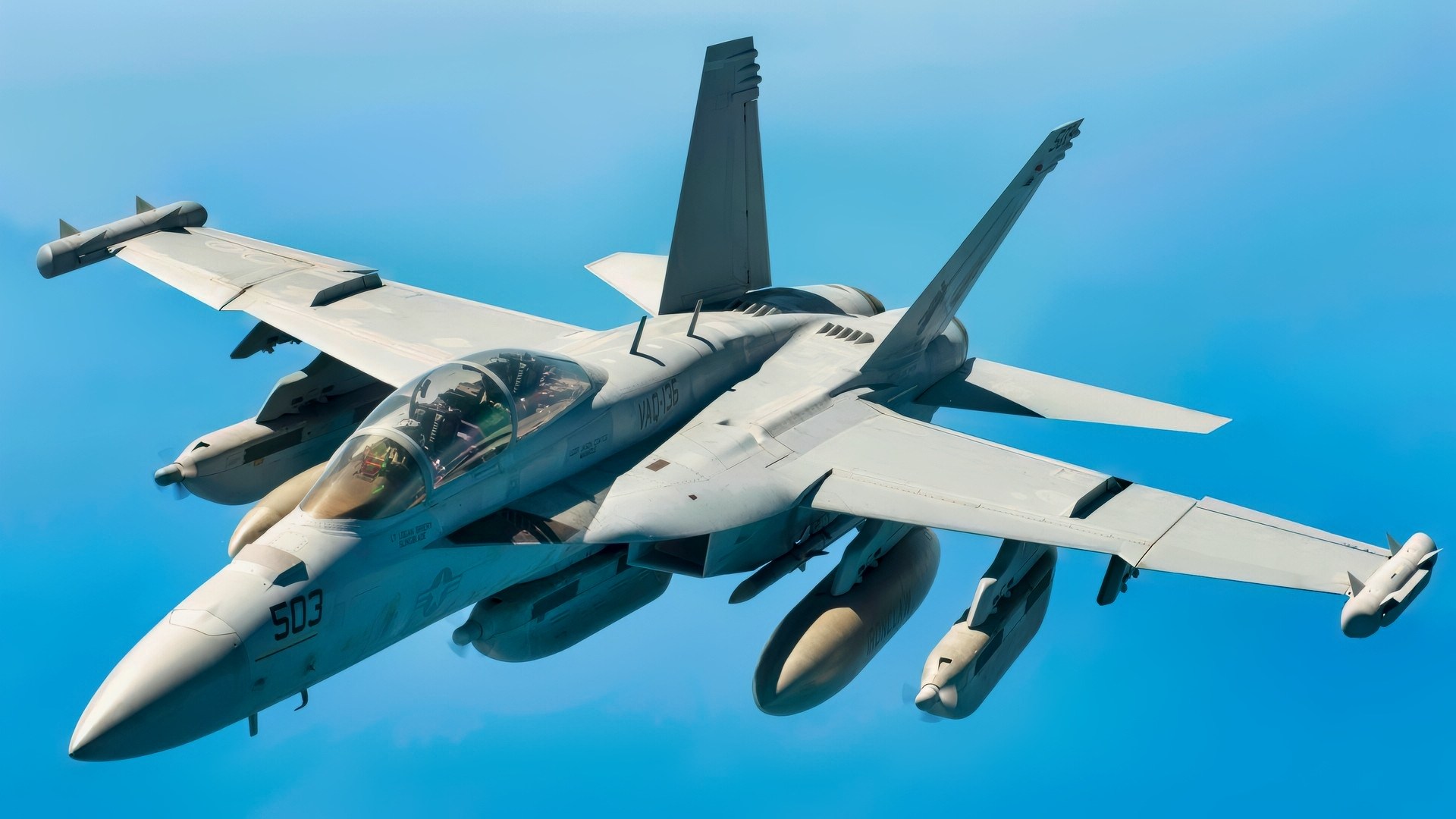
A U.S. Navy EA-18G Growler assigned to the USS Carl Vinson breaks away from a U.S. Air Force KC-135 Stratotanker from the 909th Air Refueling Squadron after conducting in-air refueling May 3, 2017, over the Western Pacific Ocean. The 909th ARS is an essential component to the mid-air refueling of a multitude of aircraft ranging from fighter jets to cargo planes from different services and nations in the region. (U.S. Air Force photo by Senior Airman John Linzmeier)
Bottom Line Up Front (BLUF)
This latest development comes to us via a 23 November 2026 report by Al Jazeera—official authorship is credited to “Al Jazeera Staff, AFP and Reuters,” with no individual authors named on the byline—that quotes a press briefing from Iranian Ministry of Foreign Affairs (Vezārat-e Omūr-e Khārejeh) spokesman Esmaeil Baghaei. To wit: “We will certainly not tolerate these actions and will use all available means to counter US aggression…You should bear in mind that what the Americans have described as economic sanctions, an economic blockade and a naval blockade undoubtedly constitute an act of military aggression against Iran…Under these circumstances, Iran is entitled, pursuant to Article 51 of the UN Charter, to use any means at its disposal to defend itself.”
About That UN Charter
That Article 51 that Mr. Baghaei is referring to falls under Chapter VII of the UN Charter, which is titled “Action with respect to Threats to the Peace, Breaches of the Peace, and Acts of Aggression.” It reads as follows: “Nothing in the present Charter shall impair the inherent right of individual or collective self-defense if an armed attack occurs against a Member of the United Nations, until the Security Council has taken measures necessary to maintain international peace and security. Measures taken by Members in the exercise of this right of self-defense shall be immediately reported to the Security Council. They shall not in any way affect the authority and responsibility of the Security Council under the present Charter to take at any time such action as it deems necessary to maintain or restore international peace and security.”
Baghaei added a token bit of carrot-and-stick approach to his aggressive words: “If the American side fulfills its commitments, security can be restored to the Strait of Hormuz and the region in the shortest possible time.”
Deeper Dive
To give our readers an idea of the intensity of the American military naval blockade, the Trump Administration deployed at one point a third aircraft carrier to the Middle East, namely the USS Theodore Roosevelt (CVN-71), which joined her fellow Nimitz-class nuclear-powered supercarriers USS George H.W. Bush (CVN- 77) and USS George Washington (CVN-73), for “adding aviation capacity for surveillance, force protection, and maritime security.” In the last few days, Washington has been pulled back towards Asia.
Even two carriers are a big deal. This is especially noteworthy when you recall the fact that, in normal circumstances, only three or four of the U.S. Navy’s 11 “flattops” are usually at sea anywhere in the world at any given time, due to a “rule of thirds” wherein one-third of the mighty warships are deployed, one-third are prepping for deployment, and one-third are undergoing maintenance.
The blockade commenced on 13 April 2026, 44 days after the full-scale kinetic strikes of Operation Epic Fury/Operation Roaring Lion kicked off. It was lifted in June after Washington reached the oh-so-controversial draft Memorandum of Understanding (MOU) with Tehran, then restored on 14 July after the agreement unsurprisingly fell apart.
As a tangible sign of the painful effectiveness of the blockade, visible Iranian crude exports decreased to near zero in recent months.
But What About the Land Blockade?
Notably absent from Baghaei’s remarks is any specific reference to the U.S. military’s newly imposed land blockade, which piggybacks on the naval and economic measure.
Officially designated Task Force Iron Gate and based in Tampa, Florida, the objectives are to (1) crack down on Tehran’s movement of advanced weapons and other sanctioned material over its land borders and through the Caspian Sea, and (2) halt the flow of dual-use technologies used by Iran and stemming from what the Trump Administration labels as illegal revenue streams.
About the Author: Christian D. Orr
Christian D. Orr is a Senior Defense Editor. He is a former Air Force Security Forces officer, Federal law enforcement officer, and private military contractor (with assignments worked in Iraq, the United Arab Emirates, Kosovo, Japan, Germany, and the Pentagon). Chris holds a B.A. in International Relations from the University of Southern California (USC) and an M.A. in Intelligence Studies (with a concentration in Terrorism Studies) from American Military University (AMU). He is also the author of the book “Five Decades of a Fabulous Firearm: Celebrating the 50th Anniversary of the Beretta 92 Pistol Series,” the second edition of which was recently published.


