

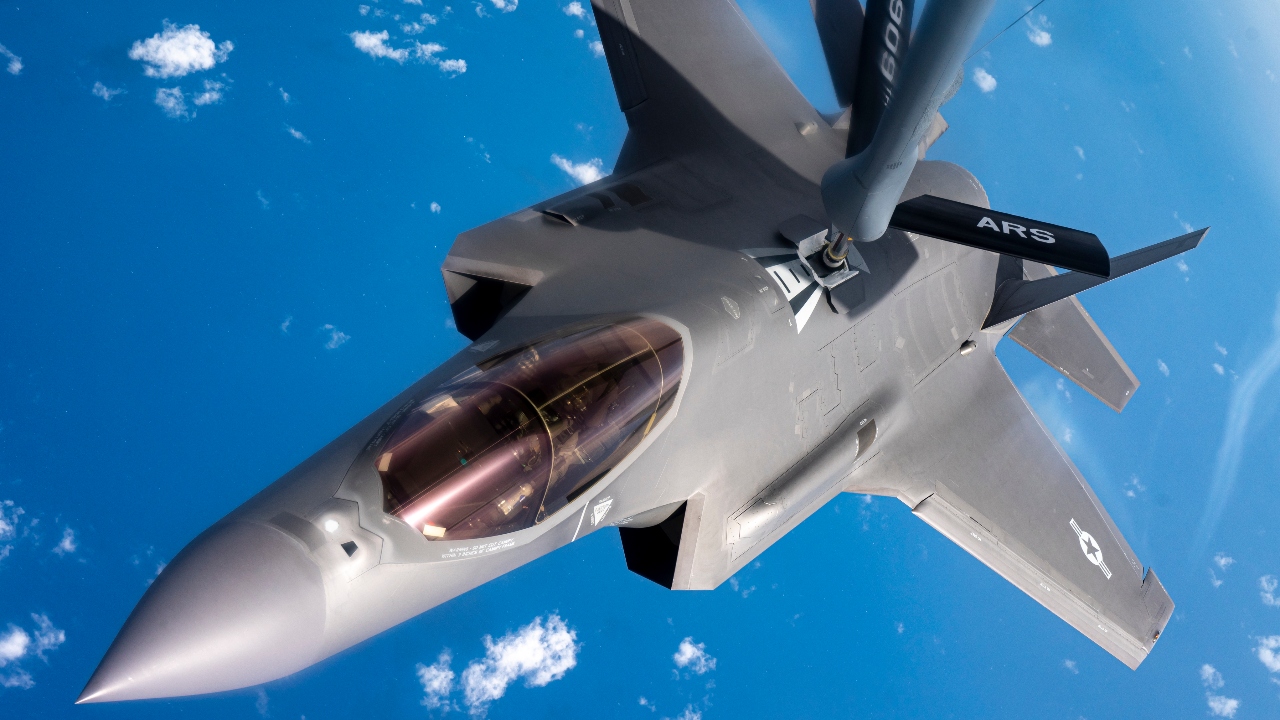
Key Points – Canada’s F-35 stealth fighter acquisition is under review by Prime Minister Mark Carney’s government, driven by strained US-Canada relations under President Trump and deep concerns about American control over the aircraft’s spare parts, software, and long-term sustainment.
-Prominent voices like retired RCAF Commander Yvan Blondin question US reliability as a partner, highlighting the risk that Washington could impede Canadian F-35 operations.
-While plans for an L3Harris F-35 maintenance depot in Canada aim to bolster domestic capabilities, the fundamental issue of US control over the F-35 ecosystem remains a critical factor in Ottawa’s re-evaluation of its future fighter fleet.
Amid US-Canada Tiff, Ottawa Puts the F-35 Stealth Fighter Program Under Review
With tensions between the two allies at historic highs, questions about the reliability of the United States as a principal defense partner — and if the American-led F-35 stealth fighter is still a wise decision. An upcoming defense review could throw previous plans asunder.
The Canadian military is preparing to accept several new platforms into service, including submarines, helicopters, and a variety of aircraft, including both early warning radar planes — and perhaps most importantly, the F-35 stealth fighter. Although the Canadian government has indicated that the program is under review, it remains unclear which direction the political winds will ultimately blow regarding that decision.
The ongoing friction between the Canadian government and the United States has prompted the Canadian government to reconsider its involvement in the American-led F-35 stealth fighter program.
Questions have been raised about the reliability of the United States, and in particular, whether the United States can cancel the extensive spare parts that comprise the F-35’s logistical chain. Given the jet’s specific needs, especially regarding their radar-absorbent stealth coatings and the attention that necessarily must be directed to the F-35’s engines and other systems to keep them in good running order — and the supplies needed to keep those jets airborne.
The Canadian review of the F-35 program is underway but still in its early stages. In a statement given to Defense News, Canadian Department of National Defence spokesman Nick Drescher Brown said, “The F-35 review is ongoing and progressing in a timely manner; it is taking into consideration internal, external, and independent input.”
Consternation in Canada
Voices in Canada — well versed in military matters — have raised questions about the F-35 as a platform. One Canadian officer, Lieutenant-General Yvan Blondin, a Royal Canadian Air Force commander and the top airman from 2012 to 2015, explained in a LinkedIn post that Ottawa should move away from the F-35 and find an alternative platform for Canada’s pilots. His argument is essentially that America is no longer the incredibly close and reliable partner that it has been to Canada for decades.
“Reliance on a US defense umbrella, a critical factor since the end of WW2 for so many countries, is no longer guaranteed. No affected country can afford to close its eyes and hope that 2026 or 2028 elections in the US will bring everything back to “normal”… and not happen again,” Lieutenant-General Blondin said. “The toothpaste cannot go back in the tube,” he added. “We have no choice but to consider its impact and figure out how to adjust to this newly created global insecurity.”
“The reality is that, without US consent, no country can hope to operate the F-35 for long: the US controls its operating software, updates, upgrades, maintenance, parts and armament,” Blondin, who served as a fighter pilot, said.
“The current US F-35 program dependency on international partner parts production cannot be taken for granted either; the way US relationships with its closest allies are deteriorating, the current administration may at any time put an end to these contracts and repatriate the production of essential parts critical to its own defense, and for the 50-year-life of the program. Believing that the currently “allowed” Canadian production of F-35 parts is a guarantee for the future of the Canadian F-35 program would be naïve at this point.”
Some Progress is Still Being Made
L3Harris, a defense firm, recently announced that it would partner with the Canadian government to build a new F-35 air vehicle depot within Canada.
“In late 2024, L3Harris was identified as a “Strategic Partner” to work with the Government of Canada, Lockheed Martin, and the F-35 Joint Program Office (JPO) to investigate requirements for an F-35 maintenance, repair, overhaul, and upgrade facility,” the company explained in a corporate statement.
“The partnership will provide a clear path forward for setting up and maintaining the capability to secure future F-35 program opportunities in Canada and North America. This initiative would provide Canada with a sovereign capability to maintain and upgrade its fleet of F-35s and produce significant economic benefits by creating and sustaining high-value jobs across Canada.”
Into the Future
What will the Canadians do? It is not yet totally clear.
However, Canada has always invested a substantial amount of money as part of its initial entry into the F-35 program. Canada would ultimately like to acquire 88 F-35s to replace the Royal Canadian Air Force’s Cold War-era CF-18 Hornets.
Historically, Canada has eschewed flying a two-jet fighter fleet. The Royal Canadian Air Force has repeatedly cited the unnecessary complications inherent to a two-fighter fleet — an increased logistics burden, as well as two sets of spare parts and differing training pipelines for both maintenance and pilots.
F-35 Soon to Be Solved?
Canada will host the G7 summit in just two weeks. During that summit in Alberta, Canadian Prime Minister Mark Carney may be keen to raise the issue with his American counterpart, President Donald Trump. There is strength in numbers; perhaps Carney and the other non-American heads of state can induce promises from the Americans about their F-35 fleets.
About the Author: Caleb Larson
Caleb Larson is an American multiformat journalist based in Berlin, Germany. His work covers the intersection of conflict and society, focusing on American foreign policy and European security. He has reported from Germany, Russia, and the United States. Most recently, he covered the war in Ukraine, reporting extensively on the war’s shifting battle lines from Donbas and writing on the war’s civilian and humanitarian toll. Previously, he worked as a Defense Reporter for POLITICO Europe. You can follow his latest work on X.
The Best Tanks on Earth
AbramsX: The Tank the US Army Wants


Pingback: F-35: How Fast Can This US Military Fighter Fly? - National Security Journal
Pingback: Canada's F-35 Fighter Buy Is Going Up in Smoke - National Security Journal