
The U.S. military has fired missiles at a commercial cargo ship attempting to reach Iran in a show of force as Iran attempts to evade the U.S. blockade and maintain control over the Strait of Hormuz.
The strikes come as Washington hopes the waterway will soon open, with a deal expected to emerge from ongoing Oman-Iran negotiations.

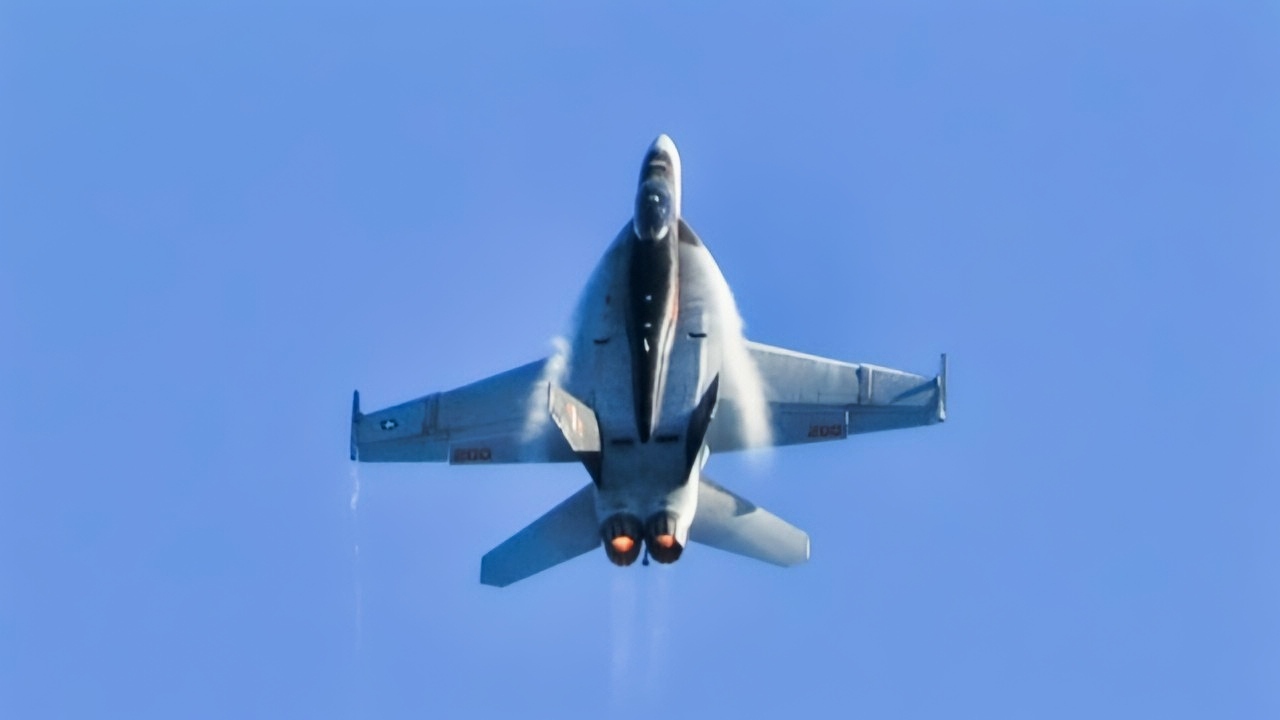
Aviation Boatswain’s Mate (Equipment) 3rd Class Mark Ruiz, assigned to Air Department aboard the world’s largest aircraft carrier, USS Gerald R. Ford (CVN 78), prepares a Carrier Air Wing 8 F/A-18E Super Hornet attached to Strike Fighter Squadron 37 for launch on the flight deck, Aug. 1, 2025. Gerald R. Ford, a first-in-class aircraft carrier and deployed flagship of Carrier Strike Group Twelve, is on a scheduled deployment in the U.S. 6th Fleet area of operations to support the warfighting effectiveness, lethality and readiness of U.S. Naval Forces Europe-Africa, and defend U.S., Allied and partner interests in the region. (U.S. Navy photo by Mass Communication Specialist 2nd Class Mariano Lopez)
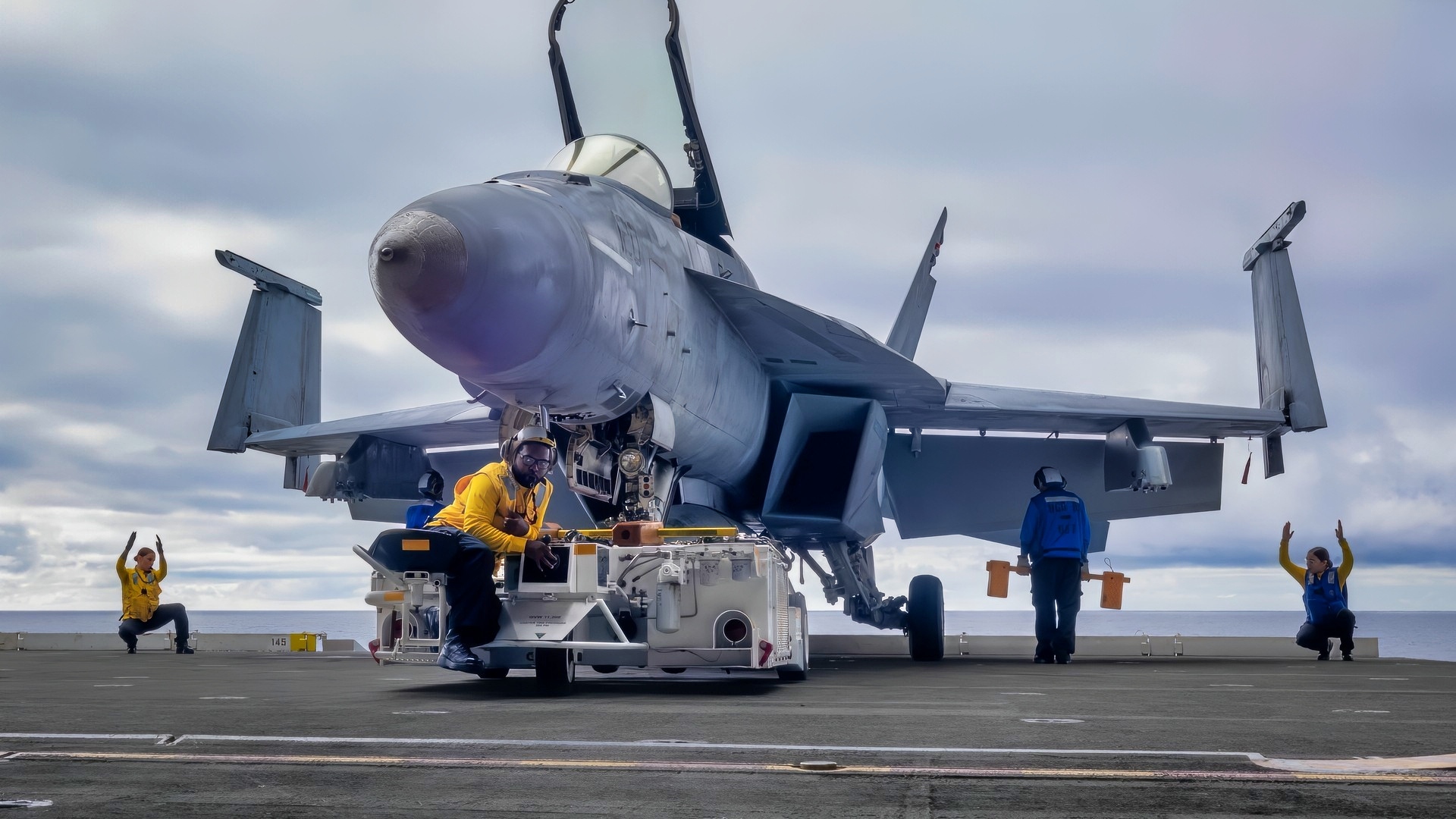
ATLANTIC OCEAN (Aug. 13, 2025) Sailors transport an F/A-18E Super Hornet attached to the “Gladiators” of Strike Fighter Squadron (VFA) 106 onto an aircraft elevator aboard the Nimitz-class aircraft carrier USS George H.W. Bush (CVN 77). George H.W. Bush is underway conducting carrier qualifications and routine operations in the Atlantic Ocean. (U.S. Navy photo by Mass Communication Specialist Seaman Apprentice Kayleigh Tucker)
U.S. Central Command said on Tuesday, August 11, that American forces intercepted the Panama-flagged M/V Vela Nova in the Gulf of Oman as the vessel moved toward an Iranian port.
U.S. forces issued warnings to change course, but the ship’s crew did not take notice, prompting a U.S. Navy MH-60 helicopter to fire two Hellfire missiles, disabling the ship’s steering gear.
The incident reportedly occurred roughly 70 nautical miles from Pakistan, with a fire breaking out aboard the vessel following the strikes.
The fire was extinguished, and no casualties were reported among the ship’s 17 crew members.
U.S. Blockade Still Enforced
In the statement, CENTCOM said that the Vela Nova had ignored repeated warnings before American forces took action.
Under the U.S. blockade, ships are prohibited from traveling to designated Iranian ports.
The blockade forms a central part of the remainder of President Donald Trump’s pressure campaign against Iran, which is intended to weaken Tehran economically without returning to large-scale airstrikes that risk worsening the United States’ current missile shortage.
CENTCOM said on August 11 that U.S. forces had so far redirected 55 commercial vessels, disabling three noncompliant ships and boarding another two since the blockade was announced.
The Vela Nova incident was also the third confirmed U.S. disabling strike against a commercial ship in approximately three weeks, according to maritime intelligence firm Windward.
Iran Refuses to Fully Reopen Hormuz
While the United States continues to enforce the blockade, Iran has said that the Strait of Hormuz will remain closed unless the United States makes a series of major concessions, including ending the naval blockade.
At a press conference on Monday, August 10, Iranian Foreign Ministry spokesperson Esmail Baghaei said that “reopening the Strait of Hormuz is conditional on the lifting of the US naval blockade.” He said Washington would also have to address other Iranian demands before Tehran agreed to restore normal traffic through the waterway.
Among the demands are the lifting of all U.S. economic sanctions against Iran, the release of frozen Iranian assets, and compensation for damage caused during the five-month U.S. campaign.
Iran has also previously demanded an end to U.S. military operations and its presence in the Gulf region, as well as guarantees against further attacks.
Iran’s newly reshuffled military leadership then reinforced that position on Tuesday, August 11, with Mohsen Rezaei, secretary of the Supreme National Security Council and a longtime critic of the United States, saying the Strait of Hormuz would remain closed until conditions are met.
Rezaei also made it clear that Iran’s separate negotiations with Oman over temporary shipping routes would not automatically amount to a full reopening of the Strait of Hormuz.
An even more explicit warning came from Mohammad-Bagher Zolghadr, Rezaei’s predecessor at the Supreme National Security Council, who warned on August 8 that the Strait will remain closed until the United States “corrects its behavior.”
Washington and Tehran At Odds
Tehran has also repeatedly indicated that it does not intend to restore the pre-war system under which international vessels routinely passed through the Strait, even if the United States satisfies the regime’s demands.
It puts Washington’s position directly at odds with Tehran’s, with the United States saying it will lift the blockade only once Iran allows commercial ships to transit the waterway without impediment.
Both sides are at a stalemate, with Washington using the blockade to prevent vessels from reaching Iran, and Tehran preventing a full reopening of Hormuz until the blockade is removed.
Trump Says U.S. Will Keep Blockade
On Wednesday, August 12, President Donald Trump announced that he has no intention of backing down and declared that the blockade of Iranian ports will remain in place despite Tehran making its removal a condition for fully reopening the Strait of Hormuz.
“The USA has total control over the Strait of Hormuz. I THINK WE WILL KEEP IT! Our Naval Blockade is being called, by everyone, ‘A WALL OF STEEL,’ and there is nothing Iran can do about it,” the president said on Truth Social.
“They have no navy, they have no air force, their remaining soldiers are unpaid, the IRGC is decimated and fleeing, and their leadership is uncertain, at best! They have no money – their country is shot,” he added.
President Trump, it seems, is willing to wait it out in the hopes that Iran will eventually buckle under economic pressure – but it’s unclear precisely how long that could take.
About the Author: Jack Buckby
Jack Buckby is a British researcher and analyst specializing in defense and national security, based in New York. His work focuses on military capability, procurement, and strategic competition, producing and editing analysis for policy and defense audiences. He brings extensive editorial experience, with a career output spanning over 1,000 articles at 19FortyFive and National Security Journal, and has previously authored books and papers on extremism and deradicalization.


