


Weeks ago, the United States proclaimed a blockade of the Strait of Hormuz, as the world awaits negotiations on the waterway’s future. However, before dawn on Tuesday, U.S. forces fired on a ship seeking to run the blockade.
The Wall Street Journal reported that an American military helicopter had fired on the ship, which flew the flag of Panama, after its crew “ignored warnings from American personnel working to enforce the naval blockade of Iran’s ports.”
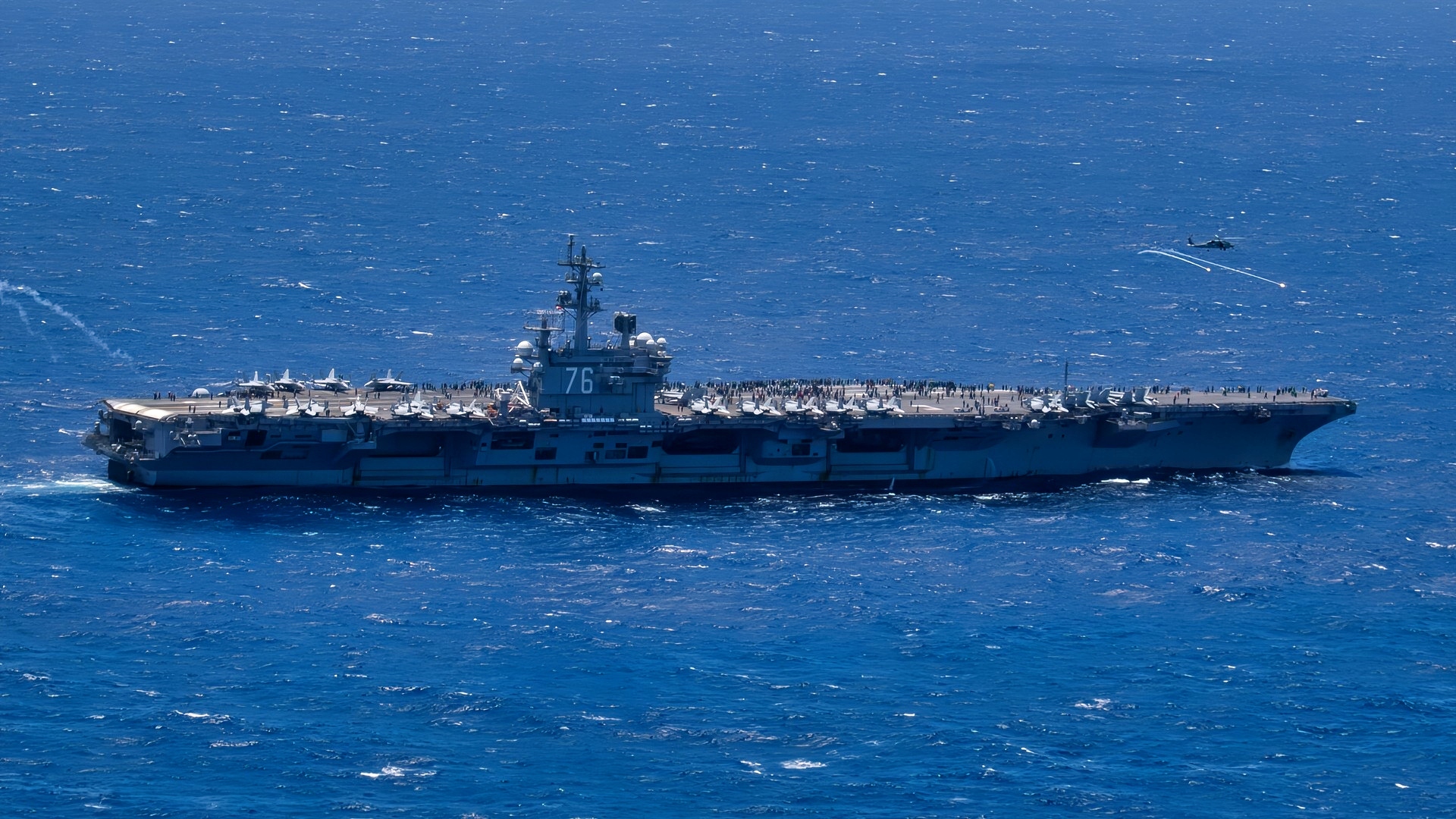
(July 3, 2024) An MH-60R Sea Hawk helicopter, attached to the Saberhawks of Helicopter Maritime Strike Squadron (HSM) 77, launches flares near the U.S. Navy’s only forward-deployed aircraft carrier, USS Ronald Reagan (CVN 76) during air combat-skills practice in the Pacific Ocean, July 3. HSM 77’s missions include surface warfare, anti-submarine warfare and a variety of support roles for Ronald Reagan and Carrier Strike Group 5. Ronald Reagan, the flagship of Carrier Strike Group 5, provides a combat-ready force that protects and defends the United States, and supports alliances, partnerships and collective maritime interests in the Indo-Pacific region. (U.S. Navy photo by Mass Communication Specialist 2nd Class Charlotte Dudenhoeffer)

USS John Finn (DDG 113) arrives Nov. 15 at the Port of Hueneme for routine Combat System Assessment Team (CSAT) repairs and training. The ship is one of four in the fleet with an Optical Dazzling Interdictor, Navy — also known as ODIN. The ODIN laser weapon system stuns enemy drones threatening surface ships. The destroyer also has two helicopter hangars, big enough to hold an MH-60R Seahawk Romeo multi-mission helicopter and the MH-60S Knighthawk Sierra helicopter. (U.S. Navy Photo by Dana Rene White/Released)
No casualties were reported, and a U.S. official told the Journal that it seemed the ship was “attempting to transfer its crew to another civilian vessel after the attack.”
The ship was called Vela Nova, the Journal said, citing maritime security firm Vanguard.
“The missile struck the vessel, causing a fire that was subsequently extinguished,” Vanguard said, adding that all 17 crew had been accounted for.
Per Al Jazeera, the attacks represented an interruption of a “period of relative calm” in the war between the U.S. and Iran, which remains in limbo amid continuing talks on the Strait of Hormuz.
In mid-June, there had been a similar incident in which the U.S. fired on an Indian tanker near the Strait, and three people were killed. In July, the U.S. fired on a ship called the M/T Lavine that was also seeking to get through the blockade.
CENTCOM Speaks
U.S. Central Command, in a social media post, stated that a Navy MH-60 helicopter, in firing two Hellfire missiles, had “disabled the steering gear of Panama-flagged M/V Vela Nova as the cargo vessel attempted to transit the Gulf of Oman and violate the U.S. blockade.”
The ship, CENTCOM said, was “no longer transiting to Iran.”
The post also said that since the blockade was instituted, the U.S. had “redirected” 55 commercial vessels from the blockade, “disabled” three that were noncompliant, and boarded two.
“U.S. forces operating in the Middle East are highly vigilant, lethal, and ready,” the message concluded.
What’s Going on With the Strait of Hormuz Talks?
It’s now been over a week since the talks between Iran and Oman over the status of the Strait of Hormuz were first reported to be nearing a deal, yet no agreement has been announced.
Little news has been reported on that front in the last 24 hours, except that Mohsin Naqvi, Pakistan’s interior minister, had arrived in Iran for talks with Iranian leaders, including President Masoud Pezeshkian, Foreign Minister Abbas Araghchi, and Interior Minister Eskandar Momeni. Pakistan has been seeking to mediate a resolution to the conflict.
Meanwhile, Reuters reported that a senior Iranian source had said this week that there were no talks about extending the ceasefire between the U.S. and Iran.
“There is no talk of an extension because, from Iran’s perspective, there is no period that began and therefore nothing to extend,” the unnamed Iranian source said. “The United States violated the interim agreement 48 hours after it was reached and withdrew from it a few days later.”
An Oil Forecast
Also on Wednesday, the Western energy watchdog, the International Energy Agency (IEA), issued a new monthly report stating that, at least in part due to the situation in the Strait of Hormuz and other ongoing energy supply chokepoints, global oil consumption and supply and demand are expected to contract.
According to the Wall Street Journal, global energy consumption is expected to fall by 1.6 barrels per day this year, compared to the previous forecast of a 1 million-barrel-per-day decline. As for demand, it’s expected to drop by 2.8 million barrels a day in the third quarter, after falling by 4.9 million barrels per day in the second quarter, although growth is expected to return in the year’s last three months.
Global supply for the full year is expected to drop by 4.3 million barrels per day, exceeding the previous forecast of 3.7 million per day.
“The continued closure of the Strait of Hormuz disrupts international supply chains and curtails product availability,” the IEA, a group of Western and Western-allied countries, said in the report. “Elevated fuel prices are putting further downward pressure on oil use.”
About the Author: Stephen Silver
Stephen Silver is an award-winning journalist, essayist, and film critic, and contributor to the Philadelphia Inquirer, the Jewish Telegraphic Agency, Broad Street Review, and Splice Today. The co-founder of the Philadelphia Film Critics Circle, Stephen lives in suburban Philadelphia with his wife and two sons. For over a decade, Stephen has authored thousands of articles that focus on politics, national security, technology, and the economy. Follow him on X (formerly Twitter) at @StephenSilver, and subscribe to his Substack newsletter.


