


The Boeing F-15EX Eagle II is the world’s fastest fighter jet at Mach 2.5—and it can carry an absolutely staggering 29,500 pounds of weapons across 23 hardpoints. That’s nearly twice the payload of an F-35 Lightning II, including the ability to haul massive hypersonic missiles like the AGM-183 ARRW that simply won’t fit inside any stealth fighter’s internal bay.
The F-15EX Eagle II Has the F-35 ‘Beat’
The American F-15 Eagle has always been a fantastic air superiority fighter jet. Boeing makes it, and the newest model, the F-15EX Eagle II, is the latest in the F-15 series. The Eagle II hails its legacy from the McDonnell Douglas F-15E Strike Eagle.
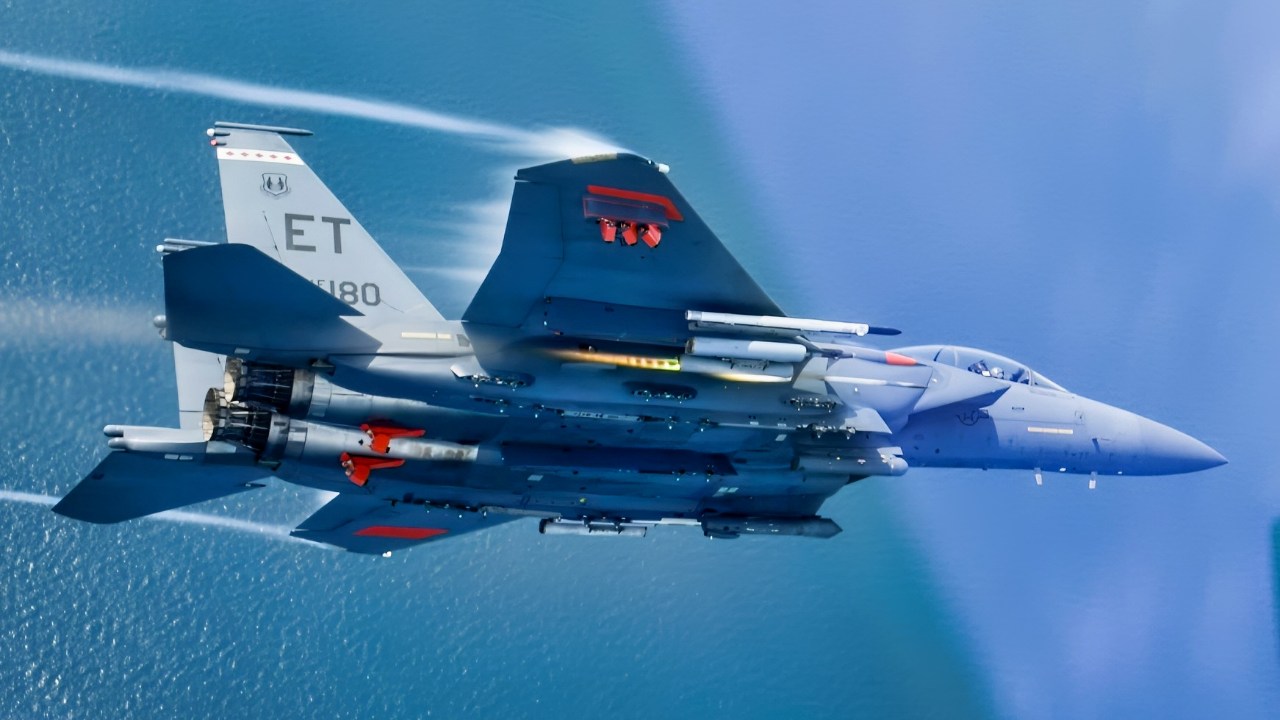
A 96th Test Wing F-15E Strike Eagle flies during a test mission May 22, 2025 over Eglin Air Force Base, Florida. The 96 TW and the 53rd Wing teamed up to test AGR-20F Advanced Precision Kill Weapon System II laser-guided rockets on the F-15E in May in an effort to get the capability to the warfighter as quickly as possible. (U.S. Air Force photo by Staff Sgt. Thomas Barley)
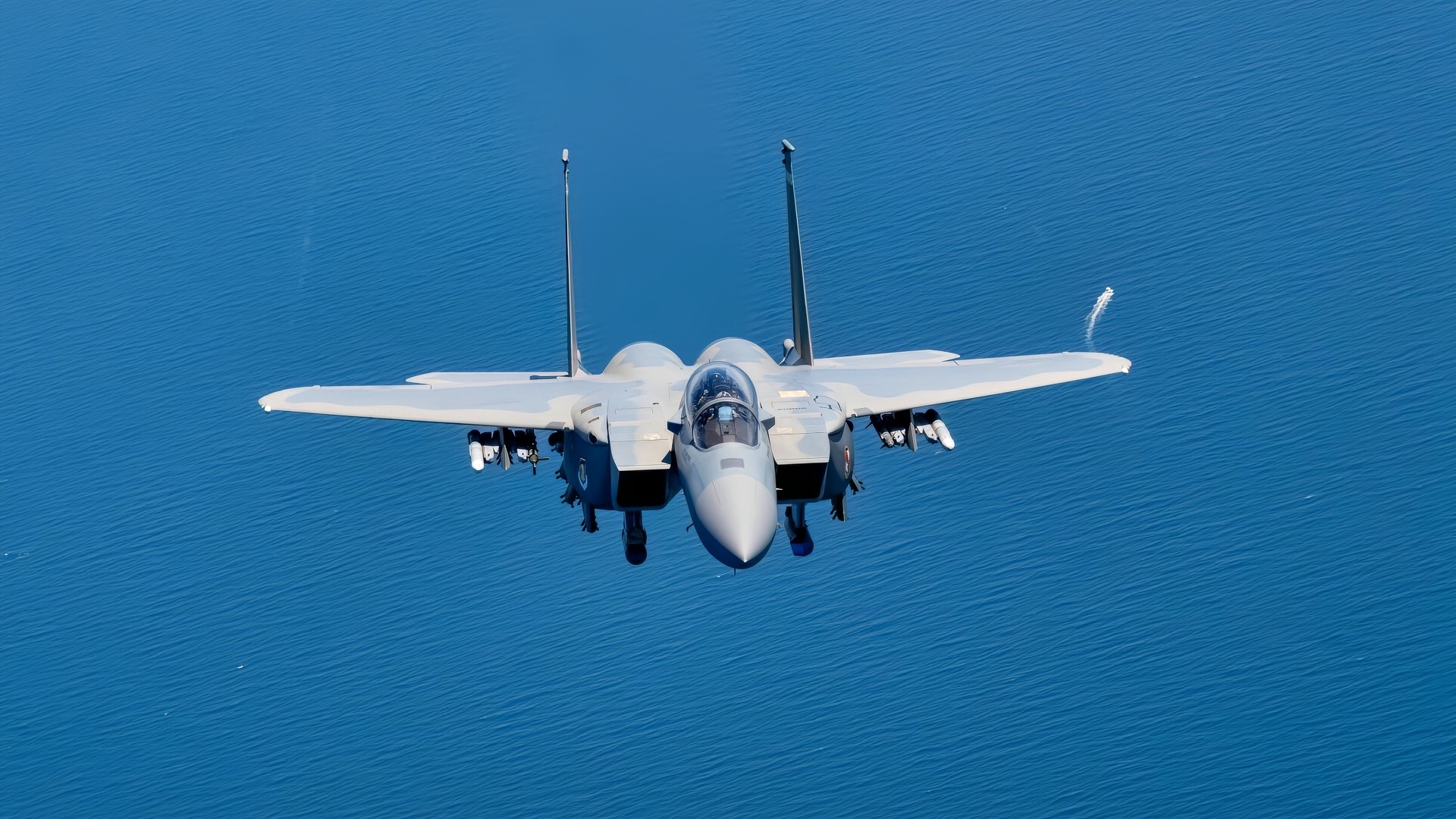
A U.S. Air Force F-15EX Eagle II flies over the Gulf of America, September 16, 2025. The F-15EX, from the 40th Flight Test Squadron at Eglin Air Force Base, Florida, is one of the first F-15EXs in the Air Force, and is going through developmental and operational test series at Eglin to confirm its operational capabilities before it is delivered to the combat Air Force. (U.S. Air Force photo by Staff Sgt. Blake Wiles)
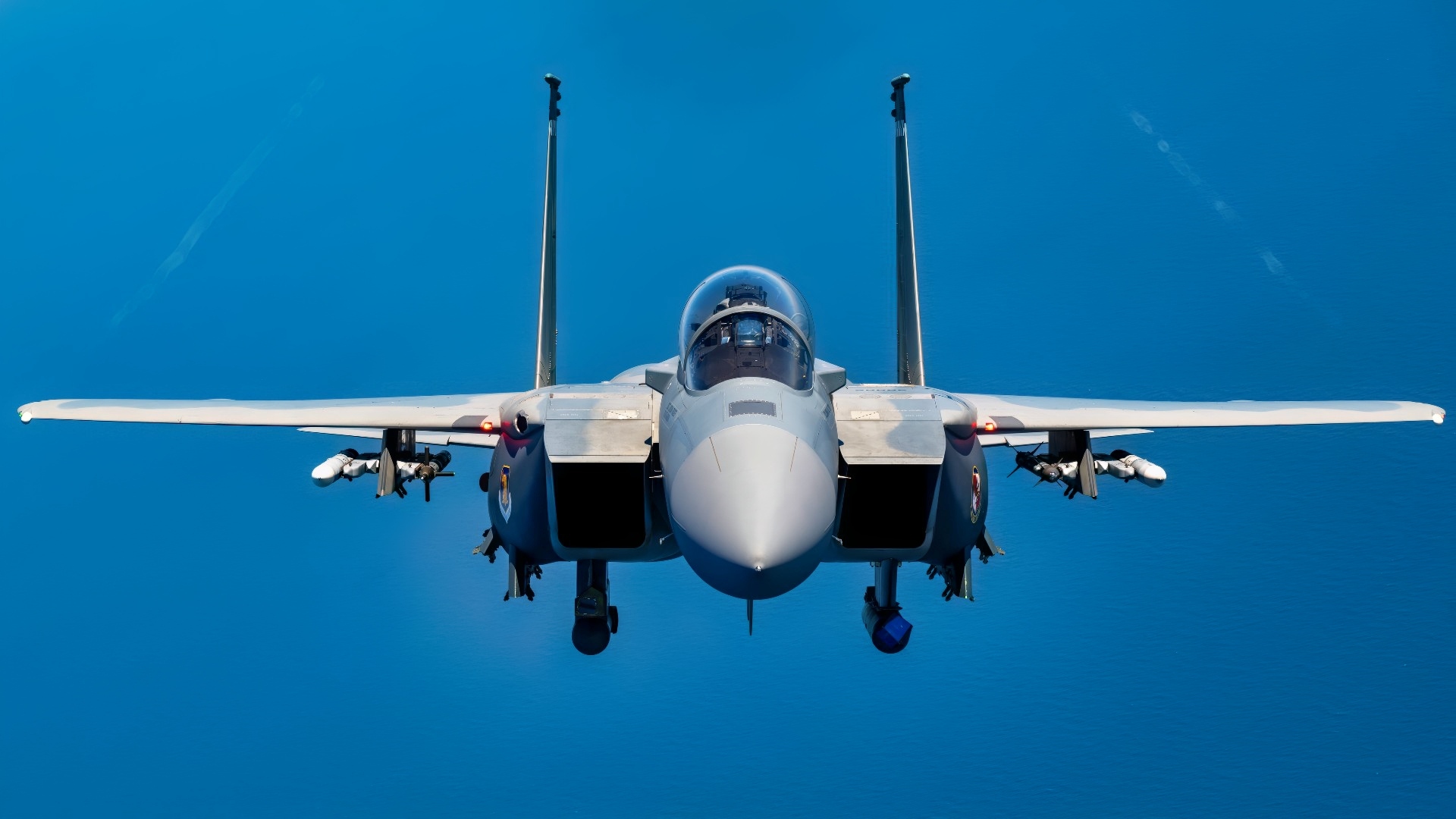
A U.S. Air Force F-15EX Eagle II flies over the Gulf of America, September 16, 2025. The F-15EX, from the 40th Flight Test Squadron at Eglin Air Force Base, Florida, is one of the first F-15EXs in the Air Force, and is going through developmental and operational test series at Eglin to confirm its operational capabilities before it is delivered to the combat Air Force. (U.S. Air Force photo by Staff Sgt. Blake Wiles)
The Eagle II is an all-weather, multi-role strike fighter that saw its beginnings as a way to upgrade and reinvigorate the aging F-15 C/D models, replacing them with the mission of performing homeland and air defense missions, and also utilized as a platform for employing large stand-off weapons to augment the stealth fighters F-22 and F-35. The aircraft was delivered in 2021 and entered operational service in July 2024.
However, some analysts argue that the cost of the Eagle II is roughly the same as that of the F-35 and wonder whether it is worth building more non-stealth aircraft or using the more modern and survivable stealth fighters today.
The answer to that debate rests in “how” the non-stealth fighters are used and how much they carry. And the F-15EX Eagle can have a lot of munitions.
F-15 EX Eagle II Hardpoints
F-15 hardpoints vary by model, but generally, F-15s have numerous attachment points around 11-12 standard. But those numbers rise to 23+ on the F-15EX.
These include underwing and fuselage stations for various air-to-air missiles (AIM-9, AIM-120), air-to-ground bombs (JDAMs, Paveways), fuel tanks, and targeting pods, with the latest F-15EX boasting a massive payload capacity for diverse, modern munitions.

The Air Force’s newest fighter, the F-15EX Eagle II, was revealed and named during a ceremony April 7 at Eglin Air Force Base, Fla. The aircraft will be the first Air Force aircraft to be tested and fielded from beginning to end, through combined developmental and operational tests. (U.S. Air Force photo/Samuel King Jr.)

A U.S. Air Force F-15EX Eagle II, assigned to 85th Test and Evaluation Squadron, Eglin Air Force Base, Florida, lands at Kadena Air Base, Japan, July 16, 2025.This short-term visit marked a key milestone in the Department of Defense’s ongoing effort to modernize U.S. airpower in the Indo-Pacific. (U.S. Air Force photo by Airman Nathaniel Jackson)
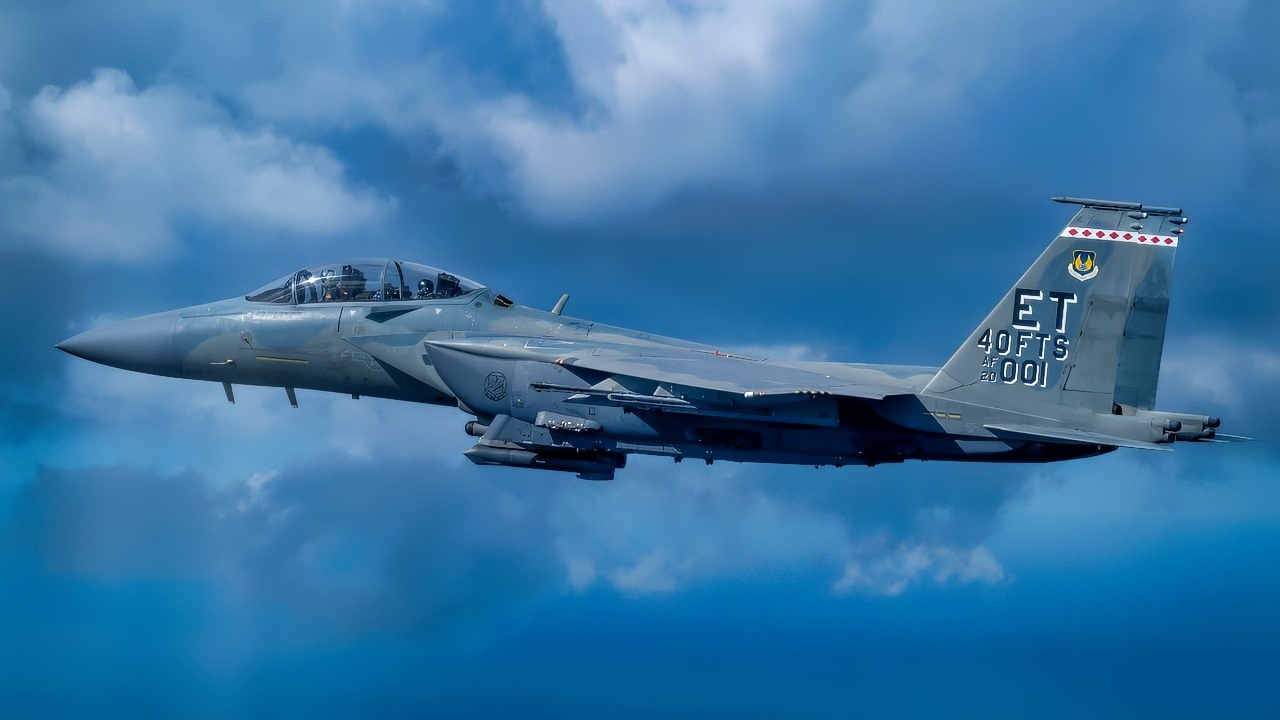
A U.S. Air Force F-15EX Eagle II fighter jet assigned to Eglin Air Force Base, Florida, flies near Jacksonville, Florida, Nov. 2, 2024. Airmen from the 40th Flight Test Squadron and 96th Aircraft Maintenance Unit supported a flyover for the annual Florida-Georgia college football game. (U.S. Air Force photo by Staff Sgt. Blake Wiles)
The F-15EX can carry a heavy load (up to 29,500 lbs) of mixed air-to-air and air-to-ground weapons, integrating the latest munitions, such as the AIM-260 JATM.
How Would The Eagle II Be Used In Offensive Use Situations
However, no sooner had they been delivered than Boeing and the US Air Force were already exploring the use of the Eagle II fighters in offensive operations. While the F-15EX Eagle II is decidedly a non-stealth Generation Four+ air superiority fighter, it may become invaluable in a use that seems tailor-made for it.
It isn’t reasonable to assume the Eagle II would survive in a war against adversaries equipped with modern air defense systems. However, it can augment a strike by accompanying F-35 or F-22 stealth fighters.
In this scenario, the F-15 EX aircraft would consist of a follow-on flight behind the stealth fighters that have neutralized the air defense systems of a target area. The Eagle II carries a much larger payload and could be used as a huge missile platform.
The stealth fighters would relay information back to the F-15s, and the F-15s could loiter beyond the range of air defense systems and unleash many more weapons than the stealth fighters could carry.
Alex Hollings of Sandboxx/Airpower recently wrote that “the U.S. Navy’s EA-18G Growler has nine total hardpoints for weapons, fuel tanks, and jamming equipment with the ability to fly with as much as 17,750 pounds of weapons and gear slung beneath it, while the Eagle II has 12 hardpoints that it could potentially be used for these sorts of systems (though it can be expanded to a whopping 23 for other weapons) and is capable of taking to the sky with a mind-boggling 29,500 pounds of ordnance and gear onboard,” he added.
The Eagle II could also carry “the Air Force’s AGM-183 Air-launched Rapid Response Weapon, or ARRW.” This weapon (which underwent a troubled test regime but may yet find its way into service) offers an immense range of more than 1,000 miles and the ability to fly and maneuver at speeds reportedly exceeding Mach 7.
“However, at roughly 22 feet long and 6,600 pounds, these massive weapons would never fit inside the internal weapons bay of an American stealth fighter.”
This type of mission fits what Israel faces in the Middle East, with potential airstrikes against Iran, specifically their nuclear enrichment sites. The US government authorized the sale to Israel of 50 F-15IAs, the Israeli variant, for $18.2 billion. This deal also includes mid-life upgrades for the IAF’s F-15I fighters. The deal would see those older models receive the F-15EX’s avionics configuration.

Lt. Col. Richard Turner, 40th Flight Test Squadron commander, pilots the F-15EX, the Air Force’s newest fighter aircraft, to its new home at Eglin Air Force Base, Florida March 11. The aircraft will be the first Air Force aircraft to be tested and fielded from beginning to end through combined developmental and operational tests. The 40th FLTS and the 85th Test and Evaluation Squadron personnel are responsible for testing the aircraft. (U.S. Air Force photo/Samuel King Jr.)
The Israeli Air Force operates their own variant of the F-35 Joint Strike Fighter, the F-35I, and has been using the F-15s for decades against Hamas, Hezbollah, Syria, and others.
Homeland Defense
Using the F-15EX Eagle for Homeland Defense is a no-brainer. The Eagle II has a top speed of Mach 2.5. Simply put, it is the world’s fastest fighter jet. And stealth isn’t as necessary for homeland defense.
The F-35 is the choice for stealth and data fusion. However, the F-15EX excels in an air superiority role, as it carries more weapons and is faster. The F-35 can carry a weapons payload of 18,000 pounds, while the F-15EX carries a payload of 29,500 pounds. It can carry a dozen air-to-air missiles.
Drone Coordination Platform/Electronic Warfare
Another area where the Eagle II could be used is as a drone coordinator for the Air Force’s Collaborative Combat Aircraft (CCAs). The Air Force has been planning for the F-35s and F-15EXs to team with the XQ-58 Valkyrie drone since 2019.
The Air Force is also working to establish some F-15EX aircraft as electronic warfare platforms, such as the EA-18G Growler, as mentioned above. In July 2024, the USAF explored integrating the Growler’s new Next Generation Jammer Pods into the Eagle II to convert the fighter into an electronic attack platform capable of penetrating contested airspace and increasing the survivability of other 4th—and 5th-generation aircraft.
So, is the F-15EX Eagle II worth the cost, the same as an F-35?
Yes, when used correctly and in conjunction with the F-35s. And with the number of munitions it can carry, it can still be a valuable asset for the US Air Force.
About the Author: Steve Balestrieri
Steve Balestrieri is a National Security Columnist. He served as a US Army Special Forces NCO and Warrant Officer. In addition to writing on defense, he covers the NFL for PatsFans.com and is a member of the Pro Football Writers of America (PFWA). His work was regularly featured in many military publications.


