

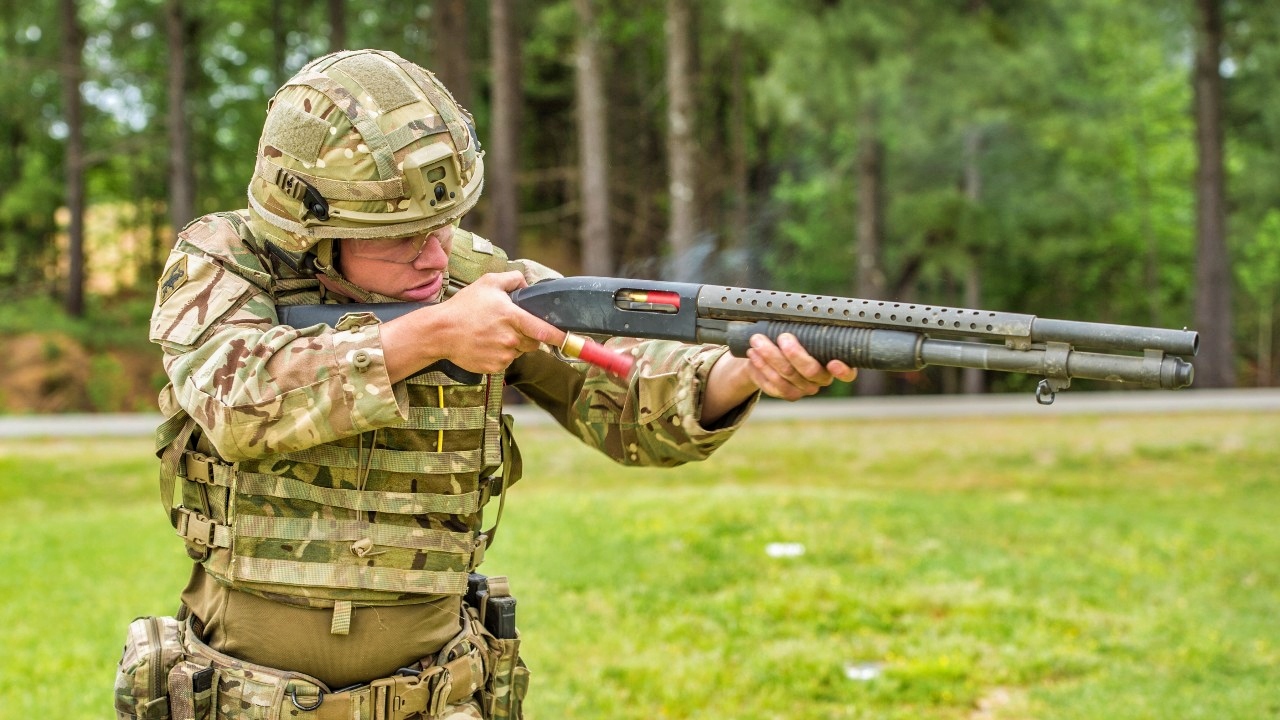
Ukrainian special forces troops that are operating near the front lines now purposely carry pump-action shotguns for short-range defense. The shotguns are not for anti-personnel purposes but as a last-resort defense against Russian first-person-view (FPV) drones, as they are impervious to electronic warfare (EW) jamming.
The use of shotguns is the Ukrainian special ops solution for a countermeasure against fiber-optic guided drones. At present, there are no practical non-kinetic means to defend against this type of drone, as the signals controlling their movements are transmitted through a physical cable and not by wireless transmissions.
Troopers with 3rd Armored Brigade Combat Team, 1st Cavalry Division firing the 25mm canon on a Bradley fighting vehicle in order to zero the vehicles weapons systems at a range in Poland. Ranges such as these familiarize troopers with the vehicles systems in order to ensure combat readiness. US Army Photo.
Since this makes this type of drone immune to any electronic warfare jamming, they are the drone type becoming more common on the battlefield. It was the 4th Ranger Regiment of Ukraine’s Special Operations Forces that first devised this solution and has developed these tactics.
But it is not just the shotguns alone that are being implemented in this new defensive tactic. In addition to arming themselves with this kind of weapon that is more effective than assault rifles or machine guns in taking down incoming drones, these units have also learned to gauge their movements on the ground. This is due to the need to confuse the sensor and targeting hardware on board these FPV drones.
The special ops units are thus forced to operate in widely dispersed formations when they deploy close to the front. They typically maintain a 10 to 20-meter distance between each serviceman, and they also walk much farther on foot. This is so as to avoid detection by the behind-the-lines drone operators watching the battlespace through the FPV’s optical sensor.
U.S. Army Soldiers assigned to 2nd Squadron, 278th Armored Cavalry Regiment, Task Force Reaper, conduct movement procedures with M2 Bradley Fighting Vehicles during the Jade Cobra VI exercise in the U.S. Central Command’s area of responsibility, Feb. 19, 2025. Jade Cobra VI strengthens military-to-military partnerships, increases readiness, and facilitates security cooperation between the United States and Jordan. (U.S. Army photo by Staff Sgt. Hector Tinoco)
By employing these tactics, the drones searching for these soldiers are forced to fly a wider pattern with more distance between them and the units on the ground. This makes it easier for the special operators on the ground to engage as isolated targets and take them out with shotguns.
How The Shotgun Became the Preferred Solution
There are normally two solutions for defense against drones that Ukrainian troops have utilized to date. One is provided by Unwave, which is a Ukrainian company that specializes in electronic warfare and drone threat mitigation.
One of the systems the company produces is the BMX250-5 MS drone jammer, which has proven to be an effective electronic countermeasure. However, jamming equipment similar to these kinds of devices that Unwave offers often is at a premium cost and also creates a number of limitations at the individual serviceman level.
Then there are kinetic defensive devices like the 35-mm Oerlikon autocannons, which have often been used to take out the unmanned suicide Shahed-series drones. But this system is not physically practical or convenient to be moved in the field by special operators. It is also not economical for use against the far smaller and lower-cost FPV drones.
Given these complications and the fact that the battlefield is excessively drone-concentrated, an unorthodox solution like the shotgun has become – at least for now – the easily portable and most-effective option. The use of this weapon against drones is undoubtedly counterintuitive, as the shotgun had previously been thought of as a crude assault weapon best suited for use in breaching attacks and close-quarter engagements.
New Technology Backed Up By Older Generation Simplicity
But not by design and almost by accident, the shotgun has become the most practical and adaptive solution for drone defense. It has the virtue of being almost universally accessible, far lower cost than any more state-of-the-art options, and at the same time the most lethal defense against the FPV drone threat.
One of the Ukrainian servicemen who has testified as to the effectiveness of the shotgun in this threat environment is Ivan Iliukhin, who is himself a former Ukrainian soldier and now the owner of the firearm training organization, GunBro Ukraine. He provided numerous details on the “shotgun thesis” for this manner of mission in an interview with Volya Radio that was conducted on 2 November 2025.
In the interview, which is translated by his daughter, he explains that “People used to laugh at shotguns, especially on the battlefield, since everyone was used to rifles. But now we see the need for shotguns and how they are being used on the battlefield…a shield against Russian drones, but also shotguns can [still] be used in trenches and close-range fighting, which makes the shotgun balanced.”
As Ivan explains, a shotgun’s spread pattern can make drone kill probability increasingly more likely when compared to the singular, linear rounds of an assault rifle. They do not require the same precision as rifles either.
Instead, a shotgun’s only demand is that of proximity, which permits its operator to be slightly more inaccurate. Ivan also mentions that the most effective way to use a shotgun is by alternating sequences of buckshot and birdshot shells within the magazine.
This is a method he used himself while serving on the frontline. But he also cautions that this tactic should be reserved strictly for well-trained shooters. Using alternating ammunition requires the experience needed to develop cognitive combat awareness. An operator must know which type of shell is chambered and what the subsequent shell will be that will enter the chamber after each shot.
This shotgun doctrine that Ukraine has developed is effective, but also adaptive to different scenarios. Six months ago, said Ivan, one trained shotgun operator for each four-person team was sufficient. But as the drone swarms have become more pervasive and more accurate, every single Ukrainian soldier operating within drone kill zones needs to have a shotgun as one of his weapons, along with the necessary training to use it effectively.
About the Author: Reuben F. Johnson
Reuben F. Johnson has thirty-six years of experience analyzing and reporting on foreign weapons systems, defense technologies, and international arms export policy. Johnson is the Director of Research at the Casimir Pulaski Foundation. He is also a survivor of the Russian invasion of Ukraine in February 2022. He worked for years in the American defense industry as a foreign technology analyst and later as a consultant for the U.S. Department of Defense, the Departments of the Navy and Air Force, and the governments of the United Kingdom and Australia. In 2022-2023, he won two awards in a row for his defense reporting. He holds a bachelor’s degree from DePauw University and a master’s degree from Miami University in Ohio, specializing in Soviet and Russian studies. He lives in Warsaw.


Zazu
July 23, 2026 at 3:50 pm
Throw an 18″ barrel on an old school street sweeper and you’ll have a fantastic anti drone weapon except for its weight. 20 round drum magazine will hold plenty of ammo, and the short barrel will give a nice spread, plus #4 shot packs a punch
Peter York
July 23, 2026 at 5:24 pm
funny he calls it ‘counter-intuitive.’
it’s the first thing I thought of.