

Russia Said It Intercepted 379 Ukrainian Drones. A Smoke Plume Still Stretched For Dozens Of Miles: Russia said its air defenses intercepted 379 Ukrainian drones during an overnight attack Saturday local time across 19 regions, Crimea, and the Black and Azov seas. The images from Elektrostal revealed what the official total omitted.
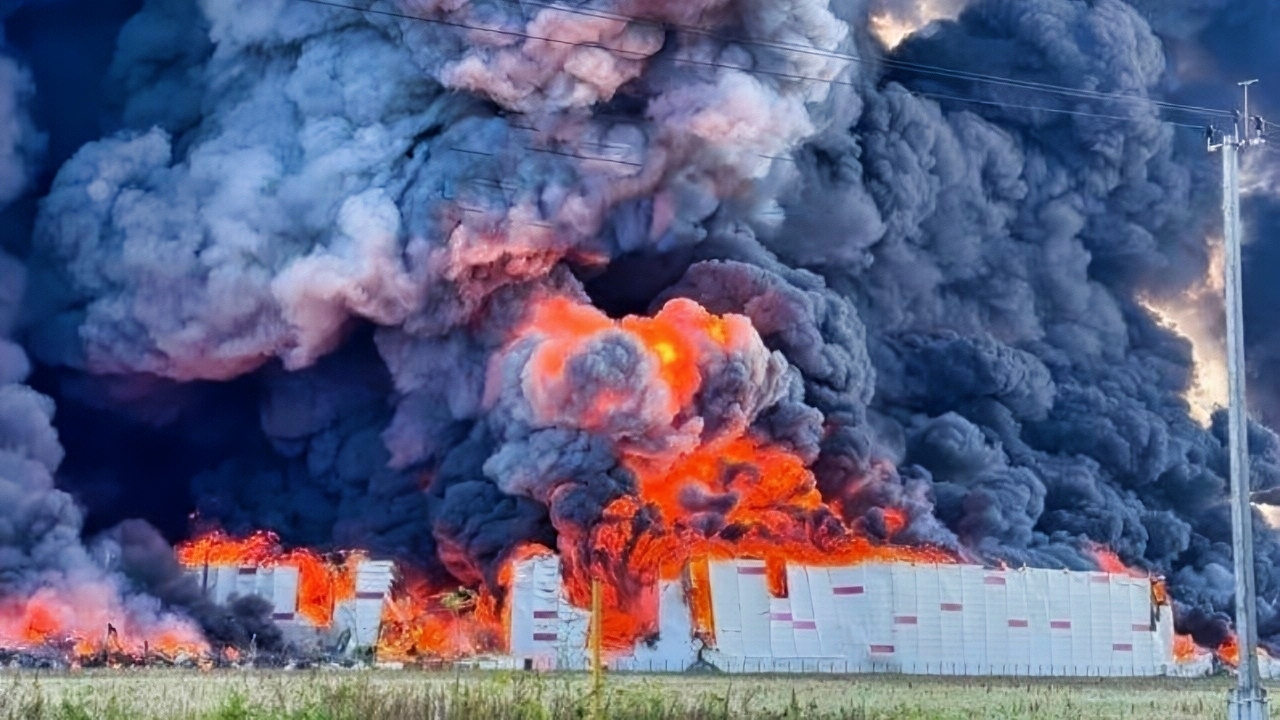
A massive column of black smoke rose from a Wildberries logistics complex about 30 miles east of Moscow. Video and photographs showed the plume spreading across the skyline for dozens of miles after the facility caught fire. The scale of the smoke made the attack visible far beyond the warehouse itself.

Su-35 Fighter X Screenshot
The visual does not establish the precise value of what was lost. It does show that Ukraine reached a major commercial logistics site near the Russian capital despite one of Moscow’s largest reported drone-interception operations of the war.
Ukraine Hit Wildberries Warehouses In Two Russian Regions
Ukrainian drones struck two facilities operated by Wildberries, Russia’s largest online retailer and the company frequently described as the country’s answer to Amazon.
One attack hit a logistics center in Kotovsk, roughly 295 miles southeast of Moscow. Seven night-shift workers died, and 25 were injured, according to the regional governor. Another strike hit a Wildberries facility in Elektrostal, where one person later died, and dozens were injured.
The wider operation also caused a fire at an oil depot in Noginsk and damage at other locations. An updated Associated Press account said at least nine people were killed and more than 60 were injured across the attacks in Russia.
Ukrainian President Volodymyr Zelensky said the two logistics sites helped supply components used in Russian drone production and navigation equipment. That assertion has not been independently verified. Wildberries Chief Executive Tatyana Kim called it a terrible night for Russia and the company, according to Reuters.
The attacks widened Ukraine’s long-range campaign beyond obvious military bases and oil refineries. Warehouses, transportation networks, processing centers, and commercial supply chains can also support the movement of electronics and industrial components.

Su-35 Flanker Fighter Jet. Image Credit: Creative Commons.
The Elektrostal Smoke Cloud Exposed Russia’s Defense Problem
The Elektrostal fire produced the defining image of the operation. The Wall Street Journal reported that enormous smoke plumes stretched across an area dozens of miles wide as employees evacuated the logistics complex.
The smoke matters because it cuts through competing claims about interception rates. Russia can shoot down hundreds of drones and still suffer serious damage if only a small percentage reach large, vulnerable facilities.
Air defense is also a geographic problem. Russia must protect Moscow, military installations, oil refineries, fuel depots, ports, factories, power infrastructure, and transportation hubs across the world’s largest country. Ukraine chooses when and where to concentrate its drones. Russia must decide which sites receive its limited radars, electronic warfare systems, interceptor missiles, and gun crews.
Moscow Warehouse Fire X Screenshot
That imbalance has grown as Ukrainian drones reach deeper into Russian territory. A separate Wall Street Journal report found that attacks reaching as far as Siberia have forced Moscow to consider protecting a much larger portion of its industrial base, even as its air-defense resources are already stretched.
The warehouse fire near Moscow was therefore more than a dramatic image. It showed the consequence of forcing Russia to defend too many possible targets at once.
Russia Cannot Protect Every Refinery and Logistics Hub
Ukraine does not need to destroy every target it attacks. Its campaign works if it forces Russia to disperse air defenses, interrupt production, reroute logistics, close facilities, and spend more money protecting sites previously considered safe.
The pressure is already visible in Russia’s energy sector. The Journal reported that Ukrainian strikes have reached all 10 of Russia’s largest refineries and that analysts estimate more than one-quarter of the country’s refining capacity has been knocked offline. The campaign has contributed to fuel shortages and greater pressure on Moscow to protect infrastructure far from the front.
Wildberries said the warehouse strikes would not create lasting disruption to its wider business. That could prove correct. Russia has a large economy and extensive logistics capacity, and a single burning warehouse does not determine the direction of the war.
The broader pattern is harder for Moscow to dismiss. Ukraine is reaching refineries, oil depots, ports, warehouses, and military-linked facilities across a widening area. Each successful penetration forces Russia to defend another category of target.
The smoke over Elektrostal gave that problem a shape visible from miles away.
About the Author: Harry J. Kazianis
Harry J. Kazianis (@Grecianformula) was the former Senior Director of National Security Affairs at the Center for the National Interest (CFTNI), a foreign policy think tank founded by Richard Nixon based in Washington, DC. Harry has over a decade of experience in think tanks and national security publishing. His ideas have been published in the NY Times, The Washington Post, The Wall Street Journal, CNN, and many other outlets worldwide. He has held positions at CSIS, the Heritage Foundation, the University of Nottingham, and several other institutions related to national security research and studies. He is the former Executive Editor of the National Interest and the Diplomat. He holds a Master’s degree focusing on international affairs from Harvard University.


