
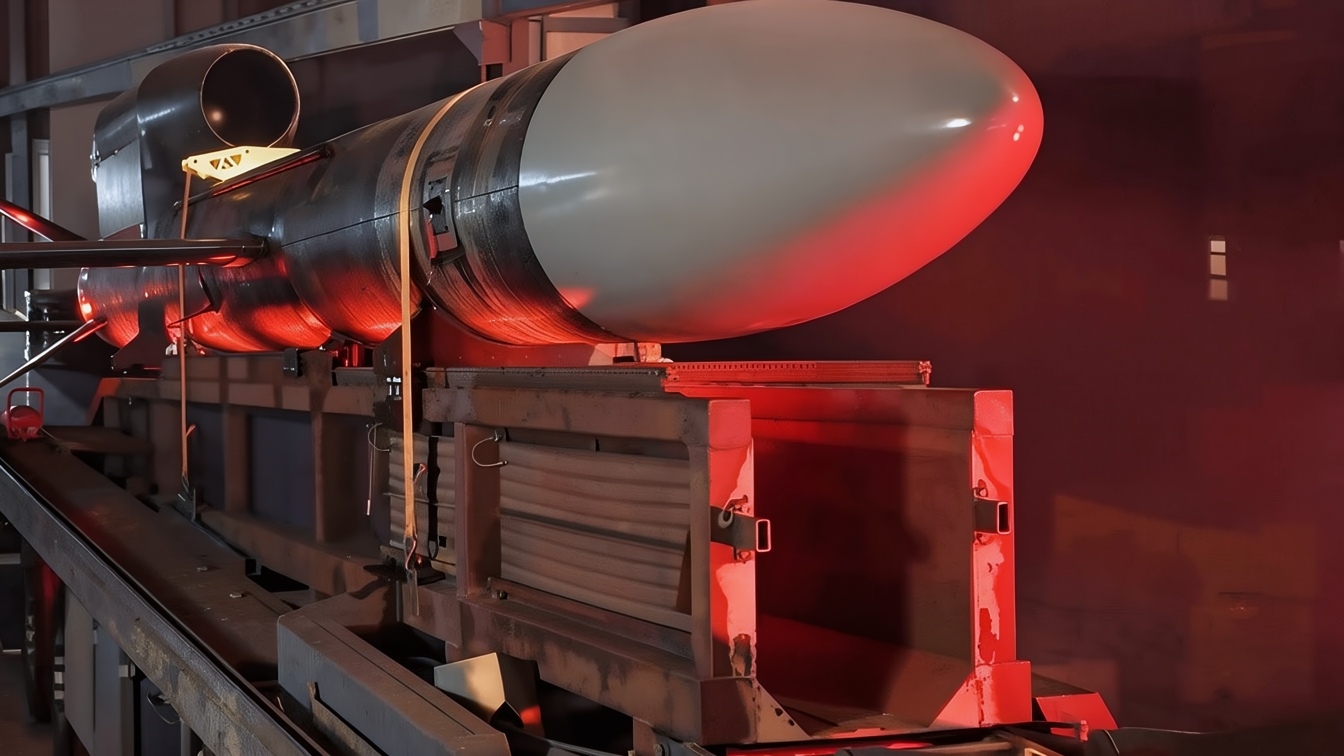
Ukraine’s latest barrage of long-range attacks inside Russia has struck military and energy infrastructure at shocking distances – and they can thank the domestically-made “Flamingo” for the chaos it’s causing for Moscow.
Flamingo Missiles Hit Russia’s Defense Industry
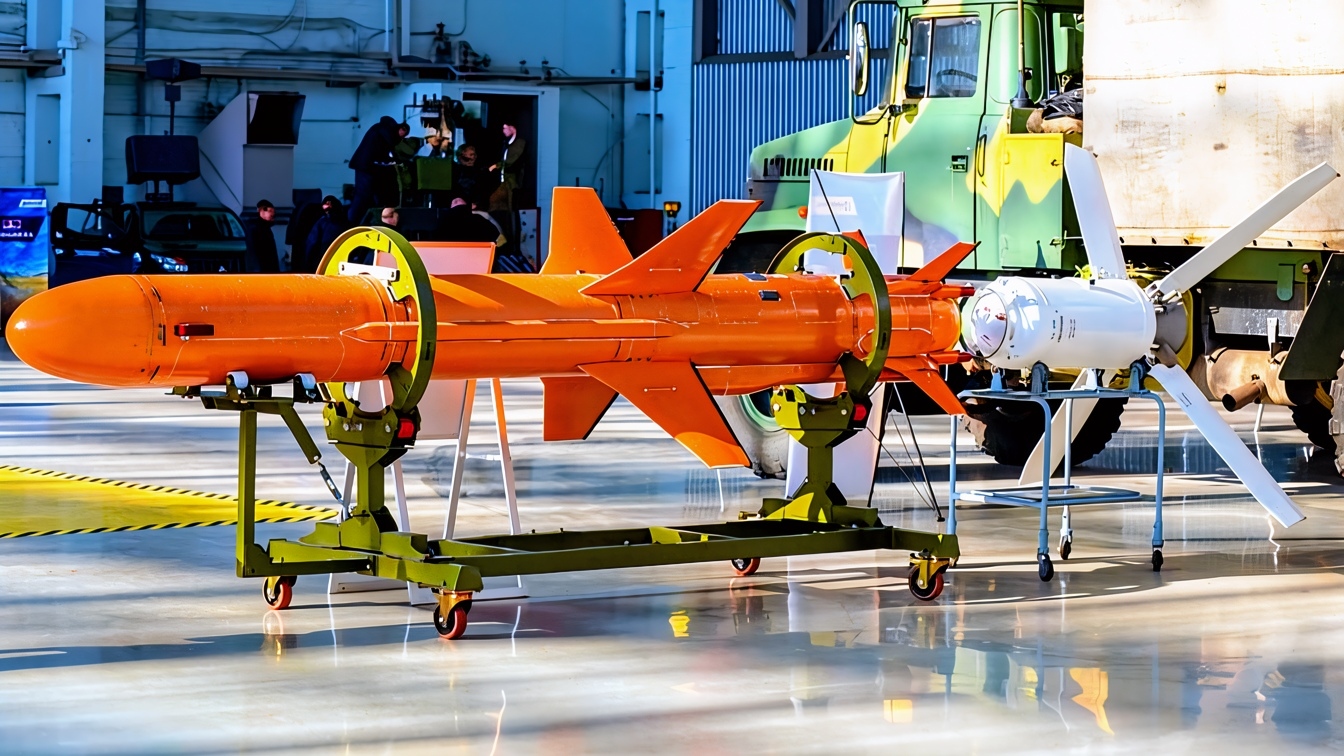
Neptune Cruise Missile Ukraine Government Photo
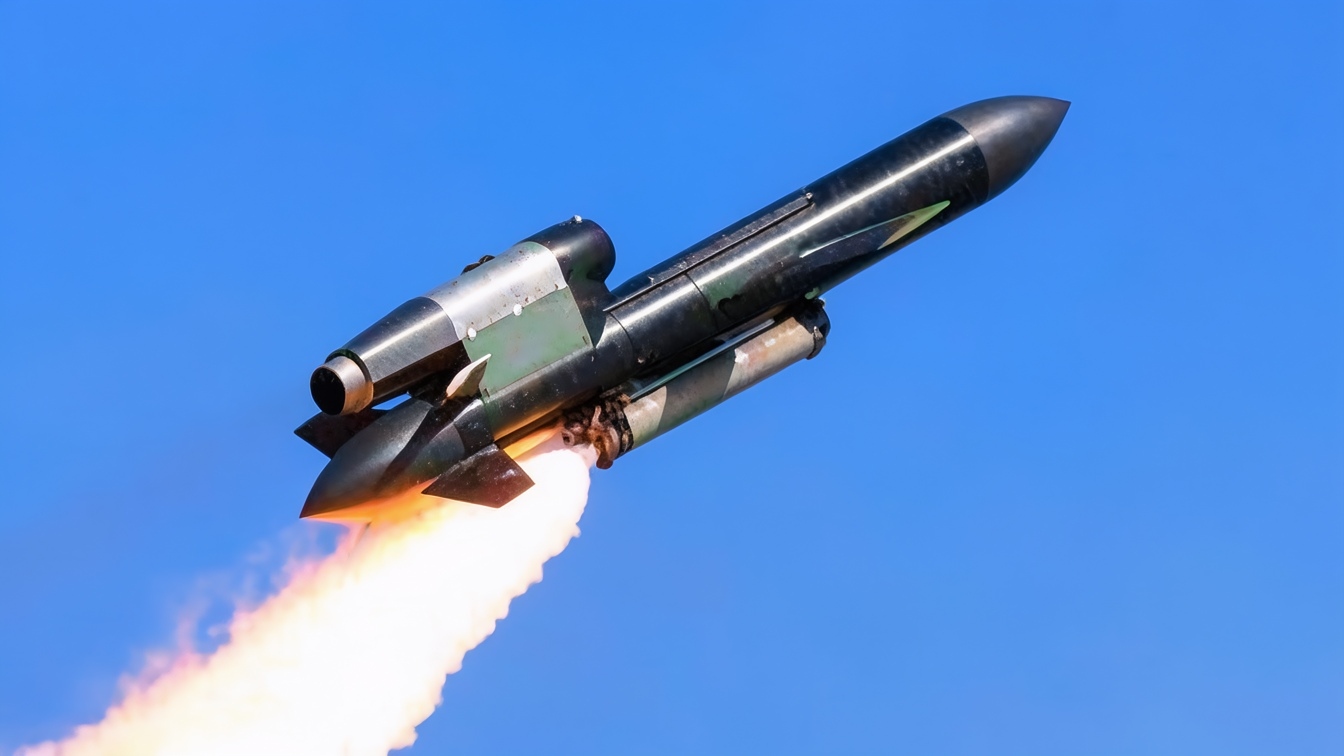
Ukraine Cruise Missile. Image Credit: Government of Ukraine.
Ukrainian President Volodymyr Zelenskyy confirmed on June 10 that Ukrainian forces had used the domestically produced FP-5 Flamingo long-range missiles to strike the VNIIR-Progress facility in Cheboksary, the capital of the Chuvash Republic. The city is some 900 kilometers from the front lines, proving that Ukraine has officially brought the fight to Russia.
“We continue to apply Ukrainian long-range sanctions against Russian military facilities and the oil industry. In particular, last night, Ukrainian FP-5 Flamingos struck a military plant in Cheboksary that supplies the occupier’s army with components for drones and missiles. I thank the Armed Forces of Ukraine for their precision!” Zelenskyy said on X.
“The Kuibyshev oil refinery in the Samara region was also hit last night. The distance from the frontline is more than 900 kilometers. I am grateful to the warriors of the Special Operations Forces, the Unmanned Systems Forces, and the Defense Intelligence of Ukraine. The entire joint response of the Security Service of Ukraine also reached two oil infrastructure facilities in the Vladimir region, located 700 kilometers away. I thank everyone who fights and works for Ukraine!” he continued.
Images and videos have emerged online showing the Flamingo missile flying through Russian airspace and major fires at the VNIIR-Progress site. The scale of the damage is significant, with videos showing much of the building completely destroyed.
The attack was acknowledged by Oleg Nikolayev, the regional governor, and Russian authorities also confirmed that operations at the facility had been suspended. Open-source intelligence suggests that the plant manufactures Kometa navigation and anti-jamming antenna systems used in Russian Shahed-type drones and other precision-guided weapons.
The strike, then, also shows that Ukraine is deliberately targeting the Russian military-industrial complex as well as its energy industry.
The Flamingo Missile
The FP-5 Flamingo is easily one of the most valuable new additions to Ukraine’s expanding arsenal of weapons.
It is the product of a long-term effort by Kyiv to build a domestic long-range strike capability that bypasses the complexity of negotiations with the West.
No longer does Ukraine need approval from the West to launch strikes – they can simply happen overnight, whenever a target is within sight.
Developed by the Ukrainian defense company Fire Point, the Flamingo was first publicly seen in 2025. The system was specifically designed to address the problem of Western leaders hesitating to provide long-range weapons in sufficient numbers or the approval required to launch them deep into Russian territory.
Because the weapon is indigenous to Ukraine, Western leaders are no longer concerned that launching attacks inside Russian territory will trigger an escalation with NATO countries.
Shocking Specs
Defense technology company Milanion claims that the FP-5 has a range of around 3,000 kilometers (1,864 miles). If accurate, that would place virtually all of European Russia within reach. The missile reportedly also carries a warhead that weighs up to 1,150 kilograms – significantly larger than the 450-kilogram warhead carried by the U.S. Tomahawk cruise missile. It may be an alternative to Western-supplied systems, but it is by no means inferior.
The International Institute for Strategic Studies (IISS) has described the Flamingo as one of the largest and longest-range ground-launched cruise missiles currently under development in the world, not just outside of the world’s largest military powers. Analysts at the IISS also note that the warhead is an “aerial bomb,” and that the powerplant “appears to be a locally made Ivchenko AI-25TL turbofan engine, originally designed for crewed aircraft.”
The system is believed to have a maximum takeoff weight of around 6,000 kilograms and a cruising speed of between 850 and 900 kilometers per hour. It is also understood to have a top speed of around 950 kilometers per hour and to use satellite navigation, supported by inertial guidance systems, to maintain accuracy even in contested environments where electronic warfare and jamming are expected.
Ukraine Is Turning A Corner
The Flamingo changes everything for Ukraine. On June 11, President Volodymyr Zelenskyy marked the country’s first-ever “Day of the Unmanned Systems Forces,” celebrating the branch created specifically to oversee drone warfare and other autonomous technologies.
“It is Ukrainians who have proved that through technology, ingenuity, and courage, we can change the nature of warfare. We can achieve objectives that were previously either completely out of reach of conventional weapons or extremely difficult to achieve and required an enormous expenditure of resources. In just one year since the establishment of the USF Grouping, Russian targets of various levels worth nearly $40 billion have been struck,” Zelenskyy said when announcing the day.
The FP-5 is part of that evolution for Ukraine.
It not only allows Ukraine to punch above its weight but also sets a standard for other smaller powers seeking to expand their military capabilities.
About the Author: Jack Buckby
Jack Buckby is a British researcher and analyst specializing in defense and national security, based in New York. His work focuses on military capability, procurement, and strategic competition, producing and editing analysis for policy and defense audiences. He brings extensive editorial experience, with a career output spanning over 1,000 articles at 19FortyFive and National Security Journal, and has previously authored books and papers on extremism and deradicalization.


Big Country
June 11, 2026 at 9:11 pm
NATO in Europe was lulled to sleep 😴 by the perceived lack of threats from Russia 🇷🇺 in the 90s and their defense spending plummeted by 2000… when Pres Yeltsin was replaced with Putin, NATO had expanded all the way to Russian borders and many former Soviet Union countries and Warsaw Pact countries had joined NATO… without Yeltsin in power and with Putin at the helm, paranoia and anxiety festered amongst the Russian hardliners in the Kremlin and gvt and relations with the West began to go sour… then the US began to withdraw from missile and other arms agreements with Russia 🇷🇺 under GW Bush… these blunders only fueled the deterioration of relations, and paranoia grew about Western intentions, and Putin used this to increase his grip on power and he began to do away with political reforms and democratic principles in Russia 🇷🇺… the results are now in full operation and Putin has cemented himself as a modern Czar and dictator for life, and has implemented his desire for a restoration of the Soviet Union and its sphere of influence…
Big Country
June 11, 2026 at 9:12 pm
Ukraine 🇺🇦 ain’t “losing badly” tho… after almost 4 yrs of fighting, Russia 🇷🇺 only controls 19% of Ukraine 🇺🇦 territory, while suffering devastating losses in manpower and equipment that has rendered Russia 🇷🇺 unable to withstand any other conflicts aside from this current disastrous one they started… as for my position on going forward at this point…
I agree with the most recent European peace deal proposals… freeze immediately the front lines in a cease fire, and set up a DMZ along the front… no demands for Russian forces to withdraw from their gained territories by Ukraine but no ceding of more territories to Russia by Ukraine… after the cease fire is implemented, multinational security forces would occupy the DMZ to ensure security of Ukraine 🇺🇦 and Russia 🇷🇺 in the region… Ukraine 🇺🇦 would be able to maintain and rebuild its military forces without limits… Ukraine 🇺🇦 would be eligible to join NATO or any other military alliance that would provide an NATO type “article 5” security guarantees deal… if Russia 🇷🇺 refuses such a deal then the following is the only option for Ukraine 🇺🇦 security guarantees and sovereignty… since
Trump has abandoned NATO and Ukraine 🇺🇦… the EU should immediately implement a security and military alliance with Ukraine 🇺🇦 and immediately deploy combat troops to Ukraine 🇺🇦 and begin operations to push the Russian forces out of all Ukraine 🇺🇦 territory including Crimea… Russia 🇷🇺 is unable to mount any serious defense or offensive posture against such a military alliance and forces, and they won’t be reckless or foolish enough to use nuclear weapons because of the retaliation with nuclear weapons by the EU and NATO…