

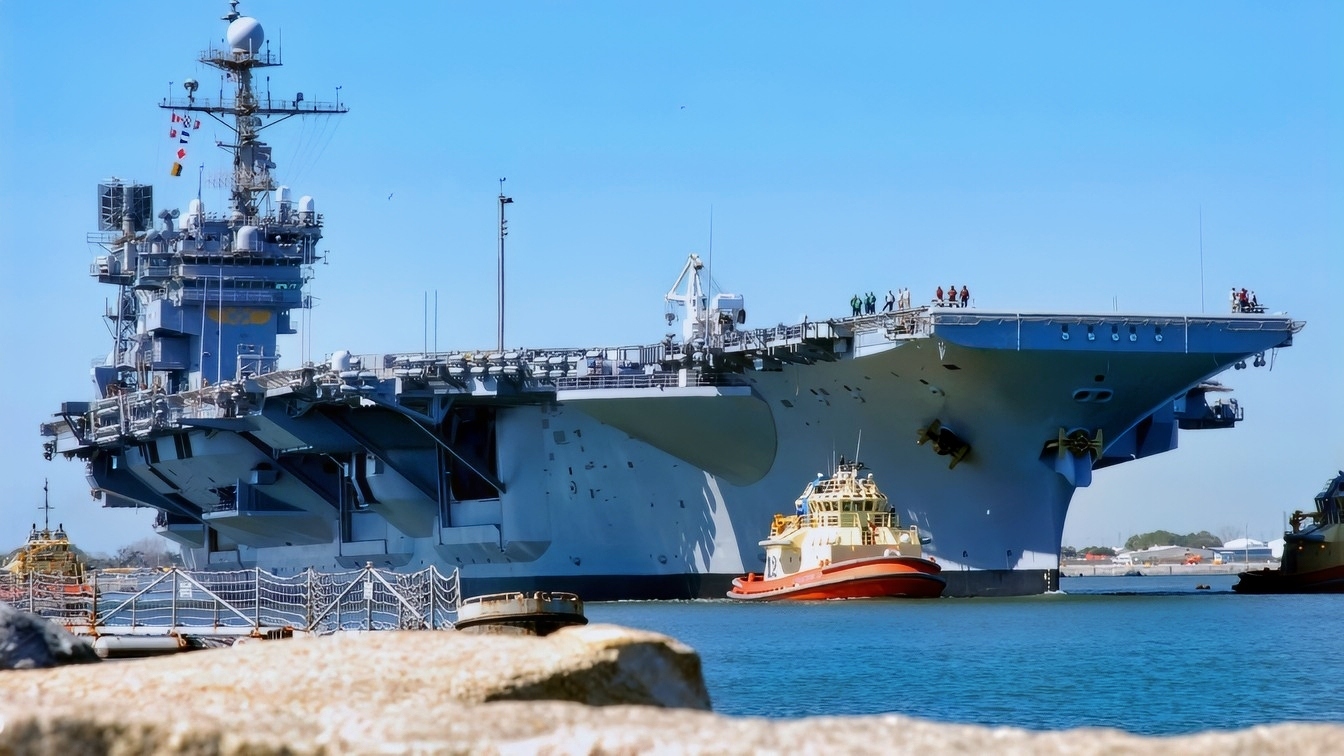
The USS John F. Kennedy (CV-67) was a unique class of supercarrier. Derived from the Kitty Hawk-class, she received several design modifications that made her truly one of a kind. Kennedy had a long and eventful service life, taking part in missions all across the globe and contributing to the invasion of Iraq and Afghanistan. She was the last conventionally powered nuclear carrier in the U.S. Navy, and her eventual retirement marked the end of an era.
Kennedy’s Unusual Construction
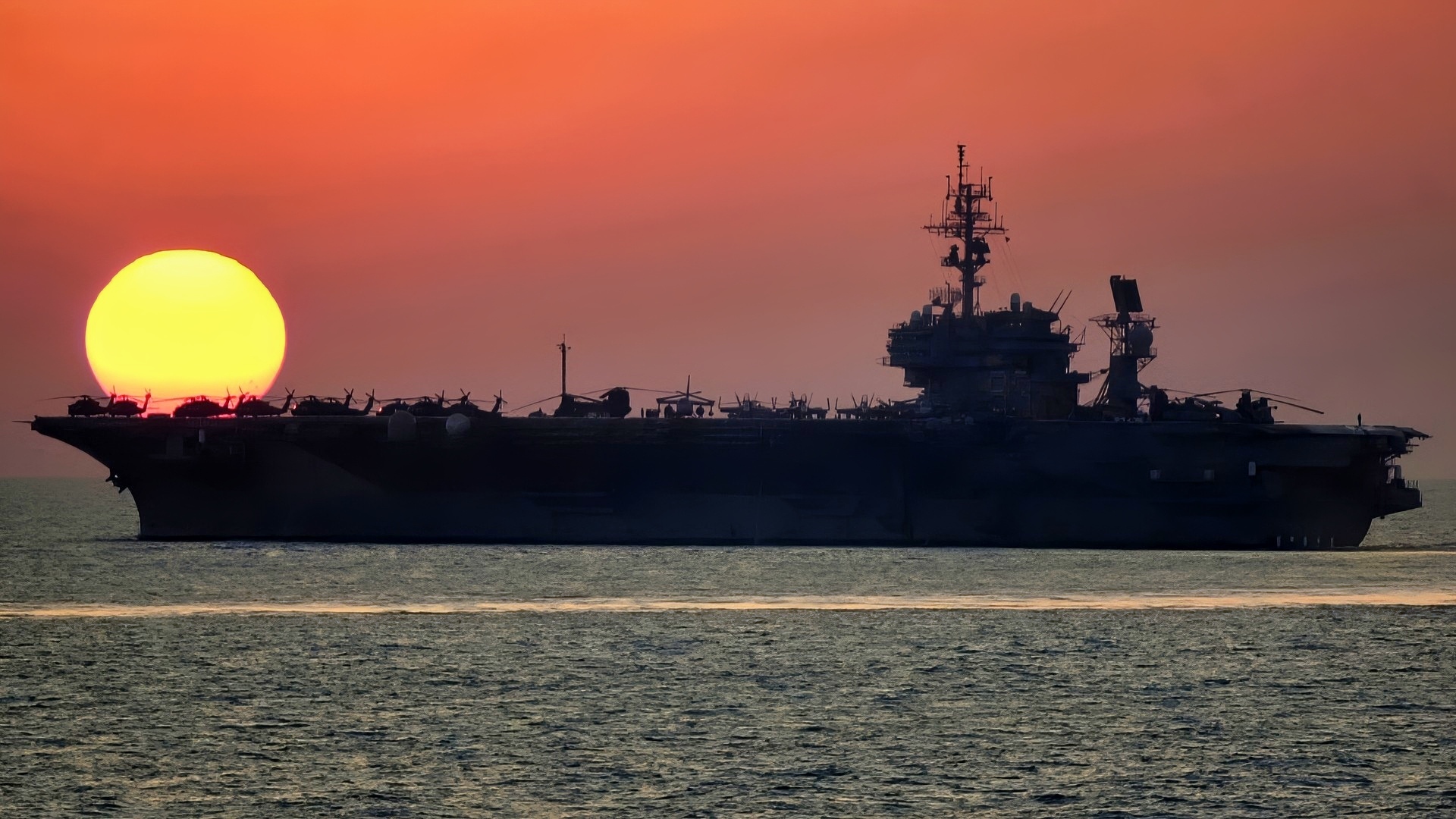
USS Kitty Hawk of Kitty-Hawk-Class. Image Credit: Creative Commons.
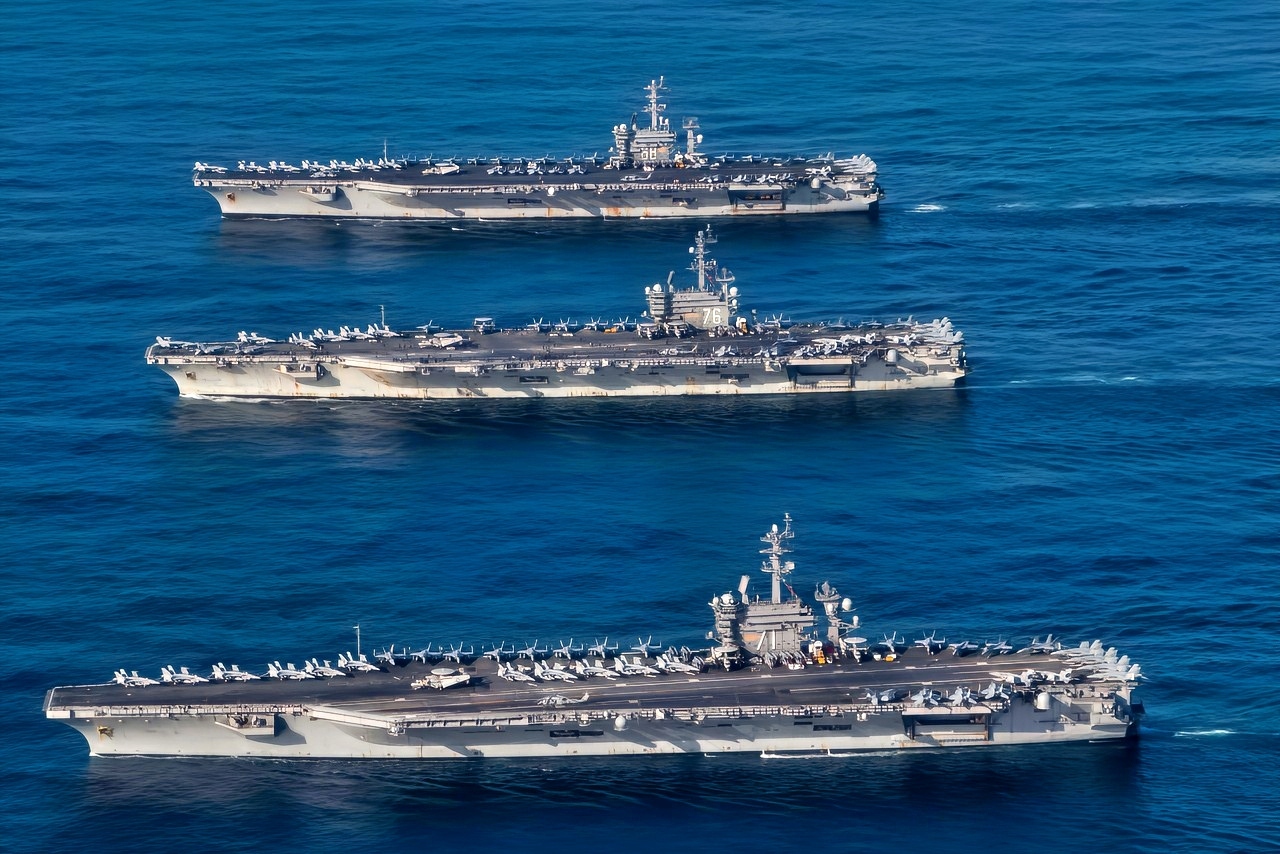
The U.S. Navy aircraft carriers USS Nimitz (CVN-68), USS Theodore Roosevelt (CVN-71) and USS Ronald Reagan (CVN-76) underway in the Western Pacific on 12 November 2017. The strike groups were underway and conducting operations in international waters as part of a three-carrier strike force exercise. This was the first time since August 2007 that three U.S. Navy carriers operated together. In 2007, USS Kitty Hawk (CV-63), USS Nimitz (CVN-68) and USS John C. Stennis (CVN-74) participated in exercise “Valiant Shield”.
Kennedy was authorized in the early 1960s. She was originally considered a Kitty Hawk-class carrier; however, during her construction, she received so many modifications that she became an entirely new class of her own.
She incorporated design elements from earlier carriers but also featured distinctive engineering choices that set her apart. Construction began at Newport News Shipbuilding in Virginia.
Her keel was laid down on October 22, 1964, and she was launched on May 27, 1967, with President Kennedy’s daughter, Caroline Kennedy, serving as the sponsor. The ship was officially commissioned into the Navy on September 7, 1968.
Originally, Kennedy was supposed to be powered by an A3W nuclear reactor. However, after construction began, the Navy decided to switch to a traditional steam-turbine propulsion system. This decision was partly due to budget considerations and partly due to the Navy’s transitional approach to nuclear propulsion at the time. As a result, she holds the distinction of being the last conventionally powered aircraft carrier built for the U.S. Navy.
Design and Capabilities
At over 1,050 feet in length and displacing more than 80,000 tons at full load, John F. Kennedy was an enormous and formidable vessel. She could reach speeds of 36 knots, and her quarters could accommodate more than 5,000 personnel. Like all modern carriers, she was built with an angled ramp, which enabled simultaneous aircraft launch and recovery, dramatically increasing operational efficiency.
The ship could carry approximately 70–80 aircraft, including fighter jets, attack aircraft, reconnaissance planes, and helicopters.
Over her lifetime, these included aircraft such as the F-4 Phantom II, A-6 Intruder, F-14 Tomcat, and later the F/A-18 Hornet. She was armed with two Sea Sparrow launchers, two Phalanx close-in weapon systems (CIWS), and two Rolling Airframe Missile (RAM) launchers.
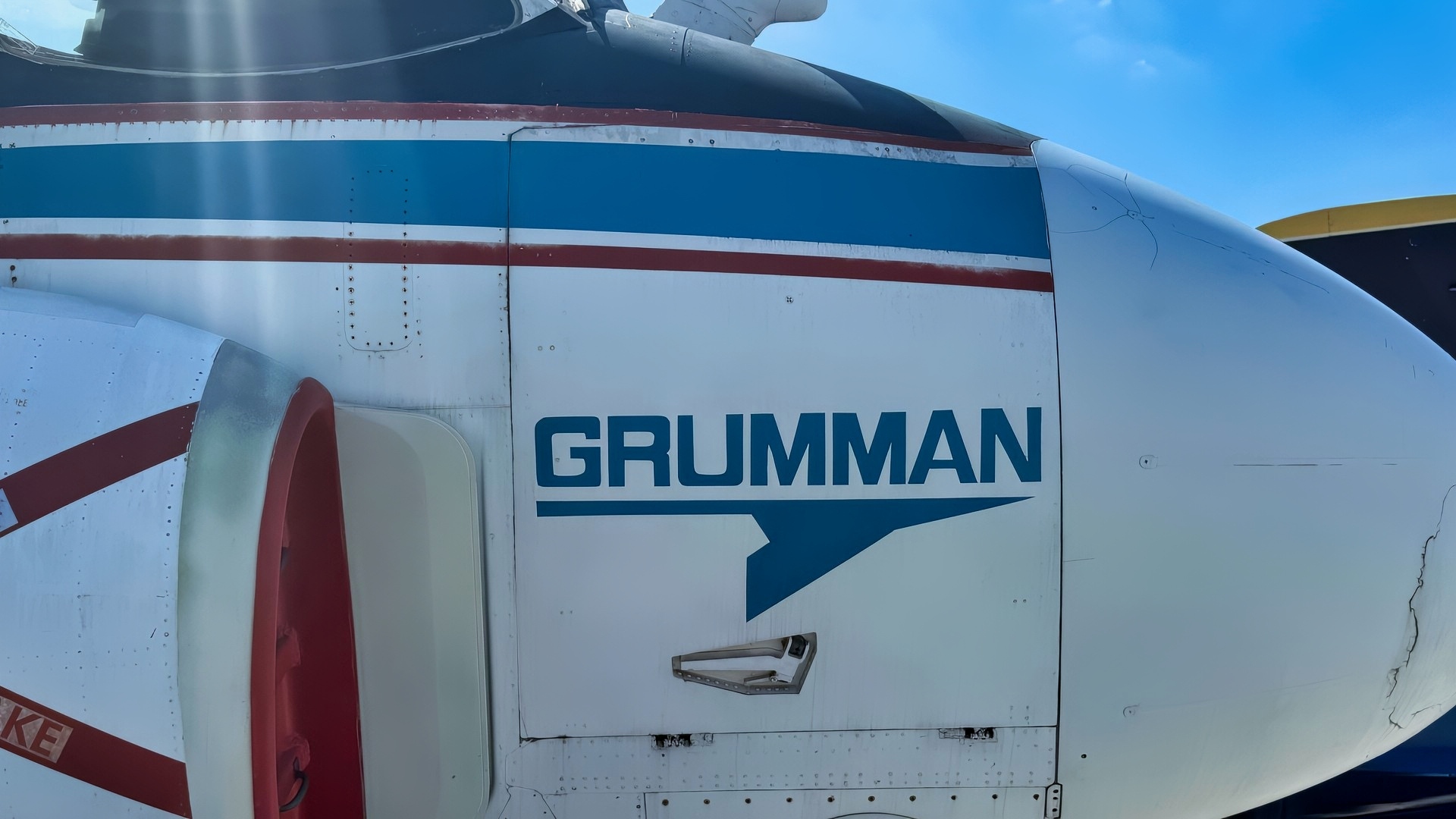
Side of A-6 Intruder. Image Credit: National Security Journal.
These defenses gave her adequate protection against contemporary threats, even without escort vessels.
Service History
Kennedy spent her early years in the Mediterranean Sea, making her first port call in Malta.
She was sent to the Middle East to monitor the situation unfolding in the Middle East during the Iranian Hostage Crisis. The Navy intended to send her to Vietnam, but the war ended with the signing of the Paris Peace Accords in 1973.
Instead, she remained in the Middle East, where she took part in the U.S. naval buildup in response to the Yom Kippur War between Egypt and Israel. During this time, the carrier underwent an overhaul to make her compatible with newer aircraft such as the F-14 and the S-3 Viking.

F-14 Tomcat on Flight Deck at USS Intrepid Museum. Image Credit: National Security Journal.
In 1975, Kennedy collided with the USS Belknap (CG-26), the lead ship of her class, off the coast of Sicily.
The collision ruptured several of the carrier’s fuel lines, spraying fuel all over the ship. Both vessels suffered from fires, which resulted in seven fatalities on Belknap and two fatalities aboard Kennady.
Aside from the fuel lines and the fire, Kennedy left the incident relatively unscathed, while Belknap was almost completely destroyed, though she was later fully repaired. This earned the carrier the nicknames “Can Opener” and “Jack the Tin Can Killer.”
Operations in the Middle East
In the 1980s and 1990s, the USS John F. Kennedy played a significant role in U.S. operations in the Middle East.
She participated in missions related to the Iran-Iraq War, including Operation Earnest Will, which involved protecting oil tankers in the Persian Gulf. During Operation Desert Storm in 1991, Kennedy launched numerous air strikes against Iraqi targets as part of the coalition effort to liberate Kuwait. Her air wing flew an insane 2,900 combat sorties, contributing to the operation’s overwhelming success.
Following the end of the Cold War, the ship continued to serve in various capacities worldwide. She was involved in peacekeeping missions, humanitarian operations, and routine patrol missions.
After the terrorist attacks of September 11, 2001, the USS John F. Kennedy participated in Operation Enduring Freedom and launched more than 31,000 tons of munitions against Al-Qaeda and Taliban targets across the Middle East. This would be her last combat operation before her retirement.
Decommissioning and Legacy
After nearly 40 years of service, the USS John F. Kennedy was officially decommissioned on March 23, 2007. Following her decommissioning, numerous efforts were made to preserve the ship as a museum.
Unfortunately, none of these efforts were successful, as maintaining the large supercarrier proved too costly. In 2021, Kennedy, along with the USS Kitty Hawk (CVA-63), was sold for scrap. The ship made its final voyage to Brownsville, Texas, in 2025, where it began its long deconstruction. She was sold for a penny.
As the last conventionally powered aircraft carrier in the U.S., the scrapping of John F. Kennedy marked the end of an era.
Even at the time of her construction, the Navy was shifting towards nuclear-powered aircraft carriers, which offered better operational longevity.
Despite her many years of valiant service, the carrier’s hull was fatigued beyond repair. Kennedy was the last holdout, and her decommissioning was the final nail in the coffin for conventionally powered carriers.
About the Author: Isaac Seitz
Isaac Seitz, a Defense Columnist, graduated from Patrick Henry College’s Strategic Intelligence and National Security program. He has also studied Russian at Middlebury Language Schools and has worked as an intelligence Analyst in the private sector.


ATW
May 20, 2026 at 12:58 am
This is not an a&$h+×e statement. Early in the article you call the JFK a conventionally powered nuclear carrier. Was just wanting some clarification on that please. Thanks