


The U.S. Navy is surging to add as many new Virginia-class attack submarines as quickly as possible, something that has been on the service’s radar for many years. As Los Angeles-class submarines retire and Columbia-class nuclear-armed ballistic missile submarines begin construction, the U.S. Navy has long been aware of its “submarine deficit,” meaning there simply are not enough operational attack submarines to meet combatant commander demand.
This is particularly true in areas such as the Pacific, given that U.S. Navy undersea superiority could potentially “save” Taiwan from a surprise Chinese amphibious assault.
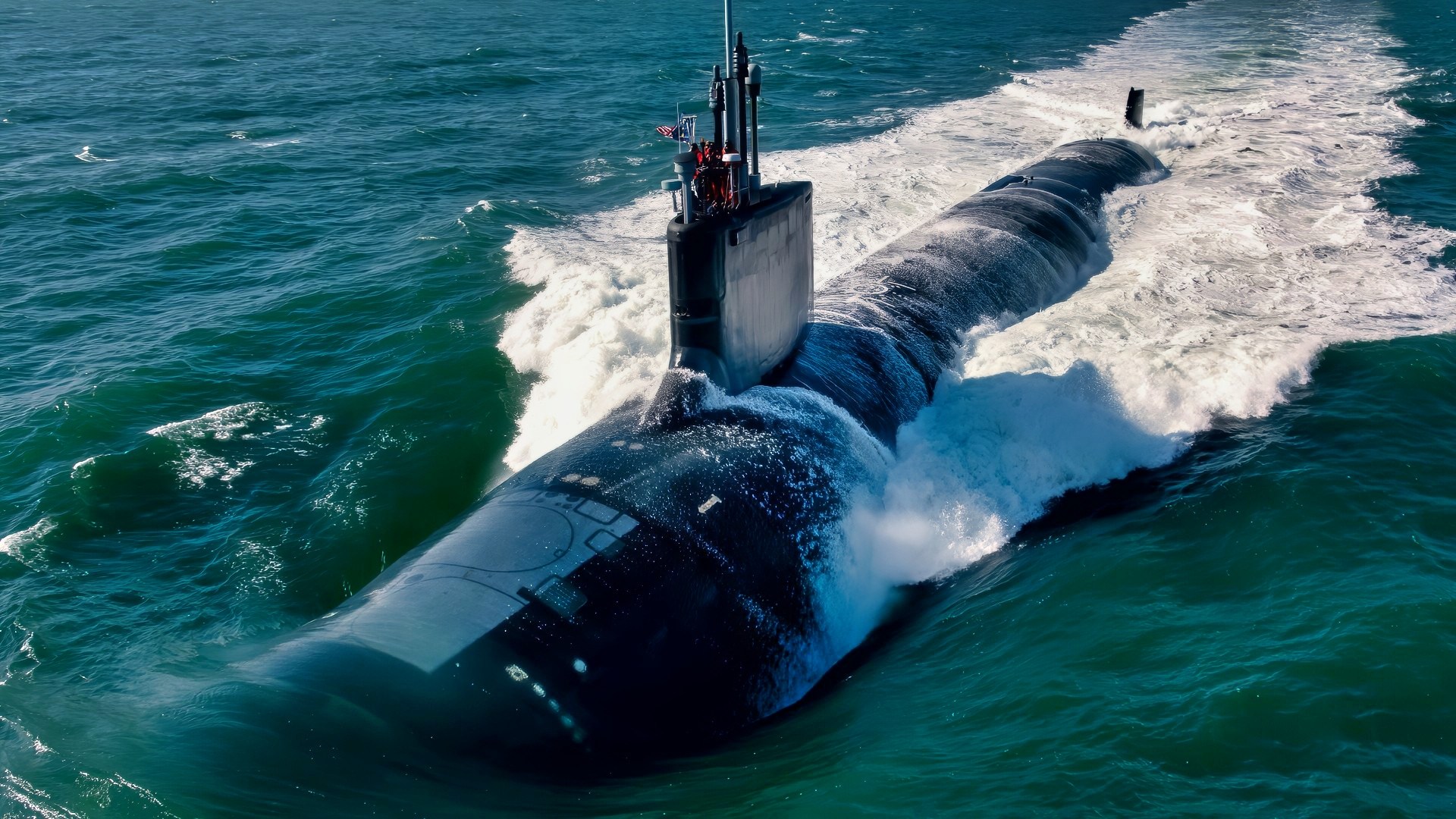
ATLANTIC OCEAN (Feb. 1, 2022) The future Virginia-class attack submarine Montana (SSN 794) conducts initial sea trials Feb. 1, 2022 in the Atlantic Ocean. Montana is the 10th Virginia-class submarine. (U.S. Navy photo courtesy of HII by Ashley Cowan) Montana SSN 794 Alpha Sea Trials
Surface ships, drones, and ground defenses supporting Taiwan would easily be seen by PLA sensors, satellites, and drones, yet secret, quiet Virginia-class submarines could potentially lurk undetected in position to destroy PLA Navy surface ships transiting the Taiwan Strait.
This is why the Navy is quick to highlight and celebrate its newest addition to the Virginia-class attack submarine fleet, the commissioning of the USS Idaho SSN 799, an advanced Block IV boat.
The U.S. Navy Is Building New Virginia-Class Submarines Fast
The U.S. Navy has thus far built eight Block IV Virginia-class attack submarines, a crucial “bridge” step between Block III and the upgunned Block V with Virginia Payload Modules.
While Block IV does not add 28 more Tomahawks and a 79ft extended hull for the additional weaponry, it builds upon and advances technologies integrated into Block III Virginia-class submarines.
Secondly, Block IV incorporates a new series of technological upgrades applied to existing Block III submarines, including additional quieting coating materials and antennas for improved connectivity, among other things.
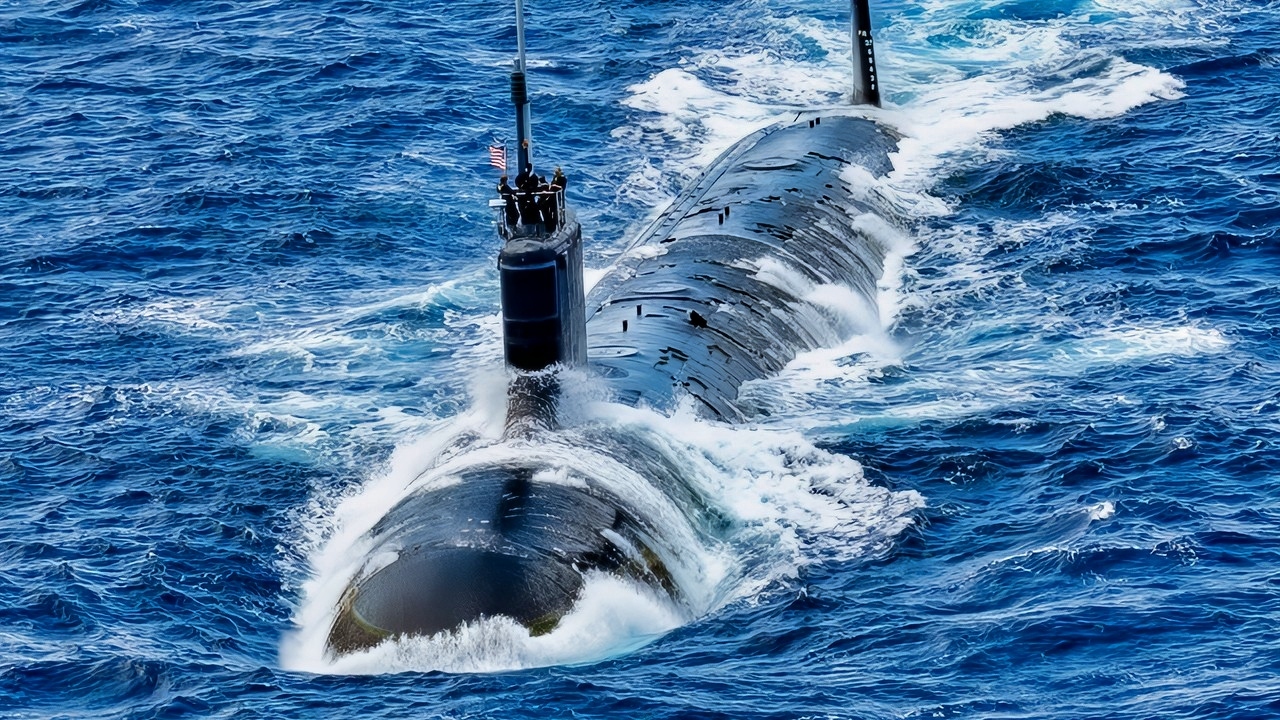
Virginia-class attack submarine USS North Carolina (SSN 777) sails in formation, off the coast of Hawaii during Exercise Rim of the Pacific (RIMPAC) 2024, July 22. Twenty-nine nations, 40 surface ships, three submarines, 14 national land forces, more than 150 aircraft and 25,000 personnel are participating in RIMPAC in and around the Hawaiian Islands, June 27 to Aug. 1. The world’s largest international maritime exercise, RIMPAC provides a unique training opportunity while fostering and sustaining cooperative relationships among participants critical to ensuring the safety of sea lanes and security on the world’s oceans. RIMPAC 2024 is the 29th exercise in the series that began in 1971. (U.S. Navy photo by Mass Communication Specialist 1st Class John Bellino)
Spy Submarines
Block III was built with a breakthrough Large Aperture Bow (LAB) sonar, designed to enable longer-range active and passive detection.
The integration of this LAB massively expanded the boats’ undersea surveillance capacity, a technological dynamic that inspired commanders to view the boats as more capable of undersea ISR.
Virginia attack submarines can increasingly “loiter” quietly in high-risk coastal areas to conduct clandestine reconnaissance missions.
These special Block III upgrades were built into a prototype submarine years ago, the USS North Dakota; the success of the integration effort inspired the service to upgrade its entire fleet of Block III Virginia-class submarines with these added technologies.
It stands to reason that these upgrades would extend into even more capable Block IV boats. Block IV Virginias build upon this ISR capacity and surge it into a new realm, designed to further enable quiet threat detection.
Supporting special operations is central to this concept of operation, as Block III submarines operate with what’s called a Lockout Trunk, a “dry” area which then fills up with water to allow Special Operations Forces to exit the submarine for secret missions without having to surface.
This greatly improves survivability for SOF missions as they regularly conduct secret reconnaissance, hostage rescue, or targeted attack missions behind enemy lines.
Virginia Computing
The largest innovation woven into Block III is the “fly-by-wire” computer technology, which uses automation and advanced algorithms to control speed, depth, angle, and trajectory, in coordination with ship-integrated sensors, to avoid collisions and follow an optimal course.
A human commander can set depth and speed and remain operational in a command-and-control capacity, while advanced computing can greatly assist navigation by making slight adjustments autonomously as needed.
Yet another advantage of the Virginia submarines is their diesel-electric engines, a propulsion technology that “powers” the ship and adds on-board power generation capability.
This is quite helpful, as Block III and Block IV have much higher power requirements due to fiber-optic cables for reconnaissance, additional computing, and on-board electronics. Electricity is also needed to analyze the sonar return images generated by the enlarged sonar
Navy Seeks Faster Submarine Building
At several points in recent years, the US Navy commissioned and launched specific industrial base studies to assess the industry’s ability to “flex” to accommodate the need to build two Virginia-class submarines every year when the Columbia-class begins to emerge.
At several points, Navy decision-makers and Congressional appropriators even outlined an ambitious plan to build “three” Virginia-class submarines per year.
The Navy has “procured” two Virginia-class boats per year since 2011, yet the service and its industrial partners have not been able to build the submarines at that pace since 2019, a circumstance that has, in recent years, greatly exacerbated the service’s submarine deficit.
As of mid 2025, the US Navy operated 19 Virginia-class boats and 29 Los Angeles-class submarines, according to Embleholics, yet the Navy has for many years hoped it could operate a fleet of as many as 50 Virginia-class attack subs by the mid 2040s, according to its 2016 30-year shipbuilding plan.
The US Navy’s 2025 “30-Year Shipbuilding Plan” states that the service plans to again build two Virginia-class submarines per year by 2028. Virginia-class submarines are built by a cooperative arrangement between the Navy and Electric Boat, a subsidiary of General Dynamics, and Newport News Shipbuilding, a division of Huntington Ingalls Industries.
Each industry partner constructs portions, or “modules,” of the submarines, which are then melded together to make a complete vessel
About the Author: Kris Osborn, Warrior Maven President
Kris Osborn is a Military Technology Editor. Osborn is also President of Warrior Maven – Center for Military Modernization. Osborn previously served at the Pentagon as a highly qualified expert in the Office of the Assistant Secretary of the Army—Acquisition, Logistics & Technology. Osborn has also worked as an anchor and on-air military specialist at national TV networks. He has appeared as a guest military expert on Fox News, MSNBC, The Military Channel, and The History Channel. He also has a Master’s Degree in Comparative Literature from Columbia University.


StayC
April 30, 2026 at 12:04 am
USA doesn’t have a submarine shortage problem. Same with aerial bombers. USA also doesn’t have any shortage of such bombers.
But, What does USA have a shortage of.
USA today has a shortage of brilliant minds. Yep, a shortage of this commodity.
Was demonstrated or shown/revealed in iran war.
Iran war was conducted by thickheaded donald trump, along with his sidekick pete hegseth, over big objections from military leaders.
So, What happened then. No regime change, strait of hormuz still controlled by iran, severe damage to US bases in gulf, high gasoline prices in US, and $25b taxpayer money straight down the sewer pipe.
So, USA mad obsession with china today, now, will surely lead to the reverse Trojan Horse syndrome being inflicted on washington, due to..(shortage of brilliant minds).
The War Dept, a.k.a. DoD, will eventually launch a high-end war against china, thinking its submarines and bombers will smash china to a pulp.
But that thinking is error of reverse Trojan Horse syndrome.
China will instead comepletely smash US bases in western pacific, causing regime change to occur in pro-US countries.
Result is USA getting kicked out of the whole region. No more bases for US subs and aircraft. No more okinawas.
bobb
April 30, 2026 at 3:13 am
USA, the current, or reigning genghis of the world today, wants absolute military supremacy & outright dominance.
Thus, the great fuss over nuclear submarines, nuclear weapons and nuclear forces, including nuclearized space force and the (anti)nuclear golden dome.
At a congress hearing on monday april 27 2026, a pentagon official said trump’s golden dome is designed to stop chinese missiles.
False. Fake news, by DoD.
The golden dome is designed to kneecap china’s nascent FOBS capability and spacebomber capability.
With that threat or threats fully neuralized, USA woild then be able to nuclear blackmail the rest of the world. Ultimate genghis, it is, really. The final genghis.
Frank Unetic
April 30, 2026 at 6:46 am
This problem surfaces every few years, when the various authors wake up. This has been a problem since the early 90’s, when CJCS decreed that 55 attack submarines was the number needed.
John Stuart
April 30, 2026 at 11:17 am
With the loss of the deck gun the Navy has no weapon for small ships, like those in the Chinese maritime militia, that don’t warrant one of a limited supply of torpedos. This would include cutters, surveillance ships, supply ships and trawlers. The Navy has a proven small torpedo that could sink these targets. These are so small that as many as 14 could fit in the existing tubes, 3 wide, 3 tall, and 2 long. This would be a force multiplier and double or triple the number of potential targets on each patrol
kellyj
April 30, 2026 at 12:56 pm
The major problem with being forced to start doing increased simultaneous purchases is that in 30+ years you end up with increased simultaneous decommissionings and the process has to repeat to keep the numbers up. Someone needs to just get real smart and do the simple math. How many do we need over a consistent 30-year period divided by how long it takes to build…then you fund that number. Every year. Forever or until you requirement changes.