

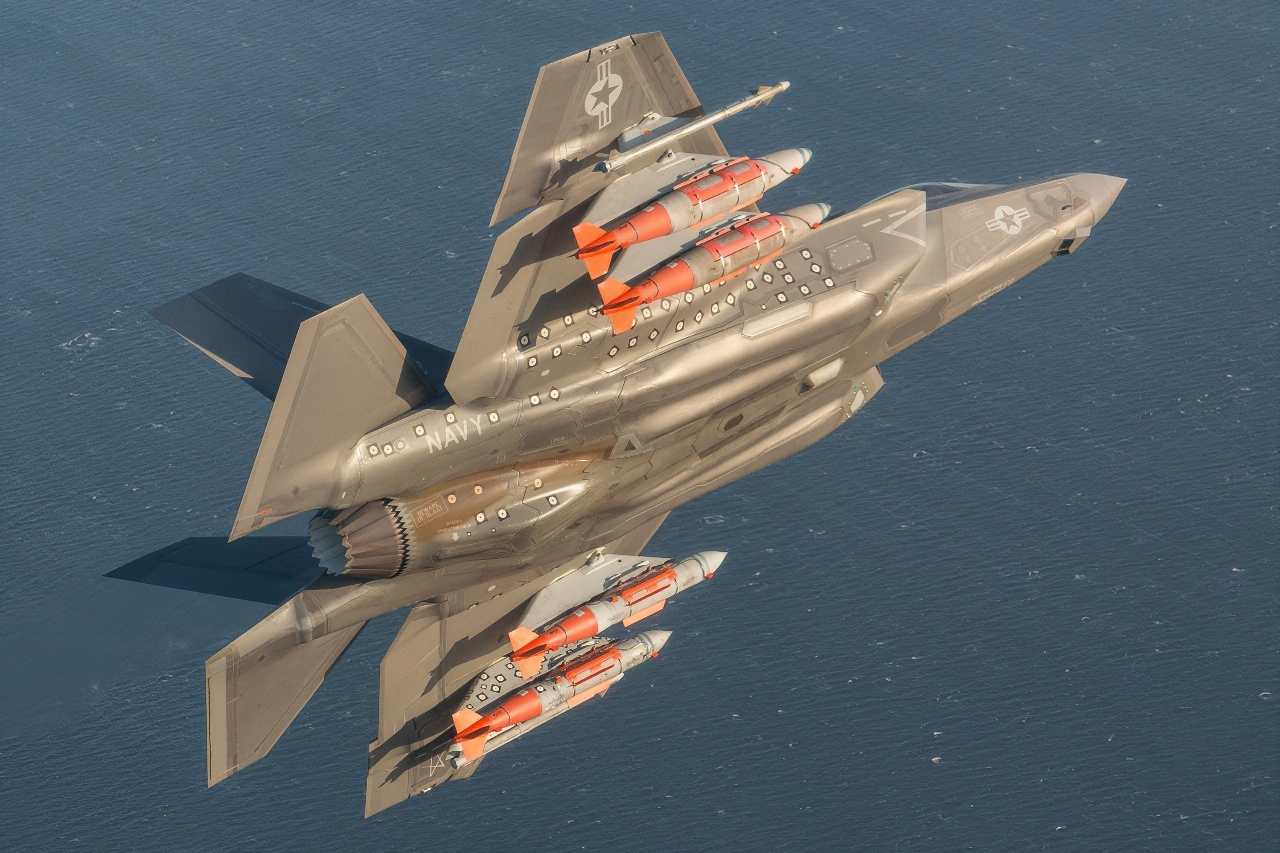
PUBLISHED on August 17, 2025, 11:41 AM EDT – Key Points and Summary: The F-35C was conspicuously absent from “Top Gun: Maverick” for several key reasons.
-According to an F-35 test pilot, the stealth jet’s capabilities would have made the mission too easy and the movie “boring.”
-The single-seat F-35 also presented a cinematic problem for a film that relied on two-seat aircraft like the F/A-18 and F-14 for its dramatic cockpit interactions.
-Furthermore, the F-35’s high cost and its advanced, standoff combat doctrine—focused on electronic warfare and long-range strikes—clashed with the film’s need for thrilling, low-altitude dogfighting action.
Why Did Top Gun: Maverick Not Use the F-35?
The summer 2022 cinematic blockbuster Top Gun 2: Maverick featured a treasure trove of super-cool, historically significant warplanes.
These ran the gamut from the World War II-era P-51D Mustang to the Cold War-era F-14 Tomcat and the 4.5-generation F/A-18E/F Super Hornet Block III. The Russian fifth-generation Sukhoi Su-57 “Felon” stealth fighter also appeared, as did the sixth-generation SR-72 Darkstar, AKA the “Son of Blackbird” – a plane whose real-world existence has never been officially confirmed.
Yet one warbird that is key to the U.S. Navy’s aerial arsenal was conspicuous by its absence from the movie: the Lockheed Martin F-35 Lightning II fifth-generation stealth fighter, specifically the naval F-35C variant.
So why didn’t the film crew use the F-35 to amaze and enthrall movie audiences?
Reason #1: The “Boring” Factor
Arguably the most important reason comes to us courtesy of Tony “Brick” Wilson, a retired Navy aviator and current a Lockheed Martin F-35 test pilot. During a January 2024 interview with Straight Arrow News’ Ryan Robertson, Wilson said:
“The reason Maverick Top Gun didn’t use the F-35 was because it would have made the movie boring. They would have launched off the carrier, they would have picked their way through the threat, they would have put the bomb on the target and come back undetected.”
Even if the F-35 were to be detected by the Su-57, the Lightning II would have been a much stronger match against the Russian Felon, compared with the 1970s-vintage Tomcat.
Reason #2: The Twofer Factor
As the classic 1965 duet song with Marvin Gaye and Kim Weston goes, “It takes two, baby, to make a dream come true.” Along those lines, it took two two-seater fighter jets, namely the F/A-18 and F-14, to bring Maverick’s cinematic vision to life.
By contrast, the F-35C is a mere single-seat fighter.
This would have created cinematographic challenges that the director and camera crew could not have overcome, given their desire to film real, up-close-and-personal scenes inside the planes’ cockpits.
Reason #3: Dollars and Sense
Although not explicitly stated by any of the sources I consulted, a combination of common sense and my own prior experience as a U.S. military officer tells me that cost would have also ruled out the F-35C as an option.
The F/A-18 has an estimated unit cost of $70.5 million.
By contrast, the F-35C’s estimated price tag rings in at $108.8 million.
This means that, had an unfortunate mishap occurred while filming, a lost Lightning II would have cost Paramount Pictures, Skydance Media, and Jerry Bruckheimer Films a heck of a lot more to reimburse the U.S. Navy.
Reason #4: The Changing Nature of Air-to-Ground Warfare
Because of its fifth-generation stealth capabilities and advanced avionics and sensors, the F-35 would take a far different approach to a suppression of enemy air defenses mission than the borderline suicidal low-altitude mission carried out by the F/A-18’s fictitious crew dogs in the movie.
As Dr. Daniel Goure, non-resident fellow with the Lexington Institute, elaborates, “The F-35 is designed to take on air defenses at range using a host of onboard weapons and electronic warfare systems, plus offboard systems. One tactic is to have the F-35 lead the way for fourth-generation aircraft, such as the Super Hornet and the EA-18 Growler electronic warfare aircraft.”
Dr. Goure adds that, “The U.S. Army and Navy have demonstrated that the F-35 can act as a passive aerial sensor in support of both long-range strike systems and missile defenses. In the near future, the joint force commander will likely team the F-35 with long-range fire systems, such as the U.S. Army’s Precision Strike Missile or its Mid-Range Capability. The JSF’s [Joint Strike Fighter’s] weapons will be reserved for extremely high-value targets or those that are only accessible for a fleeting period of time.”
Christian D. Orr, Defense Expert
Christian D. Orr is a Senior Defense Editor. He is a former Air Force Security Forces officer, Federal law enforcement officer, and private military contractor (with assignments worked in Iraq, the United Arab Emirates, Kosovo, Japan, Germany, and the Pentagon). Chris holds a B.A. in International Relations from the University of Southern California (USC) and an M.A. in Intelligence Studies (concentration in Terrorism Studies) from American Military University (AMU).


