
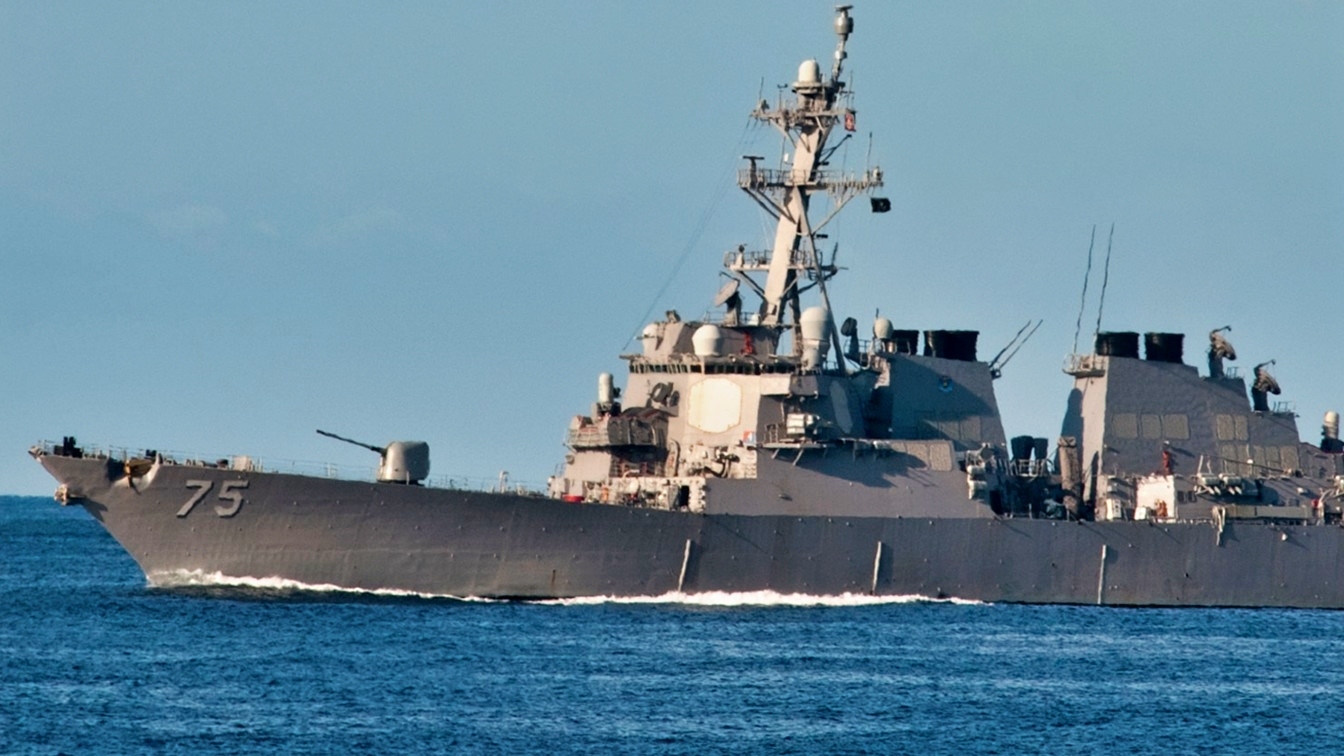
Following tensions over a United Nations-backed alternative route through the Strait of Hormuz, established on the Omani side of the waterway, Tehran sought to reassert its right to restrict shipping on Friday. In a statement, Deputy Iranian Foreign Minister Kazem Gharibabadi threatened vessels traveling through the Strait of Hormuz with “ambiguous arrangements.”
“Safe passage through the Strait of Hormuz cannot be guaranteed under ambiguous arrangements, parallel routes or decision-making that does not take Iran’s role as a coastal state into account,” Gharibabadi said.
The dispute comes as Washington and Iran continue negotiations for a lasting peace deal under the terms of a memorandum of understanding (MOU).
The Incident That Triggered It: Hormuz Crisis 2.0?
The dispute came after the United Nations’ International Maritime Organization (IMO), working with Omani authorities, announced an evacuation scheme to move hundreds of stranded commercial vessels out of the Persian Gulf. The vessels became stranded after the outbreak of the Iran War, leaving around 11,000 civilian seafarers in the region.
“We will begin the implementation of the evacuation plan for over 11,000 seafarers still stranded in the region.
This large-scale operation will be carried out in close cooperation with Iran, Oman, all other coastal States in the region, the United States, and the maritime industry,” IMO Secretary-General Arsenio Dominguez said in a statement on June 23.
Under the original plan, some ships would pass through Iranian waters while others would follow a different route closer to the Omani coastline.
The route avoided the central shipping lines that have been disrupted by mines.
Ships had been assigned designated transit windows to prevent congestion during the evacuation.
Shortly after ships began to move, reports described how the southern Omani route became the preferred option – and by the morning of June 25, the IMO had announced 57 ships carrying over 1,000 seafarers had already moved through safely.
The news proved that vessels could pass safely through the Strait via Omani waters without relying on Iran’s preferred shipping lanes, thereby posing a problem for Tehran as it seeks to continue using the Strait of Hormuz as leverage.
How Iran Responded
On June 25, Iran struck a vessel in the Strait of Hormuz as it attempted to pass using the IMO’s agreed route.
The strike came hours after the Islamic Revolutionary Guard Corps (IRGC) warned that ships must agree on safe passage with its navy and move through designated routes approved by the Iranians. Those routes must also be through Iranian waters, according to the Iranians.
In a statement issued that day, the Iranian navy said that the IMO-backed route was “unacceptable and extremely dangerous.”
“We warn all vessels to strictly refrain from any movement outside the designated routes,” it continued.
The strikes prompted the Persian Gulf Strait Authority (PGSA), the Iranian organization that controls passage through the strait, to warn that the consequences of traveling through the unauthorized routes “will be the responsibility of the owner, operator, and commander of the vessel.”
The statement also said that “any passage through routes outside the framework’s designation by PGSA will not be covered by safe passage guarantees and will not be entitled to insurance coverage or related liabilities.”
On the same day, the Singapore-flagged merchant vessel Ever Lonely was hit by an Iranian drone off the coast of Oman after passing through the area.
The ship was not part of the IMO evacuation convoy, but the strike was proof that Iranian authorities are willing to attack vessels moving through the strait even after signing the MOU with Washington.
The United Kingdom Maritime Trade Operations center said that while the vessel suffered damage, there were no injuries.
Evergreen Marine, the ship’s owner, said that the boat was struck on its starboard side and sustained damage to its windows and bridge.
“The main engine and all navigation equipment continued to operate,” the company said in a statement, adding that its seaworthiness was not impacted.
The IMO evacuation effort was suspended in the wake of the strikes pending a review of security guarantees for all participating ships.
Hormuz Traffic Keeps Moving
On Friday morning, traffic through Hormuz appeared to keep moving despite Iranian threats and the Thursday drone attack.
According to MarineTraffic data, dozens of vessels transited the strait in the morning.
And despite the threats from Iran, NBC News reported that at least 20 ships had taken a route far south of Iran that “hugs the coastline of the United Arab Emirates and bends along Oman’s Musandam Peninsula, avoiding Iranian waters.”
Per Reuters, BIMCO official Jakob Larsen said that the incident proved that the agreement between the United States and Iran needed to be clearer.
“The attack is a setback in the plans to evacuate ships and resume transits through the Strait of Hormuz, although some transits can still be expected to take place,” Larsen, BIMCO’s chief safety and security officer, said.
“The situation underscores the importance of clear and unambiguous agreements between the U.S. and Iran regarding a resumption of maritime traffic through the strait,” he continued.
About the Author: Jack Buckby
Jack Buckby is a British researcher and analyst specializing in defense and national security, based in New York. His work focuses on military capability, procurement, and strategic competition, producing and editing analysis for policy and defense audiences. He brings extensive editorial experience, with a career output spanning over 1,000 articles at 19FortyFive and National Security Journal, and has previously authored books and papers on extremism and deradicalization.


Dr. Hujjathullah M.H.Babu Sahib
June 27, 2026 at 10:40 pm
The vessels name is Ever Lovely and it seems to have used a shipping lane that was neither IMO-cleared nor Iran-designated and thus of ambiguous arrangement. Upto that point the IRGC has been right but having established a hotline of sorts with the U.S. at the heels of their mediated MOU, was it still necessary for the Guards to drone the large vessel and for the U.S. to respond in kind ?