

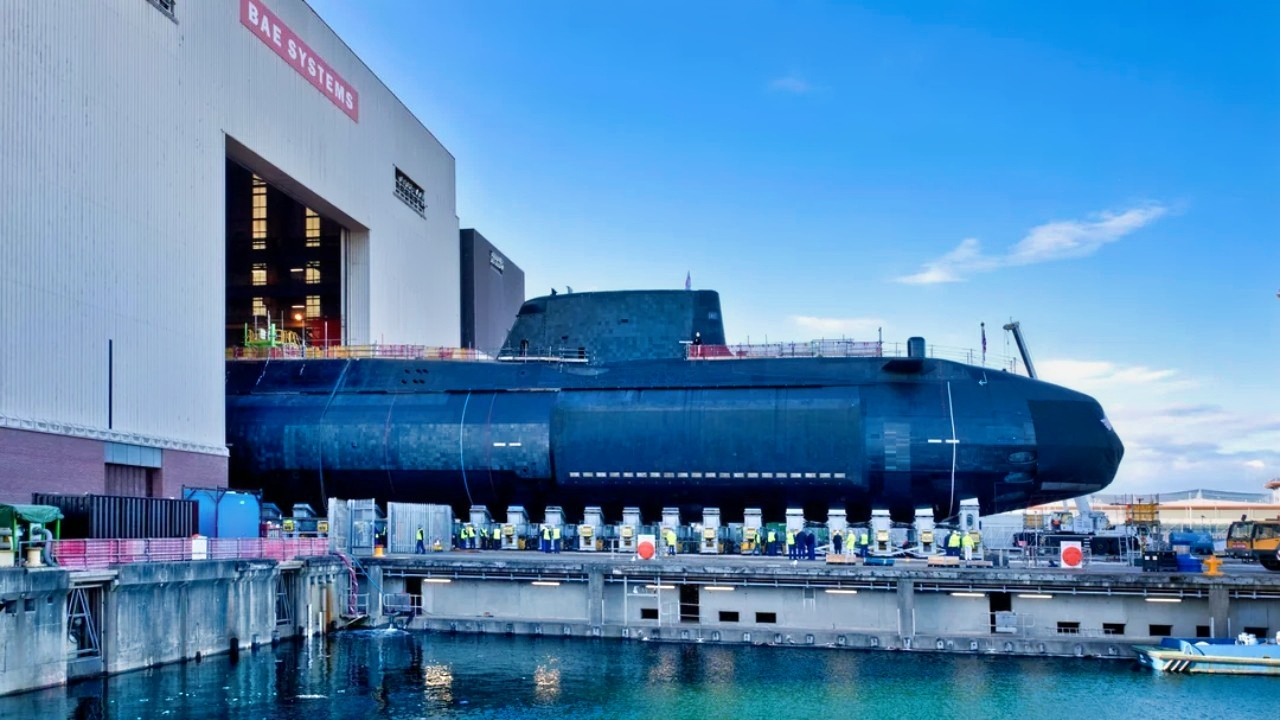
Key Points – The United Kingdom’s recent Strategic Defence Review calls for a major expansion of the Royal Navy’s submarine force with a commitment to build 12 new nuclear-powered SSN-AUKUS attack submarines.
-This move is a core component of the tripartite AUKUS security pact with the US and Australia and is driven by the need to counter growing threats from Russia and, increasingly, China in the Indo-Pacific.
-The review emphasizes a shift to “warfighting readiness” and positions the Indo-Pacific as a priority region for UK defense engagement after Europe. However, this ambitious plan faces significant funding challenges, despite UK pledges to increase defense spending.
The British Government Wants to Build a Dozen Attack Submarines
England’s recent Strategic Defence Review makes it clear what it wants British shipbuilders to build. Less apparent, however, is how the submarines will be funded.
The Royal Navy is set to receive a dramatically expanded submarine attack force following Great Britain’s reevaluation of its role in the European and Asian geopolitical landscapes, with a focus on preventing aggression from Russia and China, respectively. To better face down peer rivals and to support friends and allies, the British government is committing to build 12 SSN-AUKUS submarines.
For reference, the Royal Navy currently operates the Astute-class, a fleet of seven nuclear-powered attack submarines. However, the SSN-AUKUS is a brand-new class of submarines that Australia hopes to have in service as part of the tripartite AUKUS nuclear propulsion partnership between the United States, the United Kingdom, and Australia.
The announcement came as part of the United Kingdom’s Strategic Defence Review, a “root-and-branch review” of the UK’s defense posture and one that concluded with a swath of recommendations. The overall message was one that urged rapid expansion. This new focus includes the attack submarines.
“The increase in submarines will transform the UK’s submarine building industry and, following the £15 billion investment in the warhead programme outlined, will deliver on this government’s Plan for Change, supporting 30,000 highly skilled jobs up-and-down the country well into the 2030s, as well as helping work to deliver 30,000 apprenticeships and 14,000 graduate roles across the next ten years,” the British Government said in the lead-up to the Strategic Defence Review release.
“The announcement comes as the government unveils its new Strategic Defence Review tomorrow. The externally-led review is expected to recommend that our Armed Forces move to warfighting readiness to deter the growing threats faced by the UK,” the British Government said. “The report makes 62 recommendations, which the government is expected to accept in full.”
The Review’s recommendations are far-reaching, covering the acquisition of a new class of stealth fighter, the F-35A (the UK already flies the F-35B, a more expensive and shorter-range variant of the F-35 stealth fighter), which opens the door to British F-35As flying with nuclear weapons, potentially those stockpiled in Europe by the United States.
Eyes on China
The impetus for this shift in British defense policy is largely the increasingly loud and bellicose presence of China in Asia’s regional affairs. “China is increasingly leveraging its economic, technological, and military capabilities, seeking to establish dominance in the Indo-Pacific, erode US influence, and put pressure on the rules-based international order,” the Strategic Defence Review says.
It adds that “Chinese technology and its proliferation to other countries is already a leading challenge for the UK, with Defence likely to face Chinese technology wherever and with whomever it fights.” Indeed, so great is the threat posed by China that Washington, London, and Canberra joined forces in a virtually unprecedented way: the AUKUS partnership.
AUKUS, the Strategic Defence Review, and the Indo-Pacific
The AUKUS submarine agreement between the three allies envisions a world not far in the future in which the Royal Australian Navy operates a fleet of nuclear-powered submarines alongside those of the United States and the United Kingdom. Critically, those submarines will be conventionally armed, eschewing nuclear weapons for conventional high-explosive torpedoes and potentially other submarine-launched munitions.
The move, announced under the previous administration, snubbed French shipbuilders, who were poised to finalize a submarine-building deal to replace Australia’s diesel-electric Collins-class submarines.
However, the benefits were immediately evident. Instead of relying on quite capable but conventionally powered submarines, Canberra decided to opt for the British and American approach to underwater nuclear propulsion, affording greatly increased underwater endurance.
One of the more remarkable points highlighted by the recent Strategic Defence Review is the United Kingdom’s relationship with the Indo-Pacific region and its growing importance alongside the European continent, which remains of premier importance. “Military deployments beyond the Euro-Atlantic should be used to retain deeper and broader ‘match fitness’ of the Armed Forces, developing and demonstrating warfighting leadership, innovation, and human and technical capabilities. To ensure such deployments do not detract from delivery of Roles 1 and 2, the Armed Forces must be able to return at speed to the Euro-Atlantic if necessary,” the Strategic Defence Review states.
However, “The Review recommends the Middle East and the Indo-Pacific as the next priority regions after the Euro-Atlantic for Defence engagement,” the Strategic Defence Review says. “The growing links between Russia, China, Iran, and the Democratic People’s Republic of Korea complicate calculations of deterrence and escalation management across regions.” The AUKUS partnership has the potential to become an important pillar of Britain’s relationship with the Indo-Pacific.
The Royal Navy’s Submarines
Lofty as these aspirations are, one open question is the source of funding to undertake these defense projects. The United Kingdom has made some cuts to parts of its budget, recently cutting some foreign aid to free up funds. It has also committed to spending 2.5 percent of GDP on defense, a figure that may rise to 3 percent by 2034.
It will be a steep challenge to overcome. However, if funding cannot be found, these investments may ultimately prove less revolutionary for the British military than initially envisioned.
About the Author: Caleb Larson
Caleb Larson is an American multiformat journalist based in Berlin, Germany. His work covers the intersection of conflict and society, focusing on American foreign policy and European security. He has reported from Germany, Russia, and the United States. Most recently, he covered the war in Ukraine, reporting extensively on the war’s shifting battle lines from Donbas and writing on the war’s civilian and humanitarian toll. Previously, he worked as a Defense Reporter for POLITICO Europe. You can follow his latest work on X.
Russia’s Bomber Forces
Tu-22M3: The Bomber Ukraine Hit With Drones


