


Key Points and Summary – Despite celebrating its 40th anniversary, the B-1B Lancer bomber remains a “massively critical asset” for the U.S. Air Force.
-According to its latest budget request, the venerable bomber is receiving significant upgrades to bridge the gap until the B-21 Raider is fully operational.

B-1B Lancer Bomber National Security Journal Photo.
-These changes include reactivating external hardpoints previously disabled by arms control treaties with Russia, allowing the B-1B to test hypersonic missiles like the AGM-183 ARRW.
-This increased capacity for heavy standoff munitions will significantly enhance the Lancer’s payload, ensuring its continued strategic importance in the modern era.
The B-1B Lancer Bomber Is Going Super (As In Big Upgrades)
According to its latest budget request, the Air Force is planning numerous upgrades to the B-1B bomber, including plans to “increase the number of aircraft that can test hypersonic missiles and expand the Lancer’s loadout as USAF transitions to the B-21 bomber,” Air and Space Forces magazine reported this month.
The budget ask includes $50.26 million for “External Heavy-Stores Pylon program” for the B-1B, which will offer “increased carriage capacity of standoff munitions on B-1B aircraft.”
The Air Force, the report said, can therefore “mitigate transition risk of the Air Force bomber fleet prior to the emergence of the B-21 as a combat bomber.”
A Post-Cold War Shift
Some of the changes are being made for a surprising reason.
“The B-1 already has six external hardpoints, which were originally intended to carry two nuclear-armed AGM-86B Air-Launched Cruise Missiles, but they were deactivated under arms control treaties with Russia; those agreements saw the B-1 removed from nuclear delivery missions,” the Air and Space Forces Magazine said.
“The Air Force is now looking to reopen those weapon stations, each of which the service said should be capable of carrying a 5,000-pound payload.”
In addition, the report cited budget documents that the Air Force spent $20 million over two years to create “an external carry-enabled testbed facilitating rapid integration of priority hypersonic weapons in support of national security objectives,” for a specific purpose.
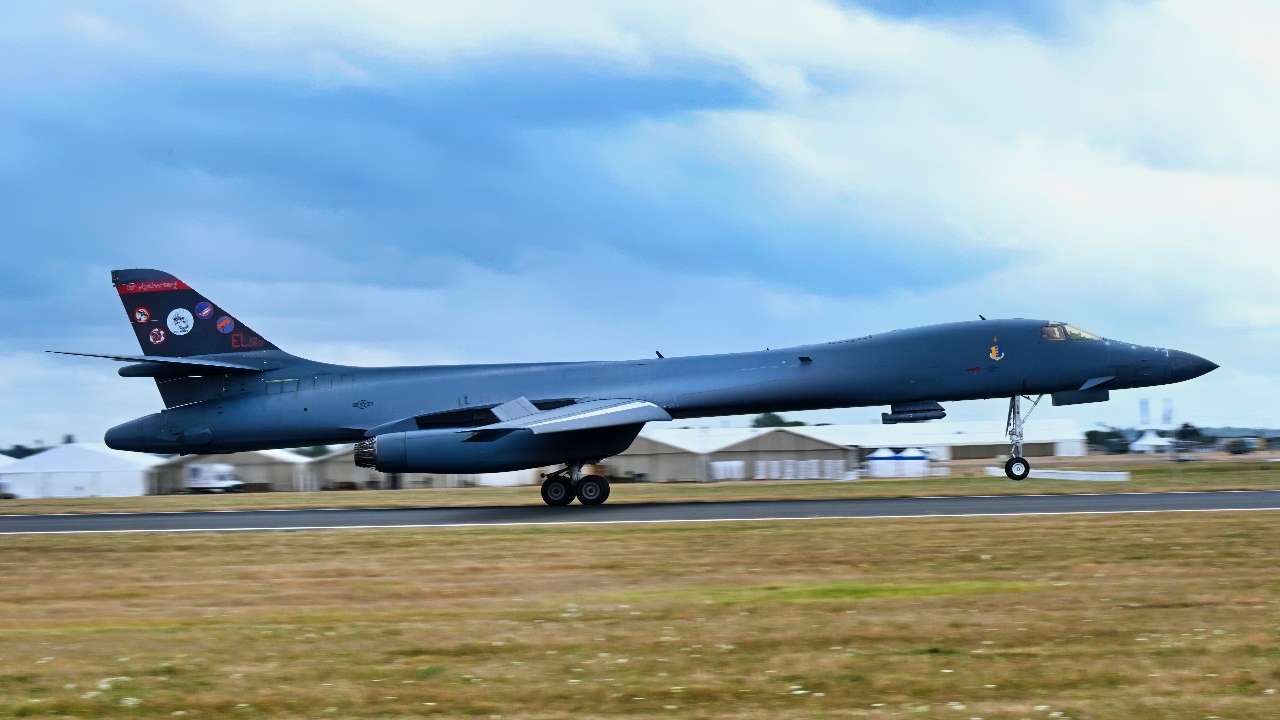
B-1B Lancer Bomber. Image Credit: Creative Commons.
“This program provides an opportunity to significantly reduce risk for an operational external carry capability on the B-1B if directed. The Hypersonic Integration Program successfully demonstrated the B-1’s ability to execute a captive carry of a 5,000-pound class store and the release of a proven weapon shape from a Load Adaptable Modular (LAM) pylon,” the budget document said.
The LAM, according to a Boeing company newsletter quoted by Air and Space Forces, could allow the B-1 to “increase 50 percent of its current weapons payload capacity with larger and heavier weapons.”
A Birthday for a B-1B Bomber
Last month, the Air Force marked the 40th birthday of the B-1B. The Air Force, in its announcement on July 14, declared the B-1B is still “a vital strategic asset,” even though it was developed in the 1980s as a temporary solution.
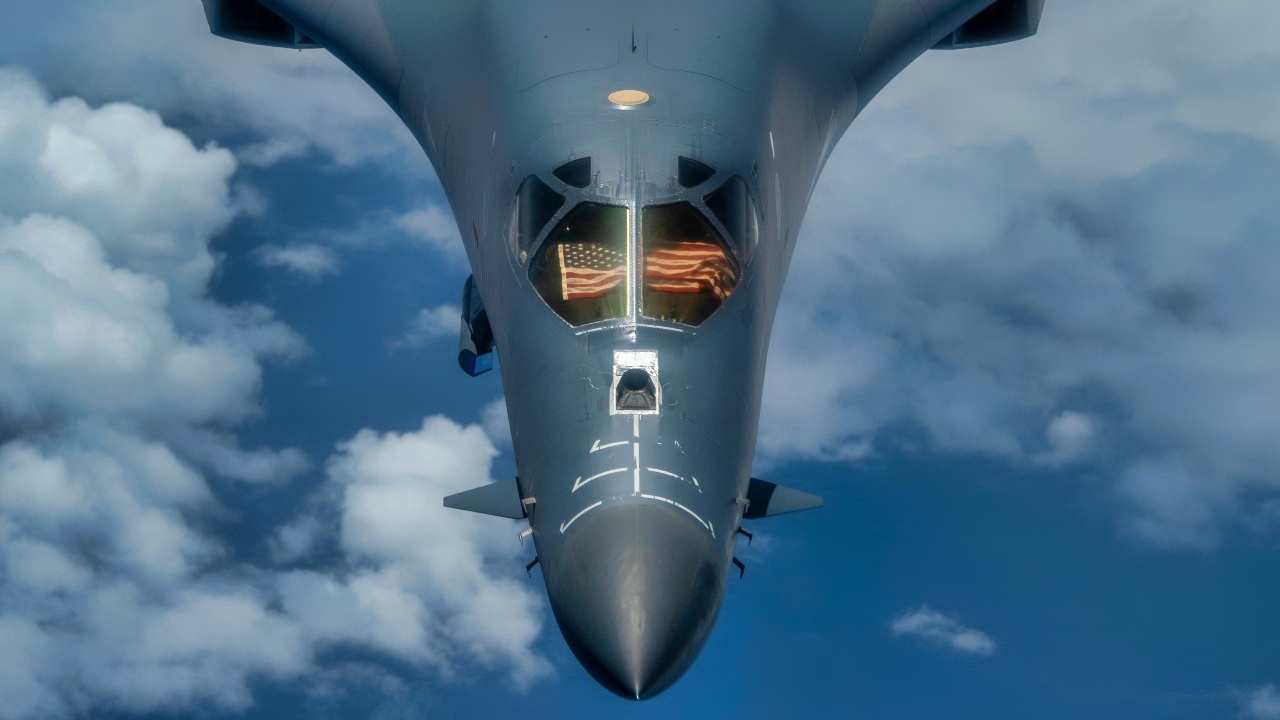
A 9th Expeditionary Bomb Squadron B-1B Lancer flies over the East China Sea May 6, 2020, during a training mission. The 9th EBS is deployed to Andersen Air Force Base, Guam, as part of a Bomber Task Force supporting Pacific Air Forces’ strategic deterrence missions and commitment to the security and stability of the Indo-Pacific region. (U.S. Air Force photo by Senior Airman River Bruce)
“The B-1 was only supposed to be around 10 years,” explained Lt. Col. David Hanisch, Deputy Assistant Program Manager for the Air Force Life Cycle Management Center’s B-1 Program Office, said in the Air Force’s July release. “The reason why the 40-year mark is a big deal is that we’ve proven that it is still a massively critical asset to the United States and our bomber force 40 years later.”
“Here we have this nuclear bomber from the 1980s, built at President Reagan urging in part to bankrupt the Soviets, and then two decades later, it’s doing close air support in Afghanistan and Iraq, making sure that our troops come home,” Joe Stupic, Senior Material Leader and Division Chief of the B-1 Program Office, said in the Air Force’s release.
Here Comes the Hypersonics
The Air and Space Forces story also shared an update on the status of American hypersonic missile development.
While the Air Force had said it was shelving the AGM-183 Air-Launched Rapid Response Weapon (ARRW), it is now back in the budget for 2026. But it has company.
“The service is also pursuing the smaller Hypersonic Attack Cruise Missile (HACM), an air-breathing missile small enough to be launched from fighters. When Boeing first unveiled the LAM to reporters in 2023, it said the pylon could likely carry up to 7,500 pounds, which would allow it to carry the ARRW, the weight of which is estimated to be around 6,500 pounds. It’s not clear if the budget language specifying 5,000 pounds is the result of test results,” the report said.
About the Author: Stephen Silver
Stephen Silver is an award-winning journalist, essayist, and film critic, and contributor to the Philadelphia Inquirer, the Jewish Telegraphic Agency, Broad Street Review, and Splice Today. The co-founder of the Philadelphia Film Critics Circle, Stephen lives in suburban Philadelphia with his wife and two sons. For over a decade, Stephen has authored thousands of articles that focus on politics, national security, technology, and the economy. Follow him on X (formerly Twitter) at @StephenSilver, and subscribe to his Substack newsletter.
Hypersonic Weapons In-Depth
Russia’s Hypersonic Missiles Summed Up in 4 Words


