

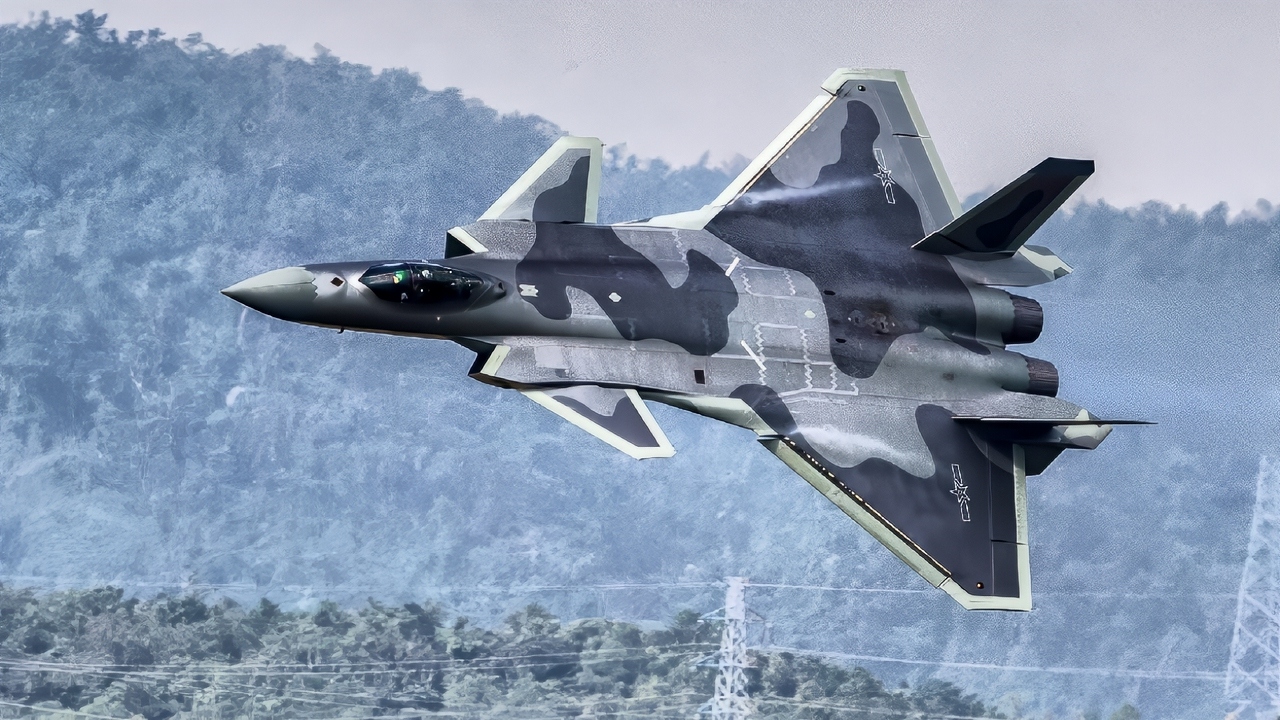
Published on August 6, 2025, 7:20 AM EST – Key Points and Summary – While the American F-22 Raptor is likely the world’s most capable stealth fighter on a one-on-one basis, the Chinese J-20’s greatest strength is China’s massive industrial capacity.
-The U.S. has a small, finite fleet of only 185 F-22s with a permanently closed production line.

U.S. Air Force Capt. Nick “Laz” Le Tourneau, F-22 Raptor Aerial Demonstration Team commander, performs an aerial maneuver during the Cocoa Beach air show in Florida, July 12, 2025. The F-22 Aerial Demonstration Team highlights cutting-edge airpower, precision, skill, all while reinforcing public confidence in the Air Force’s ability to protect and defend. (U.S. Air Force photo by Staff Sgt. Lauren Cobin)
-In contrast, China is producing around 100 J-20s annually and has already built a fleet estimated at 800 aircraft.
-In a potential conflict, this overwhelming numerical and industrial advantage, combined with the logistical benefit of fighting closer to home, could prove to be the decisive factor.
J-20 vs. F-22 Might Come Down to Numbers and Production
Although the J-20 is considered less stealthy and less capable than some of the United States’ fifth-generation aircraft, it benefits from a broad defense-industrial base. That, combined with a steadily evolving design, means that the J-20 could prove to be stiff competition.
In terms of all-around stealth, the F-22 Raptor is without rival, at least for now. As the world’s premier stealth fighter, explicitly designed for air superiority missions with a secondary strike role, that jet is extremely capable.
With the caveat that the Raptor’s stealth coatings are seemingly rather finicky and perhaps more maintenance-intensive than that of platforms like the F-35, when in a good state of maintenance, the Raptor is in all likelihood currently the world’s stealthiest fighter.
Compare that jet with the J-20, one of China’s fifth-generation fighters. China’s J-20 appears to have capable stealth capabilities, particularly from the jet’s frontal aspect. However, from the side and rear perspectives, the J-20’s radar cross-section—a measure of detectability by radar—is almost certainly less effective.
Jet engines represent a strong division between the two platforms.
Initially, J-20 flew with Saturn AL-31 jet engines, Russian engines derived from legacy Soviet antecedents.
The decision was not unusual for the Chinese aerospace industry, which has historically relied heavily on Soviet and later Russian aerospace technology, particularly in the field of jet engines.
Although China’s domestically made WS-10C engine provided the People’s Liberation Army Air Force with a home-grown option that offers sufficient performance for domestic fighters, the upcoming WS-15 engine is expected to build upon the WS-10C and deliver improved performance.
But aside from just power output, increasingly capable jet engines also promise high electrical outputs, useful for increasingly powerful radar as well as liaising with attritable unmanned “loyal wingman” fighters and the sharing of battlefield data with other assets in the air and on the ground.
Industrial Output and Capacity
One distinct disadvantage of the Raptors is its production line, which is closed. That decision, taken by lawmakers in the mid-2000s, was partly the result of the Global War on Terror and the lack of adversaries that possessed robust stealth and anti-stealth capabilities.
Though the United States Air Force originally envisioned a fleet of F-22s numbering in the hundreds, ultimately only 190 Raptors were built, a number which now stands at 185, due to several accidents in the fleet. The justification for a hugely expensive stealth fighter—even one as capable as the F-22—could not be justified by the conflicts the United States was waging in the Middle East.

U.S. Air Force Maj. Josh Gunderson, F-22 Demo Team commander, enters into the Raptor Slide during the Millville Airshow, Sept. 3, 2021, at Millville Army Airfield, Millville, New Jersey. During the Raptor Slide the aircraft actually slides down and backwards under control before Gunderson adjusts the aircrafts position and powers out of the maneuver. (U.S. Air Force photo by Staff Sgt. Don Hudson)
From an industrial sustainment perspective, the J-20 has a distinct advantage. That platform is still evolving and benefits from an active production line, which could, in theory, be expanded during a conflict scenario to expand or sustain the J-20 fleet. The F-22’s production line, in marked contrast, does not exist. New F-22s cannot be economically built.
Although estimates of China’s J-20 production vary depending on the source, it is believed that around 100 J-20s are built each year, with the total J-20 fleet currently numbering around 800.
In terms of numbers alone, the J-20 fleet is already around four times the size of the Raptor fleet, and growing.
What Could Happen: F-22 Raptor vs. J-20 Mighty Dragon?
Parsing the performance of this or that jet engine, the quality of stealth coatings, and pilot training and combat experience paints an incomplete measure of capabilities. Of utmost importance to any platform is the environment in which it is deployed.
In an aerial environment closer to home, specifically above or near China, the J-20 would have a greater chance of excelling in combat. Given the advantages of flying nearer to home — more readily available air bases and the associated ground support that facilitate refueling and rearming — a potential conflict scenario near China would favor the J-20 in the context of significant aerial battles.
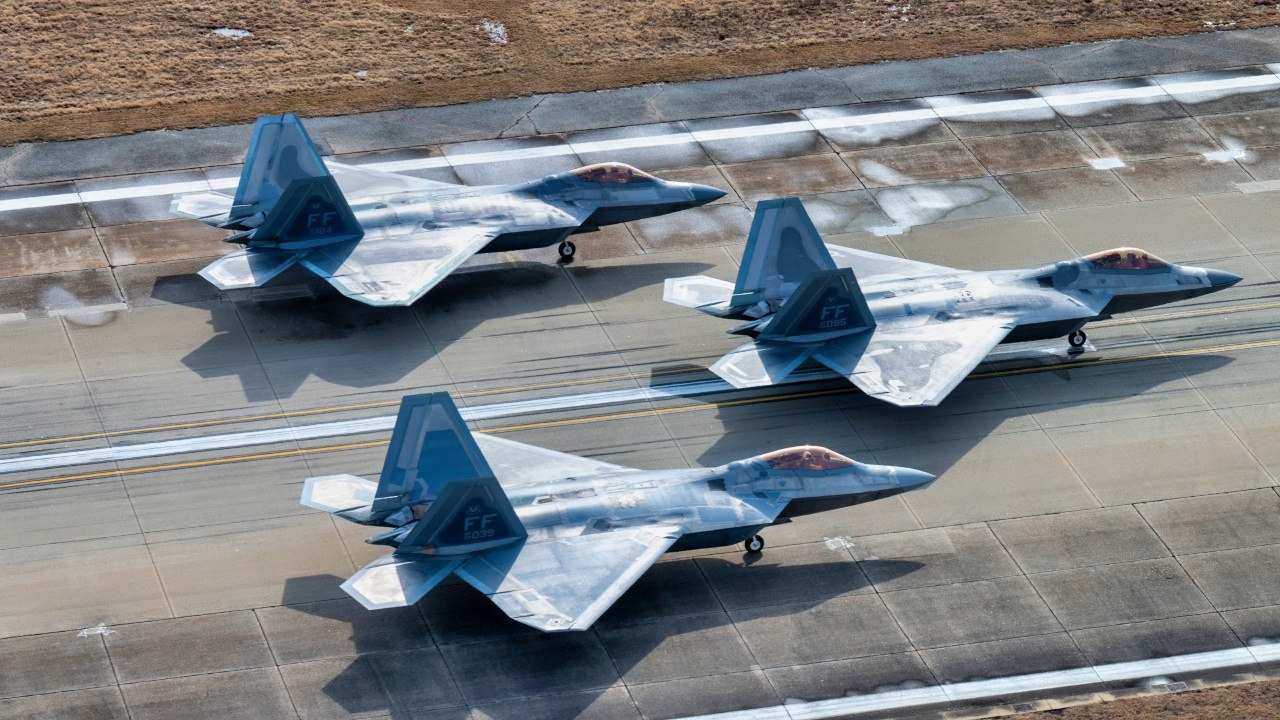
LANGLEY AIR FORCE BASE, Va. – F-22 Raptors from the 1st Fighter Wing sit in position on the runway fduring the Elephant Walk at Langley Air Force Base, Virginia, Jan. 31, 2025. The surge was designed to showcase the wing’s operational readiness and its ability to rapidly mobilize airpower. The 1st FW operates F-22 Raptors and T-38 Talons, maintaining combat capabilities that enable the U.S. Air Force to execute missions across the globe. With a focus on air superiority, the 1st FW plays a critical role in defending the nation’s interests. (U.S. Air Force photo by Tech Sgt. Matthew Coleman-Foster)
Conversely, a platform like the F-22 Raptor would be at a distinct logistical disadvantage. That fighter, incapable of operating off United States Navy aircraft carriers, would struggle with sustainment, relying on distant air bases to refuel and rearm in a theater defined by vast stretches of water separating the flakes of land that dot the surface.
In the Indo-Pacific, combat radii could be the difference between victory and defeat.
About the Author: Caleb Larson
Caleb Larson is an American multiformat journalist based in Berlin, Germany. His work covers the intersection of conflict and society, focusing on American foreign policy and European security. He has reported from Germany, Russia, and the United States. Most recently, he covered the war in Ukraine, reporting extensively on the war’s shifting battle lines from Donbas and writing on the war’s civilian and humanitarian toll. Previously, he worked as a Defense Reporter for POLITICO Europe. You can follow his latest work on X.
More Military
Su-57 vs. J-20 Fighter: Who Wins?


Pingback: We Know How China's J-20 'Mighty Dragon' Stealth Fighter Was 'Shot Down' - National Security Journal